Chapter Preamble
Signals declared
Sig-D — Diagnostic (primary). The integrated diagnostic approach — recognise the clue, draw the pedigree, look beyond the kidney, use the toolkit, and reach the genetic diagnosis.
Sig-T — Therapeutic (strong). Act on the diagnosis — genetics informs prognosis, cascade, reproduction, and donation; mechanism guides the specific treatment.
Sig-M — Mechanistic (strong). The volume's recurring lesson that the mechanism of each inherited disease points to its treatment.
Sig-V — Evidence-dense (strong). The evidence that the integrated, genetics-informed, mechanism-based approach improves care — graded and reflected on.
Levels populated and omitted
Populated (20): L1–L14, L17–L22. As the four-signal flagship capstone it fires the concept maps (L6) and triads (L9), the absolute-risk table (L14), the templates (L17), and the reflective prompts (L21).
L15 / L16 preference-sensitive map and SDM scripts — omitted. No Sig-E; the preference-sensitive decisions were built in Chapters 2 and 17. This capstone synthesises the diagnostic and therapeutic approach.
| 01 | PHASE A · LEVEL 1 · ORIENTATION & KNOWLEDGE Learning Objectives |
By the end of this chapter you should be able to:
Apply the integrated approach to a patient with possible inherited kidney disease.
Recognise the clues that an inherited disease is present.
Use the pedigree and the search beyond the kidney as diagnostic steps.
Deploy the diagnostic toolkit and genetic testing appropriately.
Explain the five ways a genetic diagnosis changes management.
Show how the mechanism of each disease guides its treatment.
Place the whole patient and family at the centre of care.
Synthesise the volume into a single, coherent clinical approach.
| 02 | PHASE A · LEVEL 2 · ORIENTATION & KNOWLEDGE Executive Summary |
The integrated approach to inherited kidney disease is a sequence: recognise the clue, draw the pedigree, look beyond the kidney, use the diagnostic toolkit, reach the genetic diagnosis, and act on it.
The clues that an inherited disease is present are young onset, a family history, consanguinity, extrarenal features, and unexplained CKD.
The pedigree is the most informative and most neglected step — it reveals the inheritance pattern and the family at risk.
Looking beyond the kidney is essential, because the extrarenal features (deafness in Alport, angiokeratomas in Fabry, skin lesions in tuberous sclerosis) often reveal the renal diagnosis.
The toolkit — ultrasound, MRI and total kidney volume, biopsy, biomarkers, and increasingly genetic testing — confirms and classifies the disease.
A genetic diagnosis changes management in five ways: it informs the prognosis, enables cascade screening of relatives, guides reproductive decisions, informs the selection of related donors, and directs treatment.
The recurring lesson of the volume is that the mechanism of each disease points to its treatment — tolvaptan for the vasopressin-cAMP axis of ADPKD, early RAAS blockade for the collagen defect of Alport, enzyme replacement for Fabry, avoidance of immunosuppression in structural genetic FSGS, targeted agents for the transporter defects, and mTOR or HIF inhibitors for the phakomatoses.
Recognising that genetic kidney disease is structural or metabolic, not necessarily immune, changes the treatment — sparing futile immunosuppression and directing mechanism-based therapy.
Throughout, the whole patient and family are at the centre — the multisystem disease, the affected relatives, the reproductive and donation decisions.
The integrated approach turns a bewildering array of rare diseases into a coherent method: a few clues trigger a systematic work-up that reaches a specific diagnosis, which then informs prognosis, family, reproduction, and a mechanism-based treatment.
Inherited kidney disease has been transformed in a generation from a set of untreatable diagnoses into a field of mechanism-based, increasingly targeted therapies.
The clinician who recognises the clue, pursues the diagnosis, and acts on it serves not just the patient but the whole family.
This capstone draws the volume together: recognise, diagnose, and act — with genetics informing and mechanism guiding, and the patient and family at the centre.
| 03 | PHASE A · LEVEL 3 · ORIENTATION & KNOWLEDGE Main Narrative |
This volume has covered a great many inherited kidney diseases — cystic, glomerular, tubular, metabolic, syndromic, and structural — and the risk is that they appear as a bewildering list of rare conditions. This capstone draws them into a single coherent method: an integrated approach in which a few clues trigger a systematic work-up that reaches a specific diagnosis, which then informs prognosis, the family, reproduction, and — guided by the mechanism — a specific treatment. Recognise, diagnose, act: with genetics informing and mechanism guiding, and the whole patient and family at the centre.
— The integrated approach
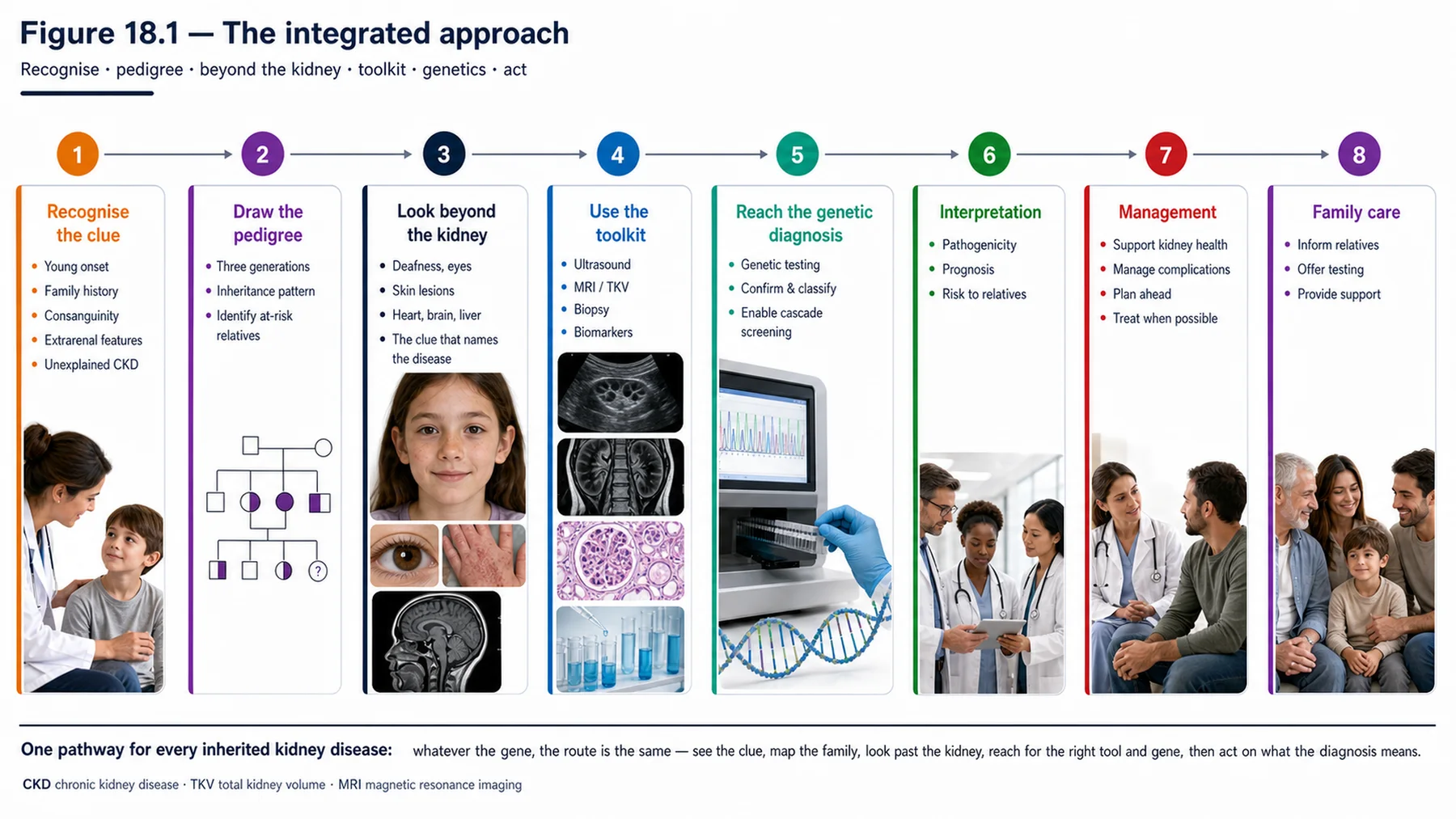
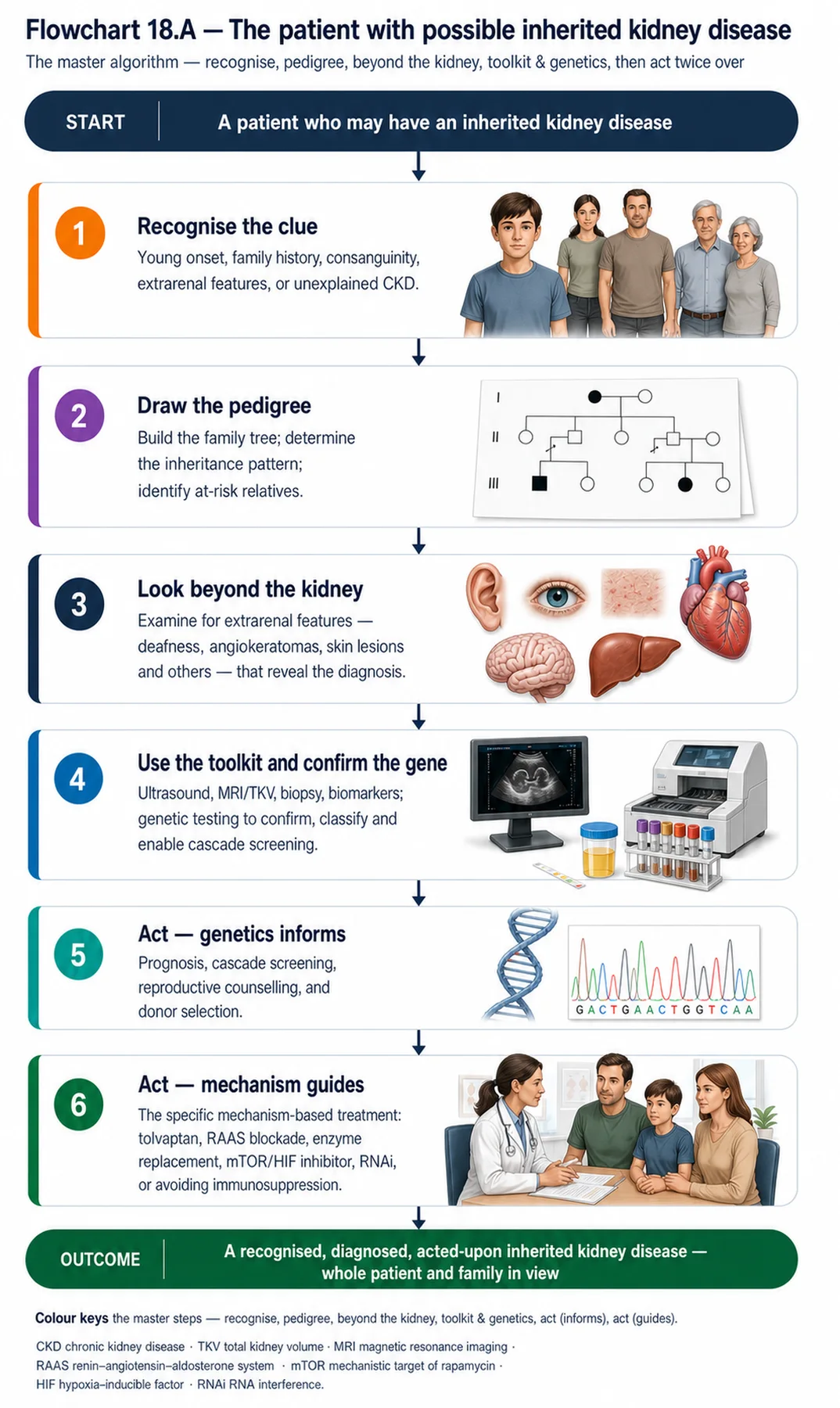
The integrated approach to a patient with possible inherited kidney disease is a sequence of steps, each built in the opening chapters and applied throughout the volume. First, recognise the clue: certain features should prompt the thought that a kidney disease may be inherited — a young age of onset, a family history of kidney disease, consanguinity, extrarenal features, and CKD of otherwise unexplained cause. Second, draw the pedigree: a careful, multi-generation family tree is the most informative and most neglected step, revealing the inheritance pattern (autosomal dominant with vertical transmission, autosomal recessive with affected siblings and consanguinity, X-linked through the maternal line) and identifying the relatives at risk. Third, look beyond the kidney: examine for the extrarenal features that so often reveal the renal diagnosis — deafness pointing to Alport, angiokeratomas to Fabry, skin lesions to tuberous sclerosis, and so on. Fourth, use the diagnostic toolkit: ultrasound (first-line), MRI and total kidney volume (in ADPKD), biopsy (now selective), and the disease-specific biomarkers. Fifth, reach the genetic diagnosis: genetic testing, increasingly central, confirms the disease, classifies the subtype and inheritance, and enables family screening. And sixth, act on the diagnosis. This sequence — recognise, pedigree, beyond the kidney, toolkit, genetics, act — is the method that turns the volume's many diseases into a single, repeatable clinical approach.
— Genetics informs
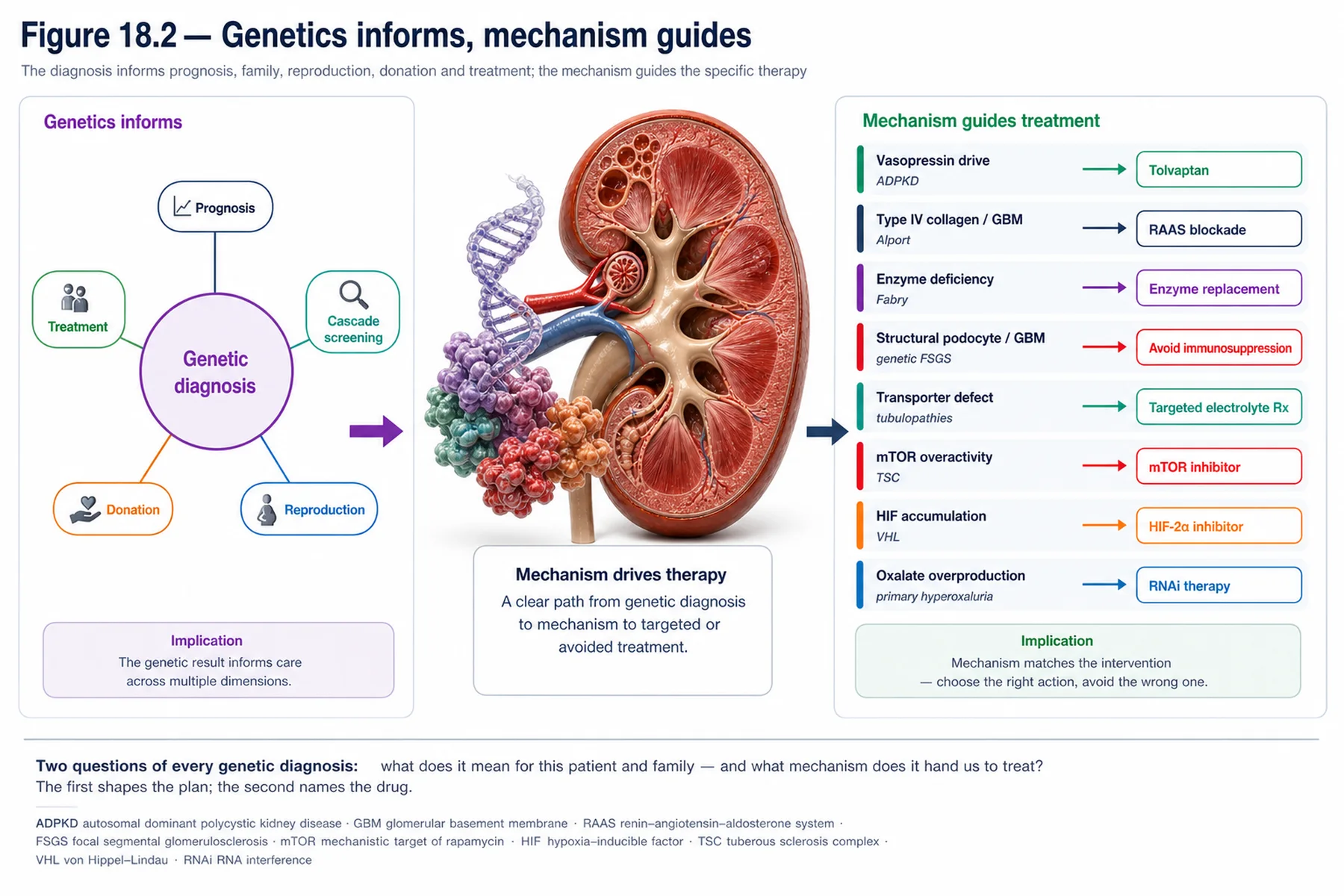
The fifth and sixth steps deserve elaboration, because the value of reaching a genetic diagnosis lies in what it then does, and a genetic diagnosis changes management in five distinct ways, met in the opening chapter and exemplified throughout. First, it informs the prognosis: knowing the gene and variant (PKD1 truncating versus PKD2, for instance) predicts the likely course and the age of kidney failure, turning a vague outlook into an individualised trajectory. Second, it enables cascade screening: once the familial mutation is known, at-risk relatives can be offered testing, identifying affected family members — including those the standard tests would miss, such as the women in X-linked Fabry. Third, it guides reproductive decisions: knowing the mutation allows the couple to consider the reproductive options (prenatal diagnosis, preimplantation genetic testing, and the rest) that the previous chapter laid out. Fourth, it informs donor selection: a related potential kidney donor can be tested to ensure they do not carry the disease before donating. And fifth, it directs treatment: the specific diagnosis selects the specific therapy. So a genetic diagnosis is not an academic label but a key that unlocks prognosis, family screening, reproductive planning, safe donation, and targeted treatment — five concrete consequences that justify the effort of reaching it.
— Mechanism guides treatment
The recurring and perhaps most powerful lesson of the volume is that the mechanism of each inherited disease points directly to its treatment — the essence of applied, mechanism-to-bedside nephrology. ADPKD's vasopressin-cAMP axis yields tolvaptan, the V2-receptor antagonist that slows cyst growth. Alport's type IV collagen defect, weakening the glomerular basement membrane, makes early RAAS blockade (and newer agents) the protective treatment. Fabry's enzyme deficiency is corrected by enzyme replacement (or a chaperone), started early before fibrosis. The structural podocyte defect of genetic FSGS means immunosuppression is futile and should be avoided — and that the disease does not recur after transplantation. The transporter defects of the tubulopathies are treated by targeting the transporter — amiloride for Liddle, a thiazide for Gordon, alkali for the acidoses. The unrestrained mTOR of tuberous sclerosis is treated with mTOR inhibitors, and the HIF-driven tumours of von Hippel-Lindau with surveillance, nephron-sparing surgery, and HIF inhibitors. The oxalate overproduction of primary hyperoxaluria is reduced by RNA-interference therapy. In each, the mechanism is the map to the treatment. And a unifying corollary runs through several chapters: recognising that a genetic kidney disease is structural or metabolic — not necessarily immune — changes the treatment, sparing patients futile and toxic immunosuppression and directing them to mechanism-based therapy. The genetic diagnosis and its mechanism are, increasingly, the treatment.
— The whole patient and family
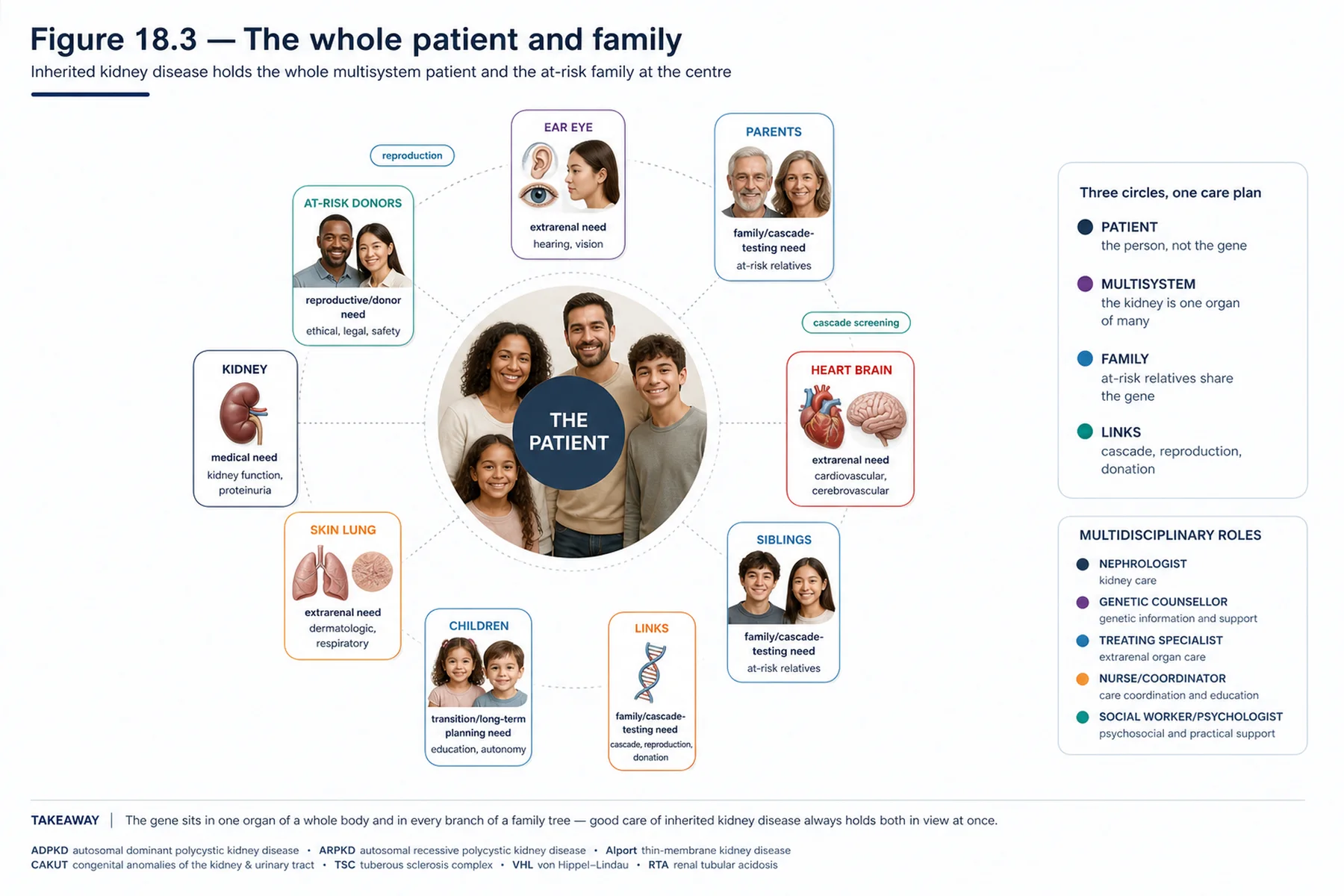
The final, integrating theme of the volume is that inherited kidney disease is never only about the kidney, or only about the individual — the whole patient and the whole family are at the centre. The patient is whole: these diseases are frequently multisystem, so Alport involves the ear and eye, Fabry the heart and brain and nerves, tuberous sclerosis the brain and skin and lungs, and von Hippel-Lindau many organs — requiring multidisciplinary care and surveillance beyond the kidney, and reminding us that the extrarenal features both reveal the diagnosis and demand attention in their own right. And the family is central: because these diseases are inherited, the diagnosis in one patient has implications for parents, siblings, children, and the wider family — cascade screening identifies affected relatives, reproductive decisions shape future generations, donor evaluation tests relatives, and the family's values guide the preference-sensitive choices. So the clinician caring for a patient with inherited kidney disease is caring, implicitly, for a family and for a whole person — which places on the clinician a responsibility that extends beyond the index patient's kidneys. The integrated approach, properly applied, holds both the multisystem patient and the at-risk family in view.
— The synthesis
Drawing the volume together, the integrated approach to inherited kidney disease can be stated simply: recognise, diagnose, and act — with genetics informing and mechanism guiding, and the whole patient and family at the centre. The many diseases of the volume — ADPKD and the cystic diseases, Alport and the inherited glomerular diseases, Fabry and the metabolic diseases, the tubulopathies and ADTKD, the phakomatoses, CAKUT, and the inherited stone diseases — are not a list to be memorised but instances of this single method: a few clues (young onset, family history, consanguinity, extrarenal features, unexplained CKD) trigger a systematic work-up (pedigree, beyond the kidney, the toolkit, genetics) that reaches a specific diagnosis, which then changes everything (prognosis, cascade screening, reproduction, donation, and a mechanism-based treatment). What makes this approach so worthwhile, and so different from a generation ago, is that inherited kidney disease has been transformed from a set of untreatable diagnoses — where the genetic label was prognostic but little more — into a field of mechanism-based, increasingly targeted therapies: tolvaptan, enzyme replacement, mTOR and HIF inhibitors, RNA-interference therapies, and the rational use (and avoidance) of established drugs. The diagnosis is now, more than ever, the treatment. And because the diseases are inherited, the clinician who recognises the clue, pursues the diagnosis, and acts on it serves not just the patient but the whole family, present and future. That is the applied message of the volume, and of nephrology's approach to the inherited kidney: think of it, pursue it, and act on it — for the patient, and for the family.
| 04 | PHASE A · LEVEL 4 · ORIENTATION & KNOWLEDGE Reference Tables |
Table 18.1 — The integrated approach
| Step | Action |
| 1. Recognise | The clues: young onset, family history, consanguinity, extrarenal features, unexplained CKD |
| 2. Pedigree | Draw the family tree — most informative, most neglected; reveals inheritance and at-risk relatives |
| 3. Beyond the kidney | Examine for extrarenal features that reveal the renal diagnosis |
| 4. Toolkit → 5. Genetics → 6. Act | Imaging/biopsy/biomarkers; genetic testing (confirm/classify/cascade); act on the diagnosis |
Table 18.2 — The clues to recognise
| Clue | Significance |
| Young age of onset | Inherited disease presents earlier than acquired |
| Family history | A pedigree of kidney disease across generations |
| Consanguinity | Raises the risk of recessive disease |
| Extrarenal features / unexplained CKD | Point to a syndromic or inherited cause |
Table 18.3 — Genetics informs (five ways)
| Way | Detail |
| Prognosis | The gene/variant predicts the course and age of kidney failure |
| Cascade screening | The familial mutation lets at-risk relatives be tested |
| Reproduction / donation | Guides reproductive options; tests related donors before donation |
| Treatment | The specific diagnosis selects the specific therapy |
Table 18.4 — Mechanism guides treatment (across the volume)
| Disease (mechanism) | Treatment |
| ADPKD (vasopressin-cAMP) | Tolvaptan (V2 antagonist) |
| Alport (collagen IV) / Fabry (enzyme) | Early RAAS blockade / enzyme replacement |
| Genetic FSGS (structural) / tubulopathies (transporter) | Avoid immunosuppression / targeted (amiloride, thiazide, alkali) |
| TSC (mTOR) / VHL (HIF) / primary hyperoxaluria (oxalate) | mTOR inhibitor / HIF inhibitor + surgery / RNAi |
Table 18.5 — The diagnostic toolkit
| Tool | Role |
| Ultrasound | First-line; age-based ADPKD criteria |
| MRI / total kidney volume | Gold standard for kidney volume; ADPKD prognosis |
| Biopsy | Selective — atypical, genetics-negative, or acquired disease possible |
| Biomarkers / genetics | Disease-specific markers; genetic testing increasingly central |
Table 18.6 — The whole patient and family, and the synthesis
| Dimension | Detail |
| The whole patient | Multisystem disease — ear/eye (Alport), heart/brain (Fabry), brain/skin/lung (TSC) |
| The whole family | Cascade screening, reproduction, donor evaluation — implications for relatives |
| The transformation | From untreatable labels to mechanism-based, targeted therapies |
| The synthesis | Recognise, diagnose, act — genetics informs, mechanism guides, patient + family at the centre |
| 05 | PHASE B · LEVEL 5 · VISUALISE & MAP Imaging & Flowchart Specifications |
| 06 | PHASE B · LEVEL 6 · VISUALISE & MAP Concept Maps |
Each chain runs from the approach to a named clinical action; read the arrows as “leads to.”
The integrated approach. Recognise the clue → pedigree → beyond the kidney → toolkit → genetics → act → ACTION: apply the sequence to every patient who may have an inherited kidney disease.
Genetics informs. Genetic diagnosis → prognosis + cascade screening + reproduction + donation + treatment → ACTION: pursue the genetic diagnosis for its five concrete consequences.
Mechanism guides treatment. Each disease's mechanism → its specific therapy (vasopressin→tolvaptan, collagen→RAAS, enzyme→ERT, structural→avoid immunosuppression, mTOR→inhibitor) → ACTION: let the mechanism choose the treatment.
Structural/metabolic, not immune. Recognising a genetic disease as structural/metabolic → not immune → spare futile immunosuppression → ACTION: avoid immunosuppression in structural genetic disease and use mechanism-based therapy.
The whole patient and family. Multisystem disease + inherited → the whole patient and the at-risk family → ACTION: care for the multisystem patient and the family, not just the index kidney.
| 07 | PHASE B · LEVEL 7 · VISUALISE & MAP Decision Pathways |
| R1 | IF a patient has young-onset, familial, consanguineous, extrarenal-featured, or unexplained CKD, THEN suspect an inherited kidney disease and begin the integrated approach. |
| R2 | IF an inherited disease is suspected, THEN draw a multi-generation pedigree — the most informative and most neglected step. |
| R3 | IF working up an inherited kidney disease, THEN look beyond the kidney — the extrarenal features often reveal the diagnosis. |
| R4 | IF confirming the diagnosis, THEN use the toolkit (imaging, biopsy, biomarkers) and genetic testing to confirm, classify, and enable cascade screening. |
| R5 | IF a genetic diagnosis is reached, THEN use it for prognosis, cascade screening, reproductive planning, donor selection, and treatment. |
| R6 | IF selecting treatment, THEN let the mechanism guide it — the specific defect points to the specific therapy. |
| R7 | IF a genetic kidney disease is structural or metabolic, THEN avoid futile immunosuppression and use mechanism-based therapy. |
| R8 | IF caring for a patient with inherited kidney disease, THEN keep the whole multisystem patient and the at-risk family in view. |
| 08 | PHASE C · LEVEL 8 · CLINICAL REASONING Clinical Cases |
| CASE 1 | FROM CLUE TO DIAGNOSIS The whole sequence The integrated approach |
Presentation
A young adult presents with unexplained CKD. There is a family history of kidney disease, and on examination some extrarenal features. A clinician orders a battery of tests without a structured approach.
❖ Pause and reflect How should this patient be approached systematically? |
Analysis
By the integrated approach — a structured sequence rather than a scattergun of tests. The clues are already present: young-onset, unexplained CKD with a family history and extrarenal features, which should immediately prompt the thought of an inherited kidney disease. The systematic work-up then follows: draw a multi-generation pedigree (the most informative and neglected step) to reveal the inheritance pattern and the at-risk relatives; look beyond the kidney by examining and characterising the extrarenal features, which often reveal the specific diagnosis (deafness suggesting Alport, angiokeratomas Fabry, skin lesions tuberous sclerosis); use the diagnostic toolkit (ultrasound, and MRI, biopsy, or biomarkers as indicated); and reach the genetic diagnosis by targeted genetic testing, which confirms and classifies the disease and enables cascade screening. Then act on the diagnosis. This structured sequence — recognise, pedigree, beyond the kidney, toolkit, genetics, act — is far more powerful than an unstructured battery of tests, because each step narrows the possibilities and the extrarenal features and pedigree often point to the diagnosis before genetics confirms it. The approach turns a daunting work-up into a method.
Plan
Apply the integrated approach — recognise the clues, draw the pedigree, characterise the extrarenal features, use the toolkit, reach the genetic diagnosis, and act — rather than ordering an unstructured battery of tests. Follow the sequence.
Teaching point
Approach possible inherited kidney disease systematically: recognise the clue, draw the pedigree, look beyond the kidney, use the toolkit, reach the genetic diagnosis, and act.
Cross-reference
Exercises rules R1–R4; the integrated-approach concept map; Figure 18.1; Tables 18.1, 18.2, 18.5; the foundations in Chapters 1–3.
| CASE 2 | ONE DIAGNOSIS, FIVE CONSEQUENCES Genetics informs Acting on the diagnosis |
Presentation
A patient receives a confirmed genetic diagnosis of an inherited kidney disease. The team records the diagnosis but treats it as a mere label, taking no further action on its implications.
❖ Pause and reflect What does a genetic diagnosis actually change? |
Analysis
A great deal — a genetic diagnosis changes management in five concrete ways, and treating it as a mere label wastes them. First, it informs the prognosis: the specific gene and variant predict the likely course and the age of kidney failure, individualising the outlook. Second, it enables cascade screening: now that the familial mutation is known, at-risk relatives can be offered testing, identifying affected family members (including those standard tests would miss, like women with X-linked Fabry). Third, it guides reproductive decisions: the couple can consider the reproductive options (prenatal diagnosis, preimplantation genetic testing, and the rest). Fourth, it informs donor selection: a related potential donor can be tested to ensure they do not carry the disease before donating. Fifth, it directs treatment: the specific diagnosis selects the specific, often mechanism-based, therapy. So the genetic diagnosis is a key that unlocks prognosis, family screening, reproductive planning, safe donation, and targeted treatment — and the team should act on all five, not file the diagnosis as a label. This is the whole point of pursuing the diagnosis in the first place.
Plan
Act on the genetic diagnosis across all five dimensions — prognosis, cascade screening, reproductive planning, donor selection, and treatment — rather than recording it as a mere label. Use the diagnosis for all it informs.
Teaching point
A genetic diagnosis changes management in five ways — prognosis, cascade screening, reproduction, donor selection, and treatment — so act on all of them, not just record the label.
Cross-reference
Exercises rule R5; the genetics-informs concept map; Figure 18.2; Table 18.3; the consequences across Chapters 1, 2, and 17.
| CASE 3 | THE MECHANISM IS THE MAP Mechanism guides treatment Mechanism-based therapy |
Presentation
A trainee, faced with several different inherited kidney diseases, struggles to remember which treatment goes with which, treating the therapies as an arbitrary list to memorise.
❖ Pause and reflect Is there a principle that links each disease to its treatment? |
Analysis
Yes — the mechanism guides the treatment, so the therapies are not an arbitrary list but follow logically from each disease's mechanism. ADPKD's vasopressin-cAMP axis drives cyst growth, so tolvaptan (a V2-receptor antagonist) blocks it. Alport's type IV collagen defect weakens the glomerular basement membrane, so early RAAS blockade protects it. Fabry's enzyme deficiency causes substrate accumulation, so enzyme replacement corrects it. Genetic FSGS is a structural podocyte defect (not immune), so immunosuppression is futile and avoided. The tubulopathies are transporter defects, so the treatment targets the transporter (amiloride for Liddle, a thiazide for Gordon, alkali for the acidoses). Tuberous sclerosis is driven by unrestrained mTOR, so mTOR inhibitors treat it; von Hippel-Lindau by HIF, so HIF inhibitors and surveillance. Primary hyperoxaluria overproduces oxalate, so RNA-interference therapy reduces it. In each, understanding the mechanism makes the treatment obvious rather than memorised — the mechanism is the map to the treatment. So the trainee should learn the mechanisms, and the treatments will follow.
Plan
Learn the mechanism of each inherited kidney disease, from which its treatment follows logically (vasopressin→tolvaptan, collagen→RAAS blockade, enzyme→replacement, structural→avoid immunosuppression, mTOR→inhibitor), rather than memorising an arbitrary list. Let the mechanism be the map.
Teaching point
The mechanism of each inherited kidney disease guides its treatment — learn the mechanisms and the therapies follow logically, not as an arbitrary list.
Cross-reference
Exercises rules R6 and R7; the mechanism-guides and structural-not-immune concept maps; Figure 18.2; Table 18.4; the mechanisms throughout the volume.
| CASE 4 | THE WHOLE PATIENT, THE WHOLE FAMILY Beyond the index kidney The whole patient and family |
Presentation
A patient with an inherited kidney disease is managed narrowly — only the kidney, only the individual — with no attention to the multisystem features or the implications for the family.
❖ Pause and reflect Is narrow, kidney-and-individual-only care adequate here? |
Analysis
No — inherited kidney disease is never only about the kidney or only about the individual, so narrow care misses much. The patient is whole: these diseases are frequently multisystem — Alport involves the ear and eye, Fabry the heart, brain, and nerves, tuberous sclerosis the brain, skin, and lungs, von Hippel-Lindau many organs — so care and surveillance must extend beyond the kidney, and the extrarenal features both reveal the diagnosis and need managing in their own right (often multidisciplinary). And the family is central: because the disease is inherited, the diagnosis has implications for parents, siblings, children, and the wider family — cascade screening to identify affected relatives, reproductive decisions for the future, donor evaluation testing relatives, and the family's values guiding the preference-sensitive choices. So managing only the index patient's kidney neglects the multisystem disease and the at-risk family, both of which the integrated approach holds in view. The clinician caring for this patient is implicitly caring for a whole person and a family, and the care should reflect that.
Plan
Care for the whole multisystem patient (with appropriate surveillance and multidisciplinary input) and the at-risk family (cascade screening, reproductive and donation implications), rather than managing only the index kidney. Keep the whole patient and family in view.
Teaching point
Inherited kidney disease involves the whole multisystem patient and the at-risk family — care extends beyond the index kidney to surveillance, multidisciplinary management, and the family.
Cross-reference
Exercises rule R8; the whole-patient-and-family concept map; Figure 18.3; Table 18.6; the multisystem and family themes throughout the volume.
| 09 | PHASE C · LEVEL 9 · CLINICAL REASONING Clinical Implications |
One triad per principle the narrative exposed: the idea, why it matters, and the bedside move.
MECHANISM A few clues mark a kidney disease as possibly inherited. |
WHY IT MATTERS Recognising them triggers a systematic, high-yield work-up. |
ACTION Apply the integrated approach when the clues are present. |
MECHANISM A genetic diagnosis informs prognosis, family, reproduction, donation, and treatment. |
WHY IT MATTERS It is a key that unlocks five concrete consequences, not a mere label. |
ACTION Act on the genetic diagnosis across all five dimensions. |
MECHANISM Each inherited disease's mechanism points to its specific therapy. |
WHY IT MATTERS The treatments follow logically from the mechanisms, not as a list. |
ACTION Let the mechanism guide the treatment. |
MECHANISM Genetic kidney disease is often structural or metabolic, not immune. |
WHY IT MATTERS Immunosuppression is then futile and harmful. |
ACTION Avoid immunosuppression in structural genetic disease; use mechanism-based therapy. |
MECHANISM Inherited kidney disease is multisystem and familial. |
WHY IT MATTERS Narrow, kidney-and-individual-only care misses the patient and the family. |
ACTION Care for the whole patient and the at-risk family. |
| 10 | PHASE C · LEVEL 10 · CLINICAL REASONING Clinical Pearls |
| Integrated approach: recognise → pedigree → beyond the kidney → toolkit → genetics → act. | Clues: young onset, family history, consanguinity, extrarenal features, unexplained CKD. |
| The pedigree is the most informative and most neglected step. | Look beyond the kidney — extrarenal features reveal the diagnosis. |
| Toolkit: ultrasound, MRI/TKV, selective biopsy, biomarkers, genetics. | Genetics informs in FIVE ways: |
| — Prognosis (gene/variant predicts the course). | — Cascade screening (test at-risk relatives). |
| — Reproduction (the reproductive options). | — Donor selection (test related donors). |
| — Treatment (the specific therapy). | Mechanism guides treatment (vasopressin→tolvaptan, collagen→RAAS, enzyme→ERT, mTOR→inhibitor, HIF→inhibitor, oxalate→RNAi). |
| Genetic disease is often structural/metabolic, NOT immune — avoid futile immunosuppression. | The diagnosis is, increasingly, the treatment. |
| Inherited kidney disease is multisystem AND familial — whole patient + family. | Recognise the clue, pursue the diagnosis, act — for the patient and the family. |
| 11 | PHASE D · LEVEL 11 · SAFETY & EVIDENCE Red Flags & Never-Do |
Panel A — Red flags
| ▲ | Young-onset, familial, consanguineous, extrarenal-featured, or unexplained CKD — apply the integrated approach. |
| ▲ | A genetic diagnosis treated as a mere label — act on all five of its consequences. |
| ▲ | Treatments memorised as an arbitrary list — let the mechanism guide them. |
| ▲ | Immunosuppression given for a structural genetic disease — it is futile; use mechanism-based therapy. |
| ▲ | Narrow, kidney-and-individual-only care — the multisystem patient and family are missed. |
Panel B — Never do
| ✖ NEVER — work up possible inherited disease without a pedigree. |
| ✖ NEVER — treat a genetic diagnosis as a mere label — act on its implications. |
| ✖ NEVER — give immunosuppression for a structural genetic kidney disease. |
| ✖ NEVER — manage inherited kidney disease as a kidney-and-individual-only problem. |
| 12 | PHASE D · LEVEL 12 · SAFETY & EVIDENCE Common Pitfalls |
Pitfall 1 — Unstructured work-up
| ✖ | WRONG Ordering a scattergun battery of tests. |
| ✓ | RIGHT Following the integrated approach (recognise→pedigree→beyond kidney→toolkit→genetics→act). |
| ✉ | WHY A structured sequence is higher-yield and points to the diagnosis. |
Pitfall 2 — Diagnosis as a label
| ✖ | WRONG Recording a genetic diagnosis and stopping there. |
| ✓ | RIGHT Acting on prognosis, cascade, reproduction, donation, and treatment. |
| ✉ | WHY The diagnosis is a key to five concrete consequences. |
Pitfall 3 — Memorising treatments
| ✖ | WRONG Treating the therapies as an arbitrary list. |
| ✓ | RIGHT Letting the mechanism guide the treatment. |
| ✉ | WHY Each treatment follows logically from its mechanism. |
Pitfall 4 — Futile immunosuppression
| ✖ | WRONG Immunosuppressing a structural genetic disease. |
| ✓ | RIGHT Recognising it as structural/metabolic and using mechanism-based therapy. |
| ✉ | WHY There is no immune target in a structural genetic disease. |
Pitfall 5 — Narrow care
| ✖ | WRONG Managing only the index patient's kidney. |
| ✓ | RIGHT Caring for the whole multisystem patient and the at-risk family. |
| ✉ | WHY Inherited disease is multisystem and familial. |
| 13 | PHASE D · LEVEL 13 · SAFETY & EVIDENCE Evidence Grading |
GRADE A HIGH CONFIDENCE The effect is real and the estimate is stable. RCTs at low risk of bias; multiple concordant prospective cohorts; meta-analyses. |
GRADE B MODERATE CONFIDENCE The effect is likely real but may shift with new data. Observational studies, registries, mechanistic human studies. |
GRADE C LOW CONFIDENCE Rests on physiology, reasoning, or consensus rather than outcomes. Pathophysiological reasoning; extrapolation; consensus without outcomes. |
Graded statements (by evidence type)
| Statement | Grade | Basis (evidence type) |
| A structured integrated approach improves diagnosis of inherited kidney disease. | A | Clinical practice and guidelines |
| A genetic diagnosis informs prognosis, cascade screening, reproduction, donation, and treatment. | A | Clinical and genetic data |
| The mechanism of each inherited disease guides its specific treatment. | A | Mechanistic and trial data |
| Immunosuppression is futile in structural genetic FSGS. | A | Cohort data |
| Mechanism-based therapies (tolvaptan, ERT, mTOR/HIF inhibitors, RNAi) modify disease. | A | RCTs across the volume |
| Inherited kidney diseases are frequently multisystem. | A | Clinical data |
| The diagnosis has implications for the wider family. | A | Genetic principles |
| 14 | PHASE E · LEVEL 14 · PATIENT DECISIONS Absolute Risk in Natural Frequency |
Natural-frequency estimates for orientation, summarising the volume's themes; they vary with the disease. They convey the size of the decisions, expressed per 100 comparable patients.
| Per 100 patients… | Outcome | Roughly how many | See |
| With CKD worked up by the integrated approach | Reach a specific (often genetic) diagnosis | More than with an unstructured work-up | L13 row 1 |
| With a genetic diagnosis | Have management changed (prognosis/family/treatment) | Most — the diagnosis is consequential | L13 row 2 |
| With a mechanism-matched targeted therapy | Have disease modified | More than with non-specific treatment | L13 rows 3, 5 |
| With structural genetic FSGS given immunosuppression | Respond | Very few — it is futile | L13 row 4 |
★ How to read these Read these as orientation, not promises; the proportions vary with the disease. The stable signals: the integrated approach reaches diagnoses, the genetic diagnosis is consequential, mechanism-matched therapy modifies disease, and immunosuppression is futile in structural genetic disease. Communicate them as people out of 100, not as a hazard ratio. |
| 17 | PHASE F · LEVEL 17 · APPLY & TEST Documentation Templates |
Paste-ready notes. Tick the boxes that apply and delete the rest; make the integrated approach and the acting-on-the-diagnosis explicit.
Template 1 — The integrated approach
Template 2 — Acting on the diagnosis
| 18 | PHASE F · LEVEL 18 · APPLY & TEST Cheat Sheet |
| Approach: recognise → pedigree → beyond the kidney → toolkit → genetics → act. | Clues: young onset, family history, consanguinity, extrarenal features, unexplained CKD. |
| Pedigree = most informative, most neglected step. | Extrarenal features reveal the renal diagnosis. |
| Toolkit: ultrasound, MRI/TKV, selective biopsy, biomarkers, genetics. | Genetics informs: prognosis, cascade, reproduction, donation, treatment. |
| Mechanism guides treatment (the volume's recurring lesson). | ADPKD → tolvaptan; Alport → RAAS blockade; Fabry → enzyme replacement. |
| Genetic FSGS → avoid immunosuppression (structural, no recurrence). | Tubulopathies → targeted (amiloride/thiazide/alkali). |
| TSC → mTOR inhibitor; VHL → HIF inhibitor + nephron-sparing surgery. | Primary hyperoxaluria → RNAi. |
| Genetic disease = often structural/metabolic, NOT immune. | The diagnosis is, increasingly, the treatment. |
| Whole patient (multisystem) + whole family (inherited). | Recognise the clue, pursue the diagnosis, act — for patient and family. |
| 19 | PHASE F · LEVEL 19 · APPLY & TEST Flashcards |
| CARD 1 | Q. What are the steps of the integrated approach to inherited kidney disease? A. Recognise the clue, draw the pedigree, look beyond the kidney, use the diagnostic toolkit, reach the genetic diagnosis, and act on it — a structured sequence that turns the many inherited diseases into a single repeatable method. DETAILED. Each step narrows the possibilities. CLINICAL. Apply the sequence to every patient who may have an inherited kidney disease. |
| CARD 2 | Q. What clues suggest a kidney disease may be inherited? A. A young age of onset, a family history of kidney disease, consanguinity, extrarenal features, and CKD of otherwise unexplained cause — any of which should prompt the integrated approach. DETAILED. Recognising them triggers a high-yield work-up. CLINICAL. Suspect inherited disease and begin the approach when the clues are present. |
| CARD 3 | Q. Why is the pedigree so important? A. Because it is the most informative and most neglected step — a careful multi-generation family tree reveals the inheritance pattern (dominant, recessive, X-linked) and identifies the relatives at risk, often pointing to the diagnosis before any test. DETAILED. It is frequently omitted yet highly informative. CLINICAL. Always draw a pedigree when an inherited disease is suspected. |
| CARD 4 | Q. In what five ways does a genetic diagnosis change management? A. It informs the prognosis (the gene/variant predicts the course), enables cascade screening of at-risk relatives, guides reproductive decisions, informs the selection of related donors, and directs the specific treatment — making the diagnosis a key, not a mere label. DETAILED. These are concrete consequences, not abstractions. CLINICAL. Act on all five dimensions of a genetic diagnosis. |
| CARD 5 | Q. How does the mechanism guide treatment in inherited kidney disease? A. The mechanism of each disease points to its therapy — vasopressin-cAMP to tolvaptan in ADPKD, collagen IV to early RAAS blockade in Alport, enzyme deficiency to enzyme replacement in Fabry, the structural podocyte defect to avoiding immunosuppression in genetic FSGS, transporter defects to targeted drugs, unrestrained mTOR to mTOR inhibitors in TSC, and HIF to HIF inhibitors in VHL. DETAILED. The treatments follow logically, not as a list. CLINICAL. Learn the mechanisms and the treatments follow. |
| CARD 6 | Q. Why does recognising a disease as structural or metabolic, not immune, matter? A. Because immunosuppression has no target in a structural or metabolic genetic disease, so it is futile and toxic — recognising this (as in genetic FSGS) spares the patient pointless immunosuppression and directs them to mechanism-based therapy. DETAILED. It changes the treatment fundamentally. CLINICAL. Avoid immunosuppression in structural genetic disease. |
| CARD 7 | Q. Why is inherited kidney disease a whole-patient and whole-family matter? A. Because the diseases are frequently multisystem (involving the ear, eye, heart, brain, skin, and lungs), requiring care beyond the kidney, and because, being inherited, the diagnosis has implications for the family — cascade screening, reproduction, and donor evaluation — so care extends to the whole person and the at-risk relatives. DETAILED. Narrow care misses both. CLINICAL. Care for the whole multisystem patient and the at-risk family. |
| CARD 8 | Q. What is the overarching synthesis of the volume? A. Recognise, diagnose, and act — with genetics informing (prognosis, cascade, reproduction, donation, treatment) and mechanism guiding (the specific therapy), and the whole patient and family at the centre; inherited kidney disease has been transformed from untreatable labels into a field of mechanism-based, targeted therapies. DETAILED. The diagnosis is now, more than ever, the treatment. CLINICAL. Recognise the clue, pursue the diagnosis, and act — for the patient and the family. |
| 20 | PHASE F · LEVEL 20 · APPLY & TEST One-Minute Preceptor |
| SCENE 1 | The intern with a scattergun work-up |
GET A COMMITMENT. “You've ordered a huge battery of tests for this young patient with unexplained, familial CKD — is that the best approach?”
PROBE FOR EVIDENCE. “I'm covering everything” — ask: “What structured sequence would narrow this down, starting with a pedigree and the extrarenal features?”
TEACH A GENERAL RULE. Use the integrated approach — recognise the clue, draw the pedigree, look beyond the kidney, use the toolkit, reach the genetic diagnosis, and act — which is higher-yield than a scattergun of tests.
REINFORCE WHAT WAS RIGHT. Recognising the inherited-disease clues was correct.
CORRECT A MISTAKE. Follow the structured sequence; start with the pedigree.
| SCENE 2 | The resident with the diagnosis as a label |
GET A COMMITMENT. “You've recorded the genetic diagnosis and moved on — is that enough?”
PROBE FOR EVIDENCE. “The diagnosis is made” — ask: “What does that diagnosis change — for the prognosis, the family, reproduction, donation, and treatment?”
TEACH A GENERAL RULE. A genetic diagnosis changes management in five ways — prognosis, cascade screening, reproduction, donation, and treatment — so act on all of them; the mechanism then guides the specific therapy.
REINFORCE WHAT WAS RIGHT. Reaching the diagnosis was the essential first step.
CORRECT A MISTAKE. Act on all five consequences of the diagnosis.
| 21 | PHASE F · LEVEL 21 · APPLY & TEST Reflective Prompts |
Genuine tensions this synthesis leaves open; sit with them rather than resolving them too quickly.
Inherited kidney disease has gone from untreatable labels to mechanism-based therapies in a generation. Which of today's 'untreatable' diagnoses will the next generation treat — and are we diagnosing them now so the option exists later?
The diagnosis is increasingly the treatment — but only for those who can access the genetic test and the often-expensive therapy. How do you hold the promise of mechanism-based medicine against the reality of unequal access?
The integrated approach makes the diagnosis efficient — but the pedigree, the most informative step, is the one most often skipped. Why do we neglect the cheapest, most powerful tool, and how do you make yourself always reach for it?
A genetic diagnosis ripples through a family across generations. When you diagnose one patient, you implicate parents, siblings, and unborn children — how do you carry that responsibility well?
This volume has treated inherited kidney disease as a triumph of mechanism-to-bedside medicine. What is lost if the elegance of the mechanism eclipses the person and family living with the disease?
| 22 | PHASE F · LEVEL 22 · APPLY & TEST Board-Style Questions |
| Q 01 | The integrated approach to inherited kidney disease is: |
| A | An unstructured battery of tests |
| B | Recognise → pedigree → beyond the kidney → toolkit → genetics → act |
| C | Genetics alone |
| D | Treatment first |
Rationale It is a structured sequence (case 1, Figure 18.1, Table 18.1). A, C, and D are not the approach. |
| Q 02 | Which is the most informative and most neglected diagnostic step? |
| A | The biopsy |
| B | The pedigree |
| C | The ultrasound |
| D | The serum creatinine |
Rationale The pedigree is the most informative and most neglected step (Table 18.1, rule R2). A, C, and D are tools, not the pedigree. |
| Q 03 | A genetic diagnosis changes management by informing all EXCEPT: |
| A | Prognosis and cascade screening |
| B | The patient's blood type |
| C | Reproduction and donor selection |
| D | Treatment |
Rationale Genetics informs prognosis, cascade, reproduction, donation, and treatment — not blood type (case 2, Table 18.3). A, C, and D are the five ways. |
| Q 04 | Tolvaptan in ADPKD is an example of: |
| A | An arbitrary treatment choice |
| B | Mechanism guiding treatment (vasopressin-cAMP → V2 antagonist) |
| C | Immunosuppression |
| D | A treatment unrelated to mechanism |
Rationale The mechanism guides the treatment (case 3, Figure 18.2, Table 18.4). A, C, and D are wrong. |
| Q 05 | In a structural genetic kidney disease (e.g. genetic FSGS), immunosuppression is: |
| A | First-line |
| B | Futile — use mechanism-based therapy |
| C | Curative |
| D | Always indicated |
Rationale There is no immune target, so immunosuppression is futile (case 3, rule R7). A, C, and D are wrong. |
| Q 06 | Looking beyond the kidney is important because: |
| A | It wastes time |
| B | The extrarenal features often reveal the renal diagnosis |
| C | Extrarenal features never matter |
| D | Only the kidney is affected |
Rationale Extrarenal features reveal the diagnosis (Table 18.1, rule R3). A, C, and D are incorrect. |
| Q 07 | Inherited kidney disease should be regarded as: |
| A | A kidney-and-individual-only problem |
| B | A whole-patient (multisystem) and whole-family matter |
| C | Untreatable |
| D | Irrelevant to relatives |
Rationale It is multisystem and familial (case 4, Figure 18.3, Table 18.6, rule R8). A, C, and D are wrong. |
| Q 08 | The overarching synthesis of the approach to inherited kidney disease is: |
| A | Treat first, diagnose later |
| B | Recognise, diagnose, and act — genetics informs, mechanism guides, patient and family at the centre |
| C | Genetics is irrelevant |
| D | Memorise the treatments |
Rationale This is the volume's synthesis (Table 18.6). A, C, and D contradict it. |