Chapter Preamble
Signals declared
Sig-D — Diagnostic (primary). Recognise acute and chronic tubulointerstitial nephritis, identify the cause (especially drugs), and use urinalysis and biopsy appropriately.
Sig-T — Therapeutic (strong). Withdraw the offending drug (the cornerstone), consider corticosteroids, and remove the chronic toxin — with recovery dependent on early action.
Sig-M — Mechanistic (strong). The hypersensitivity mechanism of acute interstitial nephritis and the fibrosis of the chronic form.
Levels populated and omitted
Populated (19): L1–L14, L17–L20, L22. The mechanistic signal fires the concept maps (L6) and triads (L9); the therapeutic signal fires the absolute-risk table (L14) and templates (L17); the diagnostic signal drives the tables, rules, cases, pitfalls, and board items.
L15 / L16 preference-sensitive map and SDM scripts — omitted. No Sig-E; diagnosis and treatment here are established care (the steroid question is evidence-based, not preference-sensitive).
L21 reflective prompts — omitted. No Sig-E/V; the content is worked through the cases and pitfalls.
| 01 | PHASE A · LEVEL 1 · ORIENTATION & KNOWLEDGE Learning Objectives |
By the end of this chapter you should be able to:
Define acute and chronic tubulointerstitial nephritis.
Explain the hypersensitivity mechanism of acute interstitial nephritis.
List the causes of acute interstitial nephritis, especially the drugs.
Recognise that the classic triad is usually absent and the presentation often subtle.
Use urinalysis and biopsy in the diagnosis.
Treat acute interstitial nephritis by withdrawing the drug and considering corticosteroids.
Explain how recovery depends on the duration before drug withdrawal.
Recognise the causes and management of chronic tubulointerstitial nephritis.
| 02 | PHASE A · LEVEL 2 · ORIENTATION & KNOWLEDGE Executive Summary |
Tubulointerstitial nephritis is inflammation of the tubules and interstitium (sparing the glomeruli and vessels), occurring in acute and chronic forms.
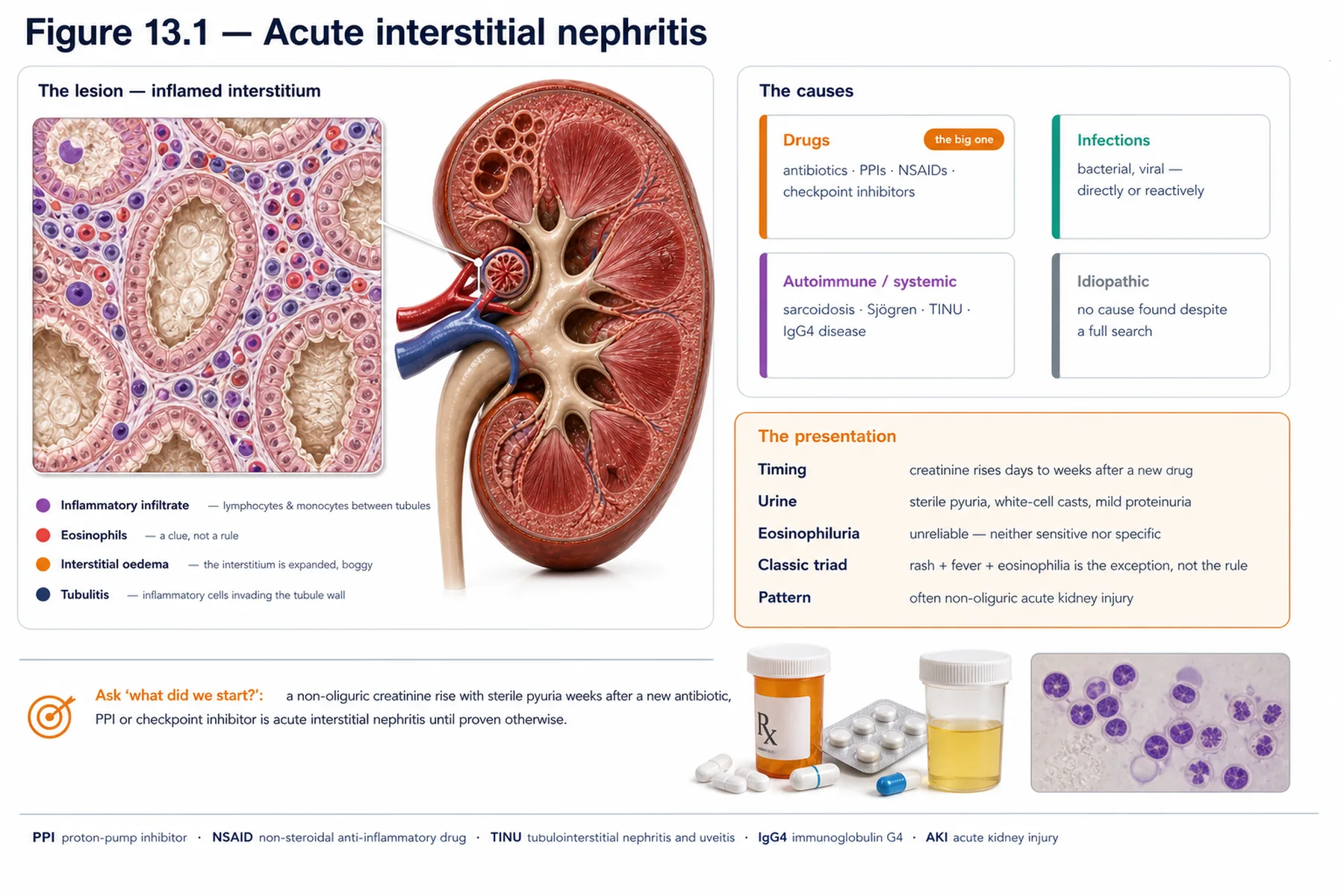
Acute interstitial nephritis is usually an immune (hypersensitivity) reaction producing an interstitial inflammatory infiltrate with eosinophils, tubulitis, and oedema, and causing acute kidney injury.
Drugs are the commonest cause — antibiotics, NSAIDs, and proton pump inhibitors prominent among them, with immune checkpoint inhibitors an emerging cause — alongside infections and systemic diseases (sarcoidosis, Sjogren's, IgG4-related disease, TINU).
It presents as acute kidney injury, often days to weeks after the drug (but proton pump inhibitors may take months), with sterile pyuria, white-cell casts, and modest proteinuria.
The classic triad of fever, rash, and eosinophilia is present in only a minority, so its absence does not exclude the diagnosis.
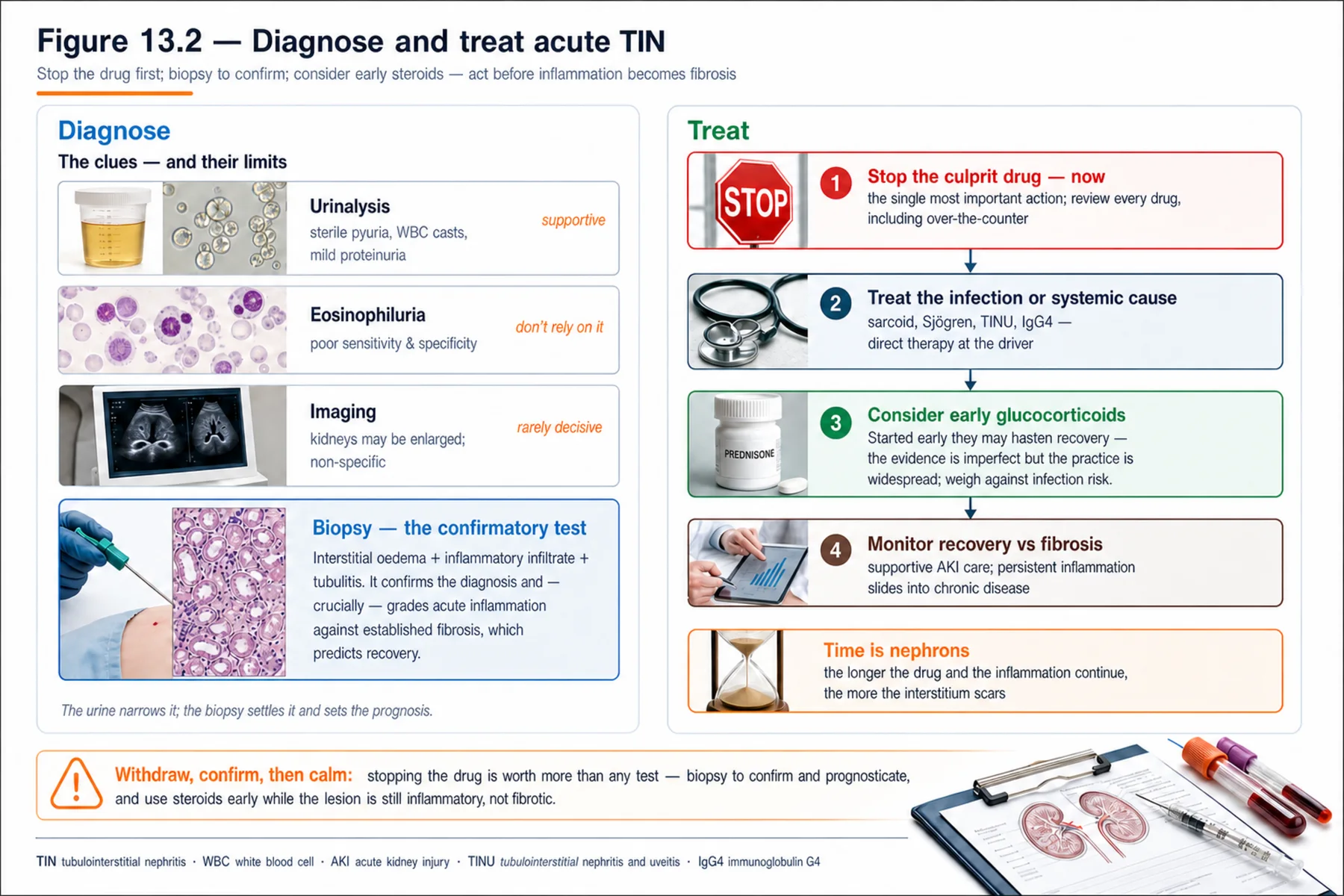
Diagnosis rests on clinical suspicion and the drug history, supported by urinalysis, with kidney biopsy the definitive test.
The cornerstone of treatment is withdrawing the offending drug, which often allows recovery.
Corticosteroids are commonly used — especially for severe or biopsy-proven disease, or when there is no recovery after drug withdrawal — and early steroids may hasten recovery.
Recovery depends on how long the injury continued before the drug was withdrawn: early withdrawal favours full recovery, while prolonged exposure causes fibrosis and incomplete recovery.
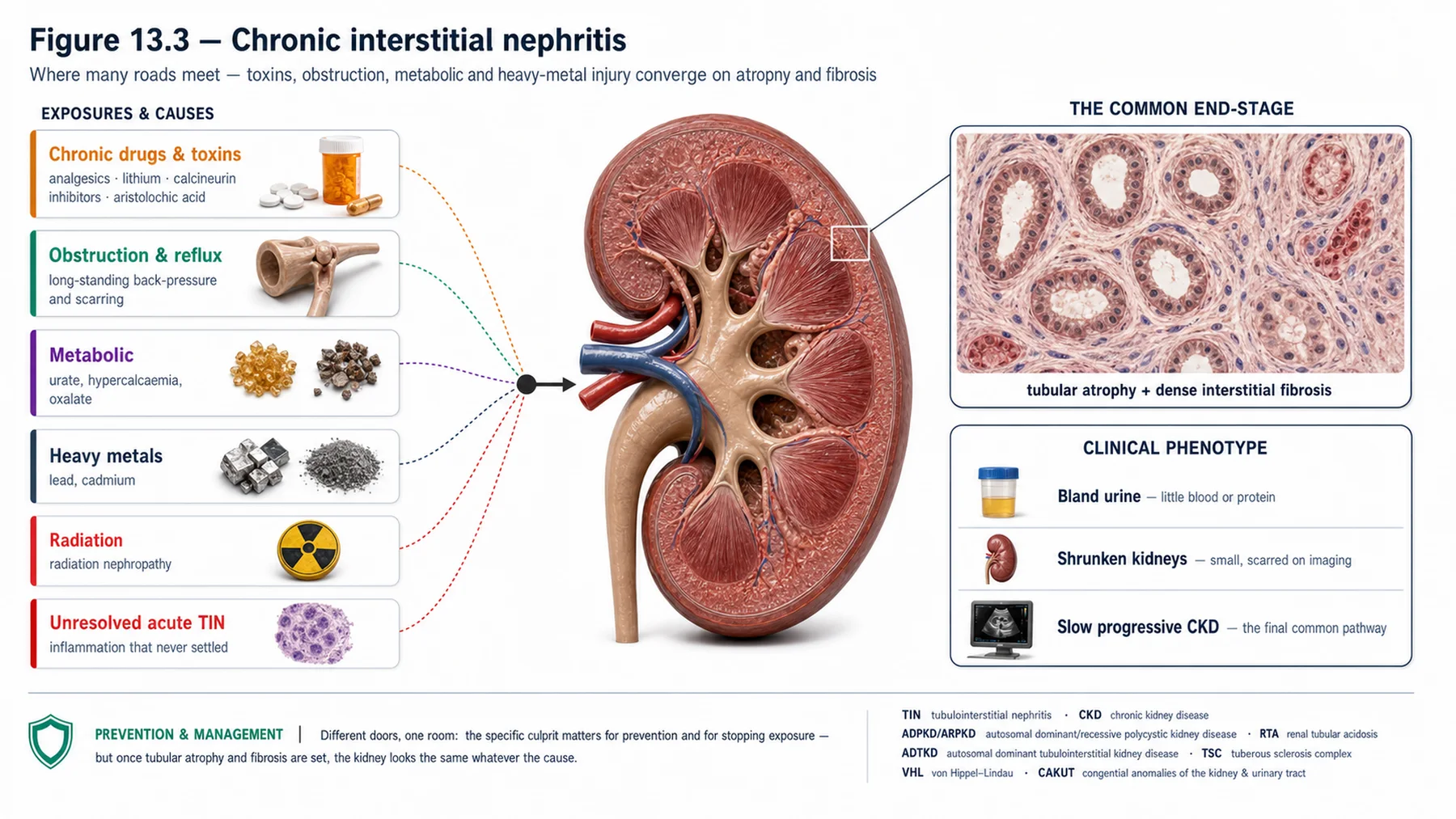
Chronic tubulointerstitial nephritis is chronic interstitial fibrosis and tubular atrophy causing slowly progressive CKD with a bland urine and tubular dysfunction.
Its causes include chronic drugs and toxins (analgesics, lithium, calcineurin inhibitors, aristolochic acid, heavy metals), chronic obstruction and reflux, recurrent infection, metabolic disorders, and the inherited disease of the previous chapter.
It is managed by removing the cause and supporting the CKD, though the fibrosis is often irreversible.
The unifying lesson is that tubulointerstitial nephritis is frequently drug-induced — so the drug history is central, and withdrawing the culprit early is the most important action.
| 03 | PHASE A · LEVEL 3 · ORIENTATION & KNOWLEDGE Main Narrative |
Tubulointerstitial nephritis is the acquired counterpart to the inherited interstitial diseases of the previous chapters — inflammation of the tubules and interstitium rather than a genetic defect of them. Its acute form is one of the commonest causes of drug-induced acute kidney injury, and its single most important lesson is that the cure is usually to stop the drug. This chapter covers the hypersensitivity mechanism and causes of acute interstitial nephritis, its frequently subtle presentation, its treatment, and the chronic interstitial nephritides.
— What tubulointerstitial nephritis is
Tubulointerstitial nephritis is inflammation centred on the tubules and the interstitium — the tissue between the tubules — with relative sparing of the glomeruli and blood vessels (which distinguishes it from glomerulonephritis and vasculitis). It comes in two forms with different tempos and mechanisms. Acute interstitial nephritis (AIN) is an acute inflammatory process — usually immune-mediated — causing acute kidney injury over days to weeks, with the interstitium infiltrated by inflammatory cells (notably eosinophils), the tubules invaded by lymphocytes (tubulitis), and the interstitium oedematous. Chronic tubulointerstitial nephritis (CTIN) is a chronic process of interstitial fibrosis and tubular atrophy causing slowly progressive CKD over months to years, with a bland urine and features of tubular dysfunction. The two share the tubulointerstitial location but differ in everything else: AIN is acute, inflammatory, and often reversible (especially if caught early); CTIN is chronic, fibrotic, and often irreversible. Both are frequently caused by drugs and toxins — the recurring theme of the chapter and the reason the drug and exposure history is central to both.
— Acute interstitial nephritis: mechanism and causes
Acute interstitial nephritis is, in most cases, an immune hypersensitivity reaction. A drug (or other antigen) triggers a cell-mediated, delayed-type hypersensitivity response in the kidney, drawing an inflammatory infiltrate — lymphocytes, eosinophils, plasma cells, and macrophages — into the interstitium, with invasion of the tubules (tubulitis) and interstitial oedema; this inflammation impairs tubular function and reduces the GFR, causing acute kidney injury. The eosinophilic, hypersensitivity character is the histological signature. The causes are led, overwhelmingly, by drugs: antibiotics (penicillins and other beta-lactams, cephalosporins, sulfonamides, fluoroquinolones, rifampicin, vancomycin), NSAIDs, and — increasingly recognised — proton pump inhibitors, along with diuretics, allopurinol, 5-aminosalicylates, and, as a newer and important cause, the immune checkpoint inhibitors used in cancer therapy. Beyond drugs, AIN is caused by infections, and by systemic and autoimmune diseases — sarcoidosis (with granulomas), Sjogren's syndrome, IgG4-related disease, and the TINU syndrome (tubulointerstitial nephritis with uveitis) — with some cases idiopathic. The dominant message is that drugs cause most AIN, so a meticulous drug history (including over-the-counter NSAIDs and proton pump inhibitors, and recently started agents) is the single most important diagnostic step — because the offending drug, once identified, is the thing to stop.
— The subtle presentation
A crucial clinical point about acute interstitial nephritis is that its presentation is often subtle and the textbook 'classic triad' usually absent — a trap for the unwary. The classic triad of fever, rash, and eosinophilia, taught as the hallmark of drug-induced AIN, is in fact present in only a minority of patients (and complete in fewer still), so its absence does not exclude AIN — most patients with AIN do not have the triad. The presentation is typically just acute kidney injury, often non-oliguric, appearing days to weeks after starting the offending drug — though the timing is variable, and proton-pump-inhibitor AIN in particular can be insidious, developing over months and easily overlooked. The urinalysis may show sterile pyuria (white cells without infection), white-cell casts, and modest (tubular, sub-nephrotic) proteinuria; eosinophiluria was traditionally sought but has poor sensitivity and specificity and is no longer relied upon (a notable exception to the bland-proteinuria rule is NSAID-associated AIN, which can occasionally cause nephrotic-range proteinuria from a coexisting minimal-change lesion). So AIN should be suspected in any unexplained acute kidney injury, especially with a recent or ongoing drug exposure, even without the classic triad; the diagnosis rests on this clinical suspicion plus the drug history and urinalysis, with kidney biopsy the definitive test (showing the interstitial eosinophilic infiltrate, tubulitis, and oedema). Waiting for the triad, or for eosinophiluria, will miss most cases.
— Treatment and the importance of timing
The treatment of acute interstitial nephritis turns on one cornerstone: withdraw the offending drug. Identifying and stopping the culprit drug is the single most important and most effective intervention, and in many cases the kidney function recovers once the drug is removed — so the priority on suspecting AIN is to review the drug chart and stop the likely offender (and treat any underlying infection or autoimmune cause). The role of corticosteroids is more debated but they are commonly used: steroids are typically given for severe or biopsy-proven AIN, or when the kidney function does not recover after the drug is withdrawn, on the rationale of suppressing the immune inflammation, and observational evidence suggests that early steroids may hasten and improve recovery (though the evidence is not from large trials). The other crucial therapeutic principle is timing: the recovery of kidney function depends heavily on how long the inflammatory injury continued before the drug was withdrawn — early withdrawal (and early steroids, if used) favours full recovery, whereas prolonged exposure allows the acute inflammation to progress to interstitial fibrosis, with incomplete recovery and residual CKD. This is why prompt recognition and drug withdrawal matter so much: the longer the offending drug continues, the more fibrosis accrues and the less the kidney recovers. So the message is to suspect AIN early (without waiting for the triad), stop the drug promptly, consider steroids, and recognise that the window for full recovery closes as fibrosis sets in.
— Chronic tubulointerstitial nephritis
Chronic tubulointerstitial nephritis is the chronic, fibrotic interstitial disease — interstitial fibrosis, tubular atrophy, and chronic inflammation causing slowly progressive CKD, typically with a bland urine and features of tubular dysfunction (a concentrating defect, tubular proteinuria, sometimes a tubular acidosis) — and it shares the bland, quiet character of the inherited interstitial diseases of the previous chapter. Its causes are diverse but, again, prominently include drugs and toxins: analgesic nephropathy (from long-term heavy analgesic use, classically with papillary necrosis), lithium (chronic interstitial nephritis, often with nephrogenic diabetes insipidus), calcineurin inhibitors (in transplant and other patients), aristolochic acid (the Balkan-endemic and Chinese-herb nephropathies, with a urothelial cancer risk), and heavy metals (lead, cadmium). Non-toxic causes include chronic urinary obstruction and reflux nephropathy, recurrent or chronic infection, metabolic disorders (chronic hypercalcaemia, hyperuricaemia, hyperoxaluria), sarcoidosis and other autoimmune diseases, radiation nephritis, the inherited ADTKD of the previous chapter, and the CKD of uncertain aetiology (CKDu, including Mesoamerican/agricultural nephropathy attributed to heat stress and toxins) increasingly recognised worldwide. Management is to identify and remove the cause — stop the offending drug or toxin (the analgesics, the lithium), relieve obstruction, treat the metabolic disorder — and to support the CKD; but the fibrosis of chronic disease is often irreversible, so prevention and early removal of the cause matter more than for the acute form. The unifying lesson across both acute and chronic tubulointerstitial nephritis is that they are so often caused by drugs and toxins that the exposure history is the key to diagnosis, and removing the culprit — early — is the key to treatment.
| 04 | PHASE A · LEVEL 4 · ORIENTATION & KNOWLEDGE Reference Tables |
Table 13.1 — Acute interstitial nephritis: mechanism
| Element | Detail |
| Process | Immune (hypersensitivity) reaction in the interstitium |
| Histology | Interstitial infiltrate (eosinophils, lymphocytes), tubulitis, oedema |
| Spares | Glomeruli and vessels (distinguishing from GN/vasculitis) |
| Result | Acute kidney injury (often non-oliguric) |
Table 13.2 — Causes of acute interstitial nephritis
| Category | Examples |
| Drugs (commonest) | Antibiotics (beta-lactams, sulfonamides, rifampicin), NSAIDs, PPIs, allopurinol, checkpoint inhibitors |
| Infections | Bacterial and viral |
| Systemic / autoimmune | Sarcoidosis (granulomas), Sjogren's, IgG4-related, TINU (with uveitis) |
| Idiopathic | A minority |
Table 13.3 — Clinical features and diagnosis
| Aspect | Detail |
| Presentation | AKI days-weeks after the drug (PPIs may take months); often subtle |
| The classic triad | Fever, rash, eosinophilia — present in only a MINORITY; absence doesn't exclude |
| Urinalysis | Sterile pyuria, white-cell casts, modest proteinuria; eosinophiluria unreliable |
| Diagnosis | Clinical suspicion + drug history; biopsy is definitive |
Table 13.4 — Treatment of acute interstitial nephritis
| Element | Detail |
| Cornerstone | WITHDRAW the offending drug — often allows recovery |
| Corticosteroids | For severe/biopsy-proven, or no recovery after withdrawal; early steroids may help |
| Timing | Recovery depends on early withdrawal; prolonged exposure → fibrosis, incomplete recovery |
| Also | Treat infection/autoimmune cause; supportive AKI care |
Table 13.5 — Chronic tubulointerstitial nephritis: causes
| Category | Examples |
| Drugs / toxins | Analgesic nephropathy (papillary necrosis), lithium, calcineurin inhibitors, aristolochic acid, heavy metals (lead, cadmium) |
| Obstruction / infection | Chronic obstruction, reflux nephropathy, recurrent infection |
| Metabolic / systemic | Hypercalcaemia, hyperuricaemia, hyperoxaluria; sarcoidosis; radiation |
| Inherited / CKDu | ADTKD (Chapter 12); CKD of uncertain aetiology (Mesoamerican/agricultural) |
Table 13.6 — Acute versus chronic
| Feature | Acute (AIN) | Chronic (CTIN) |
| Tempo / mechanism | Acute; hypersensitivity inflammation | Chronic; fibrosis, tubular atrophy |
| Presentation | AKI; sterile pyuria | Slowly progressive CKD; bland urine, tubular dysfunction |
| Treatment / recovery | Withdraw drug ± steroids; often reversible if early | Remove cause; often IRREVERSIBLE (fibrosis) |
| 05 | PHASE B · LEVEL 5 · VISUALISE & MAP Imaging & Flowchart Specifications |
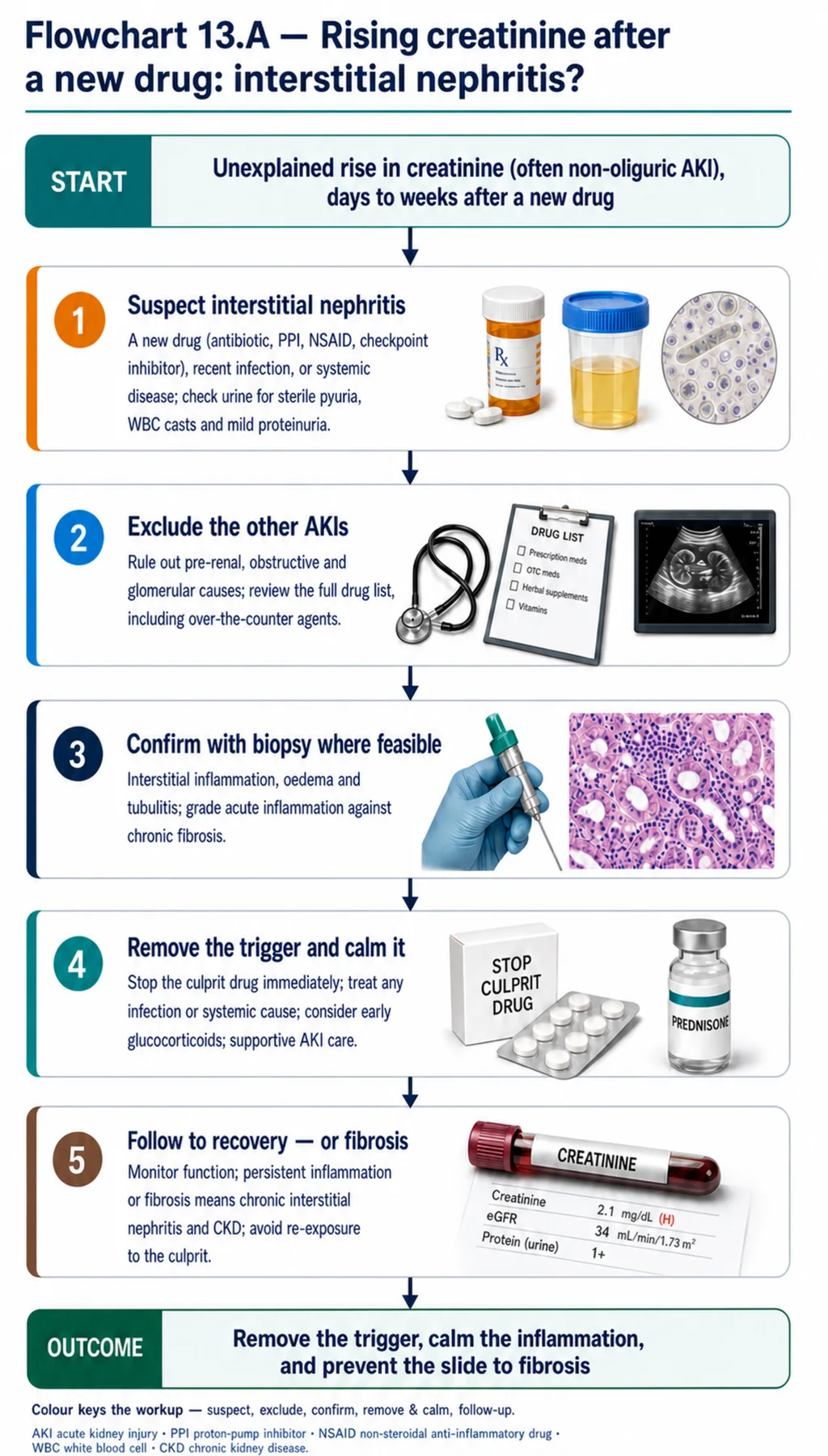
| 06 | PHASE B · LEVEL 6 · VISUALISE & MAP Concept Maps |
Each chain runs from mechanism to a named bedside action; read the arrows as “leads to.”
AIN mechanism. Drug (antigen) → cell-mediated hypersensitivity → eosinophilic interstitial infiltrate + tubulitis → AKI → ACTION: recognise AIN as a hypersensitivity reaction and find the trigger.
AIN causes. Drugs (antibiotics, NSAIDs, PPIs, checkpoint inhibitors) commonest, plus infection and autoimmune → ACTION: take a meticulous drug history (including OTC NSAIDs/PPIs).
Subtle presentation. AKI without the classic triad (present in a minority); sterile pyuria/white-cell casts; PPI-AIN insidious → ACTION: suspect AIN in unexplained AKI with drug exposure, even without the triad.
Treatment / timing. Withdraw the drug (cornerstone) ± steroids; recovery depends on early withdrawal (prolonged → fibrosis) → ACTION: stop the drug early to allow recovery before fibrosis sets in.
Chronic TIN. Chronic toxin/drug (analgesics, lithium, aristolochic acid) or obstruction/metabolic → fibrosis, atrophy → progressive CKD (bland urine) → ACTION: remove the cause; the fibrosis is often irreversible, so act early.
| 07 | PHASE B · LEVEL 7 · VISUALISE & MAP Decision Pathways |
| R1 | IF a patient has unexplained acute kidney injury with a recent or ongoing drug exposure, THEN suspect acute interstitial nephritis — even without the classic triad. |
| R2 | IF acute interstitial nephritis is suspected, THEN take a meticulous drug history, including over-the-counter NSAIDs and proton pump inhibitors and recently started agents. |
| R3 | IF the urinalysis shows sterile pyuria or white-cell casts in AKI, THEN consider acute interstitial nephritis (but a normal eosinophiluria does not exclude it). |
| R4 | IF the diagnosis is uncertain or the cause unclear, THEN consider a kidney biopsy — the definitive test. |
| R5 | IF acute interstitial nephritis is diagnosed, THEN withdraw the offending drug promptly — the cornerstone of treatment. |
| R6 | IF the disease is severe or biopsy-proven, or does not recover after drug withdrawal, THEN consider corticosteroids (early, if used). |
| R7 | IF acute interstitial nephritis is suspected, THEN act early — recovery depends on withdrawal before fibrosis sets in. |
| R8 | IF there is slowly progressive bland-urine CKD, THEN consider chronic tubulointerstitial nephritis and seek the chronic toxin, drug, obstruction, or metabolic cause to remove. |
| 08 | PHASE C · LEVEL 8 · CLINICAL REASONING Clinical Cases |
| CASE 1 | STOP THE DRUG Withdrawal is the cornerstone Drug-induced AIN |
Presentation
A patient develops acute kidney injury a couple of weeks after starting an antibiotic, with sterile pyuria and white-cell casts but no fever, rash, or eosinophilia. A clinician, finding no classic triad, doubts acute interstitial nephritis and continues the antibiotic.
❖ Pause and reflect Does the absent triad exclude AIN, and what is the key action? |
Analysis
No — the absent triad does not exclude AIN, and the key action is to stop the drug. Acute interstitial nephritis is usually a drug-induced hypersensitivity reaction, and antibiotics are a classic cause; the timing (AKI a couple of weeks after starting the antibiotic) and the urinalysis (sterile pyuria, white-cell casts) fit well. The classic triad of fever, rash, and eosinophilia is present in only a minority of AIN, so its absence is expected and does not argue against the diagnosis — continuing the drug because there is no triad is a common and harmful error. The cornerstone of treatment is to withdraw the offending drug (the antibiotic), which often allows recovery, and the sooner it is stopped the better the recovery, because prolonged exposure brings fibrosis. A biopsy can confirm the diagnosis if needed, and corticosteroids can be considered (especially if no recovery follows withdrawal), but the immediate priority is to stop the antibiotic.
Plan
Diagnose likely drug-induced acute interstitial nephritis despite the absent triad, withdraw the antibiotic promptly (the cornerstone), consider biopsy and corticosteroids, and support the AKI. Stop the offending drug — the absent triad doesn't exclude AIN.
Teaching point
The classic triad is present in only a minority of AIN — its absence doesn't exclude it; the cornerstone of treatment is to withdraw the offending drug.
Cross-reference
Exercises rules R1, R2, and R5; the AIN-mechanism and treatment concept maps; Figures 13.1, 13.2; Tables 13.2, 13.3, 13.4.
| CASE 2 | THE INSIDIOUS PPI A subtle, delayed cause Proton-pump-inhibitor AIN |
Presentation
A patient on a proton pump inhibitor for many months is found to have an unexplained, gradually rising creatinine with a bland-ish urine. The drug, taken long-term and 'just for reflux,' has not been considered as a cause.
❖ Pause and reflect Could the long-term proton pump inhibitor be causing this? |
Analysis
Yes — proton pump inhibitors are an increasingly recognised and characteristically insidious cause of acute interstitial nephritis. Unlike the classic drug-induced AIN that presents acutely days to weeks after a new drug, proton-pump-inhibitor AIN can develop insidiously over months, with a gradually rising creatinine that is easily overlooked — and the drug is often discounted because it has been taken for a long time and 'just for reflux.' This is a common blind spot: a long-standing, seemingly innocuous medication is not suspected, and the AIN smoulders. The clinician should take a full drug history including such over-the-counter and long-term agents, recognise the proton pump inhibitor as a possible cause, and stop it (with consideration of biopsy and steroids), because continuing it allows ongoing inflammation and fibrosis. The lesson is that AIN is not always acute and obvious; the proton pump inhibitor is the classic insidious culprit that requires a deliberate drug history to catch.
Plan
Recognise the proton pump inhibitor as a possible insidious cause of acute interstitial nephritis, stop it, and consider biopsy and steroids — taking a full drug history that includes long-term and over-the-counter agents. Suspect the insidious PPI in unexplained rising creatinine.
Teaching point
Proton pump inhibitors are an insidious cause of acute interstitial nephritis, developing over months — take a full drug history including long-term, 'innocuous' medications.
Cross-reference
Exercises rules R1 and R2; the AIN-causes and subtle-presentation concept maps; Figure 13.2; Tables 13.2, 13.3.
| CASE 3 | THE WINDOW CLOSES Recovery depends on timing Timing of withdrawal |
Presentation
Two patients have drug-induced acute interstitial nephritis: in one the drug was stopped promptly on suspicion; in the other, the drug was continued for many weeks before the diagnosis was made. The second recovers far less kidney function.
❖ Pause and reflect Why did the two patients recover so differently? |
Analysis
Because recovery in acute interstitial nephritis depends heavily on how long the inflammatory injury continued before the drug was withdrawn. In the first patient, prompt withdrawal stopped the inflammation while it was still acute and reversible, allowing the kidney function to recover. In the second, the drug continued for many weeks, so the acute inflammation persisted and progressed to interstitial fibrosis — and fibrosis is irreversible, so the kidney recovered far less, leaving residual CKD. This timing-dependence is why prompt recognition and early drug withdrawal matter so much: the window for full recovery closes as fibrosis sets in. It also underlies the rationale for early corticosteroids (where used), to suppress the inflammation before it fibroses. The contrast between the two patients is the clearest demonstration of the principle: the longer the offending drug continues, the more fibrosis accrues and the less the kidney recovers — so suspect AIN early and stop the drug promptly.
Plan
Recognise that early drug withdrawal favours full recovery while prolonged exposure causes irreversible fibrosis, and therefore suspect acute interstitial nephritis early and withdraw the drug promptly (with early steroids if used). Act early — the recovery window closes with fibrosis.
Teaching point
Recovery from acute interstitial nephritis depends on early drug withdrawal — prolonged exposure brings irreversible fibrosis; suspect it early and stop the drug promptly.
Cross-reference
Exercises rules R6 and R7; the treatment/timing concept map; Figure 13.3; Table 13.4.
| CASE 4 | THE CHRONIC TOXIN Remove the cause Chronic tubulointerstitial nephritis |
Presentation
A patient with slowly progressive CKD, a bland urine, and a urinary concentrating defect has a long history of heavy analgesic use (and, in another case, long-term lithium). The cause of the CKD has been recorded as 'unknown.'
❖ Pause and reflect What is the likely cause, and what should be done? |
Analysis
Chronic tubulointerstitial nephritis from a chronic toxin — analgesic nephropathy (and, in the other case, lithium nephropathy). The picture is characteristic of chronic tubulointerstitial nephritis: slowly progressive CKD with a bland urine and tubular dysfunction (the concentrating defect), reflecting interstitial fibrosis and tubular atrophy. The cause here is the long-term heavy analgesic use (analgesic nephropathy, classically with papillary necrosis); long-term lithium is another classic cause (chronic interstitial nephritis, often with nephrogenic diabetes insipidus). Recording the cause as 'unknown' misses the toxin, which the exposure history reveals — just as the drug history is central in the acute form. The management is to remove the cause (stop the analgesics, review the lithium) and support the CKD; but the fibrosis of chronic disease is often irreversible, so removing the toxin early (and preventing the exposure) matters more than in the acute form. The lesson, shared with acute interstitial nephritis, is that the exposure history identifies a removable cause.
Plan
Recognise the chronic tubulointerstitial nephritis from a chronic toxin (analgesic nephropathy; or lithium), remove the cause (stop the analgesics, review the lithium), and support the CKD — recognising the fibrosis is often irreversible. Take the exposure history and remove the chronic toxin.
Teaching point
Chronic tubulointerstitial nephritis (bland-urine, slowly progressive CKD) is often from a chronic toxin (analgesics, lithium) — the exposure history finds it; remove the cause early (fibrosis is irreversible).
Cross-reference
Exercises rule R8; the chronic-TIN concept map; Tables 13.5, 13.6; ADTKD in Chapter 12.
| 09 | PHASE C · LEVEL 9 · CLINICAL REASONING Clinical Implications |
One triad per mechanism the narrative exposed: the physiology, why it matters, and the bedside move.
MECHANISM Acute interstitial nephritis is a hypersensitivity reaction with an eosinophilic infiltrate. |
WHY IT MATTERS It is usually drug-induced and causes acute kidney injury. |
ACTION Recognise it as a hypersensitivity reaction and find the trigger. |
MECHANISM Drugs cause most acute interstitial nephritis. |
WHY IT MATTERS The offending drug, once found, is the thing to stop. |
ACTION Take a meticulous drug history, including OTC NSAIDs and proton pump inhibitors. |
MECHANISM The classic triad is present in only a minority of acute interstitial nephritis. |
WHY IT MATTERS Waiting for it (or for eosinophiluria) misses most cases. |
ACTION Suspect AIN in unexplained AKI with drug exposure, even without the triad. |
MECHANISM Recovery depends on how long the injury continued before the drug was withdrawn. |
WHY IT MATTERS Prolonged exposure allows the acute inflammation to fibrose irreversibly. |
ACTION Stop the offending drug early, before fibrosis sets in. |
MECHANISM Chronic tubulointerstitial nephritis is fibrosis from a chronic toxin, obstruction, or metabolic cause. |
WHY IT MATTERS It causes slowly progressive CKD and the fibrosis is often irreversible. |
ACTION Take the exposure history and remove the cause early. |
| 10 | PHASE C · LEVEL 10 · CLINICAL REASONING Clinical Pearls |
| Tubulointerstitial nephritis = tubulointerstitial inflammation (glomeruli/vessels spared). | Acute (AIN) = hypersensitivity inflammation → AKI; chronic (CTIN) = fibrosis → CKD. |
| AIN: eosinophilic interstitial infiltrate, tubulitis, oedema. | DRUGS are the commonest cause of AIN. |
| Common drugs: antibiotics, NSAIDs, PPIs, allopurinol, checkpoint inhibitors. | Also: infections, sarcoidosis, Sjogren's, IgG4, TINU. |
| The classic triad (fever/rash/eosinophilia) is present in only a MINORITY. | Absence of the triad does NOT exclude AIN. |
| PPI-AIN is insidious (months) — take a full drug history. | Urinalysis: sterile pyuria, white-cell casts; eosinophiluria unreliable. |
| Biopsy is the definitive diagnosis. | Treatment cornerstone: WITHDRAW the offending drug. |
| Corticosteroids for severe/biopsy-proven or no recovery (early, if used). | Recovery depends on EARLY withdrawal (prolonged → fibrosis). |
| CTIN causes: analgesics, lithium, calcineurin inhibitors, aristolochic acid, heavy metals, obstruction, metabolic, inherited (ADTKD). | CTIN: remove the cause; fibrosis often IRREVERSIBLE. |
| 11 | PHASE D · LEVEL 11 · SAFETY & EVIDENCE Red Flags & Never-Do |
Panel A — Red flags
| ▲ | Unexplained AKI with a recent or ongoing drug — suspect acute interstitial nephritis (even without the triad). |
| ▲ | Sterile pyuria or white-cell casts in AKI — consider acute interstitial nephritis. |
| ▲ | A gradually rising creatinine on a long-term proton pump inhibitor — insidious PPI-AIN; stop it. |
| ▲ | Prolonged exposure to the offending drug — fibrosis accrues; stop it promptly. |
| ▲ | Slowly progressive bland-urine CKD with a toxin history (analgesics, lithium) — chronic tubulointerstitial nephritis. |
Panel B — Never do
| ✖ NEVER — exclude acute interstitial nephritis because the classic triad is absent. |
| ✖ NEVER — overlook over-the-counter NSAIDs and long-term proton pump inhibitors in the drug history. |
| ✖ NEVER — continue the offending drug once acute interstitial nephritis is suspected. |
| ✖ NEVER — record bland-urine CKD as 'unknown cause' without an exposure history (toxins, drugs). |
| 12 | PHASE D · LEVEL 12 · SAFETY & EVIDENCE Common Pitfalls |
Pitfall 1 — Waiting for the triad
| ✖ | WRONG Excluding AIN because fever, rash, and eosinophilia are absent. |
| ✓ | RIGHT Suspecting AIN in unexplained AKI with drug exposure regardless. |
| ✉ | WHY The classic triad is present in only a minority. |
Pitfall 2 — Missing the PPI
| ✖ | WRONG Discounting a long-term proton pump inhibitor as a cause. |
| ✓ | RIGHT Recognising the insidious PPI-AIN and stopping it. |
| ✉ | WHY PPI-AIN develops over months and is easily overlooked. |
Pitfall 3 — Continuing the drug
| ✖ | WRONG Continuing the offending drug while investigating. |
| ✓ | RIGHT Withdrawing it promptly on suspicion. |
| ✉ | WHY Prolonged exposure brings irreversible fibrosis. |
Pitfall 4 — Relying on eosinophiluria
| ✖ | WRONG Excluding AIN because the urine eosinophils are negative. |
| ✓ | RIGHT Relying on clinical suspicion, drug history, and biopsy. |
| ✉ | WHY Eosinophiluria has poor sensitivity and specificity. |
Pitfall 5 — 'Unknown cause' CTIN
| ✖ | WRONG Recording chronic bland-urine CKD as 'unknown cause'. |
| ✓ | RIGHT Taking an exposure history (analgesics, lithium, toxins) to find the cause. |
| ✉ | WHY Chronic tubulointerstitial nephritis is often from a removable toxin. |
| 13 | PHASE D · LEVEL 13 · SAFETY & EVIDENCE Evidence Grading |
GRADE A HIGH CONFIDENCE The effect is real and the estimate is stable. RCTs at low risk of bias; multiple concordant prospective cohorts; meta-analyses. |
GRADE B MODERATE CONFIDENCE The effect is likely real but may shift with new data. Observational studies, registries, mechanistic human studies. |
GRADE C LOW CONFIDENCE Rests on physiology, reasoning, or consensus rather than outcomes. Pathophysiological reasoning; extrapolation; consensus without outcomes. |
Graded statements (by evidence type)
| Statement | Grade | Basis (evidence type) |
| Acute interstitial nephritis is usually a drug-induced hypersensitivity reaction. | A | Clinical and histopathological data |
| The classic triad is present in only a minority of cases. | A | Cohort data |
| Proton pump inhibitors cause an insidious acute interstitial nephritis. | A | Cohort and pharmacovigilance data |
| Withdrawing the offending drug is the cornerstone of treatment. | A | Clinical data |
| Early corticosteroids may hasten recovery in acute interstitial nephritis. | B | Observational data |
| Recovery depends on the duration before drug withdrawal. | A | Cohort data |
| Chronic tubulointerstitial nephritis is often from a removable toxin/drug. | A | Clinical data |
| 14 | PHASE E · LEVEL 14 · PATIENT DECISIONS Absolute Risk in Natural Frequency |
Natural-frequency estimates for orientation, from interstitial-nephritis cohorts; they vary with the cause and timing. They convey the size of the decisions, expressed per 100 comparable patients.
| Per 100 patients… | Outcome | Roughly how many | See |
| With acute interstitial nephritis | Have the complete classic triad | Few — hence don't wait for it | L13 row 2 |
| With AIN, drug withdrawn early vs late | Recover kidney function | More with early withdrawal | L13 rows 6 |
| With AIN given early corticosteroids | Recover more fully (selected) | Possibly more — observational | L13 row 5 |
| With chronic tubulointerstitial nephritis | Recover function after removing the cause | Fewer — the fibrosis is often irreversible | L13 row 7 |
★ How to read these Read these as orientation, not promises; outcomes vary with cause and timing. The stable signals: the triad is rare, early drug withdrawal aids recovery, steroids may help in selected cases, and chronic fibrosis is largely irreversible. Communicate them as people out of 100, not as a hazard ratio. |
| 17 | PHASE F · LEVEL 17 · APPLY & TEST Documentation Templates |
Paste-ready notes. Tick the boxes that apply and delete the rest; make the drug history and the withdrawal explicit.
Template 1 — Acute interstitial nephritis
Template 2 — Chronic tubulointerstitial nephritis
| 18 | PHASE F · LEVEL 18 · APPLY & TEST Cheat Sheet |
| TIN = tubulointerstitial inflammation (glomeruli/vessels spared). | AIN = acute hypersensitivity → AKI; CTIN = chronic fibrosis → CKD. |
| AIN histology: eosinophilic infiltrate, tubulitis, oedema. | DRUGS = commonest AIN cause. |
| Drugs: antibiotics, NSAIDs, PPIs, allopurinol, checkpoint inhibitors. | Also: infection, sarcoid, Sjogren's, IgG4, TINU. |
| Classic triad (fever/rash/eosinophilia) in a MINORITY. | Absent triad does NOT exclude AIN. |
| PPI-AIN is insidious (months). | Urinalysis: sterile pyuria, white-cell casts; eosinophiluria unreliable. |
| Biopsy = definitive. | Cornerstone: WITHDRAW the offending drug. |
| Steroids for severe/biopsy-proven/no recovery (early). | Recovery depends on EARLY withdrawal. |
| CTIN: analgesics, lithium, CNIs, aristolochic acid, heavy metals, obstruction, metabolic, ADTKD. | CTIN fibrosis often IRREVERSIBLE — remove the cause early. |
| 19 | PHASE F · LEVEL 19 · APPLY & TEST Flashcards |
| CARD 1 | Q. What is tubulointerstitial nephritis, and its two forms? A. Inflammation centred on the tubules and interstitium (sparing the glomeruli and vessels), occurring as acute interstitial nephritis (an acute, usually immune, inflammation causing acute kidney injury) and chronic tubulointerstitial nephritis (chronic interstitial fibrosis and tubular atrophy causing slowly progressive CKD). DETAILED. Both are frequently caused by drugs and toxins. CLINICAL. Take the drug/exposure history in both. |
| CARD 2 | Q. What is the mechanism and commonest cause of acute interstitial nephritis? A. A cell-mediated hypersensitivity reaction producing an interstitial inflammatory infiltrate (with eosinophils), tubulitis, and oedema; drugs are the commonest cause — antibiotics, NSAIDs, proton pump inhibitors, allopurinol, and immune checkpoint inhibitors prominent among them. DETAILED. Infections and autoimmune diseases also cause it. CLINICAL. Take a meticulous drug history to find the trigger. |
| CARD 3 | Q. Why must the absence of the classic triad not exclude acute interstitial nephritis? A. Because the classic triad of fever, rash, and eosinophilia is present in only a minority of patients (and complete in fewer still), so most patients with acute interstitial nephritis do not have it — waiting for the triad misses most cases. DETAILED. The presentation is often just AKI with drug exposure. CLINICAL. Suspect AIN in unexplained AKI with drug exposure, even without the triad. |
| CARD 4 | Q. Why are proton pump inhibitors a notable cause of acute interstitial nephritis? A. Because they cause an insidious form that develops over months (rather than the acute days-to-weeks onset of classic drug-induced AIN), with a gradually rising creatinine that is easily overlooked — and the drug is often discounted as long-standing and innocuous. DETAILED. It requires a deliberate drug history to catch. CLINICAL. Suspect the insidious PPI in unexplained rising creatinine. |
| CARD 5 | Q. What is the cornerstone of treating acute interstitial nephritis? A. Withdrawing the offending drug — the single most important and most effective intervention, which often allows recovery; corticosteroids are commonly added for severe or biopsy-proven disease or when there is no recovery after withdrawal, and early steroids may hasten recovery. DETAILED. Treat any underlying infection or autoimmune cause too. CLINICAL. Stop the offending drug; consider steroids. |
| CARD 6 | Q. Why does the timing of drug withdrawal matter in acute interstitial nephritis? A. Because recovery depends on how long the inflammatory injury continued before the drug was withdrawn — early withdrawal allows the acute, reversible inflammation to resolve with recovery, while prolonged exposure lets it progress to irreversible interstitial fibrosis with incomplete recovery. DETAILED. The window for full recovery closes as fibrosis sets in. CLINICAL. Suspect AIN early and withdraw the drug promptly. |
| CARD 7 | Q. What is chronic tubulointerstitial nephritis and what causes it? A. Chronic interstitial fibrosis and tubular atrophy causing slowly progressive CKD with a bland urine and tubular dysfunction; causes include chronic drugs and toxins (analgesics, lithium, calcineurin inhibitors, aristolochic acid, heavy metals), chronic obstruction and reflux, recurrent infection, metabolic disorders, sarcoidosis, the inherited ADTKD, and CKD of uncertain aetiology. DETAILED. The fibrosis is often irreversible. CLINICAL. Take the exposure history and remove the cause early. |
| CARD 8 | Q. What is the unifying lesson of tubulointerstitial nephritis? A. That both the acute and chronic forms are so often caused by drugs and toxins that the drug and exposure history is the key to diagnosis, and removing the culprit — early, before fibrosis sets in — is the key to treatment. DETAILED. The cure is usually to stop the offending agent. CLINICAL. Take the drug/exposure history and remove the culprit early. |
| 20 | PHASE F · LEVEL 20 · APPLY & TEST One-Minute Preceptor |
| SCENE 1 | The intern waiting for the triad |
GET A COMMITMENT. “You've ruled out acute interstitial nephritis because there's no fever, rash, or eosinophilia — and continued the antibiotic. Sure?”
PROBE FOR EVIDENCE. “There's no classic triad” — ask: “What fraction of AIN actually has the complete triad, and what is the key treatment?”
TEACH A GENERAL RULE. The classic triad is present in only a minority of AIN, so its absence doesn't exclude it — suspect AIN in unexplained AKI with drug exposure, and the cornerstone is to withdraw the offending drug.
REINFORCE WHAT WAS RIGHT. Recognising the AKI was correct.
CORRECT A MISTAKE. Stop the antibiotic; don't wait for the triad.
| SCENE 2 | The resident missing the PPI |
GET A COMMITMENT. “This creatinine has crept up on someone on a long-term PPI, and you've not considered the PPI — why?”
PROBE FOR EVIDENCE. “It's just for reflux, taken for ages” — ask: “Can a long-term PPI cause an insidious interstitial nephritis?”
TEACH A GENERAL RULE. Proton pump inhibitors cause an insidious acute interstitial nephritis over months, easily overlooked because the drug seems innocuous — take a full drug history and consider stopping it.
REINFORCE WHAT WAS RIGHT. Noticing the rising creatinine was good.
CORRECT A MISTAKE. Consider and stop the PPI as a possible cause.
| 22 | PHASE F · LEVEL 22 · APPLY & TEST Board-Style Questions |
| Q 01 | Acute interstitial nephritis is most commonly caused by: |
| A | Glomerular immune complexes |
| B | Drugs (a hypersensitivity reaction) |
| C | Renal artery stenosis |
| D | Cysts |
Rationale AIN is usually a drug-induced hypersensitivity reaction (Figure 13.1, Table 13.2). A is GN; C and D are different. |
| Q 02 | The classic triad of acute interstitial nephritis (fever, rash, eosinophilia) is: |
| A | Present in nearly all cases |
| B | Present in only a minority — its absence does not exclude AIN |
| C | Always complete |
| D | Required for the diagnosis |
Rationale The triad is present in only a minority (case 1, Table 13.3). A, C, and D are incorrect. |
| Q 03 | A gradually rising creatinine in a patient on a long-term proton pump inhibitor suggests: |
| A | Pre-renal AKI |
| B | Insidious PPI-induced acute interstitial nephritis |
| C | Obstruction |
| D | A normal finding |
Rationale PPIs cause an insidious AIN over months (case 2, Table 13.2). A, C, and D miss it. |
| Q 04 | The cornerstone of treating acute interstitial nephritis is: |
| A | Immunosuppression first |
| B | Withdrawing the offending drug |
| C | Dialysis |
| D | Antibiotics |
Rationale Drug withdrawal is the cornerstone (case 1, Table 13.4, rule R5). A is sometimes added; C and D are not the cornerstone. |
| Q 05 | Recovery from acute interstitial nephritis depends largely on: |
| A | The patient's age alone |
| B | How long the drug continued before withdrawal (early is better) |
| C | The dose of antibiotic |
| D | The urine colour |
Rationale Early withdrawal favours recovery; prolonged exposure brings fibrosis (case 3, Figure 13.3, rule R7). A, C, and D are wrong. |
| Q 06 | Urine eosinophils in suspected acute interstitial nephritis: |
| A | Reliably confirm or exclude it |
| B | Have poor sensitivity and specificity — are not relied upon |
| C | Are always present |
| D | Are diagnostic |
Rationale Eosinophiluria is unreliable (Table 13.3, rule R3). A, C, and D overstate it. |
| Q 07 | Chronic tubulointerstitial nephritis is characteristically: |
| A | Acute with heavy proteinuria |
| B | Slowly progressive CKD with a bland urine and tubular dysfunction |
| C | A glomerular disease |
| D | Always reversible |
Rationale CTIN is bland-urine, slowly progressive CKD from fibrosis (case 4, Table 13.6). A, C, and D are incorrect. |
| Q 08 | Which is a classic cause of chronic tubulointerstitial nephritis? |
| A | A single dose of an antibiotic |
| B | Long-term analgesic use (analgesic nephropathy) or lithium |
| C | Renal artery stenosis |
| D | A simple cyst |
Rationale Chronic analgesic use and lithium are classic causes (case 4, Table 13.5). A causes acute disease; C and D are different. |