Chapter Preamble
Signals declared
Sig-D — Diagnostic (primary). Recognise the bland-urine, dominant, slowly progressive CKD of ADTKD, use its clues (gout, family history, the subtype features), and make the genetic diagnosis.
Sig-M — Mechanistic (strong). How each ADTKD gene (UMOD, MUC1, REN, HNF1B) produces tubulointerstitial damage, and why the disease is so easily missed.
Levels populated and omitted
Populated (17): L1–L13, L18–L20, L22. The mechanistic signal fires the concept maps (L6) and triads (L9); the diagnostic signal drives the tables, rules, cases, pitfalls, and board items.
L14 absolute-risk — omitted. No Sig-T/E/V; this is a recognition and mechanism chapter (supportive treatment is noted within it).
L15 / L16 preference-sensitive map and SDM scripts — omitted. No Sig-E; ADTKD is recognised and managed supportively.
L17 documentation templates — omitted. No Sig-P/T as a primary signal; management is summarised in the tables and cases.
| 01 | PHASE A · LEVEL 1 · ORIENTATION & KNOWLEDGE Learning Objectives |
By the end of this chapter you should be able to:
Define ADTKD and its characteristic bland-urine, dominant, slowly progressive picture.
Explain the mechanism of ADTKD-UMOD and its association with early gout.
Describe the ADTKD-MUC1, ADTKD-REN, and ADTKD-HNF1B subtypes.
Recognise the clinical clues that distinguish the subtypes.
Explain why ADTKD is so frequently missed or mislabelled.
Explain why genetic testing, not biopsy, is the definitive diagnosis.
Recognise the HNF1B multisystem phenotype (cysts, diabetes, hypomagnesaemia).
Outline the supportive, subtype-specific management.
| 02 | PHASE A · LEVEL 2 · ORIENTATION & KNOWLEDGE Executive Summary |
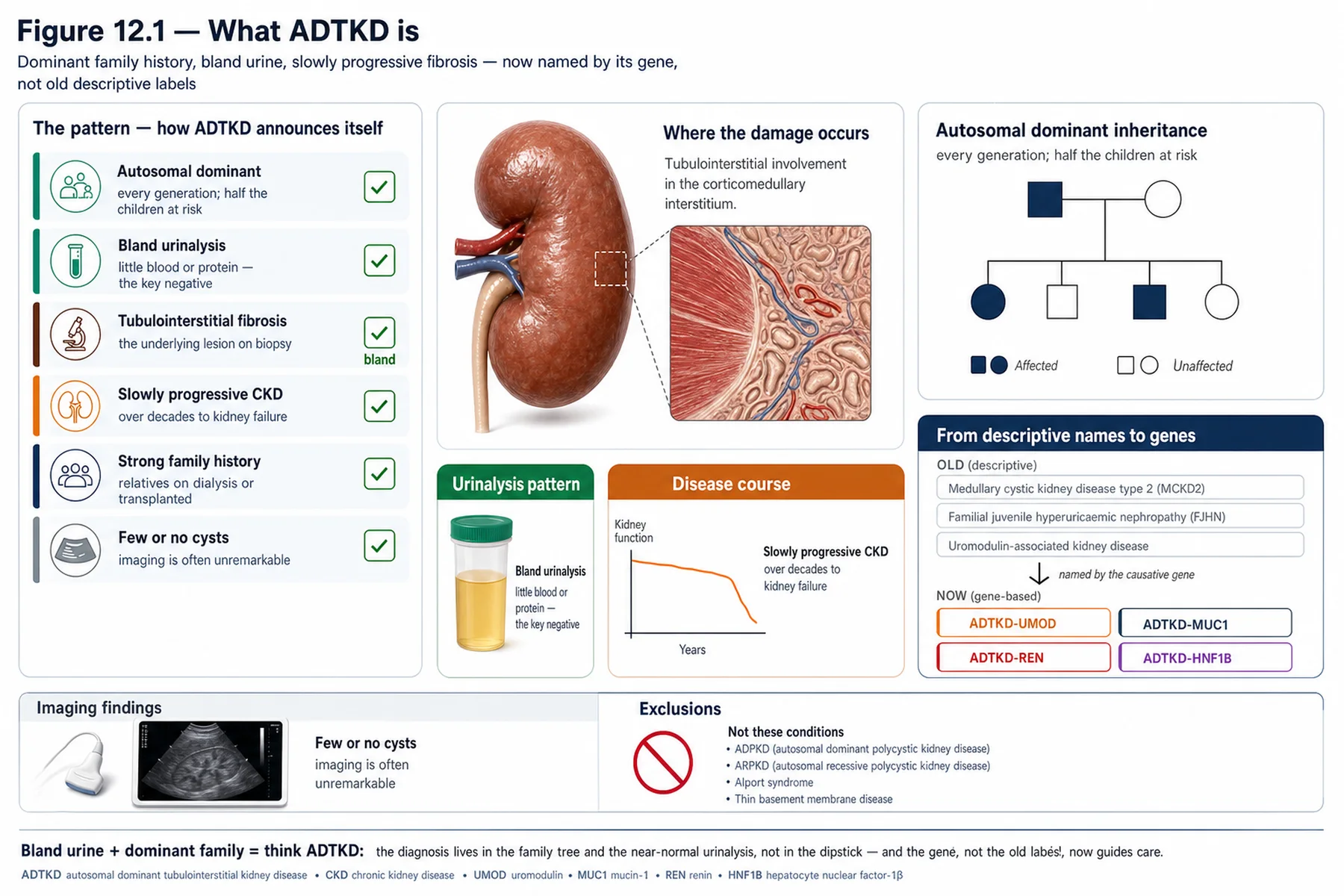
ADTKD is a group of autosomal dominant diseases causing chronic tubulointerstitial fibrosis and slowly progressive CKD, with a characteristically bland urine (little proteinuria or haematuria), few or no cysts, and normal-to-small kidneys.
It is classified by the gene involved: ADTKD-UMOD, ADTKD-MUC1, ADTKD-REN, and ADTKD-HNF1B.
ADTKD-UMOD results from mutant uromodulin (Tamm-Horsfall protein) that misfolds and accumulates in the thick ascending limb, causing endoplasmic-reticulum stress and tubular damage, and its hallmark is early-onset hyperuricaemia and gout, often preceding the CKD.
ADTKD-MUC1 results from an abnormal mucin-1 protein that accumulates and is toxic, causing a bland slowly progressive CKD with no specific extrarenal marker, and is difficult to detect by standard sequencing.
ADTKD-REN results from a renin defect, with childhood anaemia, mild hypotension, hyperkalaemia, gout, and slowly progressive CKD.
ADTKD-HNF1B has a broad multisystem phenotype — renal cysts and structural anomalies, maturity-onset diabetes of the young, hypomagnesaemia, and gout — with frequent de novo mutations.
Across the subtypes, the common features are autosomal dominant inheritance (a family history of CKD), a bland urine, few or no cysts, and slow progression.
ADTKD is frequently missed because the bland urine and nonspecific tubulointerstitial picture lead to labels like 'CKD of unknown cause' or 'chronic interstitial nephritis'.
The dominant family history and, for UMOD and REN, the gout are the clues that should prompt the diagnosis.
Biopsy shows only nonspecific tubulointerstitial fibrosis, so genetic testing is the definitive diagnosis and classifies the subtype, sparing repeated nondiagnostic biopsies.
There is no disease-specific treatment for most subtypes — management is supportive CKD care, urate-lowering for gout, and subtype-specific measures (diabetes and magnesium in HNF1B, anaemia in REN).
Transplantation does not recur, and genetic counselling reflects the autosomal dominant inheritance.
Recognising the bland-urine, dominant, slowly progressive CKD — and making the genetic diagnosis — is the whole task.
| 03 | PHASE A · LEVEL 3 · ORIENTATION & KNOWLEDGE Main Narrative |
ADTKD is one of the most under-recognised inherited kidney diseases, precisely because it has so little to show: a bland urine, few or no cysts, normal-to-small kidneys, and a slow, silent decline in function. It hides behind labels like 'CKD of unknown cause.' Yet it has a tell-tale signature — an autosomal dominant family history, and, in two subtypes, early gout — and a definitive test. This chapter covers the four ADTKD subtypes, why the disease is missed, and why genetic testing, not biopsy, makes the diagnosis.
— What ADTKD is
ADTKD — autosomal dominant tubulointerstitial kidney disease — is a group of inherited diseases that share a phenotype and are distinguished by their gene. The shared phenotype is chronic tubulointerstitial fibrosis (scarring of the tubules and interstitium, rather than the glomeruli) causing slowly progressive CKD, with a characteristically bland urine — little or no proteinuria and little or no haematuria — because the disease spares the glomerulus and its filtration barrier. The kidneys are normal-sized or small, and there are few or no cysts (or small medullary cysts), so imaging is unrevealing. The inheritance is autosomal dominant, so there is a family history of CKD across generations. This combination — dominant, bland-urine, few-cyst, slowly progressive CKD — is the signature. ADTKD replaces older, confusing names (such as medullary cystic kidney disease and familial juvenile hyperuricaemic nephropathy), and is now classified simply by the causative gene: ADTKD-UMOD, ADTKD-MUC1, ADTKD-REN, and ADTKD-HNF1B. Recognising the shared bland phenotype is the first step; the gene then defines the subtype and any extrarenal features.
— ADTKD-UMOD and the gout clue
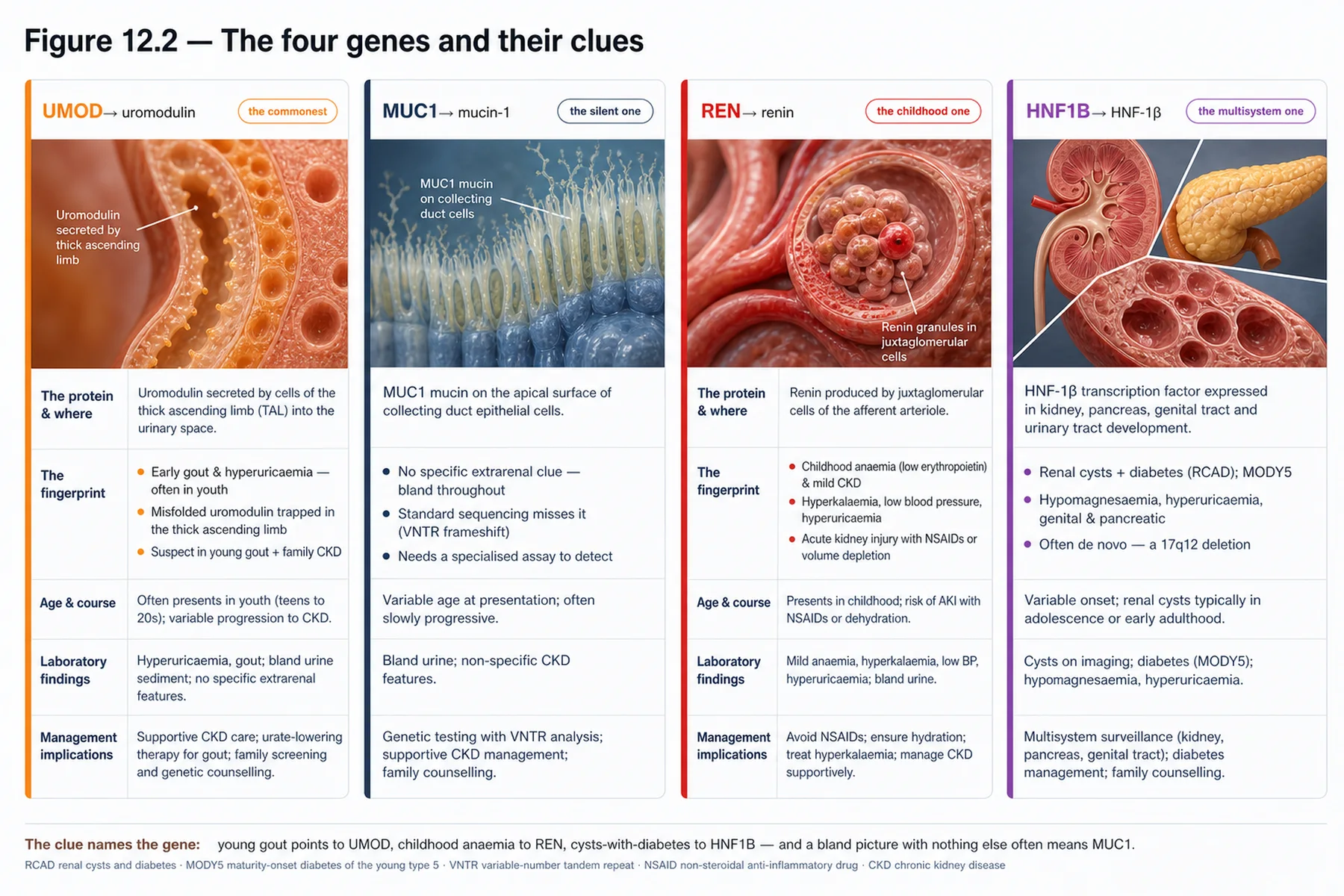
ADTKD-UMOD is the prototype and the one with the most useful clue. The UMOD gene encodes uromodulin (Tamm-Horsfall protein), the most abundant protein in normal urine, made by the cells of the thick ascending limb. In ADTKD-UMOD, a mutation causes the uromodulin to misfold and accumulate within the cell (in the endoplasmic reticulum), causing endoplasmic-reticulum stress and damage to the thick-ascending-limb cells, which drives the tubulointerstitial fibrosis and slow CKD. The hallmark clinical clue is hyperuricaemia and early-onset gout: because uromodulin influences urate handling, ADTKD-UMOD patients develop high urate and gout often in adolescence or young adulthood — out of proportion to their age and kidney function, and frequently preceding the CKD. So a young person with gout and a family history of both gout and kidney disease, with a bland urine and slowly declining function, should prompt the diagnosis of ADTKD-UMOD. This early gout is the most recognisable feature of any ADTKD subtype and is the clue that most often unlocks the diagnosis.
— The other subtypes: MUC1, REN, HNF1B
The other three subtypes complete the group. ADTKD-MUC1 results from a frameshift mutation in the MUC1 gene producing an abnormal mucin-1 protein (a neo-protein) that accumulates and is toxic to the tubular cells, causing a bland, slowly progressive CKD essentially indistinguishable clinically from ADTKD-UMOD except that it lacks the gout and any specific extrarenal feature — and, importantly, it is difficult to detect by standard genetic sequencing, requiring specialised techniques (a practical pitfall, as a 'negative' standard panel does not exclude it). ADTKD-REN results from a defect in the renin gene, and its phenotype reflects renin's roles: childhood anaemia (renin influences erythropoiesis), mild hypotension, hyperkalaemia, hyperuricaemia and gout, and slowly progressive CKD — and these patients tolerate RAAS blockade and NSAIDs poorly. ADTKD-HNF1B is the broadest, a true multisystem disorder: the HNF1B gene affects the development of several organs, so it causes renal cysts and structural/developmental anomalies (overlapping with the congenital anomalies of the next chapter), maturity-onset diabetes of the young (a specific monogenic diabetes), renal magnesium wasting with hypomagnesaemia, hyperuricaemia and gout, and pancreatic, genital, and liver abnormalities — often arising from de novo mutations or deletions (so there may be no family history). So while all four share the bland tubulointerstitial CKD, the extrarenal features distinguish them: gout (UMOD, REN), childhood anaemia and hyperkalaemia (REN), and the cysts-diabetes-hypomagnesaemia constellation (HNF1B).
— Why ADTKD is missed
ADTKD is one of the most frequently missed inherited kidney diseases, and understanding why is the key to not missing it. The problem is that the disease has so few distinguishing features on the standard work-up: the urine is bland (no proteinuria or haematuria to point to a glomerular disease), the kidneys are normal-sized or small with few or no cysts (so imaging does not point to polycystic disease), and the function declines slowly and silently — so the patient is easily labelled with a non-diagnosis like 'CKD of unknown cause,' 'chronic interstitial nephritis,' or even 'hypertensive nephropathy.' The diagnosis is missed because nothing on the routine tests shouts it. The two clues that should rescue it are, first, the autosomal dominant family history — a careful pedigree revealing CKD or kidney failure across generations should always prompt consideration of an inherited cause (the lesson of the opening chapter) — and, second, the gout, especially young-onset gout out of proportion to age and function, which points specifically to ADTKD-UMOD (or REN). A clinician who, faced with unexplained bland-urine CKD, takes a family history and asks about gout will catch many cases that would otherwise be filed under 'unknown cause.' The lesson is that ADTKD is missed not because it is rare but because it is quiet — and the family history and gout are the questions that find it.
— Diagnosis, treatment, and the lesson
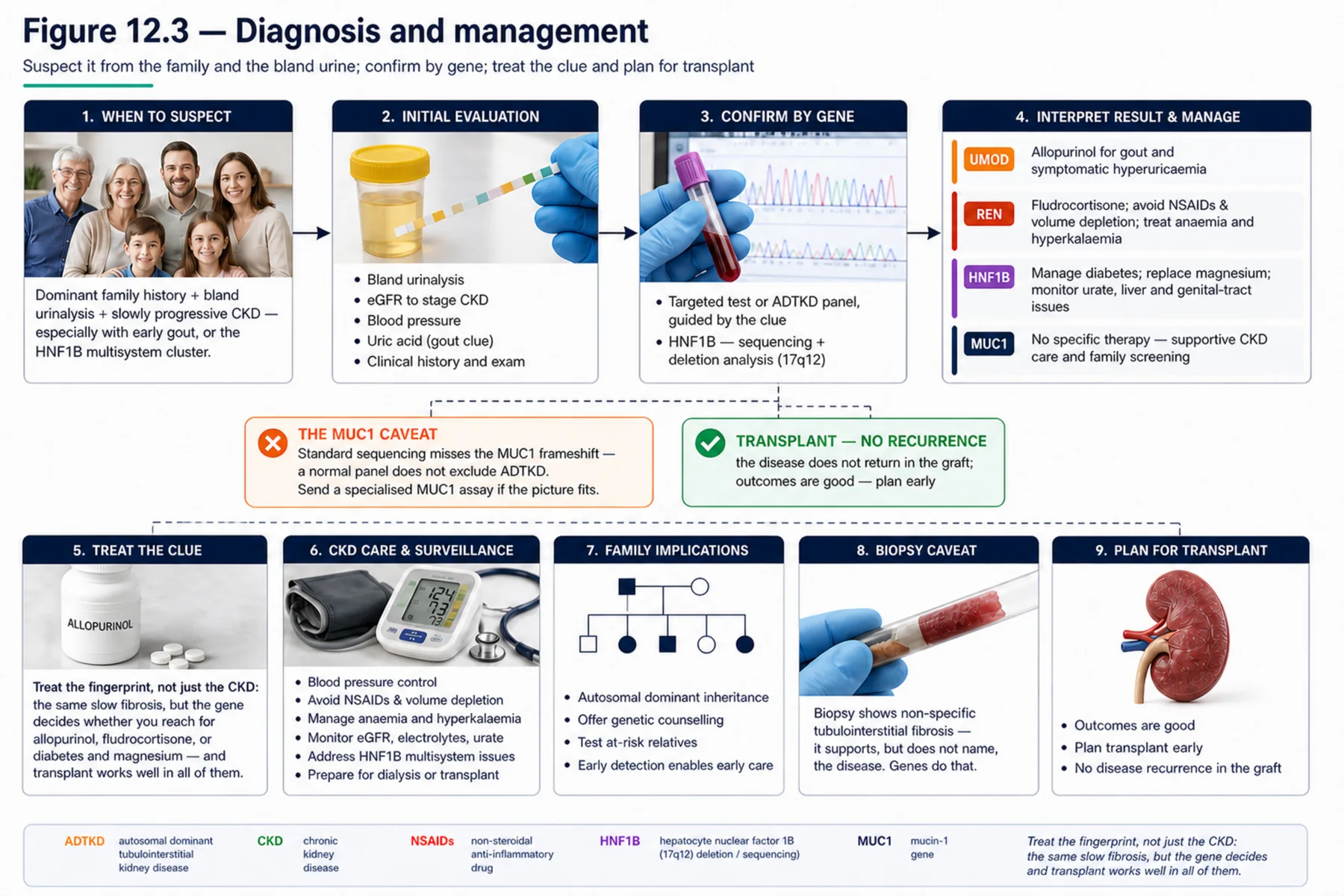
Because ADTKD is quiet and nonspecific, its diagnosis rests on genetic testing rather than biopsy. A kidney biopsy in ADTKD shows only nonspecific tubulointerstitial fibrosis — not diagnostic by itself, and the same picture as many other causes of chronic tubulointerstitial disease (though uromodulin immunostaining can suggest the UMOD subtype) — so biopsy is often repeated unhelpfully. Genetic testing, by contrast, is definitive: it confirms ADTKD and classifies the subtype (UMOD, REN, HNF1B by standard sequencing; MUC1 requiring specialised techniques), and so it is increasingly the first-line diagnostic step, sparing patients repeated nondiagnostic biopsies. Treatment is, for most subtypes, supportive rather than disease-specific: general CKD management, urate-lowering therapy (allopurinol or febuxostat) for the gout, and subtype-specific measures — managing the maturity-onset diabetes and replacing magnesium in HNF1B, managing the anaemia and avoiding RAAS blockade and NSAIDs in REN. RAAS blockade has a limited role overall (the bland urine and absence of proteinuria mean less to gain, and there is particular caution in REN with its hypotension and hyperkalaemia). Transplantation is effective and the disease does not recur, and genetic counselling reflects the autosomal dominant inheritance (a 50% risk to offspring, with cascade screening of relatives). The lesson of the chapter is recognition: ADTKD is a bland, dominant, slowly progressive CKD that is missed for want of a family history and a question about gout — and that is diagnosed not by the biopsy that so often disappoints but by the genetic test that names the subtype. Thinking of it is most of the battle.
| 04 | PHASE A · LEVEL 4 · ORIENTATION & KNOWLEDGE Reference Tables |
Table 12.1 — ADTKD: the common phenotype
| Feature | Detail |
| Pathology | Chronic tubulointerstitial fibrosis (spares the glomerulus) |
| Urine | Bland — little/no proteinuria or haematuria |
| Kidneys | Normal-to-small; few or no cysts (or small medullary cysts) |
| Inheritance / course | Autosomal dominant (family CKD); slowly progressive CKD to ESKD |
Table 12.2 — The four subtypes
| Subtype | Gene / protein | Distinguishing feature |
| ADTKD-UMOD | Uromodulin | Early-onset hyperuricaemia and GOUT (the key clue) |
| ADTKD-MUC1 | Mucin-1 | No gout/extrarenal marker; hard to detect (special techniques) |
| ADTKD-REN | Renin | Childhood anaemia, hypotension, hyperkalaemia, gout |
| ADTKD-HNF1B | HNF1B | Cysts/structural, diabetes (MODY), hypomagnesaemia; often de novo |
Table 12.3 — ADTKD-UMOD and gout
| Aspect | Detail |
| Protein | Uromodulin (Tamm-Horsfall) — made by the thick ascending limb |
| Mechanism | Mutant uromodulin misfolds → ER stress → tubular damage → fibrosis |
| Hallmark | Hyperuricaemia + early gout (adolescence/young adult), often preceding CKD |
| Why | Uromodulin influences urate handling |
Table 12.4 — Clinical clues to the subtypes
| Clue | Subtype |
| Young-onset gout + family CKD | ADTKD-UMOD (or REN) |
| Childhood anaemia, hyperkalaemia, hypotension | ADTKD-REN |
| Cysts + diabetes + hypomagnesaemia + structural anomalies | ADTKD-HNF1B |
| Bland CKD, no gout, no extrarenal marker | ADTKD-MUC1 (consider; hard to detect) |
Table 12.5 — Why ADTKD is missed, and diagnosis
| Point | Detail |
| Why missed | Bland urine + nonspecific picture → 'CKD of unknown cause'/'interstitial nephritis' |
| The clues | Autosomal dominant family history; gout (UMOD/REN) |
| Biopsy | Nonspecific tubulointerstitial fibrosis — not diagnostic alone |
| Definitive | Genetic testing (classifies subtype; MUC1 needs special techniques) — first-line |
Table 12.6 — Management
| Element | Detail |
| General | Supportive CKD management; no disease-specific therapy for most |
| Gout | Urate-lowering (allopurinol/febuxostat) |
| Subtype-specific | HNF1B: manage diabetes, replace magnesium; REN: anaemia, avoid RAAS blockade/NSAIDs |
| Transplant / counselling | Does not recur; autosomal dominant counselling (50% offspring) |
| 05 | PHASE B · LEVEL 5 · VISUALISE & MAP Imaging & Flowchart Specifications |
| 06 | PHASE B · LEVEL 6 · VISUALISE & MAP Concept Maps |
Each chain runs from mechanism to a named clinical insight; read the arrows as “leads to.”
ADTKD overview. Dominant tubulointerstitial fibrosis (glomerulus spared) → bland urine, few cysts, slow CKD → a quiet, mislabelled disease → ACTION: suspect ADTKD in dominant, bland-urine, slowly progressive CKD.
ADTKD-UMOD / gout. Mutant uromodulin misfolds → ER stress in the thick ascending limb → fibrosis + (via urate handling) early gout → ACTION: ask about young-onset gout — the key clue to ADTKD-UMOD.
The subtypes. UMOD (gout), MUC1 (no marker, hard to detect), REN (anaemia/hyperkalaemia/hypotension/gout), HNF1B (cysts/diabetes/hypomagnesaemia) → ACTION: use the extrarenal features to identify the subtype.
Why missed. Bland urine + nonspecific picture → 'CKD of unknown cause' → the dominant family history and gout are the rescuing clues → ACTION: take a pedigree and ask about gout in unexplained bland CKD.
Diagnosis. Biopsy nonspecific → genetic testing definitive (classifies subtype) → ACTION: pursue genetics, not repeated biopsies.
| 07 | PHASE B · LEVEL 7 · VISUALISE & MAP Decision Pathways |
| R1 | IF a patient has slowly progressive CKD with a bland urine, normal-to-small kidneys, few/no cysts, and a dominant family history, THEN suspect ADTKD. |
| R2 | IF there is young-onset gout out of proportion to age and function, THEN consider ADTKD-UMOD (or REN). |
| R3 | IF there is childhood anaemia, hyperkalaemia, and mild hypotension, THEN consider ADTKD-REN — and avoid RAAS blockade and NSAIDs. |
| R4 | IF there are renal cysts/structural anomalies, diabetes, and hypomagnesaemia, THEN consider ADTKD-HNF1B (often de novo). |
| R5 | IF the picture is bland CKD with no gout or extrarenal marker, THEN consider ADTKD-MUC1 — which requires specialised genetic techniques to detect. |
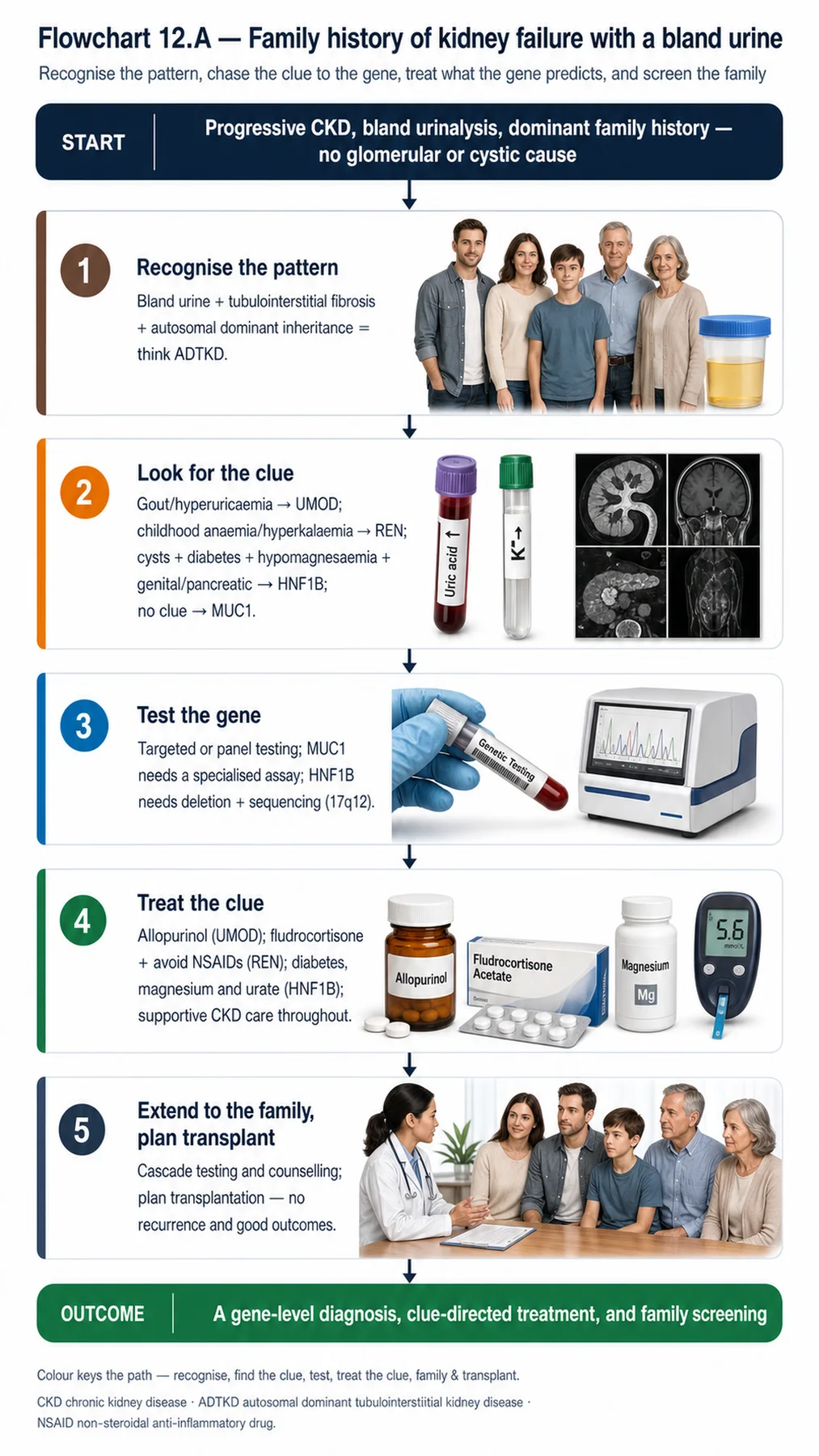
| R6 | IF unexplained bland-urine CKD is encountered, THEN take a three-generation family history and ask about gout — the clues that rescue ADTKD. |
| R7 | IF ADTKD is suspected, THEN pursue genetic testing rather than relying on the nonspecific biopsy. |
| R8 | IF ADTKD is confirmed, THEN manage supportively (CKD care, urate-lowering, subtype-specific measures), plan transplantation (no recurrence), and counsel the family. |
| 08 | PHASE C · LEVEL 8 · CLINICAL REASONING Clinical Cases |
| CASE 1 | CKD OF 'UNKNOWN CAUSE' A quiet, dominant disease Suspecting ADTKD |
Presentation
A patient with slowly progressive CKD has a bland urine, normal-to-small kidneys with no cysts, and the label 'CKD of unknown cause.' On enquiry, a parent and a sibling also have kidney disease.
❖ Pause and reflect Is 'CKD of unknown cause' the right label here? |
Analysis
Probably not — the dominant family history and bland-urine picture point to ADTKD, a disease that hides behind exactly this label. The combination is the ADTKD signature: slowly progressive CKD, a bland urine (no proteinuria or haematuria, because the glomerulus is spared), normal-to-small kidneys with few or no cysts (so imaging is unrevealing), and — the crucial clue — an autosomal dominant family history (a parent and sibling affected). ADTKD is missed precisely because nothing on the routine work-up shouts a diagnosis, so it gets filed as 'CKD of unknown cause' or 'chronic interstitial nephritis.' The family history should rescue it: a dominant pattern of CKD across generations always warrants consideration of an inherited cause. The next steps are to ask specifically about gout (pointing to UMOD or REN) and to pursue genetic testing, which is definitive.
Plan
Reconsider the 'unknown cause' label, take a detailed family history (confirming the dominant pattern), ask about gout, and pursue genetic testing for ADTKD. Suspect ADTKD in dominant, bland-urine, slowly progressive CKD.
Teaching point
ADTKD hides behind 'CKD of unknown cause' — a dominant family history with a bland urine and few cysts should prompt the diagnosis and genetic testing.
Cross-reference
Exercises rules R1 and R6; the ADTKD-overview and why-missed concept maps; Figure 12.1; Tables 12.1, 12.5; the pedigree principle in Chapter 1.
| CASE 2 | GOUT BEFORE THE KIDNEYS The UMOD clue ADTKD-UMOD |
Presentation
A young adult has had recurrent gout since adolescence, out of proportion to any obvious cause, and is now found to have early CKD with a bland urine; several relatives have both gout and kidney disease.
❖ Pause and reflect What links the early gout, the bland CKD, and the family history? |
Analysis
ADTKD-UMOD — the early gout is the tell-tale clue. In ADTKD-UMOD, a mutation causes uromodulin (made by the thick ascending limb) to misfold and accumulate, causing endoplasmic-reticulum stress and tubular damage that drives the tubulointerstitial fibrosis and slow CKD; and because uromodulin influences urate handling, these patients develop hyperuricaemia and early-onset gout, often in adolescence or young adulthood, out of proportion to their age and kidney function and frequently preceding the CKD. So the combination here — young-onset gout, early bland CKD, and a family history of both gout and kidney disease across generations — is classic ADTKD-UMOD. The early, disproportionate gout is the most recognisable feature of any ADTKD subtype and is the clue that most often makes the diagnosis. Genetic testing of UMOD confirms it.
Plan
Recognise the likely ADTKD-UMOD from the early-onset gout, bland CKD, and dominant family history of gout and kidney disease; confirm by UMOD genetic testing, give urate-lowering therapy, and manage the CKD. Young-onset gout with family CKD points to ADTKD-UMOD.
Teaching point
Early-onset gout out of proportion, with bland CKD and a dominant family history, is the hallmark of ADTKD-UMOD — the gout is the key clue.
Cross-reference
Exercises rules R2 and R7; the ADTKD-UMOD concept map; Figure 12.2; Tables 12.2, 12.3, 12.4.
| CASE 3 | MORE THAN THE KIDNEY The multisystem subtype ADTKD-HNF1B |
Presentation
A young patient has CKD with a few renal cysts and some structural renal anomalies, maturity-onset diabetes, and a low magnesium, with no clear family history.
❖ Pause and reflect What ADTKD subtype unites cysts, diabetes, and hypomagnesaemia? |
Analysis
ADTKD-HNF1B — the multisystem subtype. The HNF1B gene affects the development of several organs, so its disease is the broadest of the ADTKD subtypes: it causes renal cysts and structural/developmental anomalies (overlapping with the congenital anomalies of the kidney and urinary tract), maturity-onset diabetes of the young (a specific monogenic diabetes), renal magnesium wasting with hypomagnesaemia, hyperuricaemia and gout, and pancreatic, genital, and liver abnormalities. This patient's combination — CKD with cysts and structural anomalies, maturity-onset diabetes, and a low magnesium — is characteristic of HNF1B. The absence of a clear family history does not argue against it, because ADTKD-HNF1B frequently arises from de novo mutations or deletions (a negative family history is common). So the multisystem constellation, not the family history, makes the diagnosis here, which genetic testing of HNF1B confirms — with implications for managing the diabetes and replacing the magnesium.
Plan
Diagnose ADTKD-HNF1B from the cysts/structural anomalies, maturity-onset diabetes, and hypomagnesaemia (recognising de novo mutations explain the absent family history); confirm genetically, manage the diabetes and magnesium, and counsel. Recognise the HNF1B multisystem constellation.
Teaching point
ADTKD-HNF1B is multisystem — renal cysts/structural anomalies, maturity-onset diabetes, and hypomagnesaemia, often de novo (so the family history may be negative).
Cross-reference
Exercises rule R4; the subtypes concept map; Figure 12.3; Tables 12.2, 12.4; CAKUT in Chapter 15.
| CASE 4 | STOP BIOPSYING, START SEQUENCING Genetics is definitive Diagnosing ADTKD |
Presentation
A patient with suspected ADTKD has had a kidney biopsy showing only nonspecific tubulointerstitial fibrosis, and a clinician proposes repeating the biopsy to clarify the diagnosis.
❖ Pause and reflect Will repeating the biopsy clarify the diagnosis? |
Analysis
No — repeating the biopsy will not help, because the biopsy in ADTKD shows only nonspecific tubulointerstitial fibrosis, which is not diagnostic by itself and looks the same as many other causes of chronic tubulointerstitial disease. The definitive test is genetic testing: it confirms ADTKD and classifies the subtype (UMOD, REN, HNF1B by standard sequencing; MUC1 requiring specialised techniques, so a standard negative panel does not exclude MUC1), and it does so non-invasively. So rather than subjecting the patient to a repeat biopsy that will again show only fibrosis, the clinician should pursue genetic testing, which is increasingly the first-line diagnostic step in suspected ADTKD precisely to spare patients repeated nondiagnostic biopsies. The lesson is that ADTKD is a genetic diagnosis, not a histological one — the biopsy disappoints, the genetic test delivers.
Plan
Do not repeat the biopsy; pursue genetic testing (remembering MUC1 needs specialised techniques), which confirms ADTKD and classifies the subtype non-invasively. Diagnose ADTKD by genetics, not repeated biopsy.
Teaching point
ADTKD biopsy shows only nonspecific tubulointerstitial fibrosis — genetic testing is definitive and classifies the subtype, sparing repeated nondiagnostic biopsies.
Cross-reference
Exercises rules R5 and R7; the diagnosis concept map; Table 12.5; the role of biopsy in Chapter 3.
| 09 | PHASE C · LEVEL 9 · CLINICAL REASONING Clinical Implications |
One triad per mechanism the narrative exposed: the physiology, why it matters, and the clinical move.
MECHANISM ADTKD causes dominant tubulointerstitial fibrosis that spares the glomerulus. |
WHY IT MATTERS The urine is bland and the kidneys unremarkable, so the disease is easily missed. |
ACTION Suspect ADTKD in dominant, bland-urine, slowly progressive CKD. |
MECHANISM Mutant uromodulin misfolds and damages the thick ascending limb, and affects urate handling. |
WHY IT MATTERS It causes early gout, often before the CKD — the tell-tale clue. |
ACTION Ask about young-onset gout to catch ADTKD-UMOD. |
MECHANISM Each ADTKD gene has its own extrarenal features. |
WHY IT MATTERS These distinguish the subtypes (gout, anaemia, diabetes, hypomagnesaemia). |
ACTION Use the extrarenal features to identify the subtype. |
MECHANISM ADTKD is quiet and nonspecific on routine work-up. |
WHY IT MATTERS It is mislabelled 'CKD of unknown cause' for want of the clues. |
ACTION Take a family history and ask about gout in unexplained bland CKD. |
MECHANISM The biopsy in ADTKD shows only nonspecific tubulointerstitial fibrosis. |
WHY IT MATTERS It is not diagnostic, and repeating it does not help. |
ACTION Diagnose ADTKD by genetic testing, not repeated biopsy. |
| 10 | PHASE C · LEVEL 10 · CLINICAL REASONING Clinical Pearls |
| ADTKD = dominant tubulointerstitial fibrosis → bland-urine, slowly progressive CKD. | Bland urine (no proteinuria/haematuria), normal-to-small kidneys, few/no cysts. |
| Classified by gene: UMOD, MUC1, REN, HNF1B. | ADTKD-UMOD: misfolded uromodulin → ER stress → tubular damage. |
| ADTKD-UMOD hallmark: early-onset GOUT (often before the CKD). | ADTKD-MUC1: abnormal mucin-1; no gout/marker; HARD to detect (special techniques). |
| ADTKD-REN: childhood anaemia, hyperkalaemia, hypotension, gout. | ADTKD-HNF1B: cysts/structural, diabetes (MODY), hypomagnesaemia; often de novo. |
| Common feature: autosomal dominant family history of CKD. | Often MISSED — mislabelled 'CKD of unknown cause' / 'interstitial nephritis'. |
| The rescuing clues: dominant family history + gout. | Biopsy: nonspecific tubulointerstitial fibrosis — NOT diagnostic alone. |
| Genetic testing is DEFINITIVE (classifies subtype) — first-line. | No disease-specific treatment for most — supportive CKD care + urate-lowering. |
| Subtype-specific: diabetes/magnesium (HNF1B); anaemia, avoid RAAS/NSAIDs (REN). | Transplant doesn't recur; dominant counselling (50% offspring). |
| 11 | PHASE D · LEVEL 11 · SAFETY & EVIDENCE Red Flags & Never-Do |
Panel A — Red flags
| ▲ | 'CKD of unknown cause' with a dominant family history and bland urine — consider ADTKD. |
| ▲ | Young-onset gout out of proportion with bland CKD — ADTKD-UMOD (or REN). |
| ▲ | Cysts + diabetes + hypomagnesaemia — ADTKD-HNF1B (often de novo, so family history may be negative). |
| ▲ | Childhood anaemia, hyperkalaemia, hypotension — ADTKD-REN; avoid RAAS blockade/NSAIDs. |
| ▲ | Repeated nondiagnostic biopsies for bland tubulointerstitial CKD — do genetic testing instead. |
Panel B — Never do
| ✖ NEVER — settle for 'CKD of unknown cause' without a family history and a gout enquiry. |
| ✖ NEVER — rely on biopsy alone to diagnose ADTKD — it is nonspecific. |
| ✖ NEVER — exclude ADTKD-MUC1 on a standard negative panel — it needs special techniques. |
| ✖ NEVER — assume a negative family history excludes ADTKD-HNF1B (often de novo). |
| 12 | PHASE D · LEVEL 12 · SAFETY & EVIDENCE Common Pitfalls |
Pitfall 1 — The 'unknown cause' label
| ✖ | WRONG Accepting 'CKD of unknown cause' for a dominant bland-urine CKD. |
| ✓ | RIGHT Considering ADTKD and pursuing the diagnosis. |
| ✉ | WHY ADTKD is quiet and routinely mislabelled. |
Pitfall 2 — Missing the gout clue
| ✖ | WRONG Not asking about gout in unexplained bland CKD. |
| ✓ | RIGHT Asking about young-onset gout (the UMOD/REN clue). |
| ✉ | WHY Early gout is the most recognisable ADTKD feature. |
Pitfall 3 — Repeating the biopsy
| ✖ | WRONG Repeating a nondiagnostic biopsy to clarify ADTKD. |
| ✓ | RIGHT Pursuing genetic testing (definitive). |
| ✉ | WHY The biopsy shows only nonspecific fibrosis. |
Pitfall 4 — Trusting a negative MUC1 panel
| ✖ | WRONG Excluding ADTKD-MUC1 on a standard negative panel. |
| ✓ | RIGHT Using specialised techniques for MUC1. |
| ✉ | WHY MUC1 is difficult to detect by standard sequencing. |
Pitfall 5 — RAAS blockade in REN
| ✖ | WRONG Using RAAS blockade and NSAIDs freely in ADTKD-REN. |
| ✓ | RIGHT Avoiding them (hypotension, hyperkalaemia). |
| ✉ | WHY The renin defect makes these poorly tolerated. |
| 13 | PHASE D · LEVEL 13 · SAFETY & EVIDENCE Evidence Grading |
GRADE A HIGH CONFIDENCE The effect is real and the estimate is stable. RCTs at low risk of bias; multiple concordant prospective cohorts; meta-analyses. |
GRADE B MODERATE CONFIDENCE The effect is likely real but may shift with new data. Observational studies, registries, mechanistic human studies. |
GRADE C LOW CONFIDENCE Rests on physiology, reasoning, or consensus rather than outcomes. Pathophysiological reasoning; extrapolation; consensus without outcomes. |
Graded statements (by evidence type)
| Statement | Grade | Basis (evidence type) |
| ADTKD is a dominant, bland-urine, slowly progressive tubulointerstitial CKD. | A | Clinical and genetic data |
| ADTKD-UMOD is associated with early-onset gout. | A | Clinical cohort data |
| ADTKD-MUC1 is difficult to detect by standard sequencing. | A | Molecular data |
| ADTKD-HNF1B is multisystem and frequently de novo. | A | Clinical genetics |
| ADTKD is frequently mislabelled 'CKD of unknown cause'. | A | Clinical experience and registries |
| Biopsy shows nonspecific tubulointerstitial fibrosis, not diagnostic alone. | A | Histopathology |
| Genetic testing is the definitive diagnosis. | A | Molecular genetics and guidelines |
| 18 | PHASE F · LEVEL 18 · APPLY & TEST Cheat Sheet |
| ADTKD = dominant tubulointerstitial fibrosis → bland-urine slow CKD. | Bland urine, normal-to-small kidneys, few/no cysts. |
| Genes: UMOD, MUC1, REN, HNF1B. | UMOD: misfolded uromodulin → ER stress; hallmark = early GOUT. |
| MUC1: abnormal mucin; no marker; hard to detect (special techniques). | REN: childhood anaemia, hyperkalaemia, hypotension, gout. |
| HNF1B: cysts/structural + diabetes (MODY) + hypomagnesaemia; often de novo. | Common: autosomal dominant family history of CKD. |
| Often MISSED — 'CKD of unknown cause'. | Rescuing clues: dominant family history + gout. |
| Biopsy: nonspecific tubulointerstitial fibrosis (not diagnostic alone). | Genetics = definitive (classifies subtype) — first-line. |
| Don't exclude MUC1 on a standard negative panel. | No disease-specific Rx — supportive + urate-lowering. |
| REN: avoid RAAS blockade/NSAIDs; HNF1B: manage diabetes/magnesium. | Transplant doesn't recur; dominant counselling. |
| 19 | PHASE F · LEVEL 19 · APPLY & TEST Flashcards |
| CARD 1 | Q. What is ADTKD? A. Autosomal dominant tubulointerstitial kidney disease — a group of dominant diseases causing chronic tubulointerstitial fibrosis and slowly progressive CKD, with a characteristically bland urine (little proteinuria or haematuria), few or no cysts, and normal-to-small kidneys, classified by the gene (UMOD, MUC1, REN, HNF1B). DETAILED. The glomerulus is spared, so the urine is bland. CLINICAL. Suspect ADTKD in dominant, bland-urine, slowly progressive CKD. |
| CARD 2 | Q. What is the mechanism and hallmark of ADTKD-UMOD? A. A UMOD mutation causes uromodulin (made by the thick ascending limb) to misfold and accumulate, causing endoplasmic-reticulum stress and tubular damage that drives fibrosis; its hallmark is early-onset hyperuricaemia and gout (because uromodulin influences urate handling), often preceding the CKD. DETAILED. The early gout is the tell-tale clue. CLINICAL. Ask about young-onset gout to catch ADTKD-UMOD. |
| CARD 3 | Q. What characterises ADTKD-MUC1? A. A frameshift in MUC1 produces an abnormal, toxic mucin-1 protein causing a bland slowly progressive CKD with no gout or specific extrarenal marker — and it is difficult to detect by standard genetic sequencing, requiring specialised techniques (so a standard negative panel does not exclude it). DETAILED. It is the 'featureless' subtype. CLINICAL. Consider MUC1 even when standard sequencing is negative. |
| CARD 4 | Q. What characterises ADTKD-REN and ADTKD-HNF1B? A. ADTKD-REN (renin defect): childhood anaemia, mild hypotension, hyperkalaemia, gout, and poor tolerance of RAAS blockade and NSAIDs. ADTKD-HNF1B: a multisystem disorder with renal cysts and structural anomalies, maturity-onset diabetes of the young, hypomagnesaemia, and gout, often arising de novo. DETAILED. Their extrarenal features distinguish them. CLINICAL. Use the extrarenal features to identify the subtype. |
| CARD 5 | Q. Why is ADTKD so frequently missed? A. Because it is quiet — a bland urine (no proteinuria or haematuria), normal-to-small kidneys with few or no cysts, and a slow, silent decline — so nothing on the routine work-up points to it, and it is mislabelled 'CKD of unknown cause' or 'chronic interstitial nephritis.' DETAILED. The dominant family history and gout are the rescuing clues. CLINICAL. Take a family history and ask about gout in unexplained bland CKD. |
| CARD 6 | Q. Why is genetic testing, not biopsy, the diagnosis in ADTKD? A. Because the biopsy shows only nonspecific tubulointerstitial fibrosis — the same as many other causes and not diagnostic by itself — whereas genetic testing confirms ADTKD and classifies the subtype non-invasively, sparing repeated nondiagnostic biopsies. DETAILED. MUC1 needs specialised techniques. CLINICAL. Pursue genetic testing rather than repeating the biopsy. |
| CARD 7 | Q. How is ADTKD managed? A. For most subtypes there is no disease-specific therapy — management is supportive CKD care and urate-lowering for gout — with subtype-specific measures (managing diabetes and replacing magnesium in HNF1B; managing anaemia and avoiding RAAS blockade and NSAIDs in REN); transplantation does not recur, and counselling reflects the autosomal dominant inheritance. DETAILED. It is mostly supportive. CLINICAL. Manage supportively, treat the gout, and address subtype-specific features. |
| CARD 8 | Q. What is the practical lesson of ADTKD? A. That it is missed not because it is rare but because it is quiet — a bland, dominant, slowly progressive CKD — and that thinking of it (taking a family history, asking about gout) and confirming it by genetic testing rather than the disappointing biopsy is most of the diagnostic battle. DETAILED. Recognition is the key. CLINICAL. Think of ADTKD and confirm it genetically. |
| 20 | PHASE F · LEVEL 20 · APPLY & TEST One-Minute Preceptor |
| SCENE 1 | The intern accepting 'unknown cause' |
GET A COMMITMENT. “You've called this 'CKD of unknown cause' — but a parent and sibling have kidney disease and the urine is bland. Confident?”
PROBE FOR EVIDENCE. “Nothing points to a cause” — ask: “What does a dominant family history with a bland urine and few cysts suggest, and have you asked about gout?”
TEACH A GENERAL RULE. Dominant, bland-urine, slowly progressive CKD is ADTKD until proven otherwise — it hides behind 'unknown cause'; take a family history, ask about gout, and test genetically.
REINFORCE WHAT WAS RIGHT. Recognising the bland urine was a good observation.
CORRECT A MISTAKE. Pursue ADTKD with a pedigree, a gout enquiry, and genetic testing.
| SCENE 2 | The resident repeating the biopsy |
GET A COMMITMENT. “The first biopsy showed only nonspecific fibrosis, and you want to repeat it — why?”
PROBE FOR EVIDENCE. “To clarify the diagnosis” — ask: “What does the ADTKD biopsy ever show, and what test is actually definitive?”
TEACH A GENERAL RULE. The ADTKD biopsy shows only nonspecific tubulointerstitial fibrosis, so repeating it won't help — genetic testing is definitive and classifies the subtype; remember MUC1 needs special techniques.
REINFORCE WHAT WAS RIGHT. Wanting a definitive diagnosis was right.
CORRECT A MISTAKE. Do genetic testing instead of another biopsy.
| 22 | PHASE F · LEVEL 22 · APPLY & TEST Board-Style Questions |
| Q 01 | ADTKD characteristically presents with: |
| A | Heavy proteinuria and haematuria |
| B | A bland urine, few/no cysts, and slowly progressive CKD with a dominant family history |
| C | Massively enlarged kidneys |
| D | Nephrotic syndrome |
Rationale ADTKD is a bland-urine, dominant, slowly progressive tubulointerstitial CKD (case 1, Figure 12.1, Table 12.1). A, C, and D are other diseases. |
| Q 02 | The hallmark clinical clue of ADTKD-UMOD is: |
| A | Heavy proteinuria |
| B | Early-onset gout (often preceding the CKD) |
| C | Massive cysts |
| D | Deafness |
Rationale Misfolded uromodulin affects urate handling, causing early gout (case 2, Figure 12.2, Table 12.3). A, C, and D point elsewhere. |
| Q 03 | ADTKD-MUC1 is notable because it: |
| A | Causes gout |
| B | Is difficult to detect by standard sequencing (needs special techniques) |
| C | Has massive cysts |
| D | Causes deafness |
Rationale MUC1 requires specialised techniques; a standard negative panel doesn't exclude it (Table 12.2, rule R5). A, C, and D are wrong. |
| Q 04 | Which ADTKD subtype is multisystem with cysts, diabetes, and hypomagnesaemia? |
| A | ADTKD-UMOD |
| B | ADTKD-HNF1B |
| C | ADTKD-MUC1 |
| D | ADTKD-REN |
Rationale HNF1B causes cysts/structural anomalies, MODY diabetes, and hypomagnesaemia, often de novo (case 3, Table 12.2). A, C, and D differ. |
| Q 05 | Why is ADTKD frequently missed? |
| A | It causes dramatic symptoms |
| B | It is quiet — bland urine, few cysts, slow decline — and mislabelled 'CKD of unknown cause' |
| C | It only affects children |
| D | It is untreatable |
Rationale Its quiet, nonspecific picture leads to mislabelling (case 1, Table 12.5). A, C, and D are incorrect. |
| Q 06 | The two clues that should rescue an ADTKD diagnosis are: |
| A | Proteinuria and oedema |
| B | An autosomal dominant family history and gout |
| C | Hypertension and stones |
| D | Fever and rash |
Rationale The dominant family history and gout are the rescuing clues (Table 12.5, rule R6). A, C, and D are not. |
| Q 07 | The definitive diagnostic test for ADTKD is: |
| A | Repeat kidney biopsy |
| B | Genetic testing (classifies the subtype) |
| C | Renal ultrasound |
| D | Urine protein |
Rationale Biopsy is nonspecific; genetics is definitive (case 4, Table 12.5, rule R7). A, C, and D are not definitive. |
| Q 08 | Which drugs are poorly tolerated in ADTKD-REN? |
| A | Urate-lowering agents |
| B | RAAS blockade and NSAIDs |
| C | Magnesium supplements |
| D | Vitamin D |
Rationale The renin defect (with hypotension and hyperkalaemia) makes RAAS blockade and NSAIDs poorly tolerated (Table 12.6, rule R3). A, C, and D are not the issue. |