Chapter Preamble
Signals declared
Sig-D — Diagnostic (primary). Choose the testing modality, understand the diagnostic yield, and interpret results — including the variant of uncertain significance.
Sig-T — Therapeutic (strong). Deliver the counselling process — pre-test, disclosure, post-test — and arrange cascade testing of relatives.
Sig-E — Preference-sensitive (strong). Whether to test, whom to test, and when — especially predictive and reproductive testing — are values-driven decisions requiring consent and shared decision-making.
Levels populated and omitted
Populated (20): L1–L5, L7, L8, L10–L22. The preference signal fires the absolute-risk table (L14), the preference-sensitive map (L15), the shared-decision scripts (L16), and the reflective prompts (L21); the therapeutic signal fires the templates (L17); the diagnostic signal drives the tables, rules, cases, pitfalls, and board items.
L6 / L9 mechanism levels — omitted. No Sig-M; this is a testing, counselling, and decision chapter, not a mechanism one.
| 01 | PHASE A · LEVEL 1 · ORIENTATION & KNOWLEDGE Learning Objectives |
By the end of this chapter you should be able to:
Describe the genetic testing modalities and when each is used.
State the diagnostic yield of testing in selected nephrology populations.
Interpret a genetic result, including the variant of uncertain significance.
Outline the genetic counselling process — pre-test, disclosure, post-test.
Arrange cascade testing of at-risk relatives.
Explain why the decision to test is often preference-sensitive.
Approach predictive testing of asymptomatic relatives and of children.
Conduct a shared decision about testing with informed consent.
| 02 | PHASE A · LEVEL 2 · ORIENTATION & KNOWLEDGE Executive Summary |
Genetic testing in nephrology uses targeted single-gene tests, gene panels (the current workhorse), exome or genome sequencing, chromosomal microarray, and specific biochemical assays.
The diagnostic yield is substantial in selected populations — young-onset, familial, or unexplained kidney disease — and is improved by deep phenotyping and family segregation.
Results are classified from pathogenic to benign, and the variant of uncertain significance is the major interpretive challenge, resolved over time by phenotype correlation, family segregation, and reanalysis.
A negative test does not exclude a genetic cause, and secondary or incidental findings may arise.
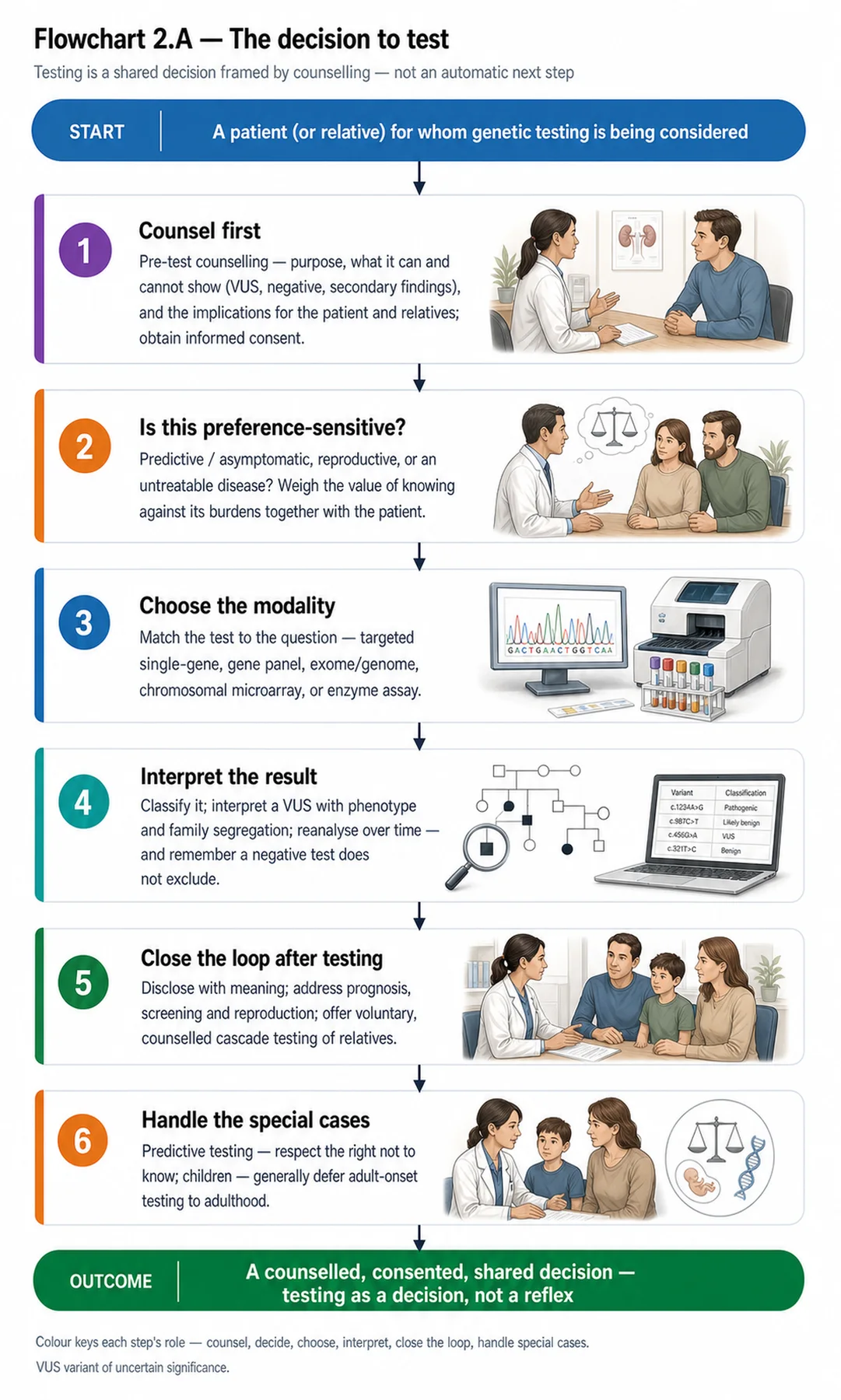
Genetic counselling frames the whole process: pre-test counselling explains what the test can and cannot show, its implications for the patient and relatives, and obtains informed consent; results are disclosed with their meaning; and post-test counselling addresses prognosis, screening, reproduction, and family testing.
After a diagnosis, cascade testing is offered to at-risk relatives, enabling their early diagnosis and monitoring.
Crucially, whether to undergo testing at all is often a preference-sensitive decision — weighing the value of a diagnosis (prognosis, targeted therapy, family information) against the burdens (anxiety, insurance and employment implications, the uncertainty of a variant of uncertain significance, and learning about an untreatable disease).
Predictive (presymptomatic) testing of an asymptomatic at-risk relative is especially values-driven, respecting the individual's right not to know.
Testing of children is generally deferred until they can decide for themselves, unless the disease is childhood-onset or actionable.
Reproductive testing decisions are deeply personal and values-driven.
So the decision to test, whom to test, and when must be shared, with informed consent and counselling, and the autonomy of the patient and family kept central.
Genetic testing is powerful, but it is a decision as much as a test.
| 03 | PHASE A · LEVEL 3 · ORIENTATION & KNOWLEDGE Main Narrative |
Genetic testing has transformed nephrology — a panel or an exome can now name the disease that a pedigree only suggested. But a genetic test is not like a creatinine: it carries implications that ripple through a family and across a lifetime, it can return an uninterpretable variant, and the decision to do it is often as much about values as about medicine. This chapter covers the modalities and their yield, the interpretation of results, the counselling that frames the whole process, and the genuinely preference-sensitive decision of whether, whom, and when to test.
— The testing modalities
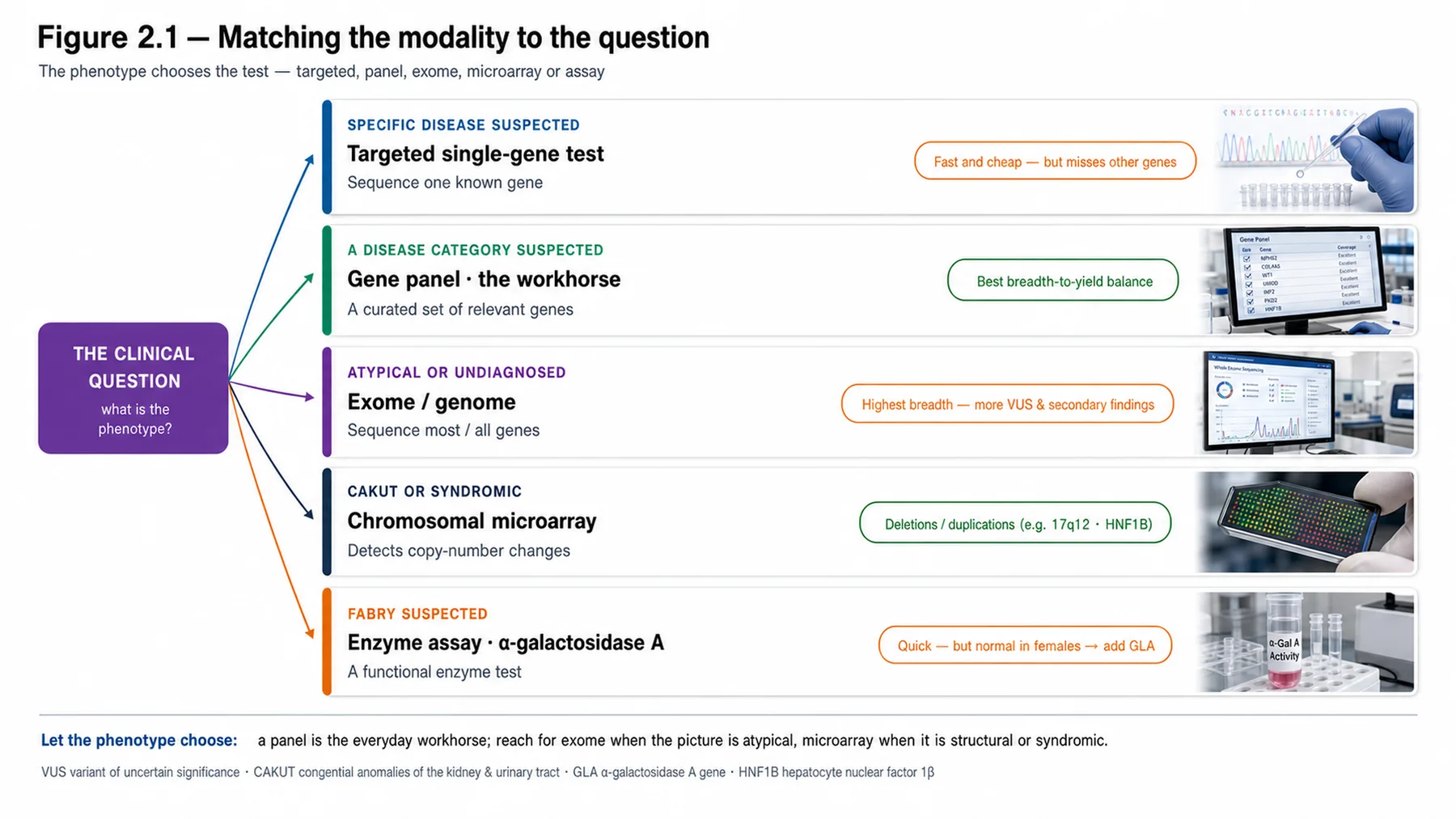
Several modalities are available, chosen by the clinical question. Targeted single-gene testing is used when a specific disease is strongly suspected — testing PKD1 and PKD2 for ADPKD, for example. Gene panels — testing many kidney-disease genes at once — are the current workhorse: they give a high diagnostic yield at reasonable cost and suit most cases where the category is suspected but the precise gene is not. Exome or genome sequencing is broader, reserved for atypical or undiagnosed cases where a panel is unrevealing, and it can uncover unexpected diagnoses (at the cost of more variants of uncertain significance and possible secondary findings). Chromosomal microarray detects copy-number changes and suits congenital anomalies and syndromic presentations. And specific biochemical or enzyme assays remain important — the alpha-galactosidase A assay for Fabry disease, for instance. The choice is guided by the phenotype: a strongly suspected single disease invites a targeted test, a suspected category invites a panel, and an atypical or undiagnosed presentation invites exome sequencing. Matching the modality to the question is the first practical skill.
— Diagnostic yield and interpreting results
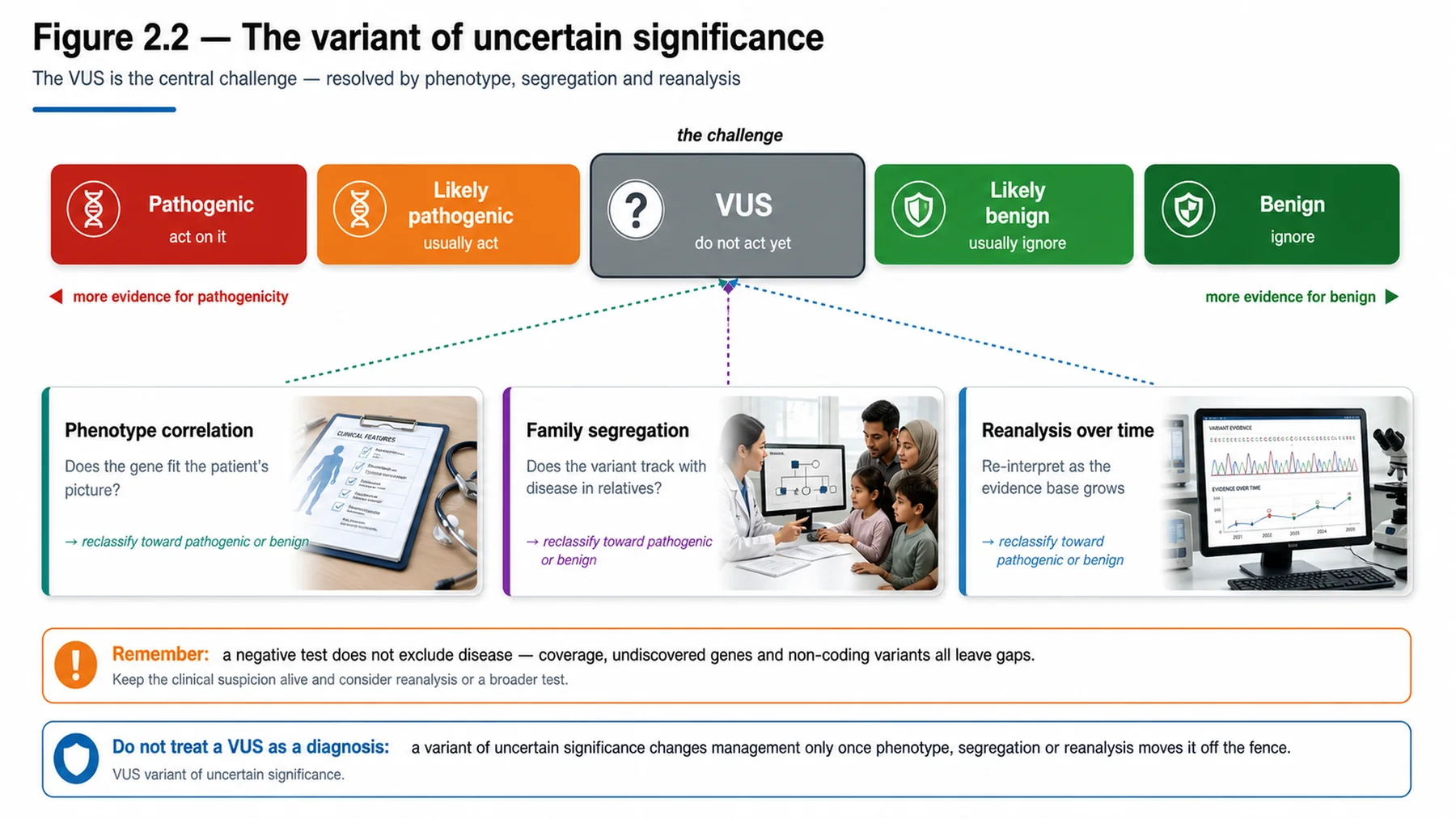
Genetic testing has a substantial diagnostic yield in the right population — young-onset, familial, or unexplained kidney disease, and suspected genetic disease — where a panel or exome provides a molecular diagnosis in a meaningful fraction of patients, and the yield rises with deep phenotyping and with the ability to test family members for segregation. But interpreting the result is where the difficulty lies. Variants are classified along a spectrum — pathogenic, likely pathogenic, variant of uncertain significance, likely benign, benign — and the variant of uncertain significance (VUS) is the central interpretive challenge: a change whose effect is genuinely unknown, which cannot be used to make or exclude a diagnosis and which causes uncertainty for the patient and family. VUS are resolved over time by correlating the variant with the phenotype, testing whether it segregates with disease in the family, and reanalysing as genetic knowledge grows (a VUS today may be reclassified tomorrow). Two further cautions: a negative test does not exclude a genetic cause (the responsible variant may be undetectable by the test used), and broad testing can return secondary or incidental findings unrelated to the kidney. So a genetic result is interpreted with the phenotype and the family, not read off in isolation.
— The counselling process
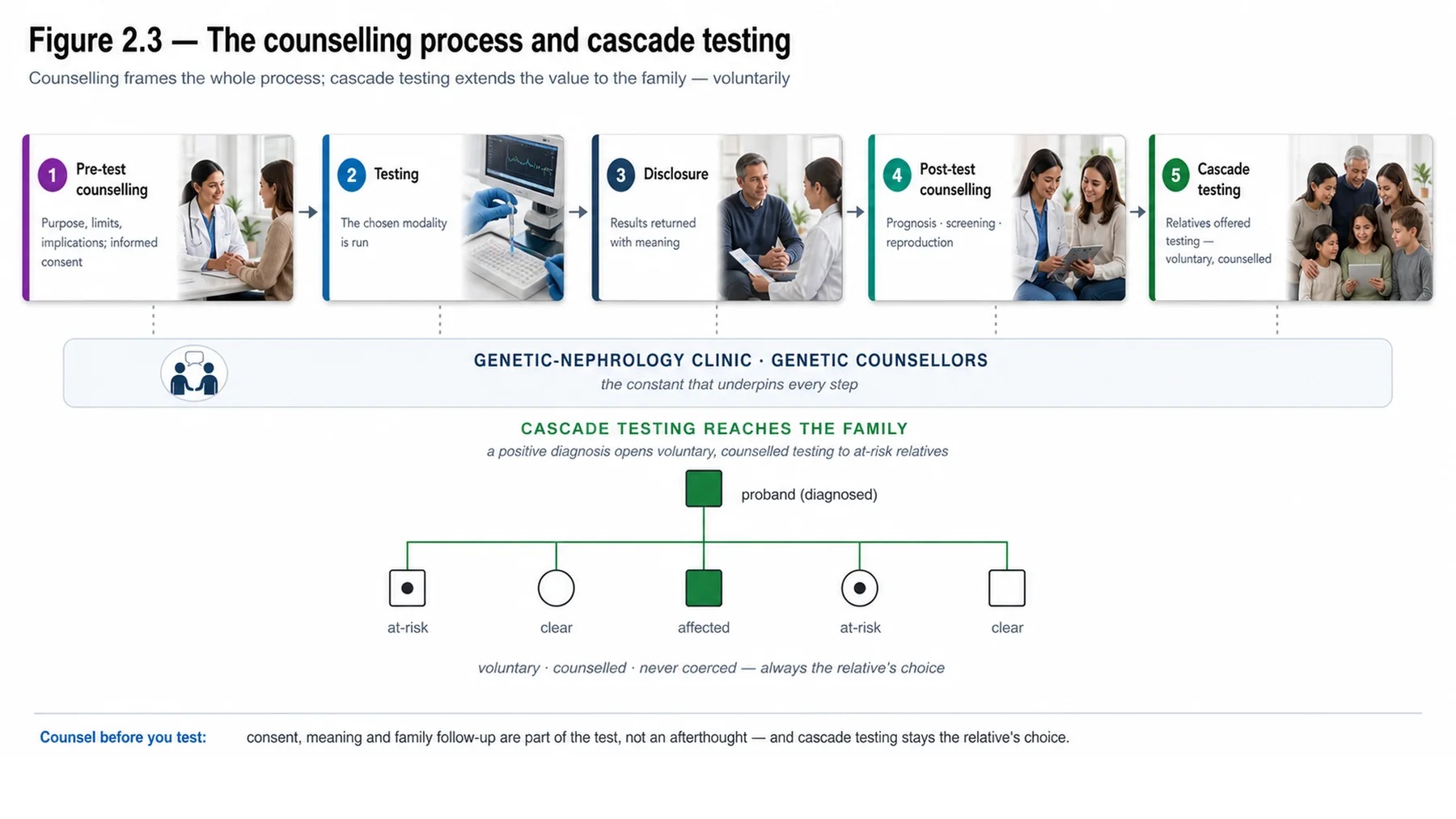
Genetic counselling frames the entire process, and a genetic test should not be sent without it. Pre-test counselling — the most important and most neglected step — explains the purpose of the test, what it can and cannot show (including the possibility of a VUS, a negative result, and secondary findings), the implications for the patient and for relatives (a genetic result is never only about one person), the psychological and practical consequences (including insurance and employment implications in some jurisdictions), and obtains genuinely informed consent. The result is then disclosed with its meaning made clear. And post-test counselling addresses what the diagnosis means — the prognosis, the screening and treatment, the reproductive options, and the testing of at-risk relatives. This process is ideally delivered in a multidisciplinary genetic-nephrology setting, with genetic counsellors central to it. The point is that genetic testing is a process of informed decision-making and support, not a one-off blood test — the counselling is as essential as the assay.
— Cascade testing of relatives
Once a pathogenic variant is identified in a patient, cascade testing — offering testing to at-risk relatives — becomes possible and valuable, because it can identify affected relatives early, when monitoring and treatment can begin before irreversible damage, and can reassure unaffected relatives. Cascade testing is one of the chief benefits of making a genetic diagnosis: it extends the value beyond the index patient to the whole family. But it is offered, not imposed — each relative makes their own informed, voluntary decision about whether to be tested, with their own counselling, because the decision (especially for an asymptomatic relative) carries the same preference-sensitive weight as the original. There is also the practical and sometimes delicate matter of how at-risk relatives are informed, which involves the index patient (who knows the family) and respects everyone's autonomy and confidentiality. Cascade testing is powerful and beneficial, but it is a cascade of individual, voluntary, counselled decisions — not an automatic family-wide screen.
— The preference-sensitive decision to test
The deepest theme of the chapter is that whether to undergo genetic testing is often a genuinely preference-sensitive decision, not a default. The value of a diagnosis is real — a precise prognosis, targeted therapy where it exists, information for family and reproduction — but so are the burdens: the anxiety of knowing, the implications for insurance and employment in some settings, the uncertainty of a possible VUS, the weight of learning about a disease that may be untreatable, and the implications for relatives who did not ask to know. Different people weigh these differently, and there is no single right answer. This is sharpest for predictive (presymptomatic) testing of an asymptomatic at-risk relative: testing a healthy person for an adult-onset, perhaps untreatable disease is a profound, values-driven choice, and the individual's right not to know must be respected — some will want the certainty and the chance to plan, others will prefer not to live under the shadow of a result. Testing of children raises its own principle: predictive testing of a child for an adult-onset condition is generally deferred until they can decide for themselves, preserving their future autonomy, unless the disease is childhood-onset or there is an actionable intervention in childhood. And reproductive testing decisions (developed further in the reproductive chapter) are among the most personal of all. Because these are values-driven decisions, they are made through shared decision-making with informed consent and counselling, keeping the autonomy of the patient and the family at the centre — the clinician informs and supports, but the patient decides. Genetic testing is powerful medicine, but it is, first, a decision.
| 04 | PHASE A · LEVEL 4 · ORIENTATION & KNOWLEDGE Reference Tables |
Table 2.1 — The testing modalities
| Modality | When used |
| Targeted single-gene | A specific disease strongly suspected (e.g. PKD1/PKD2 for ADPKD) |
| Gene panel | Suspected category — the workhorse; high yield, reasonable cost |
| Exome / genome | Atypical or undiagnosed; broad (more VUS, possible secondary findings) |
| Microarray / biochemical assay | Copy-number (CAKUT/syndromic); enzyme assay (Fabry) |
Table 2.2 — Yield and interpretation
| Aspect | Detail |
| Yield | Substantial in young-onset/familial/unexplained CKD; higher with phenotype + segregation |
| Classification | Pathogenic → likely pathogenic → VUS → likely benign → benign |
| VUS | The central challenge — cannot diagnose or exclude; resolve by phenotype/segregation/reanalysis |
| Cautions | A negative test does not exclude; secondary/incidental findings may arise |
Table 2.3 — The counselling process
| Stage | Content |
| Pre-test | Purpose; what it can/can't show (VUS, negative, secondary findings); implications for patient and relatives; informed consent |
| Disclosure | Result given with its meaning made clear |
| Post-test | Prognosis, screening, treatment, reproduction, cascade testing |
| Setting | Multidisciplinary genetic-nephrology clinic; genetic counsellors central |
Table 2.4 — Cascade testing
| Point | Detail |
| What | Offering testing to at-risk relatives after a pathogenic variant is found |
| Value | Early diagnosis, monitoring, and treatment of affected relatives; reassurance of unaffected |
| How | Offered, not imposed — each relative's own informed, counselled, voluntary decision |
| Delicate | Informing at-risk relatives involves the index patient; respect autonomy/confidentiality |
Table 2.5 — The preference-sensitive decisions
| Decision | Detail |
| Whether to test | Value (prognosis, therapy, family) vs burdens (anxiety, insurance, VUS, untreatable disease) |
| Predictive testing | Asymptomatic at-risk individual — respect the right not to know |
| Testing children | Generally defer adult-onset testing to adulthood (future autonomy) unless childhood-onset/actionable |
| Reproductive testing | Deeply personal and values-driven (Chapter 17) |
Table 2.6 — Principles of testing
| Principle | Detail |
| Match the modality to the question | Targeted / panel / exome / assay by phenotype |
| Interpret with phenotype and family | Not in isolation; reanalyse VUS over time |
| Counsel and consent | Pre-test counselling is essential — testing is a decision |
| Keep autonomy central | Shared decisions; the patient (and each relative) decides |
| 05 | PHASE B · LEVEL 5 · VISUALISE & MAP Imaging & Flowchart Specifications |
| 08 | PHASE C · LEVEL 8 · CLINICAL REASONING Clinical Cases |
| CASE 1 | PANEL OR EXOME? Match the modality to the question Choosing the test |
Presentation
A patient with a clinical picture strongly suggestive of an inherited kidney disease in a recognised category is to be tested. A clinician proposes immediate whole-genome sequencing as the broadest option.
❖ Pause and reflect Is the broadest test the best first choice here? |
Analysis
Not necessarily — the modality should match the question, and a gene panel is usually the better first choice when a category is suspected. A kidney-disease gene panel gives a high diagnostic yield at reasonable cost for a recognised category, and it returns fewer variants of uncertain significance and fewer secondary findings than broad genome sequencing — making it the workhorse for most cases. Whole-genome sequencing is broader and is reserved for atypical or undiagnosed cases where a panel is unrevealing; using it first, when a panel would answer the question, generates more interpretive uncertainty and incidental findings for no added benefit. (If the picture were truly atypical or a panel were negative, broad sequencing would then be appropriate.) Match the modality to the phenotype.
Plan
Start with a targeted kidney-disease gene panel matched to the suspected category, reserving exome or genome sequencing for atypical or panel-negative cases; counsel before testing. Match the modality to the question.
Teaching point
Match the modality to the question — a gene panel is the workhorse for a suspected category; reserve exome/genome for atypical or undiagnosed cases.
Cross-reference
Exercises the modalities content; Figure 2.1; Tables 2.1, 2.6.
| CASE 2 | AN UNCERTAIN VARIANT Interpret with phenotype and family The VUS |
Presentation
A patient's genetic test returns a variant of uncertain significance in a kidney-disease gene. A clinician is unsure whether this confirms the diagnosis and is tempted to act on it.
❖ Pause and reflect Can a variant of uncertain significance confirm or exclude the diagnosis? |
Analysis
No — a variant of uncertain significance (VUS) cannot, by definition, be used to make or exclude a diagnosis, and acting on it as if it were pathogenic is an error. A VUS is a genetic change whose clinical effect is genuinely unknown; it sits in the middle of the classification spectrum precisely because the evidence does not yet support calling it pathogenic or benign. The right approach is to interpret it with the phenotype (does it fit the clinical picture?), to test for segregation in the family (does it track with disease across affected and unaffected relatives?), and to reanalyse it over time, since a VUS may be reclassified as genetic knowledge grows. Meanwhile, management is guided by the clinical picture, not the uncertain variant, and the patient is counselled about the uncertainty rather than given a false certainty. The VUS is the central interpretive challenge of genetic testing.
Plan
Do not treat the VUS as diagnostic; interpret it with the phenotype and family segregation, arrange reanalysis over time, manage by the clinical picture, and counsel the patient about the uncertainty. A VUS neither confirms nor excludes — resolve it over time.
Teaching point
A variant of uncertain significance cannot confirm or exclude a diagnosis — interpret it with phenotype and family segregation, and reanalyse over time.
Cross-reference
Exercises the interpretation content; Figure 2.2; Tables 2.2, 2.6.
| CASE 3 | THE RIGHT NOT TO KNOW Predictive testing of a relative The preference-sensitive choice |
Presentation
After a patient is diagnosed with an adult-onset inherited kidney disease, an asymptomatic adult relative is referred for predictive testing. A clinician assumes the relative will of course want to be tested and arranges it without much discussion.
❖ Pause and reflect Should predictive testing of this asymptomatic relative simply proceed? |
Analysis
No — predictive (presymptomatic) testing of an asymptomatic at-risk relative is a profound, preference-sensitive decision that must not simply proceed by assumption. Testing a healthy person for an adult-onset disease — especially one with limited treatment — is a values-driven choice, and the individual's right not to know must be respected: some will want the certainty and the chance to plan (screening, reproduction, life decisions), while others will prefer not to live under the shadow of a positive result, and both are legitimate. The relative needs their own pre-test counselling — the value, the burdens (anxiety, insurance/employment, the weight of knowing), and the option to decline — and their own informed, voluntary decision. Arranging the test without this discussion overrides the relative's autonomy. Predictive testing is offered and counselled, not assumed.
Plan
Offer the asymptomatic relative pre-test counselling about predictive testing — the value, the burdens, and the right not to know — and support their own informed, voluntary decision rather than proceeding by assumption. Respect the right not to know.
Teaching point
Predictive testing of an asymptomatic relative is preference-sensitive — respect the right not to know; offer counselling and support a voluntary, informed decision.
Cross-reference
Exercises the preference content; the preference map (L15) and SDM scripts (L16); Table 2.5.
| CASE 4 | NOT YET Defer testing a child Predictive testing of children |
Presentation
Parents of a young, asymptomatic child at risk of an adult-onset inherited kidney disease request predictive genetic testing of the child now. There is no childhood-onset risk and no intervention that would change childhood management.
❖ Pause and reflect Should the asymptomatic child be tested now? |
Analysis
Generally no — predictive testing of a child for an adult-onset condition is usually deferred until the child can decide for themselves. The principle is to preserve the child's future autonomy and 'right not to know': testing now removes the child's later choice about whether to learn their genetic status, and — for an adult-onset disease with no childhood-onset risk and no actionable childhood intervention — there is no clinical benefit to testing in childhood that would justify overriding that future autonomy. The exception is where the disease is childhood-onset or there is an actionable intervention in childhood (where early diagnosis benefits the child), in which case testing is appropriate. Here, with neither, the testing should be deferred, the parents supported and counselled, and the decision left to the child when they are old enough. The child's future autonomy is the guiding principle.
Plan
Defer predictive testing of the child for this adult-onset disease (no childhood-onset risk, no actionable childhood intervention), counsel and support the parents, and leave the decision to the child when older; test in childhood only if childhood-onset or actionable. Defer adult-onset predictive testing in children.
Teaching point
Predictive testing of a child for an adult-onset disease is generally deferred to preserve future autonomy — unless the disease is childhood-onset or actionable in childhood.
Cross-reference
Exercises the preference content; Table 2.5; the preference map (L15); reproductive decisions in Chapter 17.
| 10 | PHASE C · LEVEL 10 · CLINICAL REASONING Clinical Pearls |
| Modalities: targeted single-gene, gene panel (workhorse), exome/genome, microarray, biochemical assay. | Match the modality to the question — panel for a category, exome for atypical/undiagnosed. |
| Diagnostic yield is substantial in young-onset/familial/unexplained CKD. | Yield rises with deep phenotyping and family segregation. |
| Classification: pathogenic → likely pathogenic → VUS → likely benign → benign. | A VUS cannot confirm or exclude a diagnosis — the central challenge. |
| Resolve a VUS by phenotype, family segregation, and reanalysis over time. | A negative test does NOT exclude a genetic cause. |
| Broad testing may return secondary/incidental findings. | Pre-test counselling is essential — purpose, limits, implications, consent. |
| Counselling: pre-test → disclosure → post-test (prognosis/screening/reproduction). | Cascade testing: offer to at-risk relatives — voluntary, counselled, individual decisions. |
| Whether to test is often PREFERENCE-SENSITIVE (value vs burdens). | Predictive testing of an asymptomatic relative — respect the right not to know. |
| Defer adult-onset predictive testing of children (future autonomy) unless actionable. | Keep autonomy central — testing is a counselled, consented decision. |
| 11 | PHASE D · LEVEL 11 · SAFETY & EVIDENCE Red Flags & Never-Do |
Panel A — Red flags
| ▲ | A genetic test about to be sent without pre-test counselling or consent — testing is a counselled decision. |
| ▲ | A variant of uncertain significance being treated as diagnostic — it cannot confirm or exclude. |
| ▲ | A negative test taken to exclude a genetic cause — it does not. |
| ▲ | Predictive testing of an asymptomatic relative arranged by assumption — respect the right not to know. |
| ▲ | A request to test a child for an adult-onset disease — generally defer to preserve future autonomy. |
Panel B — Never do
| ✖ NEVER — send a genetic test without pre-test counselling and informed consent. |
| ✖ NEVER — act on a variant of uncertain significance as if it were pathogenic. |
| ✖ NEVER — assume an at-risk relative wants predictive testing. |
| ✖ NEVER — test a child for an adult-onset disease without a childhood-actionable reason. |
| 12 | PHASE D · LEVEL 12 · SAFETY & EVIDENCE Common Pitfalls |
Pitfall 1 — Testing without counselling
| ✖ | WRONG Sending a genetic test like a routine blood test. |
| ✓ | RIGHT Counselling and consenting before testing. |
| ✉ | WHY Genetic testing has lifelong, family-wide implications — it is a decision. |
Pitfall 2 — Acting on a VUS
| ✖ | WRONG Treating a variant of uncertain significance as diagnostic. |
| ✓ | RIGHT Interpreting it with phenotype and family segregation, and reanalysing. |
| ✉ | WHY A VUS cannot confirm or exclude a diagnosis. |
Pitfall 3 — Over-reading a negative
| ✖ | WRONG Excluding a genetic cause on a negative test. |
| ✓ | RIGHT Recognising that a negative test does not exclude. |
| ✉ | WHY The responsible variant may be undetectable by the test used. |
Pitfall 4 — Assuming consent for predictive testing
| ✖ | WRONG Arranging predictive testing of a relative by assumption. |
| ✓ | RIGHT Offering counselling and supporting a voluntary, informed decision. |
| ✉ | WHY The right not to know must be respected. |
Pitfall 5 — Testing a child prematurely
| ✖ | WRONG Testing a child for an adult-onset disease on parental request alone. |
| ✓ | RIGHT Deferring to adulthood unless childhood-onset or actionable. |
| ✉ | WHY It preserves the child's future autonomy. |
| 13 | PHASE D · LEVEL 13 · SAFETY & EVIDENCE Evidence Grading |
GRADE A HIGH CONFIDENCE The effect is real and the estimate is stable. RCTs at low risk of bias; multiple concordant prospective cohorts; meta-analyses. |
GRADE B MODERATE CONFIDENCE The effect is likely real but may shift with new data. Observational studies, registries, mechanistic human studies. |
GRADE C LOW CONFIDENCE Rests on physiology, reasoning, or consensus rather than outcomes. Pathophysiological reasoning; extrapolation; consensus without outcomes. |
Graded statements (by evidence type)
| Statement | Grade | Basis (evidence type) |
| Gene panels and exome give a substantial diagnostic yield in selected CKD. | A | Genomic and clinical studies |
| A variant of uncertain significance cannot establish or exclude a diagnosis. | A | Variant-classification standards (ACMG) |
| A negative genetic test does not exclude a genetic cause. | A | Established genetics |
| Pre-test counselling and informed consent are required for genetic testing. | A | Guidelines and ethics consensus |
| Cascade testing benefits at-risk relatives. | A | Clinical data and guidelines |
| Predictive testing should respect the right not to know. | A | Ethics consensus |
| Predictive testing of children for adult-onset disease is generally deferred. | A | Guidelines and ethics consensus |
| 14 | PHASE E · LEVEL 14 · PATIENT DECISIONS Absolute Risk in Natural Frequency |
Natural-frequency estimates for orientation, from genetic-testing experience in nephrology; they vary with the population and the test. They convey the size of the decisions, expressed per 100 comparable patients.
| Per 100 patients… | Outcome | Roughly how many | See |
| Selected (young-onset/familial/unexplained) tested by panel/exome | Receive a molecular diagnosis | A meaningful share | L13 row 1 |
| Undergoing broad genetic testing | Receive a variant of uncertain significance | Some — the interpretive challenge | L13 row 2 |
| At-risk relatives offered cascade testing | Are diagnosed early and monitored | More than without cascade testing | L13 row 5 |
| Asymptomatic relatives offered predictive testing | Decline (the right not to know) | A real proportion — hence offer, don't assume | L13 row 6 |
★ How to read these Read these as orientation, not promises; the proportions vary with the population and the test. The stable signals: testing diagnoses a meaningful share of selected patients, returns some uncertain variants, benefits relatives through cascade testing, and is genuinely declined by some — so it is offered and counselled, not assumed. Communicate them as people out of 100, not as a hazard ratio. |
| 15 | PHASE E · LEVEL 15 · PATIENT DECISIONS Preference-Sensitive Decisions |
Whether to undergo genetic testing — and predictive testing in particular — is often a genuine values-driven decision. The table maps the options to what each prioritises; none is the single right answer.
| Choice | Prioritises | Trades off / suits |
| Test now | A diagnosis — prognosis, targeted therapy, family and reproductive information | Anxiety, insurance/employment risk, possible VUS — suits those who want certainty and to plan |
| Defer testing | Time to decide; avoiding premature knowledge | Delayed diagnosis — suits the ambivalent or not-yet-ready |
| Decline (the right not to know) | Living without the shadow of a result | Forgoing prognostic/planning information — suits those for whom not knowing is preferable |
| Predictive testing of an asymptomatic relative | Certainty and the chance to plan (screening, reproduction) | The burden of knowing about a possibly untreatable disease — a deeply individual choice |
❖ Using this map Elicit what the individual most wants — the certainty and ability to plan, or the freedom from a result they cannot change. The right choice matches their values; the clinician's role is to inform and support, not to assume the patient wants to know. |
| 16 | PHASE E · LEVEL 16 · PATIENT DECISIONS Shared Decision-Making |
Scripts for the preference-sensitive conversation about whether to test and predictive testing. Adapt the wording; the structure is to share the value and the burdens honestly and support the patient's own decision.
Script 1 — Pre-test counselling: whether to test
Frame the choice. “A genetic test could give us a precise diagnosis — which would tell us more about what to expect, whether there's a targeted treatment, and what it might mean for your family. But it's a real decision: a result can cause anxiety, it can have implications for things like insurance in some places, it might come back uncertain, and sometimes it tells us about a condition we can't yet change.”
Elicit values. “How do you feel about knowing — would a clear answer help you plan and feel more in control, or is there a part of you that would rather not have that hanging over you?”
Decide together. “There's no right answer — it's about what fits you. We can test now, wait until you're ready, or not test at all, and you can change your mind.”
Script 2 — Predictive testing of an at-risk relative
Acknowledge the right not to know. “Because a relative has this condition, you could be tested to find out whether you carry it too — but there's no obligation to. Some people want the certainty and the chance to plan; others would rather not live under the shadow of a result, especially when it can't yet be cured. Both are completely valid.”
Explore the implications. “If you tested positive, what would you do differently — and how would you feel carrying that knowledge? And if you'd rather not know, that's a legitimate choice too.”
Support the decision. “This is entirely your decision, in your own time, and we'll support whatever you choose — including choosing not to be tested.”
| 17 | PHASE F · LEVEL 17 · APPLY & TEST Documentation Templates |
Paste-ready notes. Tick the boxes that apply and delete the rest; make the counselling, the consent, and the shared decision explicit.
Template 1 — Pre- and post-test counselling
Template 2 — Preference-sensitive testing decision
| 18 | PHASE F · LEVEL 18 · APPLY & TEST Cheat Sheet |
| Modalities: targeted, panel (workhorse), exome/genome, microarray, assay. | Match the modality to the question. |
| Yield substantial in young-onset/familial/unexplained CKD. | Classification: pathogenic → likely pathogenic → VUS → likely benign → benign. |
| VUS cannot confirm or exclude — the central challenge. | Resolve VUS by phenotype, segregation, reanalysis. |
| Negative test does NOT exclude a genetic cause. | Broad testing → possible secondary findings. |
| Pre-test counselling + informed consent are essential. | Counselling: pre-test → disclosure → post-test. |
| Cascade testing: offered, voluntary, counselled. | Whether to test = often PREFERENCE-SENSITIVE. |
| Predictive testing — respect the right not to know. | Defer adult-onset predictive testing of children (autonomy). |
| Reproductive testing — deeply personal (Ch 17). | Testing is a counselled, consented decision — keep autonomy central. |
| 19 | PHASE F · LEVEL 19 · APPLY & TEST Flashcards |
| CARD 1 | Q. What are the genetic testing modalities and when is each used? A. Targeted single-gene testing (a specific disease suspected), gene panels (a suspected category — the workhorse, high yield, reasonable cost), exome or genome sequencing (atypical or undiagnosed cases), chromosomal microarray (copy-number, CAKUT/syndromic), and specific biochemical assays (such as the alpha-galactosidase A assay for Fabry). DETAILED. The phenotype chooses the modality. CLINICAL. Match the modality to the clinical question. |
| CARD 2 | Q. What is the diagnostic yield of genetic testing in nephrology? A. Substantial in selected populations — young-onset, familial, or unexplained kidney disease — where a panel or exome diagnoses a meaningful fraction, with the yield improved by deep phenotyping and by testing relatives for segregation. DETAILED. Yield is population-dependent. CLINICAL. Test the populations where the yield is high. |
| CARD 3 | Q. What is a variant of uncertain significance, and how is it handled? A. A genetic change whose clinical effect is genuinely unknown — the central interpretive challenge — which cannot be used to make or exclude a diagnosis; it is resolved over time by correlating with the phenotype, testing family segregation, and reanalysing as knowledge grows. DETAILED. Management follows the clinical picture, not the VUS. CLINICAL. Never act on a VUS as diagnostic; interpret and reanalyse it. |
| CARD 4 | Q. What does a negative genetic test mean? A. That no causative variant was detected by the test used — but it does not exclude a genetic cause, because the responsible variant may be undetectable by that test. DETAILED. Broad testing may also return secondary findings. CLINICAL. Do not exclude a genetic cause on a negative test. |
| CARD 5 | Q. What does the genetic counselling process involve? A. Pre-test counselling (purpose, what it can and cannot show including a VUS and secondary findings, implications for the patient and relatives, and informed consent), result disclosure with its meaning, and post-test counselling (prognosis, screening, treatment, reproduction, and cascade testing) — ideally in a multidisciplinary clinic. DETAILED. Pre-test counselling is the most important step. CLINICAL. Counsel and consent before any genetic test. |
| CARD 6 | Q. What is cascade testing? A. Offering genetic testing to at-risk relatives after a pathogenic variant is identified in a patient — enabling early diagnosis, monitoring, and treatment of affected relatives, and reassurance of unaffected ones — with each relative making their own informed, counselled, voluntary decision. DETAILED. It extends the value of the diagnosis to the family. CLINICAL. Offer cascade testing, but as individual voluntary decisions. |
| CARD 7 | Q. Why is the decision to test often preference-sensitive? A. Because the value of a diagnosis (prognosis, targeted therapy, family and reproductive information) is weighed against real burdens (anxiety, insurance and employment implications, the uncertainty of a VUS, and learning about an untreatable disease), which different people value differently. DETAILED. There is no single right answer. CLINICAL. Share the decision; the patient decides. |
| CARD 8 | Q. How are predictive testing of relatives and of children approached? A. Predictive testing of an asymptomatic at-risk relative is a values-driven choice that respects the right not to know; predictive testing of a child for an adult-onset disease is generally deferred until they can decide, to preserve future autonomy, unless the disease is childhood-onset or actionable in childhood. DETAILED. Both center on autonomy. CLINICAL. Offer predictive testing voluntarily; defer adult-onset testing of children. |
| 20 | PHASE F · LEVEL 20 · APPLY & TEST One-Minute Preceptor |
| SCENE 1 | The intern acting on a VUS |
GET A COMMITMENT. “You want to make the diagnosis on this variant of uncertain significance — is that valid?”
PROBE FOR EVIDENCE. “It's a variant in the right gene” — ask: “What does 'uncertain significance' actually mean, and can it confirm a diagnosis?”
TEACH A GENERAL RULE. A variant of uncertain significance cannot make or exclude a diagnosis — interpret it with the phenotype and family segregation, manage by the clinical picture, and reanalyse over time.
REINFORCE WHAT WAS RIGHT. Recognising the variant's potential relevance was reasonable.
CORRECT A MISTAKE. Don't act on it as diagnostic; interpret and reanalyse it.
| SCENE 2 | The resident assuming consent |
GET A COMMITMENT. “You've arranged predictive testing for this asymptomatic relative — did you discuss it with them?”
PROBE FOR EVIDENCE. “Of course they'd want to know” — ask: “Does everyone want to know their genetic status for an untreatable adult-onset disease?”
TEACH A GENERAL RULE. Predictive testing is preference-sensitive — the right not to know must be respected; offer counselling and support the relative's own voluntary, informed decision.
REINFORCE WHAT WAS RIGHT. Recognising the relative was at risk was correct.
CORRECT A MISTAKE. Offer counselling and let the relative decide, including declining.
| 21 | PHASE F · LEVEL 21 · APPLY & TEST Reflective Prompts |
Genuine tensions this evidence and these values leave open; sit with them rather than resolving them too quickly.
A genetic result belongs to a family as much as to an individual — yet medicine treats one patient at a time. How do you honour both the patient's confidentiality and a relative's interest in knowing their own risk?
The 'right not to know' protects autonomy, but a relative's choice not to know can leave their own children uninformed. Whose autonomy prevails when knowledge cascades down a family?
A variant of uncertain significance is, in a sense, the truthful answer — and the least useful one. How do you sit with a patient in genuine uncertainty without manufacturing false reassurance or false alarm?
Deferring a child's predictive testing preserves their future autonomy, but parents may feel they are protecting their child by knowing. How do you weigh a parent's wish to know against a child's right to decide later?
Testing can reveal a disease we cannot yet treat. When does a diagnosis without a treatment help a patient, and when does it only burden them?
| 22 | PHASE F · LEVEL 22 · APPLY & TEST Board-Style Questions |
| Q 01 | Which genetic test is the usual workhorse when a category of inherited kidney disease is suspected? |
| A | Whole-genome sequencing first |
| B | A kidney-disease gene panel |
| C | Karyotype |
| D | No testing |
Rationale A gene panel gives high yield at reasonable cost for a suspected category (case 1, Figure 2.1, Table 2.1). A is reserved for atypical/undiagnosed; C and D are wrong. |
| Q 02 | A variant of uncertain significance: |
| A | Confirms the diagnosis |
| B | Cannot confirm or exclude the diagnosis — interpret with phenotype/segregation and reanalyse |
| C | Excludes the diagnosis |
| D | Is always benign |
Rationale A VUS is uninterpretable and is resolved over time (case 2, Figure 2.2, Table 2.2). A, C, and D misuse it. |
| Q 03 | A negative genetic test in a patient with suspected inherited kidney disease: |
| A | Excludes a genetic cause |
| B | Does not exclude a genetic cause |
| C | Means the disease is acquired |
| D | Requires no follow-up |
Rationale The responsible variant may be undetectable, so a negative test does not exclude (Table 2.2, rule on cautions). A, C, and D are incorrect. |
| Q 04 | Before any genetic test, what is essential? |
| A | Nothing — it is a routine blood test |
| B | Pre-test counselling and informed consent |
| C | Only the patient's name |
| D | A renal biopsy |
Rationale Genetic testing has lifelong, family-wide implications and requires counselling and consent (Table 2.3, rule on counselling). A, C, and D are wrong. |
| Q 05 | Cascade testing of at-risk relatives is: |
| A | Mandatory for all relatives |
| B | Offered as individual, voluntary, counselled decisions |
| C | Done without consent |
| D | Never appropriate |
Rationale Cascade testing is offered, not imposed, with each relative deciding (Table 2.4). A and C violate autonomy; D is wrong. |
| Q 06 | Predictive testing of an asymptomatic at-risk relative should: |
| A | Proceed automatically |
| B | Respect the right not to know, with counselling and a voluntary decision |
| C | Be declined for all |
| D | Require no discussion |
Rationale It is a preference-sensitive choice respecting the right not to know (case 3, Table 2.5, L15–L16). A, C, and D ignore autonomy. |
| Q 07 | Predictive testing of a child for an adult-onset inherited kidney disease is generally: |
| A | Done on parental request |
| B | Deferred until the child can decide, unless childhood-onset or actionable |
| C | Mandatory |
| D | Never considered |
Rationale Deferral preserves the child's future autonomy unless there is a childhood-actionable reason (case 4, Table 2.5). A, C, and D are incorrect. |
| Q 08 | Why is the decision to undergo genetic testing often preference-sensitive? |
| A | It never is |
| B | The value of a diagnosis is weighed against burdens (anxiety, insurance, VUS, untreatable disease) that people value differently |
| C | Testing is always beneficial |
| D | Testing is always harmful |
Rationale It is a values-driven trade-off with no single right answer (Table 2.5, L15). A, C, and D oversimplify. |