Chapter Preamble
Signals declared
Sig-D — Diagnostic (primary). Recognise Alport syndrome from its renal and extrarenal features, classify its inheritance, and distinguish it from thin basement membrane disease and IgA nephropathy.
Sig-T — Therapeutic (strong). Slow progression with early RAAS blockade, provide audiological and ophthalmological care, and manage transplantation and its anti-GBM risk.
Sig-M — Mechanistic (strong). How type IV collagen defects damage the glomerular basement membrane (and the ear and eye), and the spectrum from thin basement membrane disease to Alport.
Levels populated and omitted
Populated (19): L1–L14, L17–L20, L22. The mechanistic signal fires the concept maps (L6) and triads (L9); the therapeutic signal fires the absolute-risk table (L14) and templates (L17); the diagnostic signal drives the tables, rules, cases, pitfalls, and board items.
L15 / L16 preference-sensitive map and SDM scripts — omitted. No Sig-E; diagnosis and treatment here are established care (genetic-testing decisions live in Chapter 2).
L21 reflective prompts — omitted. No Sig-E/V; the content is worked through the cases and pitfalls.
| 01 | PHASE A · LEVEL 1 · ORIENTATION & KNOWLEDGE Learning Objectives |
By the end of this chapter you should be able to:
Explain how type IV collagen defects damage the glomerular basement membrane.
Explain the extrarenal features of Alport (deafness, ocular signs) from the same collagen.
Distinguish the X-linked, autosomal recessive, and autosomal dominant inheritance patterns.
Describe thin basement membrane disease and its place on the collagen-IV spectrum.
Recognise why 'benign familial haematuria' is not always benign.
Diagnose Alport by biopsy electron microscopy and by genetics.
Treat Alport with early RAAS blockade and provide extrarenal care.
Recognise the post-transplant anti-GBM risk in X-linked Alport.
| 02 | PHASE A · LEVEL 2 · ORIENTATION & KNOWLEDGE Executive Summary |
The glomerular basement membrane is built of type IV collagen — the alpha-3, alpha-4, and alpha-5 network in the mature membrane — encoded by COL4A3, COL4A4, and COL4A5.
Alport syndrome results from mutations in these genes, producing a structurally abnormal basement membrane that progressively breaks down, causing persistent glomerular haematuria, then proteinuria, and progressive CKD to end-stage disease.
Because the same collagen is in the cochlea and the eye, Alport causes sensorineural deafness and characteristic ocular signs (anterior lenticonus) — the renal-ear-eye picture.
The inheritance is most often X-linked (COL4A5), with males severely affected and female carriers variably affected; autosomal recessive (biallelic COL4A3/COL4A4) is severe in both sexes; and autosomal dominant (monoallelic) is variable and often milder.
Thin basement membrane disease — 'benign familial haematuria' — is usually a heterozygous COL4A3/COL4A4 carrier state with a diffusely thinned basement membrane, causing persistent isolated microscopic haematuria with usually preserved function.
But thin basement membrane disease and Alport are a continuum of collagen-IV disease, so 'benign' is not always benign — some patients, especially with proteinuria, hypertension, or a family history of CKD, progress (autosomal dominant Alport).
Diagnosis rests on persistent glomerular haematuria with a family history, audiometry and ophthalmology, biopsy electron microscopy (a lamellated 'basket-weave' basement membrane and absent collagen IV alpha-5 in X-linked males), and, increasingly, genetic testing.
IgA nephropathy is the main alternative cause of glomerular haematuria to consider.
Treatment centres on early RAAS blockade, which slows progression and delays end-stage disease — started early, before significant CKD.
Audiological and ophthalmological care, CKD management, and genetic counselling complete it.
Transplantation has good outcomes, with a rare risk of post-transplant anti-GBM disease in X-linked Alport males who lack the antigen and form antibodies against the donor collagen.
Recognising the spectrum, treating early, and not over-reassuring the 'benign' end are the themes of the chapter.
| 03 | PHASE A · LEVEL 3 · ORIENTATION & KNOWLEDGE Main Narrative |
Alport syndrome is the disease of the glomerular basement membrane — a defect in the type IV collagen that builds it, producing haematuria, progressive kidney failure, and, because the same collagen is in the ear and eye, deafness and ocular signs. It sits at one end of a spectrum whose other end, thin basement membrane disease, is usually benign — but the two are a continuum, and the lesson of the chapter is to recognise the spectrum, treat Alport early, and not over-reassure the 'benign' end.
— Type IV collagen and the basement membrane
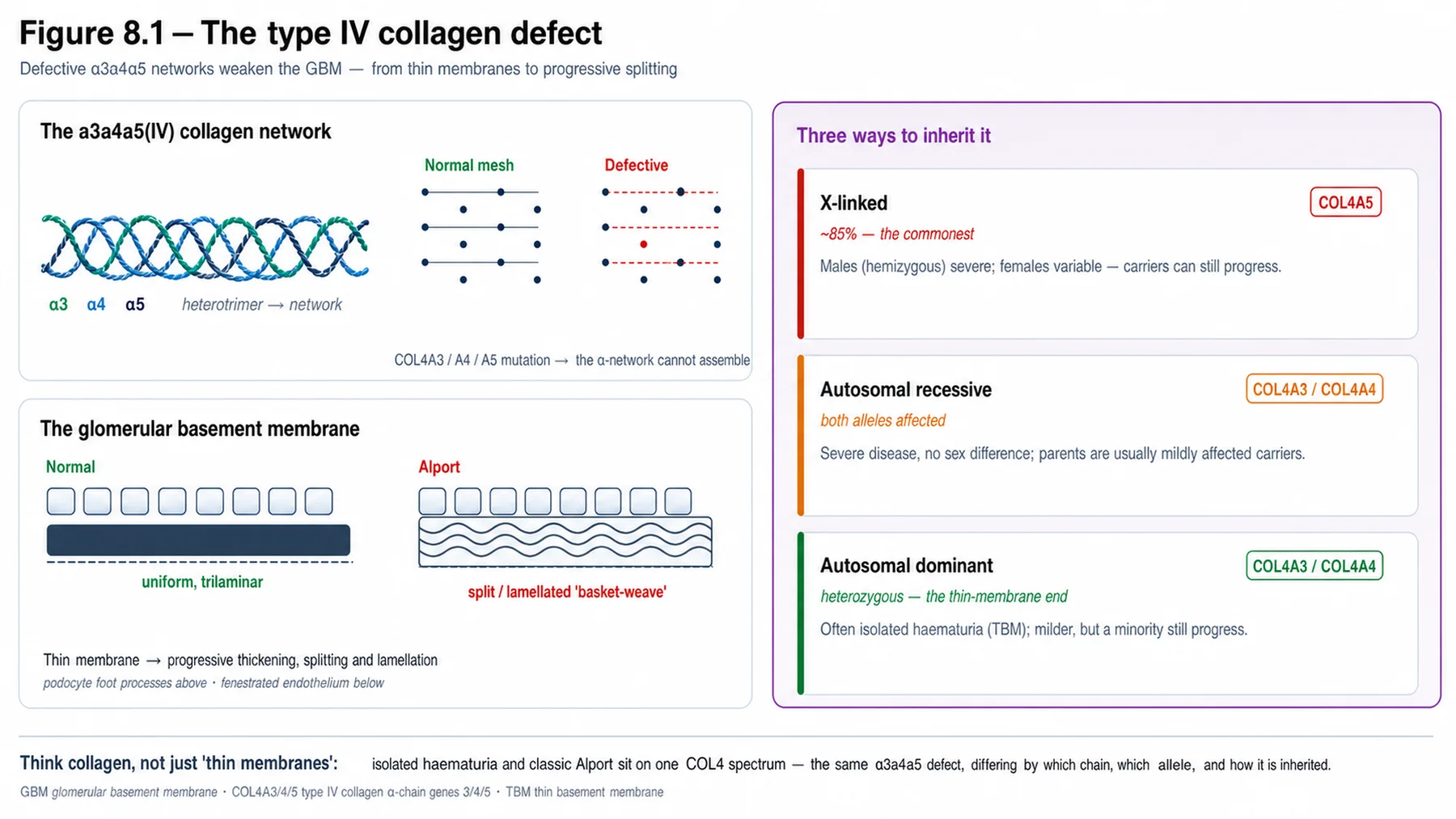
The glomerular basement membrane is constructed largely of type IV collagen, and in the mature membrane the key structure is the alpha-3/alpha-4/alpha-5 collagen IV network, encoded by three genes: COL4A3 and COL4A4 (on chromosome 2) and COL4A5 (on the X chromosome). Alport syndrome arises when mutations in these genes produce a defective or absent alpha-3/alpha-4/alpha-5 network, so the basement membrane is structurally abnormal — initially thinned, then progressively damaged, thickened, and split. This abnormal membrane cannot maintain the filtration barrier properly, so red cells leak through (persistent glomerular haematuria), then protein (proteinuria), and the progressive membrane breakdown drives progressive glomerular scarring and CKD to end-stage disease. The mechanism is thus a primary structural defect of the filtration barrier's scaffold. And because the same alpha-3/alpha-4/alpha-5 (or alpha-5-containing) collagen IV networks are found in the basement membranes of the cochlea and the eye, the defect causes extrarenal disease there too — explaining why Alport is not only a kidney disease. Understanding that Alport is a type IV collagen disease of basement membranes makes both its renal and its extrarenal features intelligible.
— The renal-ear-eye picture
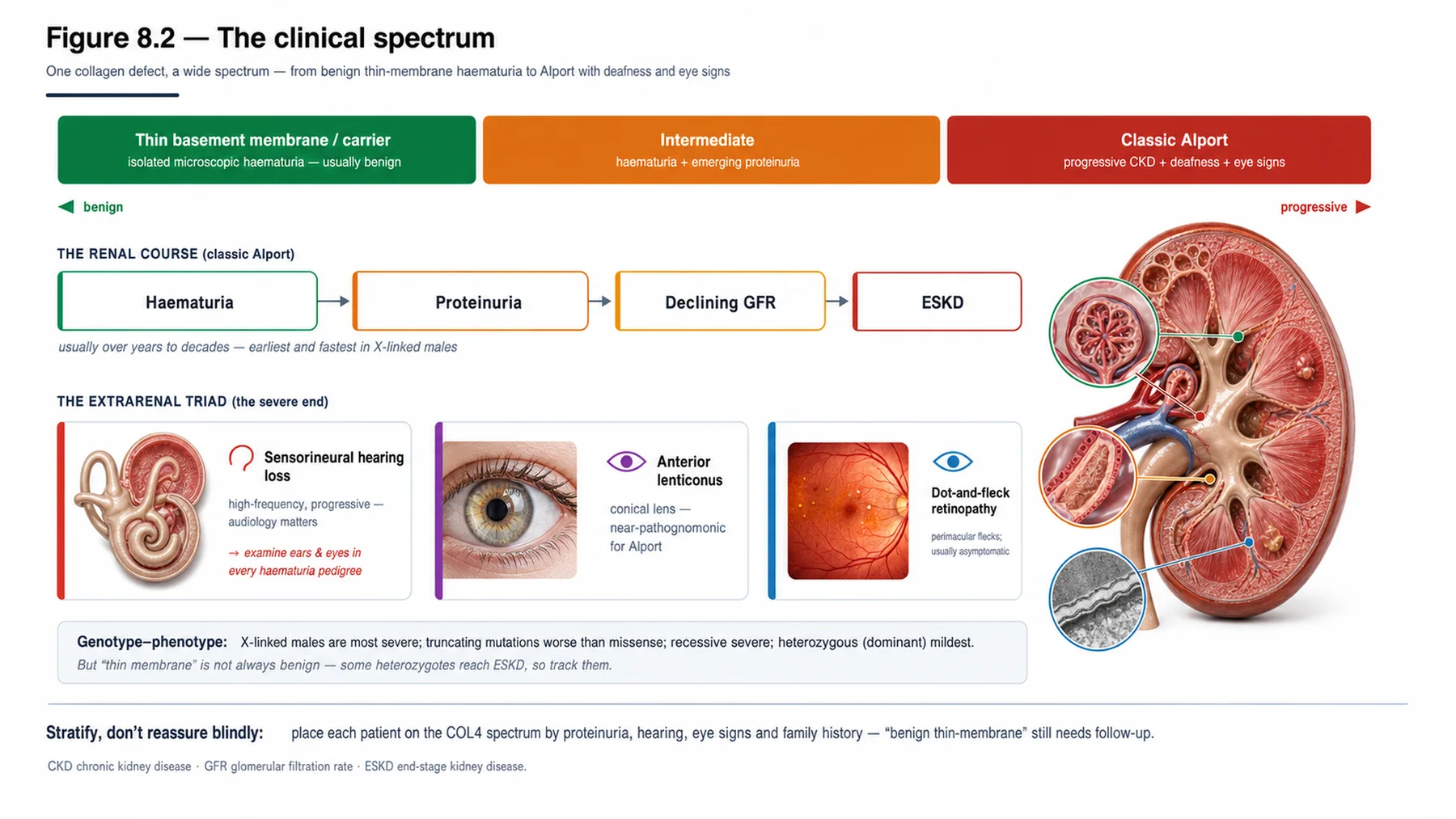
The clinical hallmark of Alport syndrome is its combination of renal and extrarenal features, all traceable to the collagen defect. The renal disease is persistent glomerular haematuria (microscopic, often from childhood, sometimes with episodes of visible haematuria), followed by proteinuria as the disease advances, and progressive CKD culminating in end-stage disease (the age depending on the genotype and inheritance). The ear is affected by progressive high-frequency sensorineural hearing loss — a key clue that often accompanies the renal disease and points to the diagnosis. The eye shows characteristic changes, most specifically anterior lenticonus (a conical deformation of the lens, essentially pathognomonic of Alport), along with retinal flecks (a dot-and-fleck retinopathy) and corneal changes. So the patient who unites glomerular haematuria, sensorineural deafness, and ocular signs — especially with a family history — has Alport syndrome, and recognising this renal-ear-eye triad (the extrarenal features revealing the renal diagnosis, as the opening chapter taught) is the clinical key. The deafness in particular is the feature most likely to be the clue that turns a 'glomerulonephritis' into Alport.
— Inheritance: X-linked, recessive, dominant
Alport's inheritance is more varied than many realise, and it determines the severity and the family implications. The commonest form is X-linked, caused by mutations in COL4A5 (on the X chromosome): males, having a single X, are severely affected and typically progress to end-stage disease, while females (heterozygous carriers) are variably affected — from isolated haematuria to significant CKD — because of X-inactivation (lyonisation), so 'carrier' females are not necessarily unaffected. The autosomal recessive form (biallelic mutations in COL4A3 or COL4A4) affects both sexes severely, like X-linked males. And the autosomal dominant form (a single COL4A3 or COL4A4 mutation) is variable and often milder, overlapping clinically with thin basement membrane disease. The pedigree pattern therefore helps: an X-linked pattern (affected males, variably affected females, no male-to-male transmission, affected through the maternal line) points to COL4A5; a recessive pattern (affected siblings, consanguinity) to biallelic COL4A3/A4; and a dominant pattern to a single COL4A3/A4 mutation. Knowing the inheritance is essential for prognosis (X-linked males and recessive patients progress; female carriers and dominant cases are variable) and for counselling and family screening.
— Thin basement membrane disease and the spectrum
At the other end of the collagen-IV spectrum is thin basement membrane disease (also called benign familial haematuria), and understanding its relationship to Alport is important. It is usually a heterozygous carrier state for an autosomal recessive Alport mutation (a single COL4A3 or COL4A4 variant), producing a diffusely and uniformly thinned glomerular basement membrane that leaks red cells — causing persistent isolated microscopic haematuria, typically with preserved kidney function and a benign course, often in multiple family members (hence 'benign familial haematuria'). The crucial point, however, is that thin basement membrane disease and Alport are a continuum of collagen-IV disease, not two separate entities — the same genes are involved — so 'benign' is not always benign: a proportion of patients, particularly those who develop proteinuria, hypertension, or have a family history of kidney failure, do progress, and these represent the autosomal dominant Alport end of the spectrum. The practical lesson is not to reflexively reassure a patient with 'benign familial haematuria' and discharge them: persistent glomerular haematuria from a collagen-IV defect should be monitored (for proteinuria, hypertension, and declining function), because a minority will turn out to have progressive disease. The spectrum thinking — thin basement membrane disease shading into Alport — guards against both over-reassurance and missed progression.
— Diagnosis and treatment
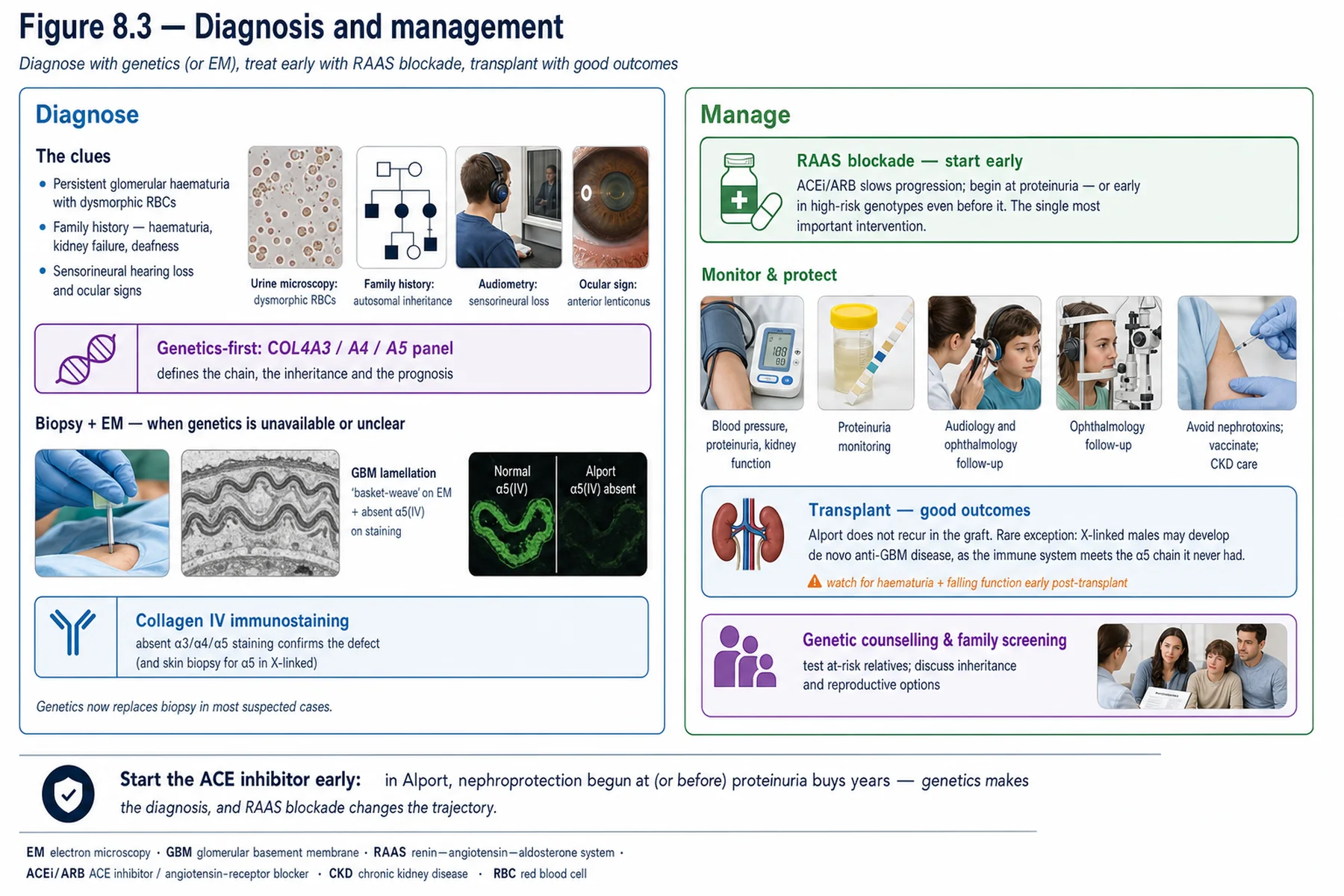
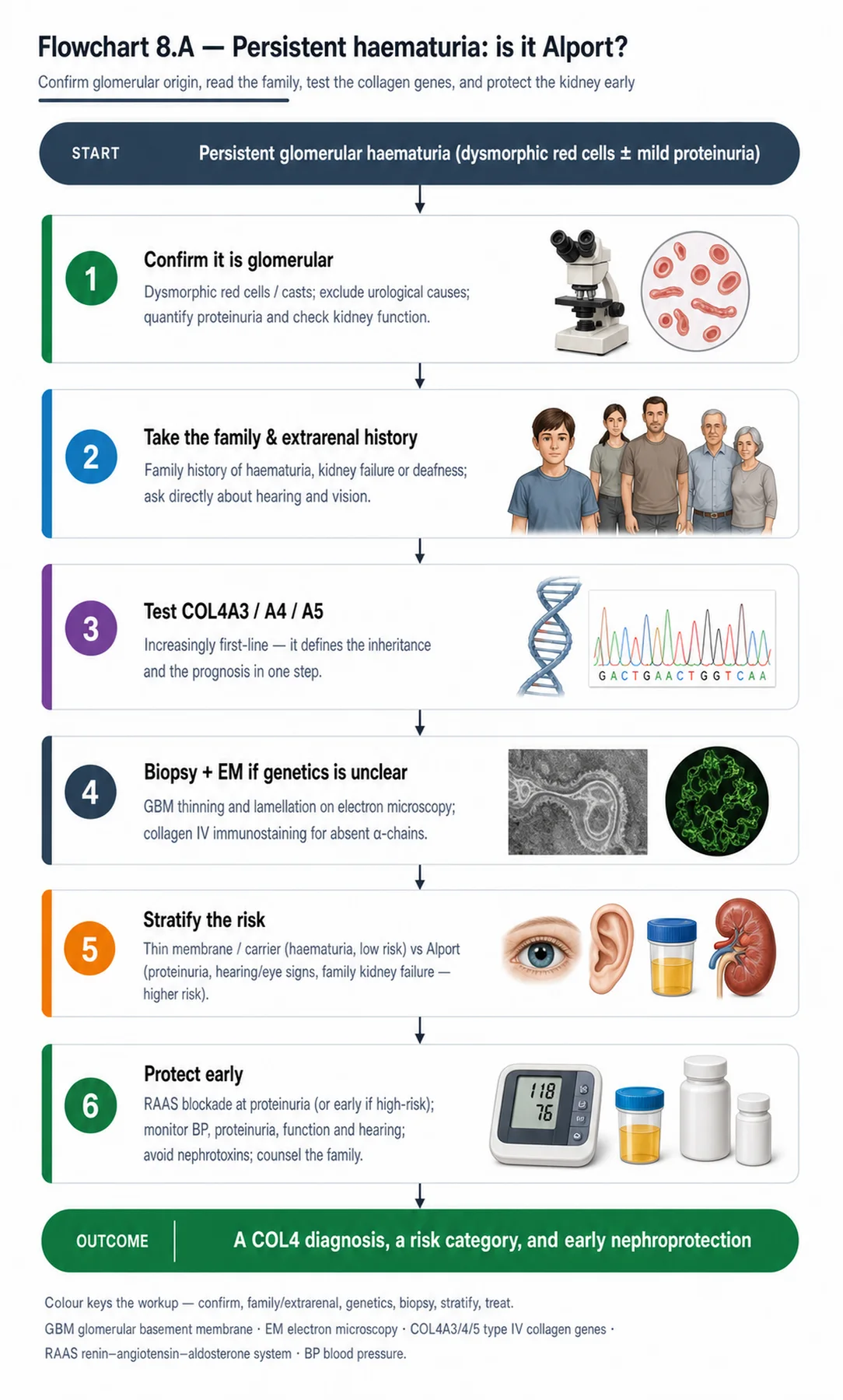
Diagnosis brings together the clinical picture and the confirmatory tests. The clinical clues are persistent glomerular haematuria (with dysmorphic red cells and sometimes red-cell casts), with or without proteinuria, a family history of haematuria, kidney failure, or deafness, and the extrarenal features (audiometry for the deafness, ophthalmology for the ocular signs). The biopsy, on electron microscopy, shows the characteristic Alport changes — a basement membrane that is thinned early and then thickened with lamellation and splitting (a 'basket-weave' appearance) — and immunostaining shows absent collagen IV alpha-5 in X-linked males (and abnormal staining in others), while thin basement membrane disease shows diffuse uniform thinning. Increasingly, genetic testing (COL4A3/COL4A4/COL4A5) is first-line, confirming the diagnosis, classifying the inheritance, enabling family screening, and often sparing a biopsy. The main alternative to exclude is IgA nephropathy, the commonest cause of glomerular haematuria. Treatment centres on RAAS blockade (an ACE inhibitor or ARB), which is renoprotective and slows the progression of Alport — and the evidence (from Alport registries) supports starting it early, before significant CKD (at the onset of proteinuria or microalbuminuria), because earlier treatment delays end-stage disease. Around this sit audiological care (hearing aids), ophthalmological care, CKD management, and genetic counselling tailored to the inheritance pattern. Transplantation has good outcomes in Alport, with one important caveat: a small proportion of X-linked Alport males, who lack the normal collagen IV antigen, can mount an alloantibody response against the collagen in the donor kidney, causing post-transplant anti-glomerular-basement-membrane (anti-GBM) disease — a rare but recognised complication. The synthesis: Alport is a type IV collagen disease of the basement membrane (and the ear and eye), spanning a spectrum from the usually benign thin basement membrane disease to progressive Alport, diagnosed by the renal-ear-eye picture with EM or genetics, and treated by early RAAS blockade — with the spectrum thinking and early treatment as the two practical themes.
| 04 | PHASE A · LEVEL 4 · ORIENTATION & KNOWLEDGE Reference Tables |
Table 8.1 — Type IV collagen and the genes
| Element | Detail |
| Mature GBM | Built of the alpha-3/alpha-4/alpha-5 type IV collagen network |
| Genes | COL4A3, COL4A4 (chromosome 2); COL4A5 (X chromosome) |
| Alport | Mutations → defective network → abnormal GBM → haematuria, proteinuria, progressive CKD |
| Extrarenal | Same collagen in cochlea and eye → deafness and ocular signs |
Table 8.2 — Alport: the renal-ear-eye features
| System | Feature |
| Kidney | Persistent glomerular haematuria → proteinuria → progressive CKD/ESKD |
| Ear | Progressive high-frequency sensorineural hearing loss |
| Eye | Anterior lenticonus (near-pathognomonic); dot-and-fleck retinopathy; corneal changes |
| Clinical key | The renal-ear-eye combination (with family history) makes the diagnosis |
Table 8.3 — Inheritance patterns
| Pattern | Gene(s) | Phenotype |
| X-linked (commonest) | COL4A5 | Males severe (ESKD); females (carriers) variable |
| Autosomal recessive | Biallelic COL4A3/COL4A4 | Severe in both sexes |
| Autosomal dominant | Monoallelic COL4A3/COL4A4 | Variable, often milder; overlaps TBMN |
Table 8.4 — Thin basement membrane disease versus Alport
| Feature | Thin basement membrane disease | Alport syndrome |
| Genetics | Usually heterozygous COL4A3/A4 (carrier) | COL4A5 (X-linked), or biallelic/AD COL4A3/A4 |
| GBM (EM) | Diffuse uniform thinning | Thinning then lamellation/splitting ('basket-weave') |
| Course | Isolated haematuria, usually benign | Haematuria + proteinuria + deafness/eye + progressive CKD |
Table 8.5 — Diagnosis
| Modality | Detail |
| Clinical | Persistent glomerular haematuria ± proteinuria; family history; audiometry; ophthalmology |
| Biopsy (EM) | Alport: lamellated 'basket-weave' GBM; absent collagen IV α5 (X-linked males). TBMN: diffuse thinning |
| Genetics | COL4A3/A4/A5 — increasingly first-line; confirms, classifies inheritance, enables family screening |
| Differential | IgA nephropathy (commonest cause of glomerular haematuria) |
Table 8.6 — Treatment
| Element | Detail |
| RAAS blockade | Mainstay — renoprotective, slows progression; start EARLY (before significant CKD) |
| Extrarenal care | Audiology (hearing aids); ophthalmology |
| Transplant | Good outcomes; rare post-transplant anti-GBM disease in X-linked males |
| Other | CKD management; genetic counselling by inheritance pattern; emerging therapies |
| 05 | PHASE B · LEVEL 5 · VISUALISE & MAP Imaging & Flowchart Specifications |
| 06 | PHASE B · LEVEL 6 · VISUALISE & MAP Concept Maps |
Each chain runs from mechanism to a named clinical action; read the arrows as “leads to.”
Collagen IV / GBM. COL4A3/A4/A5 mutation → defective α3α4α5 network → abnormal GBM (thinned then lamellated) → haematuria, proteinuria, CKD → ACTION: recognise Alport as a type IV collagen disease of the basement membrane.
Extrarenal (ear/eye). Same collagen in cochlea and eye → sensorineural deafness + ocular signs (lenticonus) → ACTION: use the deafness and eye signs as the clue that reveals the renal diagnosis.
Inheritance. X-linked (COL4A5; males severe, females variable), recessive (biallelic, both sexes severe), dominant (variable) → ACTION: classify the inheritance to prognosticate and counsel.
The spectrum. Thin basement membrane disease (carrier, thin GBM, usually benign) ↔︎ Alport (lamellated GBM, progressive) — a collagen-IV continuum → ACTION: monitor 'benign familial haematuria' — it is not always benign.
Diagnosis & treatment. EM (basket-weave, absent collagen IV α5) or genetics → confirm; RAAS blockade slows progression → ACTION: confirm the diagnosis and start RAAS blockade early.
| 07 | PHASE B · LEVEL 7 · VISUALISE & MAP Decision Pathways |
| R1 | IF a patient has persistent glomerular haematuria with sensorineural deafness or ocular signs and a family history, THEN suspect Alport syndrome. |
| R2 | IF Alport is suspected, THEN seek the extrarenal features (audiometry, ophthalmology) — they reveal the renal diagnosis. |
| R3 | IF confirming the diagnosis, THEN use biopsy electron microscopy (lamellated GBM, absent collagen IV α5) and/or genetic testing (COL4A3/A4/A5). |
| R4 | IF classifying Alport, THEN determine the inheritance (X-linked, recessive, dominant) for prognosis and counselling. |
| R5 | IF a patient has isolated microscopic haematuria with a thin basement membrane, THEN consider thin basement membrane disease — but monitor rather than over-reassure. |
| R6 | IF thin basement membrane disease develops proteinuria, hypertension, or declining function, THEN reconsider progressive (autosomal dominant) Alport. |
| R7 | IF Alport is diagnosed, THEN start RAAS blockade early (before significant CKD) — it slows progression and delays ESKD. |
| R8 | IF an X-linked Alport male receives a transplant, THEN watch for the rare post-transplant anti-GBM disease. |
| 08 | PHASE C · LEVEL 8 · CLINICAL REASONING Clinical Cases |
| CASE 1 | HAEMATURIA AND DEAFNESS The renal-ear-eye clue Diagnosing Alport |
Presentation
A young man with persistent microscopic haematuria and some proteinuria is being worked up for glomerulonephritis. He has progressive high-frequency hearing loss, and a maternal uncle developed kidney failure in his thirties.
❖ Pause and reflect What ties the haematuria, deafness, and family history together? |
Analysis
Alport syndrome — a type IV collagen disease, not a generic glomerulonephritis. The combination is characteristic: persistent glomerular haematuria with proteinuria (the renal disease), progressive high-frequency sensorineural deafness (the same collagen in the cochlea), and a family history fitting X-linked inheritance (an affected maternal uncle, transmitted through the maternal line, no male-to-male transmission). The deafness is the key extrarenal clue that turns 'glomerulonephritis' into Alport, exactly the principle that extrarenal features reveal the renal diagnosis. He should also be examined for ocular signs (anterior lenticonus). The diagnosis is confirmed by biopsy electron microscopy (a lamellated 'basket-weave' basement membrane, with absent collagen IV alpha-5 expected in an X-linked male) or, increasingly, by genetic testing (COL4A5), which also classifies the inheritance and enables family screening. Recognising the renal-ear-eye picture is the clinical key.
Plan
Diagnose Alport syndrome from the haematuria-proteinuria, sensorineural deafness, and X-linked family pattern; confirm with biopsy electron microscopy or genetics, examine for ocular signs, and arrange family screening. Use the renal-ear-eye clue to make the diagnosis.
Teaching point
Persistent glomerular haematuria with sensorineural deafness and a family history is Alport syndrome — the extrarenal features reveal the renal diagnosis.
Cross-reference
Exercises rules R1 and R2; the collagen-IV and extrarenal concept maps; Figure 8.1; Tables 8.1, 8.2; the extrarenal principle in Chapter 1.
| CASE 2 | WHICH PATTERN, WHICH RISK X-linked, recessive, dominant Inheritance |
Presentation
In an Alport family, a clinician must counsel an affected male, his daughters, and his sons about their risk and prognosis, and assumes everyone is affected equally.
❖ Pause and reflect Does the inheritance pattern affect who is at risk and how severely? |
Analysis
Greatly — and in X-linked Alport (the commonest form), the pattern produces very different risks for sons and daughters. An affected male with X-linked Alport (a COL4A5 mutation on his single X) is severely affected and typically progresses to end-stage disease. Because the gene is on the X, his transmission follows X-linked rules: all his daughters inherit his X and are carriers (variably affected, from isolated haematuria to significant CKD, because of X-inactivation), while none of his sons inherit his X (no male-to-male transmission), so his sons are not affected by his mutation. This is quite different from the assumption that everyone is affected equally. (If the family had autosomal recessive Alport, both sexes would be severely affected and the pattern would be siblings, not vertical; if autosomal dominant, the pattern would be vertical with variable, often milder, disease.) Counselling must therefore be tailored to the specific inheritance pattern, and the prognosis differs by sex in the X-linked form.
Plan
Counsel according to the X-linked pattern — all daughters of the affected male are carriers (variably affected) and none of his sons inherit the mutation — and tailor the prognosis (severe in X-linked males, variable in female carriers), confirming the inheritance genetically. Counsel by the inheritance pattern.
Teaching point
Alport inheritance determines risk and severity — in X-linked Alport, all daughters of an affected male are carriers and no sons inherit it; classify the pattern to counsel.
Cross-reference
Exercises rule R4; the inheritance concept map; Figure 8.2; Table 8.3; inheritance patterns in Chapter 1.
| CASE 3 | NOT ALWAYS BENIGN The collagen-IV spectrum Thin basement membrane disease |
Presentation
A patient with lifelong isolated microscopic haematuria and a thin basement membrane on biopsy is labelled 'benign familial haematuria,' reassured, and discharged with no follow-up. Over years, they develop proteinuria and a falling eGFR.
❖ Pause and reflect Was the reassurance-and-discharge appropriate? |
Analysis
No — 'benign familial haematuria' is not always benign, and discharging without follow-up was the error. Thin basement membrane disease (usually a heterozygous carrier state for an autosomal recessive Alport mutation, with diffuse uniform GBM thinning) typically causes isolated microscopic haematuria with preserved function and a benign course — but it lies on a continuum with Alport, the same collagen-IV genes being involved, so a proportion of patients progress, particularly those who develop proteinuria, hypertension, or have a family history of kidney failure — these represent the autosomal dominant Alport end of the spectrum. This patient's later proteinuria and falling eGFR show they were in the progressive minority, which monitoring would have caught and treated (RAAS blockade) earlier. The lesson is not to reflexively reassure and discharge patients with persistent glomerular haematuria from a collagen-IV defect, but to monitor them for the features of progression.
Plan
Monitor 'thin basement membrane disease' rather than discharging it — watch for proteinuria, hypertension, and declining function (signalling progressive, dominant Alport) — and treat with RAAS blockade if they appear. Don't over-reassure 'benign familial haematuria.'
Teaching point
Thin basement membrane disease and Alport are a collagen-IV continuum — 'benign familial haematuria' is not always benign; monitor for proteinuria, hypertension, and declining function.
Cross-reference
Exercises rules R5 and R6; the spectrum concept map; Figure 8.3; Table 8.4.
| CASE 4 | TREAT EARLY RAAS blockade and the transplant caveat Treatment of Alport |
Presentation
A young man with confirmed X-linked Alport and early proteinuria but preserved eGFR is being monitored without treatment 'until the kidney function declines.' He is also being considered for eventual transplantation.
❖ Pause and reflect Should treatment wait until the eGFR falls, and what transplant caveat applies? |
Analysis
No — treatment should start early, not wait for the eGFR to fall. RAAS blockade (an ACE inhibitor or ARB) is the mainstay of Alport treatment, renoprotective and slowing progression, and the evidence (from Alport registries) supports starting it early — at the onset of proteinuria or microalbuminuria, before significant CKD — because earlier treatment delays end-stage disease. This patient, with early proteinuria and preserved eGFR, is exactly the patient who benefits from early initiation; waiting until the function declines forfeits the protective window. As for transplantation, Alport patients generally do well, but there is one important caveat in X-linked Alport males like this one: because they lack the normal collagen IV antigen, a small proportion can mount an alloantibody response against the collagen in the donor kidney, causing post-transplant anti-GBM disease — a rare but recognised complication to be aware of. So the plan is early RAAS blockade now, with the post-transplant anti-GBM risk noted for the future.
Plan
Start RAAS blockade now, given the early proteinuria (don't wait for the eGFR to fall), provide audiological and ophthalmological care, and note the rare post-transplant anti-GBM risk for the future transplant. Treat Alport early with RAAS blockade.
Teaching point
Treat Alport early with RAAS blockade (at proteinuria onset, before significant CKD) — it slows progression; and note the rare post-transplant anti-GBM disease in X-linked males.
Cross-reference
Exercises rules R7 and R8; the diagnosis-and-treatment concept map; Table 8.6.
| 09 | PHASE C · LEVEL 9 · CLINICAL REASONING Clinical Implications |
One triad per mechanism the narrative exposed: the physiology, why it matters, and the clinical move.
MECHANISM Type IV collagen defects produce a structurally abnormal glomerular basement membrane. |
WHY IT MATTERS The abnormal membrane leaks red cells and protein and progressively scars. |
ACTION Recognise Alport as a collagen-IV basement-membrane disease. |
MECHANISM The same collagen builds the basement membranes of the ear and eye. |
WHY IT MATTERS Deafness and ocular signs accompany the renal disease. |
ACTION Use the deafness and eye signs as the clue to the renal diagnosis. |
MECHANISM Alport is most often X-linked, but also recessive or dominant. |
WHY IT MATTERS The pattern determines severity (males severe in X-linked) and counselling. |
ACTION Classify the inheritance to prognosticate and counsel the family. |
MECHANISM Thin basement membrane disease and Alport are a collagen-IV continuum. |
WHY IT MATTERS 'Benign familial haematuria' is not always benign — some progress. |
ACTION Monitor isolated glomerular haematuria for proteinuria, hypertension, and declining function. |
MECHANISM RAAS blockade slows the progression of Alport. |
WHY IT MATTERS Earlier treatment delays end-stage disease. |
ACTION Start RAAS blockade early, at the onset of proteinuria. |
| 10 | PHASE C · LEVEL 10 · CLINICAL REASONING Clinical Pearls |
| Alport = type IV collagen disease of the basement membrane. | Mature GBM = alpha-3/alpha-4/alpha-5 collagen IV (COL4A3/A4/A5). |
| Renal: persistent glomerular haematuria → proteinuria → progressive CKD. | Extrarenal: sensorineural deafness; ocular signs (anterior lenticonus). |
| The renal-ear-eye picture makes the diagnosis. | X-linked (COL4A5, commonest): males severe, females (carriers) variable. |
| Autosomal recessive (biallelic COL4A3/A4): both sexes severe. | Autosomal dominant (monoallelic): variable, milder, TBMN overlap. |
| X-linked: all daughters of an affected male are carriers; no male-to-male transmission. | Thin basement membrane disease ('benign familial haematuria'): carrier, thin GBM, usually benign. |
| TBMN and Alport are a CONTINUUM — 'benign' is not always benign. | Monitor isolated haematuria for proteinuria/hypertension/declining function. |
| Biopsy EM: Alport = lamellated 'basket-weave', absent collagen IV α5 (X-linked males). | Genetics (COL4A3/A4/A5) increasingly first-line. |
| RAAS blockade is the mainstay — start EARLY (slows progression, delays ESKD). | Transplant good; rare post-transplant anti-GBM disease in X-linked males. |
| 11 | PHASE D · LEVEL 11 · SAFETY & EVIDENCE Red Flags & Never-Do |
Panel A — Red flags
| ▲ | Glomerular haematuria with sensorineural deafness — Alport; look for ocular signs and a family history. |
| ▲ | An X-linked Alport male — severe disease, expect ESKD; counsel daughters as carriers. |
| ▲ | 'Benign familial haematuria' developing proteinuria or hypertension — progressive (dominant) Alport; treat. |
| ▲ | Early proteinuria in Alport — start RAAS blockade now, don't wait for the eGFR to fall. |
| ▲ | New glomerulonephritis in an X-linked Alport transplant — consider post-transplant anti-GBM disease. |
Panel B — Never do
| ✖ NEVER — label glomerular haematuria with deafness a generic glomerulonephritis. |
| ✖ NEVER — reassure-and-discharge 'benign familial haematuria' without follow-up. |
| ✖ NEVER — delay RAAS blockade in Alport until the eGFR falls. |
| ✖ NEVER — counsel an Alport family without knowing the inheritance pattern. |
| 12 | PHASE D · LEVEL 12 · SAFETY & EVIDENCE Common Pitfalls |
Pitfall 1 — Missing the diagnosis
| ✖ | WRONG Calling haematuria-with-deafness a generic glomerulonephritis. |
| ✓ | RIGHT Recognising Alport from the renal-ear-eye picture. |
| ✉ | WHY The extrarenal features reveal the renal diagnosis. |
Pitfall 2 — Over-reassuring TBMN
| ✖ | WRONG Discharging 'benign familial haematuria' without follow-up. |
| ✓ | RIGHT Monitoring for proteinuria, hypertension, and declining function. |
| ✉ | WHY TBMN and Alport are a continuum — some progress. |
Pitfall 3 — Delaying treatment
| ✖ | WRONG Waiting for the eGFR to fall before treating Alport. |
| ✓ | RIGHT Starting RAAS blockade early, at proteinuria onset. |
| ✉ | WHY Earlier treatment slows progression and delays ESKD. |
Pitfall 4 — Ignoring the pattern
| ✖ | WRONG Counselling an Alport family as if all are affected equally. |
| ✓ | RIGHT Counselling by the inheritance pattern (X-linked males severe, etc.). |
| ✉ | WHY The pattern determines risk, severity, and transmission. |
Pitfall 5 — Forgetting the transplant caveat
| ✖ | WRONG Overlooking new glomerulonephritis in an X-linked Alport transplant. |
| ✓ | RIGHT Considering post-transplant anti-GBM disease. |
| ✉ | WHY X-linked Alport males can form antibodies against donor collagen. |
| 13 | PHASE D · LEVEL 13 · SAFETY & EVIDENCE Evidence Grading |
GRADE A HIGH CONFIDENCE The effect is real and the estimate is stable. RCTs at low risk of bias; multiple concordant prospective cohorts; meta-analyses. |
GRADE B MODERATE CONFIDENCE The effect is likely real but may shift with new data. Observational studies, registries, mechanistic human studies. |
GRADE C LOW CONFIDENCE Rests on physiology, reasoning, or consensus rather than outcomes. Pathophysiological reasoning; extrapolation; consensus without outcomes. |
Graded statements (by evidence type)
| Statement | Grade | Basis (evidence type) |
| Alport is caused by type IV collagen (COL4A3/A4/A5) mutations. | A | Molecular genetics |
| Sensorineural deafness and ocular signs accompany Alport. | A | Clinical data |
| X-linked Alport males progress to ESKD; female carriers are variable. | A | Cohort data |
| Thin basement membrane disease and Alport are a collagen-IV continuum. | A | Genetic and clinical data |
| RAAS blockade slows progression in Alport. | A | Registry/observational data |
| Earlier RAAS blockade delays end-stage disease. | B | Registry analyses |
| Post-transplant anti-GBM disease occurs rarely in X-linked Alport males. | A | Case series and immunology |
| 14 | PHASE E · LEVEL 14 · PATIENT DECISIONS Absolute Risk in Natural Frequency |
Natural-frequency estimates for orientation, from Alport cohorts; they vary with genotype and sex. They convey the size of the decisions, expressed per 100 comparable patients.
| Per 100 patients… | Outcome | Roughly how many | See |
| X-linked Alport males | Reach end-stage kidney disease | Most (untreated) — the severe form | L13 row 3 |
| Patients labelled 'benign familial haematuria' | Progress to CKD | A minority — hence monitor, don't over-reassure | L13 row 4 |
| Alport patients started early vs late on RAAS blockade | Delay end-stage disease | More with earlier treatment | L13 rows 5–6 |
| X-linked Alport male transplant recipients | Develop post-transplant anti-GBM disease | A small minority — rare but recognised | L13 row 7 |
★ How to read these Read these as orientation, not promises; outcomes vary with genotype and sex. The stable signals: X-linked males progress, a minority of 'benign' haematuria progresses, earlier RAAS blockade delays ESKD, and post-transplant anti-GBM disease is rare. Communicate them as people out of 100, not as a hazard ratio. |
| 17 | PHASE F · LEVEL 17 · APPLY & TEST Documentation Templates |
Paste-ready notes. Tick the boxes that apply and delete the rest; make the diagnosis, the inheritance, and the early treatment explicit.
Template 1 — Diagnosis and classification
Template 2 — Treatment and follow-up
| 18 | PHASE F · LEVEL 18 · APPLY & TEST Cheat Sheet |
| Alport = type IV collagen (COL4A3/A4/A5) basement-membrane disease. | Renal: haematuria → proteinuria → progressive CKD. |
| Extrarenal: sensorineural deafness; ocular (anterior lenticonus). | Renal-ear-eye picture = the diagnosis. |
| X-linked (COL4A5, ~80%): males severe, females variable. | Recessive (biallelic): both sexes severe. |
| Dominant (monoallelic): variable, TBMN overlap. | X-linked: daughters of affected male = carriers; no male-to-male transmission. |
| TBMN ('benign familial haematuria'): carrier, thin GBM, usually benign. | TBMN ↔︎ Alport = continuum; 'benign' not always benign — monitor. |
| Biopsy EM: lamellated 'basket-weave', absent collagen IV α5 (X-linked males). | Genetics (COL4A3/A4/A5) increasingly first-line. |
| Differential: IgA nephropathy. | RAAS blockade = mainstay — start EARLY. |
| Audiology + ophthalmology; CKD management; counsel by pattern. | Transplant good; rare post-transplant anti-GBM (X-linked males). |
| 19 | PHASE F · LEVEL 19 · APPLY & TEST Flashcards |
| CARD 1 | Q. What is the molecular basis of Alport syndrome? A. Mutations in the type IV collagen genes COL4A3, COL4A4, and COL4A5, which encode the alpha-3/alpha-4/alpha-5 collagen IV network of the mature glomerular basement membrane; the defective network produces a structurally abnormal basement membrane that progressively breaks down. DETAILED. The same collagen is in the ear and eye. CLINICAL. Recognise Alport as a type IV collagen basement-membrane disease. |
| CARD 2 | Q. What is the renal-ear-eye picture of Alport? A. Persistent glomerular haematuria progressing to proteinuria and CKD (kidney), progressive high-frequency sensorineural hearing loss (ear), and characteristic ocular signs, most specifically anterior lenticonus (eye) — all from the shared collagen defect. DETAILED. The extrarenal features reveal the renal diagnosis. CLINICAL. Use the deafness and eye signs to make the diagnosis. |
| CARD 3 | Q. What are the inheritance patterns of Alport? A. X-linked (COL4A5, the commonest — males severely affected, female carriers variable from X-inactivation), autosomal recessive (biallelic COL4A3/COL4A4 — severe in both sexes), and autosomal dominant (monoallelic — variable, often milder, overlapping thin basement membrane disease). DETAILED. In X-linked Alport, all daughters of an affected male are carriers and no sons inherit it. CLINICAL. Classify the inheritance for prognosis and counselling. |
| CARD 4 | Q. What is thin basement membrane disease, and how does it relate to Alport? A. Usually a heterozygous COL4A3/COL4A4 carrier state ('benign familial haematuria') with a diffusely thinned glomerular basement membrane causing persistent isolated microscopic haematuria, usually with preserved function — but it lies on a continuum with Alport, so some patients (with proteinuria, hypertension, or family CKD) progress (autosomal dominant Alport). DETAILED. 'Benign' is not always benign. CLINICAL. Monitor isolated glomerular haematuria rather than over-reassuring. |
| CARD 5 | Q. How is Alport diagnosed? A. By the clinical picture (persistent glomerular haematuria, family history, deafness, ocular signs), biopsy electron microscopy (a lamellated, 'basket-weave' basement membrane, with absent collagen IV alpha-5 in X-linked males), and increasingly genetic testing (COL4A3/A4/A5), which confirms, classifies the inheritance, and enables family screening. DETAILED. IgA nephropathy is the main alternative. CLINICAL. Confirm with EM or genetics and classify the inheritance. |
| CARD 6 | Q. What is the mainstay of Alport treatment? A. RAAS blockade (an ACE inhibitor or ARB), which is renoprotective and slows progression; the evidence supports starting it early — at the onset of proteinuria or microalbuminuria, before significant CKD — because earlier treatment delays end-stage disease. DETAILED. Don't wait for the eGFR to fall. CLINICAL. Start RAAS blockade early in Alport. |
| CARD 7 | Q. What is the post-transplant anti-GBM risk in Alport? A. A small proportion of X-linked Alport males, who lack the normal collagen IV antigen, can mount an alloantibody response against the collagen in the donor kidney, causing post-transplant anti-glomerular-basement-membrane (anti-GBM) disease — a rare but recognised complication. DETAILED. Transplant outcomes are otherwise good. CLINICAL. Watch for post-transplant anti-GBM disease in X-linked Alport males. |
| CARD 8 | Q. Why must 'benign familial haematuria' not be over-reassured? A. Because thin basement membrane disease and Alport are a continuum of collagen-IV disease, and a minority of patients — especially those who develop proteinuria, hypertension, or have a family history of kidney failure — progress (representing autosomal dominant Alport), so discharging without follow-up risks missing progressive disease. DETAILED. It is not always benign. CLINICAL. Monitor for proteinuria, hypertension, and declining function. |
| 20 | PHASE F · LEVEL 20 · APPLY & TEST One-Minute Preceptor |
| SCENE 1 | The intern missing Alport |
GET A COMMITMENT. “You've labelled this young man's haematuria a glomerulonephritis — but he's deaf and has an affected maternal uncle. Are you sure?”
PROBE FOR EVIDENCE. “He has haematuria and proteinuria” — ask: “What does the sensorineural deafness add, and what is the inheritance pattern?”
TEACH A GENERAL RULE. Glomerular haematuria with sensorineural deafness and an X-linked family pattern is Alport syndrome — the extrarenal features reveal the renal diagnosis.
REINFORCE WHAT WAS RIGHT. Recognising the glomerular haematuria was correct.
CORRECT A MISTAKE. Diagnose Alport, confirm by EM/genetics, and screen the family.
| SCENE 2 | The resident over-reassuring |
GET A COMMITMENT. “You want to discharge this 'benign familial haematuria' patient with no follow-up — is that safe?”
PROBE FOR EVIDENCE. “It's benign” — ask: “How are thin basement membrane disease and Alport related, and who progresses?”
TEACH A GENERAL RULE. Thin basement membrane disease and Alport are a collagen-IV continuum, so 'benign' is not always benign — a minority progress; monitor for proteinuria, hypertension, and declining function.
REINFORCE WHAT WAS RIGHT. Recognising the likely thin basement membrane disease was reasonable.
CORRECT A MISTAKE. Monitor rather than discharge.
| 22 | PHASE F · LEVEL 22 · APPLY & TEST Board-Style Questions |
| Q 01 | Alport syndrome is caused by defects in: |
| A | Polycystin |
| B | Type IV collagen (COL4A3/A4/A5) |
| C | Fibrocystin |
| D | Nephrin |
Rationale Alport is a type IV collagen basement-membrane disease (Figure 8.1, Table 8.1). A is ADPKD; C is ARPKD; D is congenital nephrotic. |
| Q 02 | Which extrarenal feature most strongly points to Alport? |
| A | Hepatomegaly |
| B | Sensorineural deafness (and anterior lenticonus) |
| C | Angiokeratomas |
| D | Skin tumours |
Rationale Deafness and ocular signs accompany Alport (case 1, Table 8.2). A, C (Fabry), and D (TSC) point elsewhere. |
| Q 03 | The commonest inheritance pattern of Alport is: |
| A | Autosomal recessive |
| B | X-linked (COL4A5) |
| C | Autosomal dominant |
| D | Mitochondrial |
Rationale X-linked (COL4A5) is commonest, with males severe and female carriers variable (case 2, Table 8.3). A and C occur but are less common; D is wrong. |
| Q 04 | In X-linked Alport, an affected male's children: |
| A | All sons are affected |
| B | All daughters are carriers; no sons inherit the mutation |
| C | All children are affected equally |
| D | No children are at risk |
Rationale X-linked transmission: daughters are carriers, no male-to-male transmission (case 2, Figure 8.2). A, C, and D are incorrect. |
| Q 05 | Thin basement membrane disease ('benign familial haematuria') is: |
| A | Always benign — discharge |
| B | Usually benign but on a continuum with Alport — monitor |
| C | Always progressive |
| D | Unrelated to collagen IV |
Rationale It is a collagen-IV continuum with Alport; some progress (case 3, Table 8.4). A over-reassures; C overstates; D is wrong. |
| Q 06 | The characteristic biopsy finding in Alport (electron microscopy) is: |
| A | Diffuse uniform thinning only |
| B | A lamellated 'basket-weave' basement membrane with absent collagen IV α5 (X-linked males) |
| C | Immune deposits |
| D | Zebra bodies |
Rationale Alport shows lamellation/splitting and absent collagen IV α5; uniform thinning alone is TBMN (Table 8.5). A is TBMN; C is immune GN; D is Fabry. |
| Q 07 | The mainstay of Alport treatment is: |
| A | Immunosuppression |
| B | Early RAAS blockade |
| C | A vasopressin antagonist |
| D | No treatment |
Rationale RAAS blockade slows progression and should start early (case 4, Table 8.6). A, C, and D are wrong. |
| Q 08 | A rare complication of transplantation specific to X-linked Alport males is: |
| A | Recurrent Alport in the graft |
| B | Post-transplant anti-GBM disease |
| C | Polycystic transformation |
| D | Cyst infection |
Rationale X-linked males can form antibodies against donor collagen, causing post-transplant anti-GBM disease (case 4, Table 8.6). A, C, and D are incorrect. |