Chapter Preamble
Signals declared
Sig-D — Diagnostic (primary). Recognise the clues to an inherited kidney disease, take a pedigree, and follow a structured approach to the diagnosis.
Sig-M — Mechanistic (strong). The categories of inherited kidney disease and the inheritance patterns that underlie the pedigree and the approach.
Levels populated and omitted
Populated (17): L1–L13, L18–L20, L22. The mechanistic signal fires the concept maps (L6) and triads (L9); the diagnostic signal drives the tables, rules, cases, pitfalls, and board items.
L14 absolute-risk — omitted. No Sig-T/E/V; this is a foundational orientation chapter, with treatment outcomes quantified in the disease-specific chapters.
L15 / L16 preference-sensitive map and SDM scripts — omitted. No Sig-E; the preference-sensitive decisions (testing, reproduction) are developed in the genetic-counselling and reproductive chapters.
L17 documentation templates — omitted. No Sig-P/T; the management and pedigree templates belong with the testing and disease-specific chapters.
| 01 | PHASE A · LEVEL 1 · ORIENTATION & KNOWLEDGE Learning Objectives |
By the end of this chapter you should be able to:
Explain why inherited kidney disease matters and is often underdiagnosed.
List the major categories of inherited kidney disease.
Describe the inheritance patterns and their pedigree signatures.
Recognise the clinical clues that should prompt suspicion of an inherited cause.
Take a structured three-generation family history and pedigree.
Outline a structured approach from clue to genetic diagnosis.
Explain how a genetic diagnosis changes management, prognosis, and family care.
Recognise the extrarenal features that point to a syndromic diagnosis.
| 02 | PHASE A · LEVEL 2 · ORIENTATION & KNOWLEDGE Executive Summary |
A substantial fraction of chronic and end-stage kidney disease is inherited — especially the young-onset and familial cases — and it is frequently underdiagnosed.
Making the genetic diagnosis matters because it sharpens the prognosis, directs targeted therapy, avoids unnecessary immunosuppression, enables family screening, informs reproductive decisions, and guides safe related-donor transplantation.
Inherited kidney diseases fall into categories: cystic (ADPKD, ARPKD), glomerular and basement-membrane (Alport), metabolic and storage (Fabry), tubular (the inherited tubulopathies), tubulointerstitial (ADTKD, nephronophthisis), syndromic and phakomatoses (tuberous sclerosis, von Hippel-Lindau), structural (congenital anomalies), and inherited stone disease.
They follow recognisable inheritance patterns — autosomal dominant (vertical transmission, half the offspring, variable expression), autosomal recessive (often with consanguinity, affecting siblings), and X-linked (males affected, females variable) — each with a pedigree signature.
The clinical clues to an inherited cause are young onset, a positive family history, consanguinity, extrarenal features suggesting a syndrome, characteristic imaging or biochemistry, and the absence of an acquired cause.
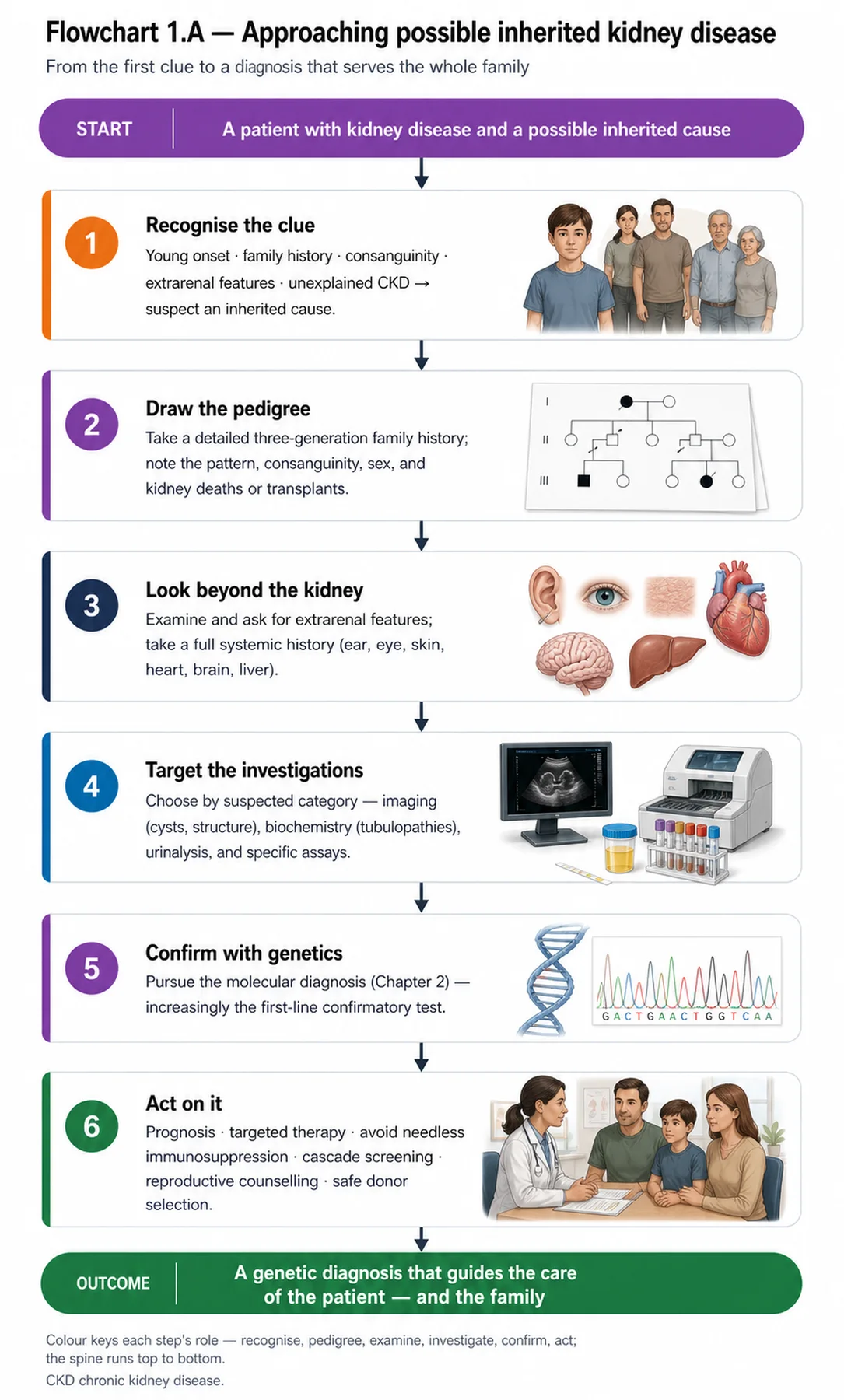
The structured approach is to recognise the clue, take a detailed three-generation pedigree, examine for extrarenal features, perform targeted investigations, and proceed to genetic testing.
A detailed family history and pedigree is the single most informative and most neglected step.
Extrarenal features — deafness in Alport, angiokeratomas in Fabry, skin lesions in tuberous sclerosis — often reveal the diagnosis.
The genetic diagnosis is not merely academic: it changes the care of the patient and the family.
This chapter is the map and the method for the inherited and cystic kidney diseases that the rest of the volume details.
| 03 | PHASE A · LEVEL 3 · ORIENTATION & KNOWLEDGE Main Narrative |
A surprising amount of kidney disease is written in the genes. Inherited kidney diseases account for a large share of chronic and end-stage disease — more in the young, more where there is a family history — and they are routinely missed, mislabelled as 'hypertensive' or 'unknown' CKD. Yet making the genetic diagnosis changes everything: the prognosis, the treatment, the screening of relatives, the reproductive choices, the choice of a living donor. This opening chapter is the map of the inherited kidney diseases and the method for reaching their diagnosis, which the rest of the volume builds on.
— Why inherited kidney disease matters
Inherited kidney disease is common and consequential, yet under-recognised. A substantial fraction of all chronic and end-stage kidney disease has a genetic basis — and the proportion is much higher in particular groups: those with young-onset disease, a family history of kidney disease, consanguinity, or extrarenal features. Much of it is missed, because a patient with a slowly progressive CKD and some hypertension is easily labelled 'hypertensive nephropathy' or 'CKD of uncertain cause' when the true cause is genetic. This matters for several concrete reasons. A genetic diagnosis gives a precise prognosis (the natural history of ADPKD or Alport differs greatly from generic CKD); it directs targeted therapy (tolvaptan in ADPKD, enzyme replacement in Fabry); it can spare a patient unnecessary and harmful immunosuppression given for a presumed glomerulonephritis that is actually an inherited disease; it enables cascade screening of at-risk relatives (who can be diagnosed early, monitored, and treated); it informs reproductive decisions; and it allows safe selection of living kidney donors (avoiding donation by an affected or carrier relative). The cost of making the diagnosis is the cost of a pedigree and a test; the cost of missing it is a wrong prognosis, wrong treatment, and a family left unscreened.
— The categories: a map
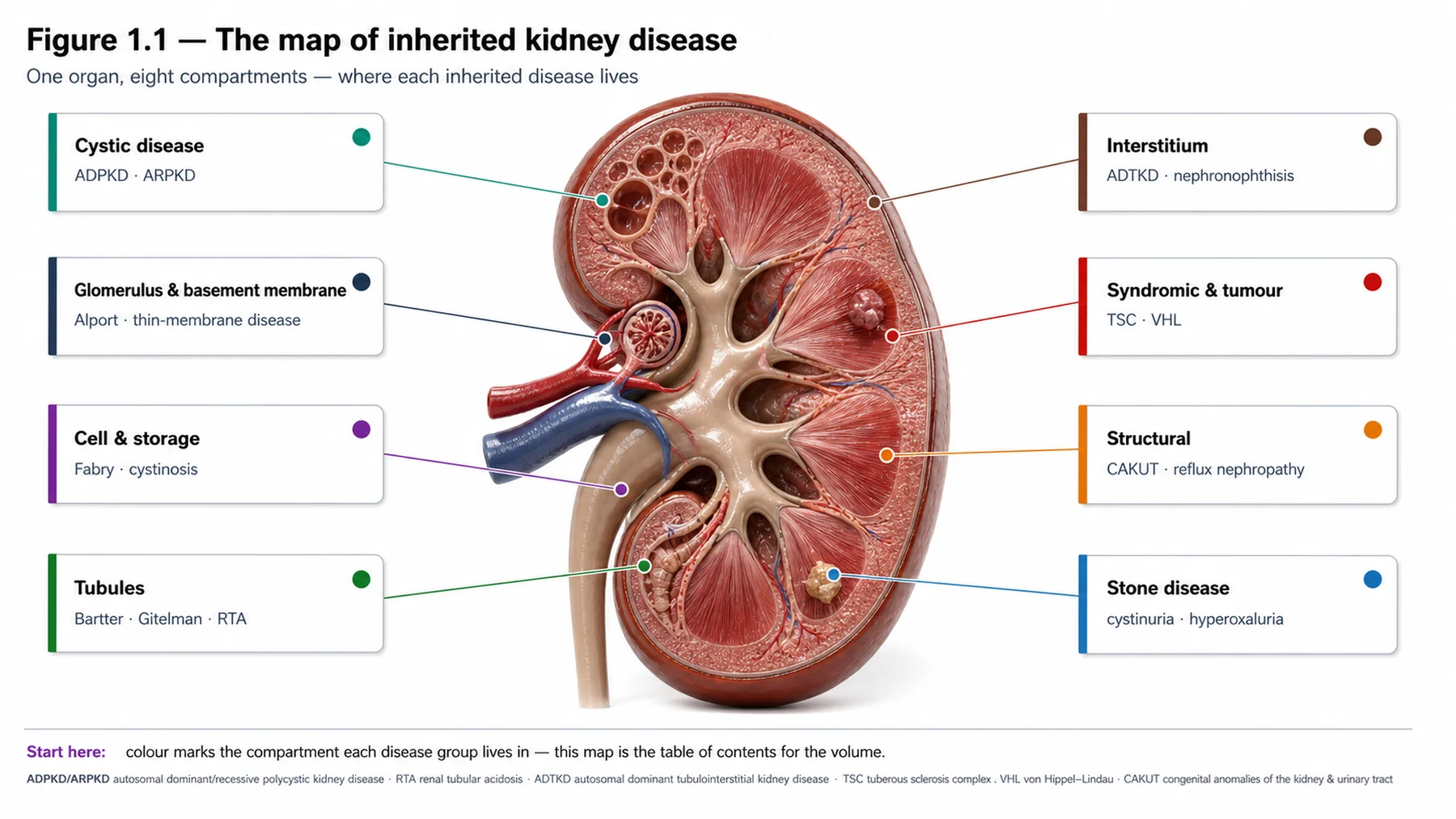
The inherited kidney diseases are most usefully organised by the part of the kidney they affect — a map that orients the whole volume. The cystic diseases (autosomal dominant and recessive polycystic kidney disease) are the largest and most familiar group. The inherited glomerular and basement-membrane diseases centre on Alport syndrome (and thin basement membrane disease). The metabolic and storage diseases are exemplified by Fabry disease. The inherited tubulopathies (Bartter, Gitelman, Liddle, Dent, and others) affect specific tubular transporters. The inherited tubulointerstitial diseases include autosomal dominant tubulointerstitial kidney disease and nephronophthisis. The syndromic diseases and phakomatoses (tuberous sclerosis, von Hippel-Lindau) affect the kidney among multiple organs. The structural disorders are the congenital anomalies of the kidney and urinary tract. And inherited stone disease (primary hyperoxaluria, cystinuria) is a further group. This categorisation — cystic, glomerular, metabolic, tubular, tubulointerstitial, syndromic, structural, stone — is the table of contents of the volume and the framework for thinking about which inherited disease a patient might have.
— Inheritance patterns and the pedigree
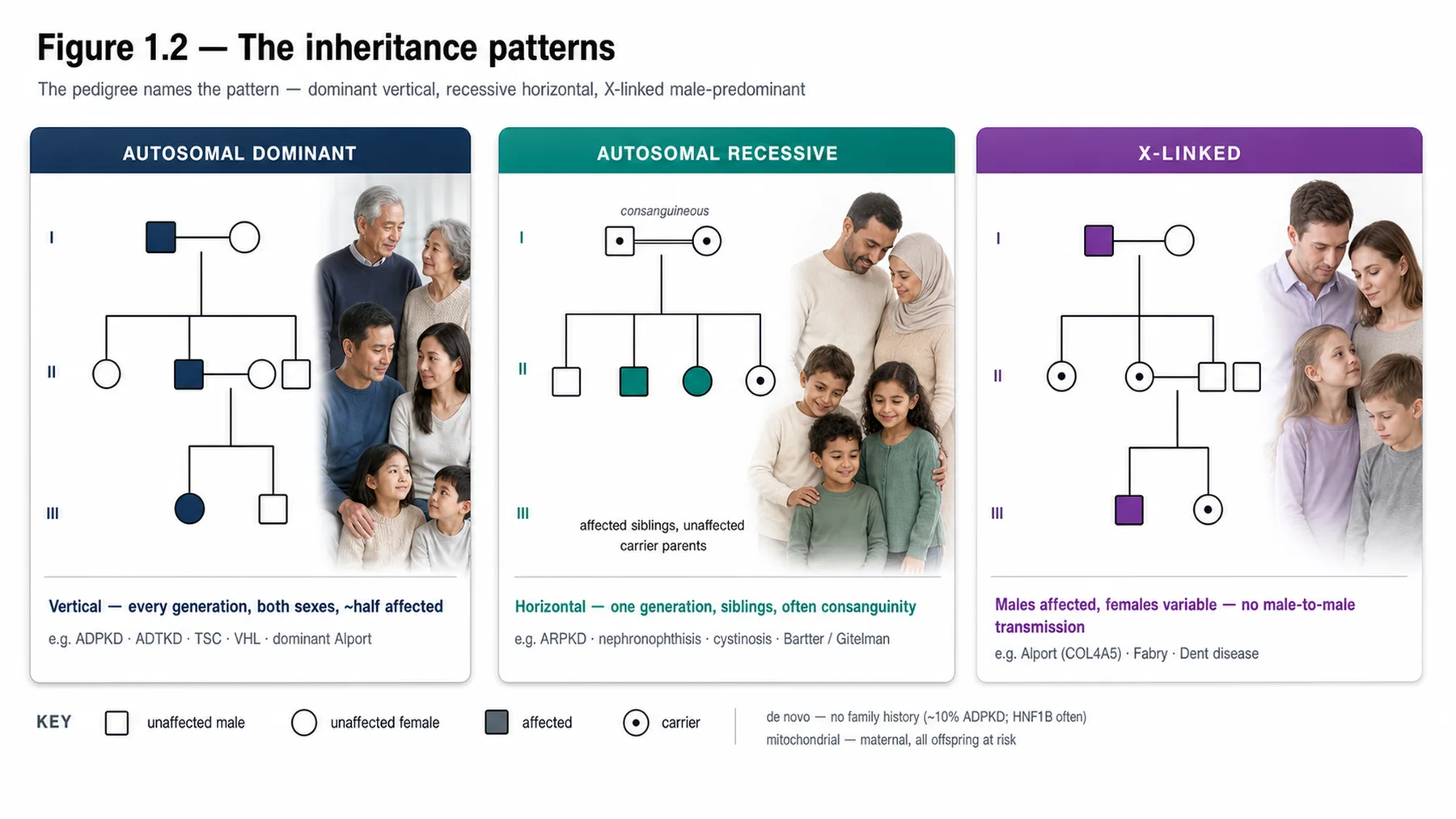
Each inherited kidney disease follows an inheritance pattern, and recognising the pattern from the family tree is central to the diagnosis. Autosomal dominant diseases (ADPKD, ADTKD, von Hippel-Lindau, tuberous sclerosis) show vertical transmission — affected individuals in every generation, roughly half the offspring affected, both sexes equally — though with variable expressivity and penetrance, so relatives may be mildly or differently affected. Autosomal recessive diseases (ARPKD, nephronophthisis, cystinosis, primary hyperoxaluria) typically appear in a single generation (affected siblings, unaffected parents), are more common with parental consanguinity, and affect both sexes. X-linked diseases (Alport in its common form, Fabry, Dent) affect males more severely, with females (carriers) variably affected through X-inactivation. There are also mitochondrial diseases (maternal transmission), de novo mutations (no family history, which does not exclude a genetic cause), and digenic or oligogenic inheritance. The practical skill is to take a detailed three-generation family history and draw a pedigree — the single most informative and most neglected step in inherited kidney disease — because the pattern of affected and unaffected relatives, the presence of consanguinity, and the sex distribution narrow the diagnosis before any test is sent. A 'negative' family history must be interpreted cautiously, as it may reflect a recessive disease, a de novo mutation, variable penetrance, or simply incomplete information.
— The clinical clues and the extrarenal features
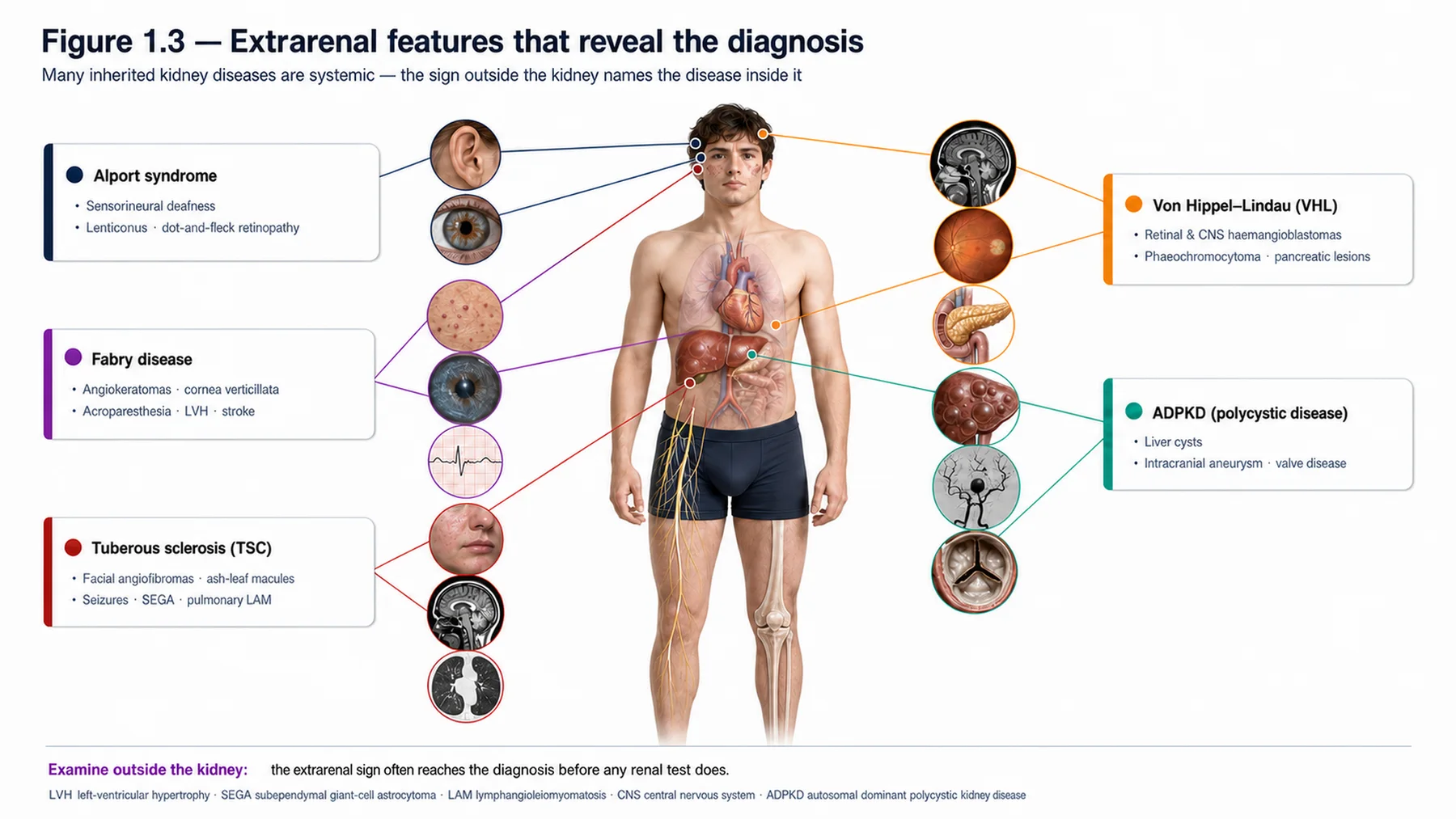
Several clinical clues should raise suspicion of an inherited kidney disease and trigger the structured approach. The strongest are young-onset kidney disease (especially without the usual acquired causes), a positive family history of kidney disease or of dialysis/transplantation, and consanguinity. Others include characteristic imaging (cysts), specific biochemistry (a tubulopathy's electrolyte pattern), and the absence of a clear acquired cause for the CKD. But among the most powerful clues are the extrarenal features, because many inherited kidney diseases are systemic, and the non-renal manifestation often reveals the diagnosis: sensorineural deafness and eye changes in Alport syndrome; angiokeratomas, neuropathic pain, and cardiac and neurological involvement in Fabry disease; the skin lesions, seizures, and tumours of tuberous sclerosis; the haemangioblastomas and other tumours of von Hippel-Lindau; the liver involvement of polycystic disease. So the assessment of a possible inherited kidney disease deliberately looks beyond the kidney — asking about and examining for the extrarenal features — because a deaf young man with haematuria, or a man with neuropathic pain and angiokeratomas, carries the diagnosis on the surface. The extrarenal features are often the key that unlocks the renal diagnosis.
— The structured approach, and the value of the diagnosis
Putting it together, the approach to a possible inherited kidney disease is structured and stepwise. First, recognise the clue — young onset, family history, consanguinity, extrarenal features, characteristic findings, or unexplained CKD. Second, take a detailed three-generation family history and draw a pedigree, noting affected and unaffected relatives, consanguinity, sex distribution, and any deaths or transplants attributable to kidney disease. Third, examine for extrarenal features and take a systemic history. Fourth, perform targeted investigations — imaging (for cysts and structure), biochemistry (for tubulopathies), urinalysis, and specific tests (such as a Fabry enzyme assay) — guided by the suspected category. Fifth, proceed to genetic testing (the subject of the next chapter), which increasingly provides a precise molecular diagnosis. And then, with the diagnosis, comes the payoff: a precise prognosis, targeted therapy where it exists, the avoidance of inappropriate treatment, cascade screening of relatives, reproductive counselling, and safe donor selection. The genetic diagnosis is not an end in itself but the gateway to better care for the patient and the family — which is why the structured approach, beginning with the much-neglected pedigree, is worth the effort. The chapters that follow take each category in turn, but they all rest on this foundation: recognise the clue, take the pedigree, look beyond the kidney, test, and let the diagnosis guide the care.
| 04 | PHASE A · LEVEL 4 · ORIENTATION & KNOWLEDGE Reference Tables |
Table 1.1 — Why inherited kidney disease matters
| Reason | Detail |
| Common, underdiagnosed | A large share of CKD/ESKD — more in the young/familial; often mislabelled |
| Prognosis & therapy | Precise prognosis; targeted treatment (tolvaptan, enzyme replacement) |
| Avoid harm | Spares unnecessary immunosuppression for a presumed glomerulonephritis |
| Family & reproduction | Cascade screening of relatives; reproductive counselling; safe donor selection |
Table 1.2 — The categories (the map)
| Category | Examples |
| Cystic | ADPKD, ARPKD |
| Glomerular / basement membrane | Alport syndrome, thin basement membrane disease |
| Metabolic / storage | Fabry disease |
| Tubular / tubulointerstitial | Inherited tubulopathies; ADTKD, nephronophthisis |
| Syndromic / structural / stone | Tuberous sclerosis, von Hippel-Lindau; CAKUT; inherited stone disease |
Table 1.3 — Inheritance patterns and pedigree signatures
| Pattern | Pedigree signature | Examples |
| Autosomal dominant | Vertical; ~half offspring; both sexes; variable expression | ADPKD, ADTKD, VHL, TSC |
| Autosomal recessive | Siblings affected, parents not; consanguinity | ARPKD, nephronophthisis, cystinosis |
| X-linked | Males affected; females variable | Alport (common), Fabry, Dent |
| Other | Mitochondrial (maternal); de novo (no family history) | — |
Table 1.4 — Clinical clues to an inherited cause
| Clue | Detail |
| Young onset | Especially without an acquired cause |
| Family history / consanguinity | Kidney disease, dialysis, or transplant in relatives; parental consanguinity |
| Extrarenal features | Deafness (Alport), angiokeratomas (Fabry), skin/tumours (TSC/VHL) |
| Characteristic findings | Cysts on imaging; a tubulopathy's biochemistry; unexplained CKD |
Table 1.5 — The structured approach
| Step | Action |
| 1. Recognise the clue | Young onset, family history, consanguinity, extrarenal features, unexplained CKD |
| 2. Pedigree | Detailed three-generation family history — the most informative, most neglected step |
| 3. Look beyond the kidney | Examine and ask for extrarenal features (systemic history) |
| 4. Targeted investigation | Imaging, biochemistry, urinalysis, specific assays by suspected category |
| 5. Genetic testing | Precise molecular diagnosis (Chapter 2) |
Table 1.6 — The value of a genetic diagnosis
| Benefit | Detail |
| Prognosis | Precise natural history (differs from generic CKD) |
| Targeted therapy / avoid harm | Tolvaptan, enzyme replacement; avoid unnecessary immunosuppression |
| Cascade screening | Early diagnosis, monitoring, and treatment of at-risk relatives |
| Reproduction & donation | Reproductive counselling; safe related-donor selection |
| 05 | PHASE B · LEVEL 5 · VISUALISE & MAP Imaging & Flowchart Specifications |
| 06 | PHASE B · LEVEL 6 · VISUALISE & MAP Concept Maps |
Each chain runs from principle to a named clinical action; read the arrows as “leads to.”
Why it matters. Inherited disease is common and underdiagnosed → a genetic diagnosis gives prognosis, targeted therapy, family screening, and donor safety → ACTION: actively consider an inherited cause, especially in young/familial CKD.
The categories. Cystic / glomerular / metabolic / tubular / tubulointerstitial / syndromic / structural / stone → a map by compartment → ACTION: use the category map to focus the differential and the targeted investigation.
Inheritance patterns. Autosomal dominant (vertical), recessive (siblings/consanguinity), X-linked (males) → each with a pedigree signature → ACTION: take a three-generation pedigree to read the pattern and narrow the diagnosis.
Extrarenal clues. Many inherited kidney diseases are systemic → deafness, angiokeratomas, skin/tumours → the non-renal feature reveals the renal diagnosis → ACTION: look beyond the kidney.
The value of the diagnosis. A precise molecular diagnosis → prognosis + targeted therapy + avoided harm + cascade screening + reproductive/donor decisions → ACTION: pursue the diagnosis and act on it for the patient and the family.
| 07 | PHASE B · LEVEL 7 · VISUALISE & MAP Decision Pathways |
| R1 | IF a patient has young-onset, familial, consanguineous, or unexplained kidney disease, THEN actively consider an inherited cause. |
| R2 | IF an inherited cause is suspected, THEN take a detailed three-generation family history and draw a pedigree — the most informative step. |
| R3 | IF taking a pedigree, THEN read the pattern — vertical (dominant), siblings/consanguinity (recessive), male-predominant (X-linked) — to narrow the diagnosis. |
| R4 | IF the family history is 'negative', THEN interpret it cautiously — it may reflect a recessive disease, a de novo mutation, variable penetrance, or incomplete information. |
| R5 | IF assessing a possible inherited kidney disease, THEN look beyond the kidney for the extrarenal features that often reveal the diagnosis. |
| R6 | IF a category is suspected, THEN perform the targeted investigation — imaging for cysts, biochemistry for tubulopathies, specific assays. |
| R7 | IF a precise diagnosis is needed, THEN proceed to genetic testing (and counselling). |
| R8 | IF a genetic diagnosis is made, THEN act on it — prognosis, targeted therapy, avoiding unnecessary immunosuppression, cascade screening, reproductive counselling, and donor selection. |
| 08 | PHASE C · LEVEL 8 · CLINICAL REASONING Clinical Cases |
| CASE 1 | TOO YOUNG, TOO FAMILIAL Suspect an inherited cause Young-onset familial CKD |
Presentation
A patient in their thirties has progressive CKD labelled 'hypertensive nephropathy,' with a father and an uncle who reached dialysis at a similar age. No one has taken a family history or considered a genetic cause.
❖ Pause and reflect Is 'hypertensive nephropathy' the right label here? |
Analysis
Probably not — the young onset and the strong family history point to an inherited kidney disease that has been mislabelled. Progressive CKD in a young adult with affected first-degree relatives reaching dialysis at a similar age is a classic presentation of an inherited disease (the vertical transmission suggesting an autosomal dominant condition such as ADPKD or ADTKD), and the 'hypertensive nephropathy' label — a common dumping ground for unexplained CKD — obscures it. The missing step is a detailed three-generation family history and pedigree, which would reveal the pattern, followed by targeted investigation (imaging for cysts) and genetic testing. Making the genetic diagnosis would give a precise prognosis, enable screening of the patient's relatives, and inform reproductive and donor decisions — none of which the generic label provides.
Plan
Reconsider the diagnosis, take a detailed three-generation family history and pedigree, examine for extrarenal features, investigate by category (imaging), and pursue genetic testing — then act on the diagnosis for the patient and family. Suspect an inherited cause in young-onset familial CKD.
Teaching point
Young-onset familial CKD mislabelled 'hypertensive nephropathy' is a classic missed inherited disease — take a pedigree and pursue the genetic diagnosis.
Cross-reference
Exercises rules R1 and R2; the why-it-matters and inheritance concept maps; Figure 1.2; Tables 1.1, 1.4.
| CASE 2 | LOOK BEYOND THE KIDNEY Extrarenal features reveal it The systemic clue |
Presentation
A young man with haematuria and proteinuria is being worked up for glomerulonephritis. On questioning, he has progressive sensorineural deafness, and a maternal uncle had kidney failure.
❖ Pause and reflect What does the deafness add to the renal picture? |
Analysis
The deafness is the key that unlocks the diagnosis — this is Alport syndrome, not a generic glomerulonephritis. Alport syndrome is an inherited basement-membrane disease (commonly X-linked, fitting the affected maternal uncle) whose hallmark extrarenal feature is sensorineural deafness (with characteristic eye changes), accompanying the haematuria and progressive renal disease. Many inherited kidney diseases are systemic, and the extrarenal feature often reveals the renal diagnosis — a deaf young man with haematuria and an affected maternal-line relative carries Alport on the surface. Recognising it changes the work-up (towards Alport, not an immune glomerulonephritis), avoids inappropriate immunosuppression, and triggers family screening and counselling. Looking beyond the kidney made the diagnosis.
Plan
Recognise the likely Alport syndrome from the deafness, family pattern, and renal findings; confirm (genetics, and the eye/basement-membrane features), avoid inappropriate immunosuppression, and arrange family screening and counselling. Look beyond the kidney — the extrarenal feature reveals the diagnosis.
Teaching point
Extrarenal features often reveal the renal diagnosis — sensorineural deafness with haematuria points to Alport syndrome, not a generic glomerulonephritis.
Cross-reference
Exercises rule R5; the extrarenal-clues concept map; Figure 1.3; Table 1.4; Alport in Chapter 8.
| CASE 3 | THE CONSANGUINEOUS FAMILY Recognise the recessive pattern Autosomal recessive disease |
Presentation
A child of consanguineous parents has kidney disease, and an older sibling is similarly affected while the parents are healthy. A clinician, finding the parents unaffected, doubts a genetic cause.
❖ Pause and reflect Do healthy parents exclude an inherited cause here? |
Analysis
No — healthy parents with two affected children and consanguinity is the classic picture of an autosomal recessive inherited kidney disease. In recessive inheritance, the disease appears in a single generation (affected siblings) with unaffected carrier parents, and parental consanguinity markedly increases the risk by making it more likely both parents carry the same recessive variant. So the unaffected parents do not argue against a genetic cause — they fit a recessive pattern (ARPKD, nephronophthisis, cystinosis, or primary hyperoxaluria, depending on the features). The pedigree pattern — affected siblings, unaffected consanguineous parents — should prompt recessive-disease testing, not reassurance. This is why a 'negative' family history (no affected parents) must be interpreted in the light of the inheritance pattern.
Plan
Recognise the autosomal recessive pattern (affected siblings, unaffected consanguineous parents), investigate for the recessive inherited kidney diseases by the features, and pursue genetic testing and counselling. Healthy parents do not exclude a recessive inherited disease.
Teaching point
Affected siblings with healthy consanguineous parents is the autosomal recessive pattern — unaffected parents do not exclude an inherited cause.
Cross-reference
Exercises rules R3 and R4; the inheritance concept map; Figure 1.2; Table 1.3.
| CASE 4 | THE DIAGNOSIS CHANGES EVERYTHING Act on the genetic diagnosis The value of diagnosis |
Presentation
A patient with an inherited kidney disease newly confirmed by genetic testing is about to be treated, screened, and counselled, and a relative has offered to be a living kidney donor. A trainee asks what the genetic diagnosis actually changes.
❖ Pause and reflect What does the genetic diagnosis change in this patient's care? |
Analysis
A great deal — the genetic diagnosis is the gateway to better care across several domains. It gives a precise prognosis (the natural history of the specific disease, not generic CKD). It directs targeted therapy where one exists (tolvaptan, enzyme replacement) and avoids inappropriate treatment (sparing immunosuppression for what is not an immune disease). It enables cascade screening of at-risk relatives, who can be diagnosed early and monitored. It informs reproductive counselling. And — directly relevant here — it allows safe living-donor selection: the relative offering to donate must be tested to ensure they do not carry the disease (donating an affected or at-risk kidney would harm both donor and recipient). So the genetic diagnosis changes the prognosis, the treatment, the family screening, the reproductive advice, and the donor work-up. It is not academic; it reshapes the care of the patient and the whole family.
Plan
Use the genetic diagnosis to set the prognosis, direct targeted therapy and avoid inappropriate treatment, arrange cascade screening and reproductive counselling, and test the potential related donor before accepting the donation. Act on the genetic diagnosis for the patient and family.
Teaching point
A genetic diagnosis changes prognosis, targeted therapy, avoidance of harm, cascade screening, reproductive counselling, and — critically — safe related-donor selection.
Cross-reference
Exercises rule R8; the value-of-diagnosis concept map; Table 1.6; genetic counselling in Chapter 2; reproductive/donor decisions in Chapter 17.
| 09 | PHASE C · LEVEL 9 · CLINICAL REASONING Clinical Implications |
One triad per mechanism the narrative exposed: the idea, why it matters, and the clinical move.
MECHANISM A large share of CKD — especially young-onset and familial — is inherited and underdiagnosed. |
WHY IT MATTERS It is easily mislabelled, with the wrong prognosis, treatment, and family care. |
ACTION Actively consider an inherited cause in young, familial, or unexplained CKD. |
MECHANISM Inherited kidney diseases group by the compartment they affect. |
WHY IT MATTERS The category map focuses the differential and the targeted investigation. |
ACTION Use the map — cystic, glomerular, metabolic, tubular, interstitial, syndromic, structural, stone. |
MECHANISM Each disease follows an inheritance pattern with a pedigree signature. |
WHY IT MATTERS The pattern narrows the diagnosis before any test is sent. |
ACTION Take a three-generation pedigree and read the pattern. |
MECHANISM Many inherited kidney diseases are systemic. |
WHY IT MATTERS The extrarenal feature often reveals the renal diagnosis. |
ACTION Look beyond the kidney for deafness, angiokeratomas, skin lesions, and tumours. |
MECHANISM A genetic diagnosis is the gateway to targeted care. |
WHY IT MATTERS It changes prognosis, therapy, family screening, reproduction, and donor selection. |
ACTION Pursue the diagnosis and act on it for the patient and the family. |
| 10 | PHASE C · LEVEL 10 · CLINICAL REASONING Clinical Pearls |
| A large share of CKD/ESKD is inherited — more in the young and familial. | Inherited disease is commonly mislabelled (e.g. 'hypertensive nephropathy'). |
| A genetic diagnosis changes prognosis, therapy, screening, reproduction, donation. | Categories: cystic, glomerular/basement membrane, metabolic, tubular, tubulointerstitial, syndromic, structural, stone. |
| Autosomal dominant: vertical, ~half offspring, both sexes, variable expression. | Autosomal recessive: affected siblings, unaffected parents, consanguinity. |
| X-linked: males affected, females variable (Alport, Fabry, Dent). | A 'negative' family history does NOT exclude a genetic cause. |
| Clues: young onset, family history, consanguinity, extrarenal features, unexplained CKD. | Extrarenal features often reveal the diagnosis (deafness → Alport; angiokeratomas → Fabry). |
| Take a detailed THREE-GENERATION pedigree — the most informative, most neglected step. | Examine beyond the kidney; take a systemic history. |
| Targeted investigation by category (imaging, biochemistry, specific assays). | Genetic testing gives the precise molecular diagnosis. |
| Avoid unnecessary immunosuppression for an inherited disease. | The diagnosis enables cascade screening and safe related-donor selection. |
| 11 | PHASE D · LEVEL 11 · SAFETY & EVIDENCE Red Flags & Never-Do |
Panel A — Red flags
| ▲ | Young-onset CKD labelled 'hypertensive' or 'uncertain' — consider an inherited cause and take a pedigree. |
| ▲ | A family history of kidney disease, dialysis, or transplant — pursue the inherited diagnosis. |
| ▲ | Extrarenal features (deafness, angiokeratomas, skin lesions, tumours) — they may reveal the renal diagnosis. |
| ▲ | Affected siblings with healthy consanguineous parents — an autosomal recessive disease, not exclusion. |
| ▲ | A related living-donor offer in inherited disease — test the donor for the disease before accepting. |
Panel B — Never do
| ✖ NEVER — label young-onset familial CKD generically without considering an inherited cause. |
| ✖ NEVER — take 'no affected parents' as excluding a genetic disease. |
| ✖ NEVER — omit the three-generation family history and pedigree. |
| ✖ NEVER — accept a related living donor in inherited disease without testing them. |
| 12 | PHASE D · LEVEL 12 · SAFETY & EVIDENCE Common Pitfalls |
Pitfall 1 — The generic label
| ✖ | WRONG Labelling young-onset familial CKD 'hypertensive nephropathy.' |
| ✓ | RIGHT Considering and pursuing an inherited cause. |
| ✉ | WHY Inherited disease is common in this setting and is easily mislabelled. |
Pitfall 2 — Skipping the pedigree
| ✖ | WRONG Working up a possible inherited disease without a family history. |
| ✓ | RIGHT Taking a detailed three-generation pedigree. |
| ✉ | WHY The pedigree is the most informative step and narrows the diagnosis. |
Pitfall 3 — Misreading a negative family history
| ✖ | WRONG Excluding a genetic cause because no parent is affected. |
| ✓ | RIGHT Interpreting it in light of recessive inheritance, de novo mutation, and penetrance. |
| ✉ | WHY A negative family history does not exclude a genetic disease. |
Pitfall 4 — Ignoring the extrarenal
| ✖ | WRONG Focusing only on the kidney in a systemic inherited disease. |
| ✓ | RIGHT Looking beyond the kidney for the revealing extrarenal feature. |
| ✉ | WHY Many inherited kidney diseases are systemic. |
Pitfall 5 — An untested related donor
| ✖ | WRONG Accepting a related living donor without testing for the disease. |
| ✓ | RIGHT Testing the donor before accepting the donation. |
| ✉ | WHY An affected or at-risk donor would harm both donor and recipient. |
| 13 | PHASE D · LEVEL 13 · SAFETY & EVIDENCE Evidence Grading |
GRADE A HIGH CONFIDENCE The effect is real and the estimate is stable. RCTs at low risk of bias; multiple concordant prospective cohorts; meta-analyses. |
GRADE B MODERATE CONFIDENCE The effect is likely real but may shift with new data. Observational studies, registries, mechanistic human studies. |
GRADE C LOW CONFIDENCE Rests on physiology, reasoning, or consensus rather than outcomes. Pathophysiological reasoning; extrapolation; consensus without outcomes. |
Graded statements (by evidence type)
| Statement | Grade | Basis (evidence type) |
| A substantial fraction of CKD/ESKD has a genetic basis. | A | Epidemiological and genomic data |
| A genetic diagnosis changes management and family care. | A | Clinical data and guidelines |
| Inheritance patterns produce recognisable pedigree signatures. | A | Established genetics |
| A negative family history does not exclude a genetic cause. | A | Established genetics |
| Extrarenal features frequently reveal the renal diagnosis. | A | Clinical data |
| Cascade screening benefits at-risk relatives. | A | Clinical data and guidelines |
| Related living donors must be tested for the inherited disease. | A | Transplant guidelines |
| 18 | PHASE F · LEVEL 18 · APPLY & TEST Cheat Sheet |
| Much CKD/ESKD is inherited — more in the young/familial; often mislabelled. | Genetic diagnosis changes prognosis, therapy, screening, reproduction, donation. |
| Categories: cystic, glomerular/BM, metabolic, tubular, tubulointerstitial, syndromic, structural, stone. | AD: vertical, ~half offspring, variable expression. |
| AR: siblings affected, parents not, consanguinity. | X-linked: males affected, females variable. |
| Negative family history does NOT exclude a genetic cause. | Clues: young onset, family history, consanguinity, extrarenal features, unexplained CKD. |
| Extrarenal features reveal the diagnosis (deafness → Alport; angiokeratomas → Fabry). | Take a THREE-GENERATION pedigree (most informative, most neglected). |
| Look beyond the kidney. | Targeted Ix by category (imaging/biochemistry/assays). |
| Genetic testing → molecular diagnosis (Ch 2). | Avoid unnecessary immunosuppression. |
| Cascade-screen relatives. | Test related donors before accepting. |
| 19 | PHASE F · LEVEL 19 · APPLY & TEST Flashcards |
| CARD 1 | Q. Why does inherited kidney disease matter? A. Because a substantial fraction of chronic and end-stage kidney disease is genetic (especially the young-onset and familial cases) and is often underdiagnosed, and because a genetic diagnosis sharpens the prognosis, directs targeted therapy, avoids unnecessary immunosuppression, enables family screening, and informs reproductive and donor decisions. DETAILED. It is often mislabelled as 'hypertensive' or 'uncertain' CKD. CLINICAL. Actively consider an inherited cause and pursue the diagnosis. |
| CARD 2 | Q. What are the categories of inherited kidney disease? A. Cystic (ADPKD, ARPKD), glomerular and basement-membrane (Alport), metabolic and storage (Fabry), tubular and tubulointerstitial (the inherited tubulopathies, ADTKD, nephronophthisis), syndromic and phakomatoses (tuberous sclerosis, von Hippel-Lindau), structural (CAKUT), and inherited stone disease. DETAILED. It is a map by the compartment affected. CLINICAL. Use the category map to focus the differential. |
| CARD 3 | Q. What are the inheritance patterns and their pedigree signatures? A. Autosomal dominant (vertical transmission, about half the offspring, both sexes, variable expression — ADPKD, ADTKD), autosomal recessive (affected siblings, unaffected parents, consanguinity — ARPKD, nephronophthisis), and X-linked (males affected, females variable — Alport, Fabry); plus mitochondrial and de novo. DETAILED. The pattern shows in the pedigree. CLINICAL. Read the pattern from a three-generation pedigree. |
| CARD 4 | Q. Why must a 'negative' family history be interpreted cautiously? A. Because it may reflect a recessive disease (unaffected carrier parents), a de novo mutation (no affected relatives), variable penetrance or expressivity, or simply incomplete information — none of which excludes a genetic cause. DETAILED. Healthy parents with affected siblings is the recessive pattern. CLINICAL. Never take a negative family history as excluding inherited disease. |
| CARD 5 | Q. What clinical clues should prompt suspicion of an inherited kidney disease? A. Young-onset kidney disease, a positive family history (kidney disease, dialysis, transplant), consanguinity, extrarenal features suggesting a syndrome, characteristic imaging or biochemistry, and the absence of an acquired cause. DETAILED. These raise the pre-test probability of a genetic cause. CLINICAL. Recognise the clues and start the structured approach. |
| CARD 6 | Q. Why look beyond the kidney in inherited disease? A. Because many inherited kidney diseases are systemic, and the extrarenal feature often reveals the renal diagnosis — deafness in Alport, angiokeratomas and neuropathic pain in Fabry, skin lesions and tumours in tuberous sclerosis and von Hippel-Lindau. DETAILED. The non-renal manifestation can be the key. CLINICAL. Examine and ask for the extrarenal features. |
| CARD 7 | Q. What is the structured approach to a possible inherited kidney disease? A. Recognise the clue, take a detailed three-generation family history and pedigree, examine for extrarenal features, perform targeted investigations by suspected category, and proceed to genetic testing — then act on the diagnosis. DETAILED. The pedigree is the most informative, most neglected step. CLINICAL. Follow the approach: clue, pedigree, beyond the kidney, targeted Ix, genetics. |
| CARD 8 | Q. How does a genetic diagnosis change care? A. It gives a precise prognosis, directs targeted therapy and avoids inappropriate treatment, enables cascade screening of at-risk relatives, informs reproductive counselling, and allows safe selection of living kidney donors (testing related donors before accepting). DETAILED. It is the gateway to better care for the patient and family. CLINICAL. Pursue the diagnosis and act on it across all these domains. |
| 20 | PHASE F · LEVEL 20 · APPLY & TEST One-Minute Preceptor |
| SCENE 1 | The intern with the generic label |
GET A COMMITMENT. “You've labelled this 33-year-old's CKD 'hypertensive nephropathy' — with a father and uncle on dialysis. Are you confident?”
PROBE FOR EVIDENCE. “He has hypertension” — ask: “What does young onset with affected relatives across generations suggest, and have you taken a pedigree?”
TEACH A GENERAL RULE. Young-onset familial CKD is a classic inherited disease, often mislabelled — take a three-generation pedigree and pursue the genetic diagnosis, which changes prognosis, screening, and donor decisions.
REINFORCE WHAT WAS RIGHT. Recognising the CKD and hypertension was a start.
CORRECT A MISTAKE. Take the pedigree and investigate for an inherited cause before settling on the label.
| SCENE 2 | The resident reassured by healthy parents |
GET A COMMITMENT. “You've ruled out a genetic cause because the parents are healthy — but two siblings are affected and the parents are cousins. Why rule it out?”
PROBE FOR EVIDENCE. “No parent is affected” — ask: “What inheritance pattern gives affected siblings with healthy consanguineous parents?”
TEACH A GENERAL RULE. Affected siblings with unaffected consanguineous parents is the autosomal recessive pattern — healthy parents do not exclude a genetic disease.
REINFORCE WHAT WAS RIGHT. Checking the parents was reasonable.
CORRECT A MISTAKE. Recognise the recessive pattern and test for a recessive inherited disease.
| 22 | PHASE F · LEVEL 22 · APPLY & TEST Board-Style Questions |
| Q 01 | Young-onset CKD with affected relatives across generations should prompt: |
| A | A label of 'hypertensive nephropathy' |
| B | Suspicion of an inherited kidney disease and a pedigree |
| C | Reassurance |
| D | Immediate immunosuppression |
Rationale Young-onset familial CKD is a classic inherited disease, often mislabelled (case 1, Tables 1.1, 1.4, rule R1). A is the dumping-ground label; C and D are wrong. |
| Q 02 | Sensorineural deafness with haematuria and an affected maternal uncle suggests: |
| A | A generic glomerulonephritis |
| B | Alport syndrome |
| C | A urinary tract infection |
| D | Hypertension |
Rationale Deafness with haematuria and X-linked-pattern relatives points to Alport (case 2, Figure 1.3, Table 1.4). A, C, and D miss the extrarenal clue. |
| Q 03 | Affected siblings with healthy, consanguineous parents indicate which pattern? |
| A | Autosomal dominant |
| B | Autosomal recessive |
| C | X-linked dominant |
| D | Mitochondrial |
Rationale This is the autosomal recessive pattern, made more likely by consanguinity (case 3, Figure 1.2, Table 1.3). A, C, and D do not fit. |
| Q 04 | A 'negative' family history in a patient with suspected inherited kidney disease: |
| A | Excludes a genetic cause |
| B | Does not exclude it — recessive disease, de novo mutation, or variable penetrance |
| C | Means the disease is acquired |
| D | Requires no further thought |
Rationale A negative family history is interpreted cautiously and does not exclude a genetic cause (rule R4). A, C, and D are incorrect. |
| Q 05 | The single most informative (and most neglected) step in diagnosing inherited kidney disease is: |
| A | A renal biopsy |
| B | A detailed three-generation family history and pedigree |
| C | A CT scan |
| D | Serum creatinine |
Rationale The pedigree narrows the diagnosis before any test (Table 1.5, rule R2). A, C, and D are secondary to the pedigree here. |
| Q 06 | Why look beyond the kidney in inherited kidney disease? |
| A | It is unnecessary |
| B | Many are systemic, and the extrarenal feature often reveals the diagnosis |
| C | Only the kidney is affected |
| D | To save time |
Rationale Extrarenal features frequently reveal the renal diagnosis (Figure 1.3, Table 1.4, rule R5). A, C, and D are wrong. |
| Q 07 | Inherited kidney diseases are usefully categorised by: |
| A | Age of onset only |
| B | The kidney compartment affected (cystic, glomerular, metabolic, tubular, interstitial, syndromic, structural, stone) |
| C | Severity alone |
| D | Sex |
Rationale The compartment-based map organises the differential and the volume (Figure 1.1, Table 1.2). A, C, and D are inadequate. |
| Q 08 | Before accepting a related living kidney donor in inherited disease, you must: |
| A | Accept them without testing |
| B | Test the donor for the inherited disease |
| C | Decline all related donors |
| D | Test only the recipient |
Rationale A related donor must be tested to avoid donating an affected or at-risk kidney (case 4, Table 1.6, rule R8). A, C, and D are wrong. |