Chapter Preamble
Signals declared
Sig-D — Diagnostic (primary). Know the reproductive options, the predictive-testing and donation questions, and the assessment of pregnancy in inherited kidney disease.
Sig-T — Therapeutic (strong). Support the chosen reproductive path, test related donors, optimise drugs and disease before pregnancy, and manage pregnancy in inherited kidney disease.
Sig-E — Preference-sensitive (strong). Reproductive choices, testing of children, and donation are among the most values-driven decisions in medicine — the clinician informs and supports non-directively.
Levels populated and omitted
Populated (20): L1–L5, L7, L8, L10–L22. The preference signal fires the absolute-risk table (L14), the preference-sensitive map (L15), the shared-decision scripts (L16), and the reflective prompts (L21); the therapeutic signal fires the templates (L17); the diagnostic signal drives the tables, rules, cases, pitfalls, and board items.
L6 / L9 mechanism levels — omitted. No Sig-M; this is a decision, counselling, and management chapter.
| 01 | PHASE A · LEVEL 1 · ORIENTATION & KNOWLEDGE Learning Objectives |
By the end of this chapter you should be able to:
List the reproductive options for a couple at risk of transmitting an inherited kidney disease.
Explain why these reproductive choices are deeply preference-sensitive.
Approach predictive testing of children, balancing parental wishes against the child's future autonomy.
Manage related living-donor decisions, including testing the at-risk relative.
Counsel a woman with inherited kidney disease about pregnancy.
Recognise the unsafe drugs in pregnancy and the need for pre-pregnancy planning.
Conduct a non-directive shared decision about reproduction and family testing.
Support informed, autonomous, values-based decisions in inherited kidney disease.
| 02 | PHASE A · LEVEL 2 · ORIENTATION & KNOWLEDGE Executive Summary |
A couple at risk of transmitting an inherited kidney disease has several reproductive options: natural conception with prenatal diagnosis (and the option to continue or terminate an affected pregnancy), preimplantation genetic testing with IVF (selecting unaffected embryos), natural conception accepting the risk, donor gametes, adoption, or choosing not to have children.
Each is a legitimate, values-driven choice, and there is no medically right answer.
These are among the most preference-sensitive decisions in medicine — shaped by personal, ethical, religious, and cultural values — so the clinician's role is non-directive: to inform about the options and risks and to support the couple's own decision.
Predictive testing of an asymptomatic child for an adult-onset disease is generally deferred until the child can decide, to preserve their future autonomy, unless the disease is childhood-onset or actionable in childhood.
This creates a sharp tension between a parent's wish to know and the child's right to decide later.
When a relative offers to donate a kidney, the relative must be tested to ensure they do not carry the disease — especially in ADPKD, where a young at-risk relative needs definitive exclusion by genetics or MRI, because a normal ultrasound does not exclude it.
Family dynamics and potential pressure on at-risk relatives must be navigated with counselling.
Pregnancy in inherited kidney disease requires pre-pregnancy planning: CKD and pregnancy interact (with increased pre-eclampsia and maternal and fetal risks), and several drugs are unsafe.
RAAS blockers and tolvaptan are teratogenic and contraindicated, and in transplant patients mycophenolate is teratogenic and must be switched before pregnancy.
Pre-pregnancy counselling optimises the disease and the drug regimen, assesses the risk, and plans monitoring, with pre-eclampsia surveillance and aspirin prophylaxis.
Throughout, the clinician informs and supports informed, autonomous, values-based decisions non-directively, respecting that the choices belong to the patient and family.
Inherited kidney disease is, in the end, a family matter — of reproduction, of testing relatives, of donation, and of pregnancy — and these decisions deserve the same care as the medical management.
| 03 | PHASE A · LEVEL 3 · ORIENTATION & KNOWLEDGE Main Narrative |
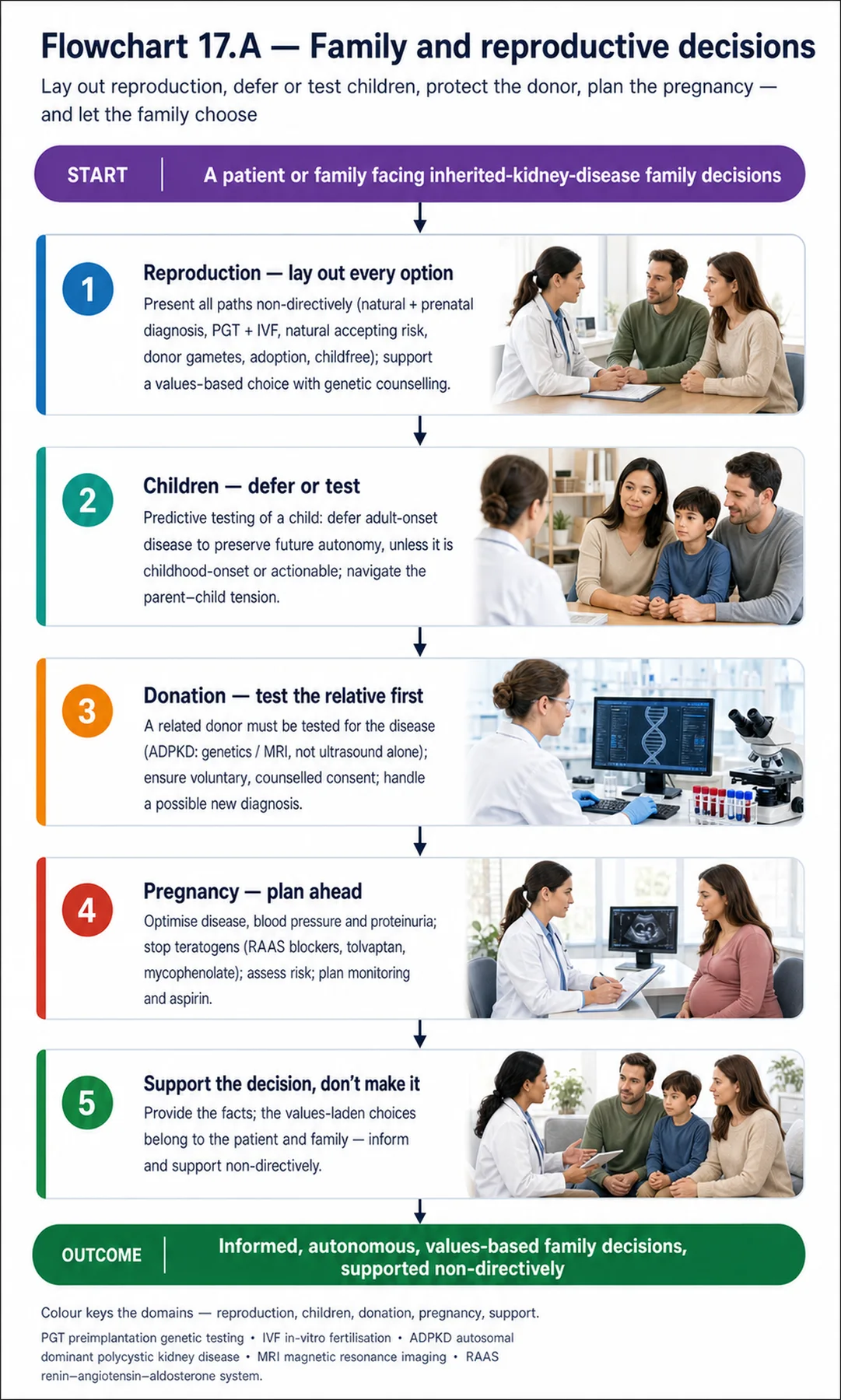
Inherited kidney disease is never only about the individual patient — it is a family matter, raising decisions about whether and how to have children, whether to test relatives and children, whether a relative should donate a kidney, and how to manage pregnancy. These decisions are among the most values-driven in all of medicine, with no medically right answer, and the clinician's role is to inform and support, not to direct. This chapter, the volume's second equipoise chapter, covers the reproductive options, predictive testing of children, related donation, and pregnancy.
— The reproductive options
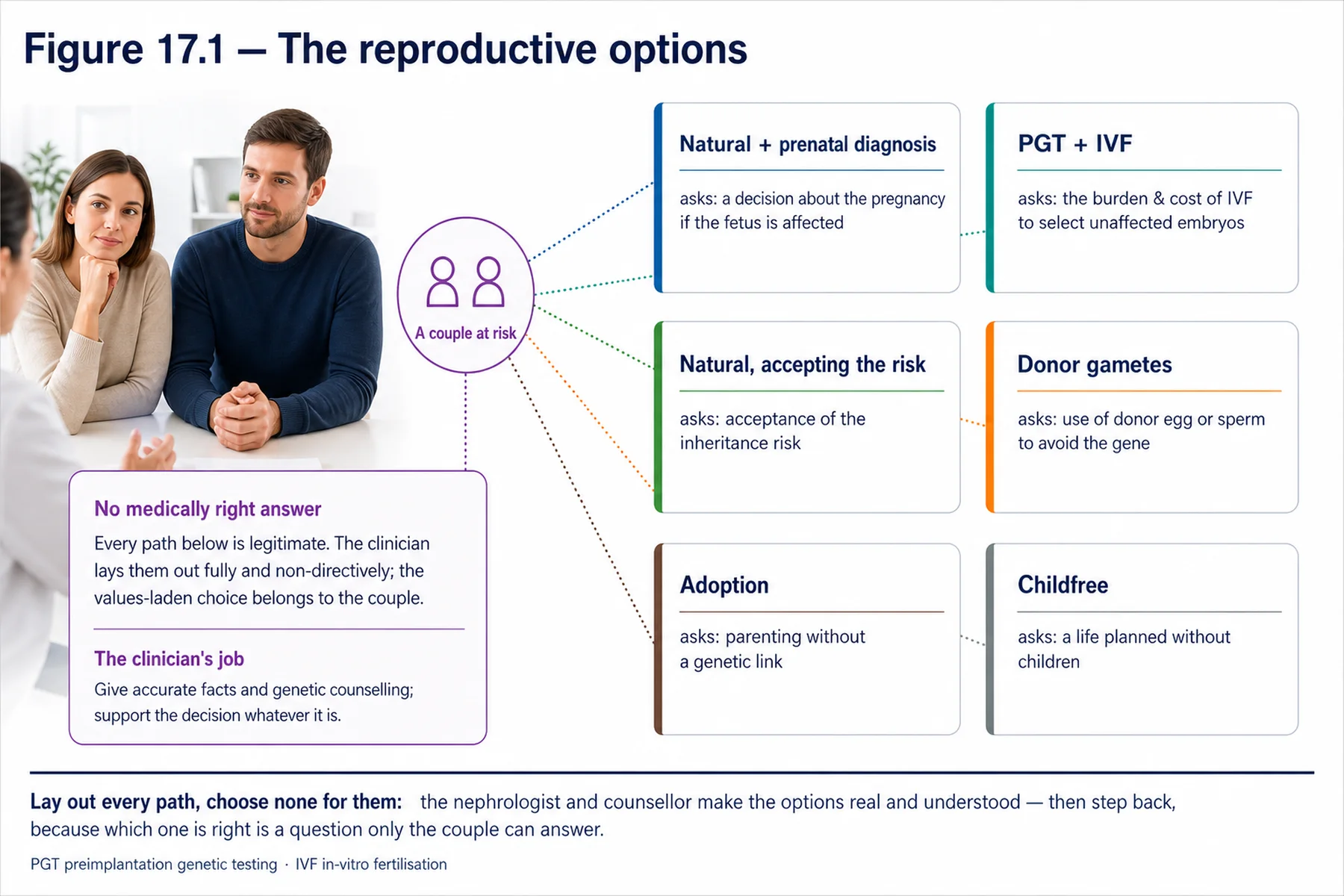
A couple at risk of transmitting an inherited kidney disease has a spectrum of reproductive options, and the clinician's first task is to lay them out fully and fairly. Natural conception with prenatal diagnosis involves conceiving naturally and testing the pregnancy (by chorionic villus sampling or amniocentesis) for the mutation, with the option to continue or terminate an affected pregnancy — which requires a willingness to face a termination decision. Preimplantation genetic testing with IVF creates embryos by in-vitro fertilisation, tests them for the mutation, and transfers only unaffected ones — avoiding a termination decision but requiring the burden, cost, and uncertainty of IVF (which is not always successful) and raising its own ethical considerations. Natural conception accepting the risk means conceiving naturally without testing, accepting the chance of an affected child. Donor gametes (a donor egg or sperm) avoid transmitting the affected parent's mutation altogether. Adoption avoids the genetic transmission and the pregnancy. And some couples choose not to have children. Each of these is a legitimate option, and the right choice depends entirely on the couple's circumstances and values — there is no single medically correct path. The clinician's job is to ensure the couple understands all the options and their implications, in conjunction with genetic counselling (the counselling chapter), so they can make an informed choice that is theirs.
— Why these are preference-sensitive
Reproductive decisions in inherited disease are perhaps the clearest example in all of nephrology — indeed in medicine — of a genuinely preference-sensitive decision, where the right answer is determined by the patient's values, not by medical evidence. The options differ not in their medical efficacy alone but in what they ask of the couple morally and personally: a willingness (or not) to consider terminating an affected pregnancy; feelings about IVF and the creation and selection of embryos; views on using donor gametes versus having a genetically related child; openness to adoption; and the couple's own assessment of how acceptable the risk of transmitting the disease is to them. These are shaped by deeply personal, ethical, religious, and cultural values, which vary enormously between couples and which the clinician cannot and should not adjudicate. The crucial professional stance, therefore, is non-directiveness: the clinician (with the genetic counsellor) provides complete, balanced, accurate information about each option and its implications, explores the couple's values, and supports whatever decision they reach — without steering them toward a particular choice, and without imposing the clinician's own values. This non-directive, values-based, shared approach is the substance of the shared-decision scripts that follow, and it is the appropriate stance for any decision where the answer lies in values rather than evidence.
— Predictive testing of children
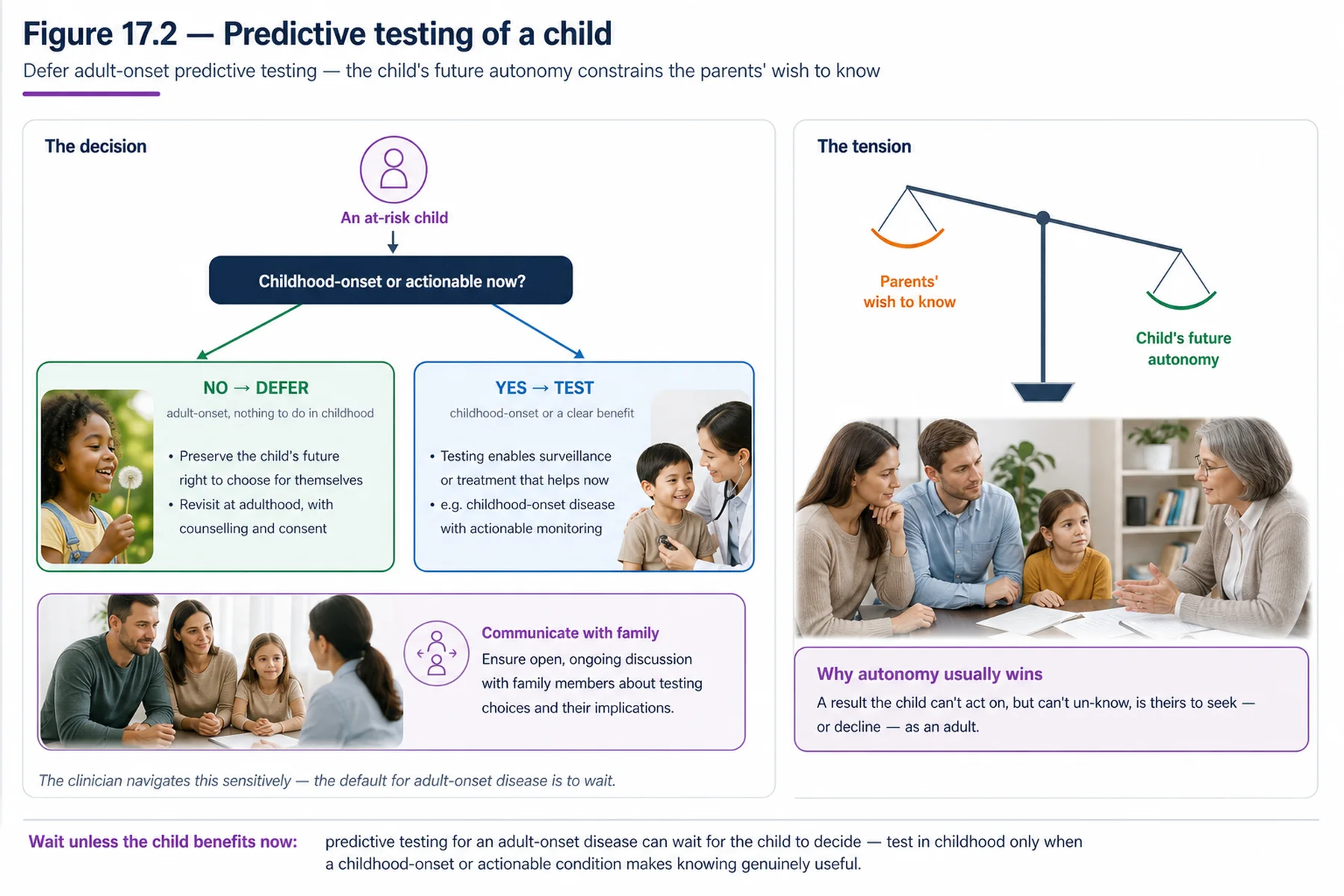
A distinct and recurring family decision is whether to test an asymptomatic child for an inherited kidney disease, and it carries a particular ethical tension. The general principle, met in the counselling chapter, is that predictive testing of a child for an adult-onset disease is deferred until the child is old enough to decide for themselves — because testing now removes the child's future autonomy and their own right to decide whether they wish to know their genetic status, and, for a disease that does not present or require intervention in childhood, there is no clinical benefit to testing early that would justify overriding that future autonomy. The exception is where the disease is childhood-onset or there is an actionable intervention in childhood, in which case testing benefits the child and is appropriate. The tension that arises in families is between a parent's understandable wish to know their child's status (for planning, peace of mind, or anxiety) and the child's right to make that choice themselves when grown — and the clinician must navigate this sensitively, generally supporting deferral for adult-onset diseases while acknowledging the parents' feelings, and offering to support the child's own decision when they are older. This is a values-laden decision too, but one in which the child's future autonomy is a guiding principle that constrains the parents' wishes — distinguishing it from the couple's own reproductive choices, which are fully theirs to make.
— Related living-donor decisions
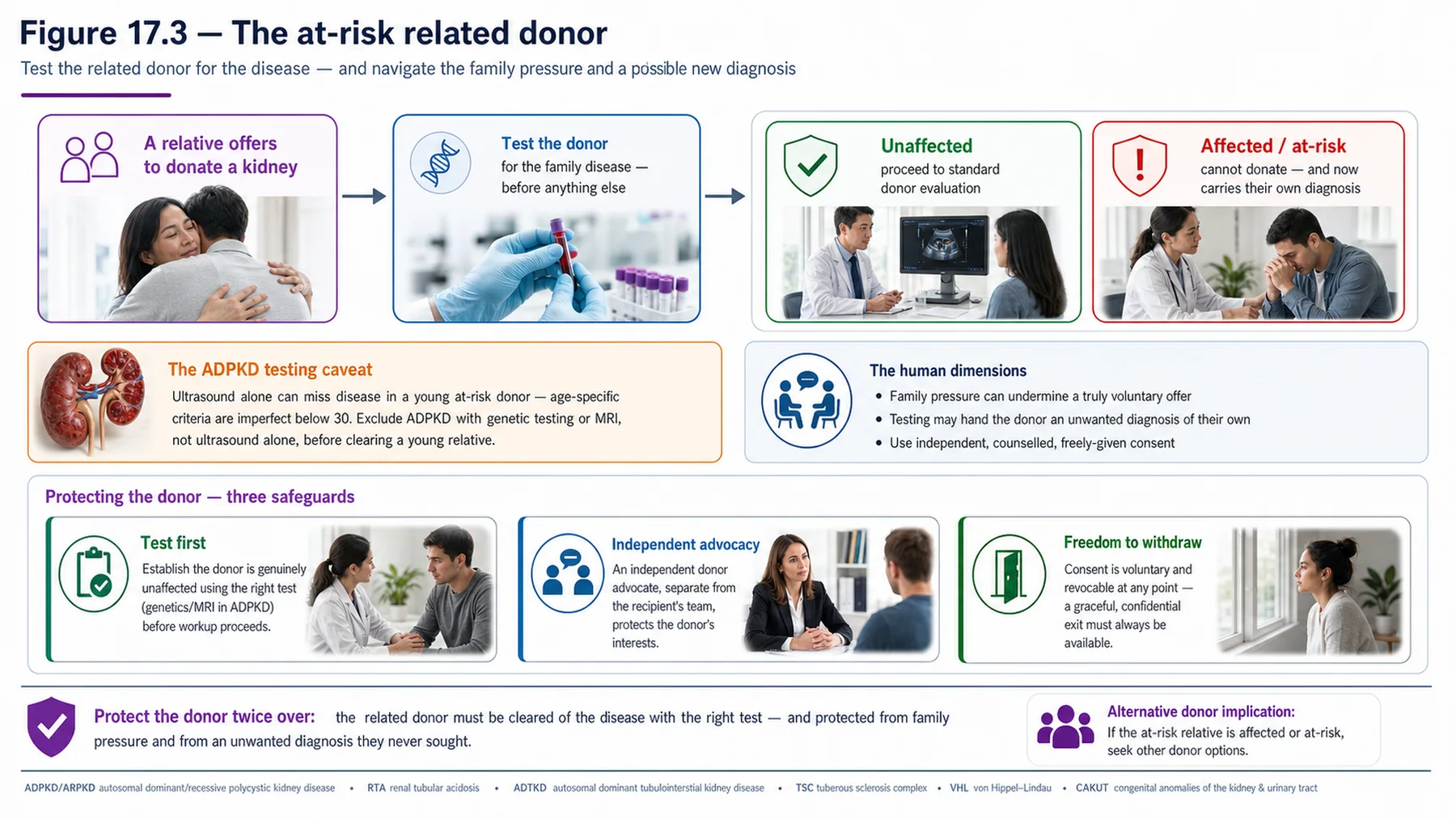
Inherited kidney disease frequently raises the question of related living kidney donation, with both a clinical and a relational dimension. The clinical imperative, met in the opening and ADPKD chapters, is that a relative who offers to donate must be tested to ensure they do not themselves carry the inherited disease — because donating an affected or at-risk kidney would harm both the donor (left with a diseased kidney) and the recipient (receiving one). This is most important in ADPKD, where a young at-risk relative requires definitive exclusion of the disease by genetic testing or MRI before being accepted as a donor, since a normal ultrasound does not exclude ADPKD in the young. So the at-risk relative donor cannot be cleared on a normal ultrasound alone. Beyond the testing, there is a relational and ethical dimension: family members may feel pressure (overt or subtle) to donate to an affected relative, and the at-risk relative who is found, in the course of donor evaluation, to carry the disease faces an unexpected and unwanted diagnosis. Counselling must therefore navigate the family dynamics, ensure the donor's decision is genuinely voluntary and informed, and handle sensitively the possibility that donor testing reveals the relative's own disease. The donation decision is thus both a clinical (test the relative) and a values-and-relationships (voluntary, counselled, supported) matter.
— Pregnancy, and the supporting role
Finally, for a woman with inherited kidney disease who becomes (or wishes to become) pregnant, there are specific medical considerations requiring pre-pregnancy planning. CKD and pregnancy interact adversely: CKD increases the risks of pre-eclampsia and of maternal and fetal complications, and pregnancy can accelerate the kidney disease — so the risk depends on the level of kidney function, blood-pressure control, and proteinuria, and must be assessed before conception. Several drugs used in inherited kidney disease are unsafe in pregnancy and must be addressed: RAAS blockers (so widely used for renoprotection) and tolvaptan (in ADPKD) are teratogenic or fetotoxic and contraindicated, and in transplant patients mycophenolate is teratogenic and must be switched to a pregnancy-safe immunosuppressant before conception. So pre-pregnancy counselling is essential: it optimises the disease (blood pressure, proteinuria, kidney function) and the drug regimen (stopping teratogens, switching to safe agents), assesses and communicates the risk, and plans the monitoring — including pre-eclampsia surveillance and low-dose aspirin prophylaxis (the pregnancy chapter of the hypertension volume). The management of the pregnant woman with inherited kidney disease or a kidney transplant is then a multidisciplinary effort. The unifying theme of the chapter, and a fitting close to the inherited-disease decisions, is that inherited kidney disease is a family matter — of reproduction, of testing relatives and children, of donation, and of pregnancy — in which the medical facts (the options, the testing, the drug safety, the risk) must be provided clearly, but the values-laden choices (whether and how to have children, whether to test a child, whether to donate) belong to the patient and family, and the clinician's role is to inform and support them non-directively. These family decisions deserve the same care and rigour as the medical management of the disease itself.
| 04 | PHASE A · LEVEL 4 · ORIENTATION & KNOWLEDGE Reference Tables |
Table 17.1 — Reproductive options
| Option | Detail |
| Natural + prenatal diagnosis | Conceive naturally, test the pregnancy (CVS/amniocentesis), continue or terminate |
| Preimplantation genetic testing + IVF | Create embryos by IVF, test, transfer only unaffected (avoids termination; needs IVF) |
| Natural, accepting the risk | Conceive naturally without testing |
| Donor gametes / adoption / childfree | Avoid transmission by donor egg/sperm, adoption, or not having children |
Table 17.2 — Why reproductive decisions are preference-sensitive
| Point | Detail |
| No medically right answer | The options differ in what they ask morally/personally, not in efficacy alone |
| Values that shape them | Views on termination, IVF/embryo selection, donor gametes, adoption, acceptable risk |
| Deeply personal | Personal, ethical, religious, cultural — the clinician cannot adjudicate |
| Clinician stance | NON-DIRECTIVE — inform fully, explore values, support the couple's choice |
Table 17.3 — Predictive testing of children
| Aspect | Detail |
| General rule | Defer adult-onset predictive testing until the child can decide (future autonomy) |
| Exception | Test if childhood-onset or actionable in childhood |
| The tension | Parent's wish to know vs the child's right to decide later |
| Clinician role | Support deferral for adult-onset, acknowledge parents' feelings, offer testing when the child is older |
Table 17.4 — Related living-donor decisions
| Aspect | Detail |
| Clinical imperative | Test the relative — a carrier/affected kidney harms donor and recipient |
| ADPKD | Young at-risk relative: exclude by genetics/MRI (normal ultrasound doesn't exclude) |
| Relational | Family pressure to donate; an at-risk donor may receive an unwanted diagnosis |
| Counselling | Ensure voluntary, informed donation; handle the donor's own diagnosis sensitively |
Table 17.5 — Pregnancy in inherited kidney disease
| Aspect | Detail |
| Interaction | CKD increases pre-eclampsia and maternal/fetal risk; pregnancy can accelerate CKD |
| Unsafe drugs | RAAS blockers, tolvaptan (teratogenic/contraindicated); mycophenolate (transplant) — switch before pregnancy |
| Pre-pregnancy planning | Optimise disease and drugs, assess/communicate risk, plan monitoring |
| Pregnancy care | Pre-eclampsia surveillance + aspirin; multidisciplinary (cross-ref Volume 8) |
Table 17.6 — The supporting role
| Point | Detail |
| A family matter | Inherited kidney disease involves reproduction, relatives, donation, pregnancy |
| Provide the facts | Options, testing, drug safety, risk — clearly and fully |
| The choices are theirs | Whether/how to have children, test a child, donate — belong to patient/family |
| Non-directive support | Inform and support; respect autonomy |
| 05 | PHASE B · LEVEL 5 · VISUALISE & MAP Imaging & Flowchart Specifications |
| 08 | PHASE C · LEVEL 8 · CLINICAL REASONING Clinical Cases |
| CASE 1 | ALL THE OPTIONS, NO STEERING Non-directive counselling Reproductive choices |
Presentation
A couple, one of whom has an inherited kidney disease, ask how to avoid passing it on. A clinician, keen to help, recommends preimplantation genetic testing with IVF as 'the best option' and steers them toward it.
❖ Pause and reflect Should the clinician recommend a single 'best' reproductive option? |
Analysis
No — there is no medically 'best' reproductive option, and steering the couple is the wrong stance. The couple has a spectrum of legitimate options — natural conception with prenatal diagnosis (and the option to continue or terminate), preimplantation genetic testing with IVF (selecting unaffected embryos), natural conception accepting the risk, donor gametes, adoption, or not having children — and they differ not in medical efficacy but in what they ask of the couple morally and personally (a willingness to consider termination, feelings about IVF and embryo selection, views on donor gametes or adoption, the acceptability of the risk). These are shaped by deeply personal, ethical, religious, and cultural values that the clinician cannot adjudicate, so the right professional stance is non-directive: lay out all the options and their implications fully and fairly, explore the couple's values, and support whatever they decide — not impose the clinician's own preference. Recommending IVF as 'the best option' substitutes the clinician's values for the couple's and forecloses a genuinely personal decision. The couple should be referred for genetic counselling and supported in an informed, values-based choice.
Plan
Lay out all the reproductive options non-directively, explore the couple's values, refer for genetic counselling, and support their own choice — rather than recommending a single 'best' option. Counsel non-directively; the choice is theirs.
Teaching point
Reproductive options are values-driven with no medically 'best' answer — the clinician informs and supports non-directively, never steering the couple to a particular choice.
Cross-reference
Exercises the reproductive-options content; Figure 17.1; the preference map (L15) and SDM scripts (L16); Tables 17.1, 17.2.
| CASE 2 | NOT YET, FOR THE CHILD'S SAKE Defer adult-onset testing Predictive testing of a child |
Presentation
Parents with an inherited adult-onset kidney disease ask to have their young, asymptomatic child tested now, for their own peace of mind. The disease has no childhood-onset risk and no childhood-actionable intervention.
❖ Pause and reflect Should the asymptomatic child be tested now at the parents' request? |
Analysis
Generally no — predictive testing of the child for this adult-onset disease should be deferred, despite the parents' wish. The guiding principle is the child's future autonomy: testing now would remove the child's later right to decide for themselves whether they wish to know their genetic status, and for an adult-onset disease with no childhood-onset risk and no actionable childhood intervention, there is no clinical benefit to testing in childhood that would justify overriding that future autonomy. This is the sharp tension of reproductive families: the parents' understandable wish to know (for planning or peace of mind) versus the child's right to make that choice when grown. The clinician should navigate this sensitively — acknowledging and validating the parents' feelings while explaining why deferral protects the child, and offering to support the child's own decision when they are old enough. The exception (childhood-onset or actionable disease) does not apply here. So unlike the couple's own reproductive choices, which are fully theirs, the testing of the child is constrained by the child's future autonomy.
Plan
Defer predictive testing of the child for this adult-onset disease (preserving future autonomy), acknowledge and support the parents' feelings, and offer to test the child when they are old enough to decide — testing now only if childhood-onset or actionable. Defer adult-onset testing for the child's future autonomy.
Teaching point
Predictive testing of a child for an adult-onset disease is generally deferred to preserve future autonomy — navigate the parents' wish sensitively; the child's autonomy constrains it.
Cross-reference
Exercises the children-testing content; Figure 17.2; Table 17.3; predictive testing in Chapter 2.
| CASE 3 | TEST THE DONOR FIRST The at-risk relative Related living donation |
Presentation
A young sibling of a patient with ADPKD offers to donate a kidney, and has a normal renal ultrasound. The team is ready to accept them as a donor, and the family is keen for the donation to proceed quickly.
❖ Pause and reflect Can this young sibling be accepted as a donor on a normal ultrasound? |
Analysis
No — a young at-risk relative cannot be cleared as a donor on a normal ultrasound alone, and there are family dynamics to navigate. The clinical imperative is to ensure the relative does not carry the disease before they donate, because donating an affected or at-risk kidney would harm both the donor (left with a diseased kidney) and the recipient. In ADPKD specifically, a normal ultrasound does not exclude the disease in a young person (cysts may not yet be visible), so this young sibling needs definitive exclusion by genetic testing or MRI before being accepted as a donor. Beyond the testing, the relational dimension matters: the family's keenness for a quick donation can create pressure on the sibling, so the donor's decision must be genuinely voluntary and well counselled; and donor evaluation may reveal that the sibling carries the disease — an unexpected and unwanted diagnosis that must be handled sensitively. So the donation should not proceed on the normal ultrasound: the sibling needs definitive testing (genetics/MRI), voluntary informed consent free of family pressure, and support for whatever the testing shows.
Plan
Do not accept the sibling on the normal ultrasound; definitively exclude ADPKD by genetics or MRI, ensure the donation is voluntary and free of family pressure, and prepare to support the sibling if testing reveals their own disease. Test the at-risk related donor definitively before accepting.
Teaching point
A young at-risk relative donor must be tested definitively (genetics/MRI in ADPKD — ultrasound does not exclude it), with voluntary consent free of family pressure, and support if the donor's own disease is revealed.
Cross-reference
Exercises the donation content; Figure 17.3; Table 17.4; donor evaluation in Chapters 1, 3, and 5.
| CASE 4 | PLAN BEFORE PREGNANCY Optimise disease and drugs Pregnancy in inherited kidney disease |
Presentation
A woman with an inherited kidney disease, on a RAAS blocker (and, in another case, a transplant patient on mycophenolate), becomes pregnant without prior planning, having continued her usual medications.
❖ Pause and reflect What should have happened before this pregnancy? |
Analysis
Pre-pregnancy planning — to optimise the disease and, critically, to stop the unsafe drugs. CKD and pregnancy interact adversely (CKD increases pre-eclampsia and maternal/fetal risk, and pregnancy can accelerate CKD), so the risk should have been assessed before conception. And several drugs used here are unsafe in pregnancy: the RAAS blocker (widely used for renoprotection) is teratogenic and contraindicated and should have been stopped before conception; tolvaptan (in ADPKD) is likewise contraindicated; and in the transplant patient, mycophenolate is teratogenic and must be switched to a pregnancy-safe immunosuppressant before pregnancy. Continuing these drugs into an unplanned pregnancy exposes the fetus to teratogens. The correct approach is pre-pregnancy counselling: optimise the disease (blood pressure, proteinuria, kidney function), stop the teratogens and switch to safe agents, assess and communicate the risk, and plan the monitoring — including pre-eclampsia surveillance and low-dose aspirin prophylaxis. Now that she is pregnant, the teratogenic drugs must be stopped/switched urgently and the pregnancy managed in a multidisciplinary, high-risk pathway.
Plan
Stop the teratogenic drugs urgently (RAAS blocker, tolvaptan; switch mycophenolate to a safe immunosuppressant), assess the risk, and manage as a high-risk pregnancy with pre-eclampsia surveillance and aspirin — and, for the future, emphasise pre-pregnancy planning. Plan before pregnancy; stop the teratogens.
Teaching point
Pregnancy in inherited kidney disease needs pre-pregnancy planning — optimise the disease and stop teratogens (RAAS blockers, tolvaptan, mycophenolate) before conception, with pre-eclampsia surveillance and aspirin.
Cross-reference
Exercises the pregnancy content; Table 17.5; teratogenic drugs in Chapters 6 and 9; pregnancy in Volume 8 Chapter 15.
| 10 | PHASE C · LEVEL 10 · CLINICAL REASONING Clinical Pearls |
| Inherited kidney disease is a FAMILY matter: reproduction, relatives, donation, pregnancy. | Reproductive options: natural + prenatal diagnosis; PGT + IVF; natural accepting risk; donor gametes; adoption; childfree. |
| Each option is legitimate — NO medically 'best' answer. | Reproductive choices are deeply preference-sensitive (values-driven). |
| Clinician stance: NON-DIRECTIVE — inform fully, explore values, support the choice. | Prenatal diagnosis (CVS/amniocentesis) → continue or terminate. |
| PGT + IVF selects unaffected embryos (avoids termination; IVF burden/cost). | Predictive testing of a child: DEFER adult-onset (future autonomy). |
| Test a child only if childhood-onset or actionable in childhood. | Tension: parent's wish to know vs child's right to decide later. |
| Related donor must be TESTED for the disease before donating. | ADPKD donor: exclude by genetics/MRI (normal ultrasound doesn't exclude in the young). |
| Navigate family pressure; ensure voluntary, counselled donation. | Pregnancy + CKD: increased pre-eclampsia and maternal/fetal risk. |
| Stop teratogens before pregnancy: RAAS blockers, tolvaptan, mycophenolate. | Pre-pregnancy planning + pre-eclampsia surveillance + aspirin. |
| 11 | PHASE D · LEVEL 11 · SAFETY & EVIDENCE Red Flags & Never-Do |
Panel A — Red flags
| ▲ | A clinician steering a couple toward one reproductive option — these are values-driven; counsel non-directively. |
| ▲ | A request to test an asymptomatic child for an adult-onset disease — generally defer (future autonomy). |
| ▲ | A young at-risk relative donor with a normal ultrasound — in ADPKD this doesn't exclude; test definitively. |
| ▲ | Family pressure on a relative to donate — ensure the decision is voluntary and counselled. |
| ▲ | A woman on a RAAS blocker, tolvaptan, or mycophenolate planning/in pregnancy — teratogens; plan and switch. |
Panel B — Never do
| ✖ NEVER — impose your own values on a couple's reproductive decision. |
| ✖ NEVER — test a child for an adult-onset disease without a childhood-actionable reason. |
| ✖ NEVER — accept a young at-risk ADPKD relative as a donor on a normal ultrasound. |
| ✖ NEVER — continue teratogenic drugs into a planned or actual pregnancy. |
| 12 | PHASE D · LEVEL 12 · SAFETY & EVIDENCE Common Pitfalls |
Pitfall 1 — Directive reproductive counselling
| ✖ | WRONG Recommending a single 'best' reproductive option. |
| ✓ | RIGHT Laying out all options non-directively and supporting the couple's choice. |
| ✉ | WHY The decision is values-driven with no medically right answer. |
Pitfall 2 — Testing a child prematurely
| ✖ | WRONG Testing a child for an adult-onset disease on parental request. |
| ✓ | RIGHT Deferring to adulthood unless childhood-onset/actionable. |
| ✉ | WHY It preserves the child's future autonomy. |
Pitfall 3 — Clearing the donor on ultrasound
| ✖ | WRONG Accepting a young at-risk ADPKD relative donor on a normal ultrasound. |
| ✓ | RIGHT Excluding the disease definitively by genetics/MRI. |
| ✉ | WHY A normal ultrasound does not exclude ADPKD in the young. |
Pitfall 4 — Ignoring family pressure
| ✖ | WRONG Proceeding with a related donation without addressing family dynamics. |
| ✓ | RIGHT Ensuring the donation is voluntary and counselled. |
| ✉ | WHY Relatives may feel pressured to donate. |
Pitfall 5 — No pre-pregnancy planning
| ✖ | WRONG Letting a woman conceive on teratogenic drugs without planning. |
| ✓ | RIGHT Pre-pregnancy counselling — optimise disease, stop/switch teratogens. |
| ✉ | WHY RAAS blockers, tolvaptan, and mycophenolate are teratogenic. |
| 13 | PHASE D · LEVEL 13 · SAFETY & EVIDENCE Evidence Grading |
GRADE A HIGH CONFIDENCE The effect is real and the estimate is stable. RCTs at low risk of bias; multiple concordant prospective cohorts; meta-analyses. |
GRADE B MODERATE CONFIDENCE The effect is likely real but may shift with new data. Observational studies, registries, mechanistic human studies. |
GRADE C LOW CONFIDENCE Rests on physiology, reasoning, or consensus rather than outcomes. Pathophysiological reasoning; extrapolation; consensus without outcomes. |
Graded statements (by evidence type)
| Statement | Grade | Basis (evidence type) |
| Several reproductive options exist for at-risk couples. | A | Clinical practice and guidelines |
| Reproductive decisions are preference-sensitive and require non-directive counselling. | A | Ethics consensus |
| Predictive testing of children for adult-onset disease should be deferred. | A | Guidelines and ethics consensus |
| Related donors must be tested for the inherited disease. | A | Transplant guidelines |
| A normal ultrasound does not exclude ADPKD in a young at-risk relative. | A | Imaging data |
| RAAS blockers, tolvaptan, and mycophenolate are teratogenic. | A | Clinical and pharmacovigilance data |
| CKD increases pre-eclampsia and maternal/fetal risk. | A | Cohort data |
| 14 | PHASE E · LEVEL 14 · PATIENT DECISIONS Absolute Risk in Natural Frequency |
Natural-frequency estimates for orientation, from the reproductive and family context; they vary widely. They convey the size of the decisions, expressed per 100 comparable patients or pregnancies.
| Per 100… | Outcome | Roughly how many | See |
| Children of an affected parent (dominant disease) | Inherit the mutation | About 50 — the basis of the reproductive decision | L13 row 1 |
| Young at-risk ADPKD relatives with a normal ultrasound | Still carry the disease | Some — hence definitive testing before donation | L13 row 5 |
| Pregnancies on a teratogen (RAAS blocker/tolvaptan/mycophenolate) | Risk fetal harm | More — hence pre-pregnancy switching | L13 row 6 |
| Pregnancies in CKD vs normal renal function | Develop pre-eclampsia/complications | More with CKD — hence planning and surveillance | L13 row 7 |
★ How to read these Read these as orientation, not promises; the proportions vary with the disease and inheritance. The stable signals: dominant disease carries a 50% transmission risk, ultrasound misses ADPKD in young relatives, teratogens harm the fetus, and CKD raises pregnancy risk. Communicate them as people out of 100, not as a hazard ratio. |
| 15 | PHASE E · LEVEL 15 · PATIENT DECISIONS Preference-Sensitive Decisions |
The reproductive decision in inherited kidney disease is among the most values-driven in medicine. The table maps the options to what each prioritises and asks; none is the single right answer.
| Choice | Prioritises | Asks / suits |
| Natural + prenatal diagnosis | A genetically related child, with the chance to avoid an affected birth | A willingness to consider termination — suits those comfortable with prenatal testing |
| Preimplantation genetic testing + IVF | An unaffected, genetically related child without a termination decision | The burden, cost, and uncertainty of IVF — suits those who can access it and prefer embryo selection |
| Natural, accepting the risk | Conceiving naturally and embracing whatever comes | Accepting the transmission risk — suits those who would not test or terminate |
| Donor gametes / adoption / childfree | Avoiding transmission entirely (or parenthood differently) | Forgoing a genetically related child (donor/adoption) or children — suits those for whom this fits their values |
❖ Using this map Elicit the couple's values — their feelings about termination, IVF, donor gametes, adoption, and the acceptability of the risk — and let those, not the clinician's preference, choose the path. There is no medically right answer; the clinician informs and supports. |
| 16 | PHASE E · LEVEL 16 · PATIENT DECISIONS Shared Decision-Making |
Scripts for the preference-sensitive conversations about reproduction and testing a child. Adapt the wording; the structure is non-directive — inform fully, explore values, and support the family's own decision.
Script 1 — Discussing the reproductive options
Frame it non-directively. “There are several ways to approach having children when there's a condition in the family that can be passed on, and none of them is the single right answer — it depends on what feels right for you. Let me lay them all out, and then we can think about which fits you.”
Lay out the options. “You could conceive naturally and test the pregnancy, with the choice to continue or not; or use IVF with embryo testing to avoid that; or conceive naturally and accept the chance; or consider donor eggs or sperm, adoption, or not having children. Each asks something different of you.”
Explore values and support. “How do you feel about things like testing a pregnancy, or IVF? There's no wrong answer — my job is to give you the information and support whatever you decide, with the help of a genetic counsellor.”
Script 2 — A parent asking to test a young child
Acknowledge the wish. “I understand why you'd want to know whether your child has inherited this — it's natural to want certainty and to plan. Let me explain how we usually think about testing a child.”
Explain the autonomy principle. “For a condition that wouldn't affect them until adulthood, we usually wait, so that your child can decide for themselves whether they want to know when they're old enough — testing now would take that choice away from them, and there's nothing we'd do differently in childhood.”
Offer support. “We'd of course test if it were something that mattered in childhood. And we'll support your child to decide for themselves later. How does that sit with you?”
| 17 | PHASE F · LEVEL 17 · APPLY & TEST Documentation Templates |
Paste-ready notes. Tick the boxes that apply and delete the rest; make the non-directive counselling, the testing decisions, and the pre-pregnancy planning explicit.
Template 1 — Reproductive and family counselling
Template 2 — Donation and pregnancy
| 18 | PHASE F · LEVEL 18 · APPLY & TEST Cheat Sheet |
| Inherited kidney disease = a family matter. | Reproductive options: natural + prenatal Dx; PGT + IVF; natural accepting risk; donor gametes; adoption; childfree. |
| No medically 'best' option — values-driven. | Counsel NON-DIRECTIVELY; the choice is the couple's. |
| Prenatal Dx (CVS/amniocentesis) → continue/terminate. | PGT + IVF → select unaffected embryos (avoids termination). |
| Predictive testing of a child: DEFER adult-onset (future autonomy). | Test a child only if childhood-onset/actionable. |
| Parent's wish vs child's right to decide later. | Related donor: TEST for the disease first. |
| ADPKD donor: genetics/MRI, not ultrasound (young). | Navigate family pressure; voluntary, counselled donation. |
| Pregnancy + CKD: increased pre-eclampsia/maternal/fetal risk. | Stop teratogens: RAAS blockers, tolvaptan, mycophenolate. |
| Pre-pregnancy planning + aspirin + surveillance. | Inform and support; the values-laden choices belong to the family. |
| 19 | PHASE F · LEVEL 19 · APPLY & TEST Flashcards |
| CARD 1 | Q. What reproductive options does an at-risk couple have? A. Natural conception with prenatal diagnosis (and the option to continue or terminate an affected pregnancy), preimplantation genetic testing with IVF (selecting unaffected embryos), natural conception accepting the risk, donor gametes, adoption, or not having children — each a legitimate, values-driven choice. DETAILED. There is no medically best answer. CLINICAL. Lay out all the options non-directively. |
| CARD 2 | Q. Why are reproductive decisions in inherited disease preference-sensitive? A. Because the options differ not in medical efficacy but in what they ask of the couple morally and personally — a willingness to consider termination, feelings about IVF and embryo selection, views on donor gametes or adoption, and the acceptability of the risk — all shaped by personal, ethical, religious, and cultural values the clinician cannot adjudicate. DETAILED. The right answer lies in values, not evidence. CLINICAL. Counsel non-directively and support the couple's choice. |
| CARD 3 | Q. How should predictive testing of a child be approached? A. Predictive testing of an asymptomatic child for an adult-onset disease is generally deferred until the child can decide for themselves, to preserve their future autonomy, unless the disease is childhood-onset or actionable in childhood — navigating sensitively the tension between the parent's wish to know and the child's right to decide later. DETAILED. The child's future autonomy constrains the parents' wishes. CLINICAL. Defer adult-onset testing of a child unless childhood-actionable. |
| CARD 4 | Q. What must be done before accepting a related living kidney donor? A. The relative must be tested to ensure they do not carry the inherited disease — in ADPKD, by genetic testing or MRI, because a normal ultrasound does not exclude it in a young person — because donating an affected or at-risk kidney would harm both donor and recipient. DETAILED. Family pressure and the donor's possible own diagnosis must also be navigated. CLINICAL. Test the related donor definitively and ensure voluntary consent. |
| CARD 5 | Q. What are the considerations for pregnancy in inherited kidney disease? A. CKD and pregnancy interact adversely (increased pre-eclampsia and maternal and fetal risks, with pregnancy potentially accelerating CKD), and several drugs are unsafe — RAAS blockers and tolvaptan are teratogenic/contraindicated, and in transplant patients mycophenolate is teratogenic and must be switched before pregnancy. DETAILED. Pre-pregnancy planning is essential. CLINICAL. Plan before pregnancy: optimise the disease and stop the teratogens. |
| CARD 6 | Q. What does pre-pregnancy counselling in inherited kidney disease involve? A. Optimising the disease (blood pressure, proteinuria, kidney function), stopping teratogens and switching to pregnancy-safe agents, assessing and communicating the risk, and planning the monitoring — including pre-eclampsia surveillance and low-dose aspirin prophylaxis — with multidisciplinary care. DETAILED. It is best done before conception. CLINICAL. Counsel and optimise before pregnancy. |
| CARD 7 | Q. What is the clinician's stance in these family decisions? A. Non-directive: providing complete, balanced, accurate information about the options and their implications, exploring the family's values, and supporting whatever decision they reach — without steering them toward a particular choice or imposing the clinician's own values. DETAILED. The values-laden choices belong to the patient and family. CLINICAL. Inform and support non-directively; respect autonomy. |
| CARD 8 | Q. Why is inherited kidney disease described as a family matter? A. Because it involves decisions that extend beyond the individual — whether and how to have children, whether to test relatives and children, whether a relative should donate, and how to manage pregnancy — so the family decisions deserve the same care and rigour as the medical management of the disease itself. DETAILED. These decisions ripple through the family. CLINICAL. Manage the family decisions with the same care as the medical disease. |
| 20 | PHASE F · LEVEL 20 · APPLY & TEST One-Minute Preceptor |
| SCENE 1 | The intern recommending IVF |
GET A COMMITMENT. “You've told this couple that IVF with embryo testing is the best way to avoid passing on the disease — is that the right stance?”
PROBE FOR EVIDENCE. “It avoids an affected child without termination” — ask: “Is there a medically best option, and whose values should decide?”
TEACH A GENERAL RULE. Reproductive options are values-driven with no medically best answer — lay them all out non-directively, explore the couple's values, and support their choice, rather than steering them.
REINFORCE WHAT WAS RIGHT. Knowing the options was good.
CORRECT A MISTAKE. Counsel non-directively; let the couple's values decide.
| SCENE 2 | The resident clearing the young donor |
GET A COMMITMENT. “You're ready to accept this young sibling as an ADPKD donor on a normal ultrasound — is that safe?”
PROBE FOR EVIDENCE. “The scan is clear” — ask: “Does a normal ultrasound exclude ADPKD in a young person, and what should you do before accepting them?”
TEACH A GENERAL RULE. A normal ultrasound doesn't exclude ADPKD in the young, so the at-risk relative needs definitive exclusion by genetics or MRI before donating — with voluntary, counselled consent.
REINFORCE WHAT WAS RIGHT. Pursuing a related donor was reasonable.
CORRECT A MISTAKE. Test definitively (genetics/MRI) before accepting; ensure consent is voluntary.
| 21 | PHASE F · LEVEL 21 · APPLY & TEST Reflective Prompts |
Genuine tensions these decisions leave open; sit with them rather than resolving them too quickly.
Reproductive options range from accepting the risk to selecting embryos to forgoing children — and the clinician is asked to be neutral among them. Is true neutrality possible, and what does non-directiveness cost the clinician who has a view?
Preimplantation genetic testing lets a couple select against a disease that the affected parent lives with. What does it mean for that parent to help choose a child who will not be like them?
Deferring a child's testing protects their future autonomy — yet leaves a parent in years of uncertainty about their own child. Whose interest should weigh more, and who decides?
A relative's offer to donate is generous — but family love can shade into family pressure. How do you ensure a donation is truly voluntary within the bonds and obligations of a family?
Donor evaluation can hand an at-risk relative an unwanted diagnosis they never sought. How do you weigh the recipient's need for a kidney against the donor's right not to know?
| 22 | PHASE F · LEVEL 22 · APPLY & TEST Board-Style Questions |
| Q 01 | For a couple at risk of transmitting an inherited kidney disease, the clinician should: |
| A | Recommend the single best reproductive option |
| B | Lay out all options non-directively and support the couple's values-based choice |
| C | Decide for them |
| D | Discourage children |
Rationale Reproductive decisions are values-driven with no medically best answer (case 1, Figure 17.1, Tables 17.1–17.2). A, C, and D are directive. |
| Q 02 | Which avoids a termination decision while allowing a genetically related child? |
| A | Natural conception with prenatal diagnosis |
| B | Preimplantation genetic testing with IVF |
| C | Accepting the risk |
| D | Adoption |
Rationale PGT with IVF selects unaffected embryos, avoiding termination (Table 17.1). A involves a termination decision; C and D differ. |
| Q 03 | Predictive testing of an asymptomatic child for an adult-onset inherited kidney disease should: |
| A | Be done on parental request |
| B | Be deferred until the child can decide, unless childhood-onset/actionable |
| C | Never be discussed |
| D | Be mandatory |
Rationale Deferral preserves the child's future autonomy (case 2, Figure 17.2, Table 17.3). A, C, and D are wrong. |
| Q 04 | Before accepting a young at-risk relative as a kidney donor in ADPKD, you must: |
| A | Accept them on a normal ultrasound |
| B | Definitively exclude the disease by genetics or MRI |
| C | Decline all relatives |
| D | Test only the recipient |
Rationale A normal ultrasound doesn't exclude ADPKD in the young (case 3, Figure 17.3, Table 17.4). A, C, and D are incorrect. |
| Q 05 | Which drugs must be stopped before pregnancy in inherited kidney disease? |
| A | Antibiotics |
| B | RAAS blockers, tolvaptan, and (in transplant) mycophenolate — teratogens |
| C | Iron |
| D | Vitamin D |
Rationale These are teratogenic and must be stopped/switched before pregnancy (case 4, Table 17.5). A, C, and D are not the issue. |
| Q 06 | Pregnancy in a woman with CKD: |
| A | Carries no extra risk |
| B | Increases pre-eclampsia and maternal/fetal risk, needing planning and surveillance |
| C | Improves the CKD |
| D | Requires no monitoring |
Rationale CKD and pregnancy interact adversely (Table 17.5). A, C, and D are wrong. |
| Q 07 | A relative feeling pressured by the family to donate a kidney should: |
| A | Be told to proceed |
| B | Have the voluntariness of the decision ensured through counselling |
| C | Be ignored |
| D | Be excluded automatically |
Rationale The donation must be genuinely voluntary and counselled (Table 17.4, rule on counselling). A, C, and D are inappropriate. |
| Q 08 | The clinician's overall role in these family decisions is to: |
| A | Direct the family to the right choice |
| B | Provide the facts and support informed, autonomous, values-based decisions non-directively |
| C | Make the decisions |
| D | Avoid the topic |
Rationale The values-laden choices belong to the family; the clinician informs and supports (Table 17.6). A, C, and D are wrong. |