Chapter Preamble
Signals declared
Sig-D — Diagnostic (primary). Recognise the spectrum of CAKUT, the obstruction of posterior urethral valves, and vesicoureteric reflux with reflux nephropathy, and investigate appropriately.
Sig-T — Therapeutic (strong). Relieve obstruction, manage reflux and urinary infection, protect the kidney from the low-nephron-number progression, and optimise the bladder before transplantation.
Sig-M — Mechanistic (strong). How developmental anomalies, obstruction, reflux, and a low nephron number produce CKD — from fetal life into adulthood.
Levels populated and omitted
Populated (19): L1–L14, L17–L20, L22. The mechanistic signal fires the concept maps (L6) and triads (L9); the therapeutic signal fires the absolute-risk table (L14) and templates (L17); the diagnostic signal drives the tables, rules, cases, pitfalls, and board items.
L15 / L16 preference-sensitive map and SDM scripts — omitted. No Sig-E; recognition and management here are established care.
L21 reflective prompts — omitted. No Sig-E/V; the content is worked through the cases and pitfalls.
| 01 | PHASE A · LEVEL 1 · ORIENTATION & KNOWLEDGE Learning Objectives |
By the end of this chapter you should be able to:
Define CAKUT and its place as the commonest cause of childhood CKD.
Describe the parenchymal anomalies (agenesis, hypoplasia, dysplasia).
Describe the urinary tract anomalies and obstruction, including posterior urethral valves.
Explain vesicoureteric reflux and how reflux nephropathy develops.
Explain the low-nephron-number, hyperfiltration progression to CKD.
Recognise the antenatal and postnatal presentations and the relevant imaging.
Manage obstruction, reflux, and urinary infection.
Protect the kidney long-term and optimise the bladder before transplantation.
| 02 | PHASE A · LEVEL 2 · ORIENTATION & KNOWLEDGE Executive Summary |
CAKUT — congenital anomalies of the kidney and urinary tract — is a spectrum of developmental abnormalities and the commonest cause of CKD and end-stage kidney disease in children.
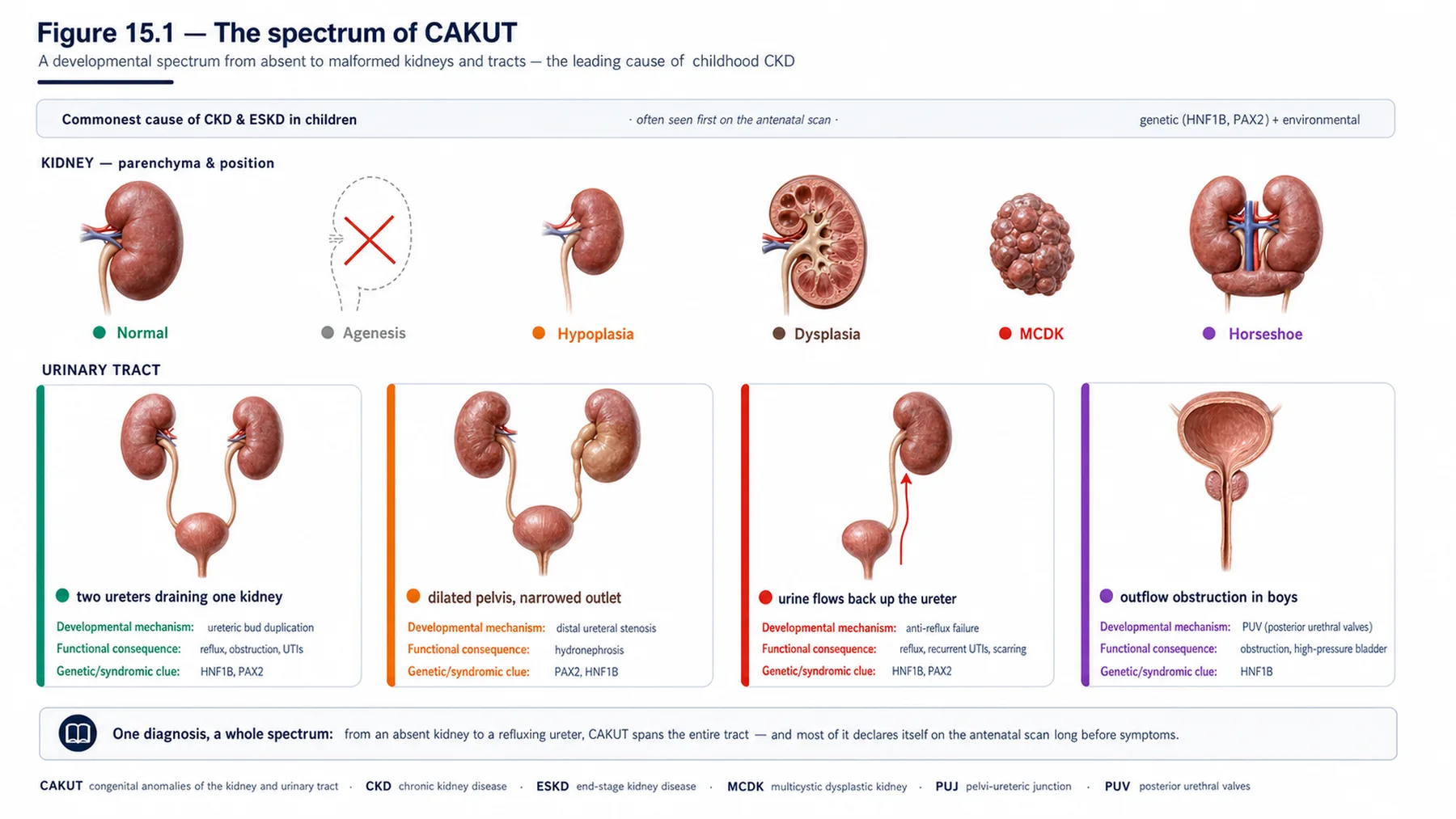
The parenchymal anomalies include renal agenesis (bilateral being lethal, with Potter sequence), hypoplasia (a small kidney with few nephrons), dysplasia (disorganised tissue, as in the multicystic dysplastic kidney), and fusion or ectopia (horseshoe kidney).
The urinary tract anomalies include obstruction — pelvi-ureteric junction obstruction, posterior urethral valves — duplex systems, and vesicoureteric reflux.
Posterior urethral valves cause congenital bladder outlet obstruction in boys, with antenatal hydronephrosis, oligohydramnios, renal dysplasia, bladder dysfunction, and progressive CKD — a major cause of childhood kidney failure in boys.
Vesicoureteric reflux is the retrograde flow of urine from the bladder up the ureter, predisposing to ascending infection.
Reflux nephropathy is the renal scarring associated with reflux — from refluxing infected urine and, importantly, from congenital dysplasia accompanying high-grade reflux — causing hypertension, proteinuria, and progressive CKD, often presenting in young adults.
A reduced nephron number, from hypoplasia, dysplasia, or a solitary kidney, drives compensatory hyperfiltration of the remaining nephrons, leading to glomerular hypertension, secondary glomerulosclerosis, hypertension, proteinuria, and progressive CKD over time.
So CAKUT, even when initially compensated, can progress to CKD in adulthood through this low-nephron-number mechanism.
Diagnosis is increasingly antenatal (hydronephrosis, oligohydramnios, abnormal kidneys on ultrasound), with postnatal imaging — ultrasound, voiding cystourethrogram, and a DMSA scan for scarring — and a low threshold to investigate a child with urinary infection or unexplained CKD.
Treatment relieves obstruction (valve ablation, pyeloplasty), manages reflux (most low-grade primary reflux resolves; treat infections; surgery for high-grade or non-resolving disease), prevents urinary infection, and protects the kidney with RAAS blockade and blood-pressure control.
The bladder must be optimised before transplantation, and lifelong follow-up addresses hypertension, proteinuria, and progression.
The unifying lesson is that a kidney problem present from fetal life can progress, through a low nephron number, into adult CKD — so CAKUT is a lifelong, not just a paediatric, disease.
| 03 | PHASE A · LEVEL 3 · ORIENTATION & KNOWLEDGE Main Narrative |
CAKUT — the congenital anomalies of the kidney and urinary tract — is the commonest cause of kidney failure in children, and a disease that follows the patient from fetal life into adulthood. It spans malformed kidneys, obstructed urinary tracts, and the reflux that scars the kidney, and it carries a unifying mechanism: a reduced nephron number that drives progressive CKD long after the childhood diagnosis. This chapter covers the spectrum, the major entities (posterior urethral valves, vesicoureteric reflux and reflux nephropathy), and the lifelong protection of the kidney.
— The CAKUT spectrum and the parenchymal anomalies
CAKUT is not one disease but a spectrum of developmental abnormalities of the kidney and urinary tract, arising from disrupted kidney and tract development in fetal life — often genetic (genes such as HNF1B, met in the tubulointerstitial chapter, PAX2, and many others), sometimes syndromic, often multifactorial — and collectively it is the commonest cause of CKD and end-stage kidney disease in children. The parenchymal (kidney-tissue) anomalies form one part of the spectrum. Renal agenesis is the absence of a kidney: unilateral agenesis leaves a solitary kidney (which usually compensates but carries a long-term risk of hypertension and CKD), while bilateral agenesis is incompatible with life, producing the Potter sequence (oligohydramnios and pulmonary hypoplasia, as in ARPKD). Renal hypoplasia is a small kidney with a reduced number of nephrons. Renal dysplasia is abnormally developed, disorganised renal tissue, often with cysts — the multicystic dysplastic kidney being the classic form, a non-functioning kidney that often involutes. And fusion and ectopia anomalies (horseshoe kidney, pelvic kidney) complete the parenchymal group. These anomalies matter because they reduce functioning renal tissue and nephron number, setting up the progression to CKD.
— Obstruction and posterior urethral valves
The other part of the CAKUT spectrum is the urinary tract anomalies, chief among them obstruction. Obstruction can occur at several levels — the pelvi-ureteric junction (the commonest cause of antenatal hydronephrosis), the vesicoureteric junction, or the bladder outlet — and the most important obstructive lesion is posterior urethral valves. Posterior urethral valves are an obstructing membrane in the posterior urethra of boys, causing congenital bladder outlet obstruction, and they are a major cause of childhood CKD and end-stage disease in boys. The obstruction has profound consequences from fetal life: the back-pressure causes bilateral hydronephrosis and renal dysplasia, the reduced fetal urine output causes oligohydramnios (and so pulmonary hypoplasia, the neonatal threat seen in ARPKD), and the bladder itself becomes thick-walled and dysfunctional. Treatment is endoscopic ablation of the valves to relieve the obstruction, but — crucially — the renal dysplasia is already established and the bladder dysfunction persists, so these boys need lifelong bladder management and have ongoing CKD risk despite valve ablation. The lesson of posterior urethral valves is that relieving the obstruction is necessary but does not undo the developmental kidney and bladder damage already done — the disease continues.
— Vesicoureteric reflux and reflux nephropathy
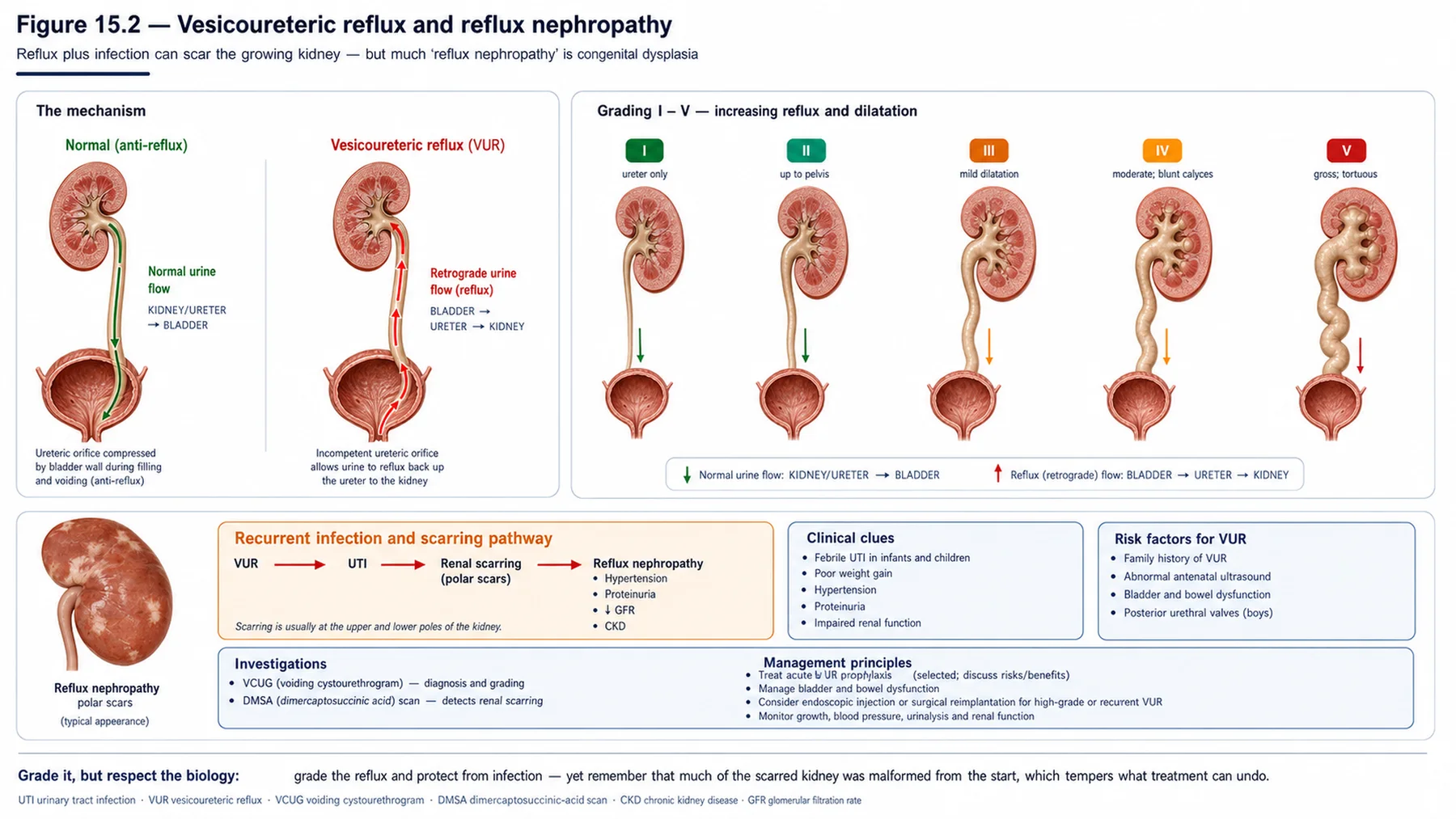
Vesicoureteric reflux (VUR) is the retrograde flow of urine from the bladder up the ureter (and sometimes to the kidney), caused by an incompetent vesicoureteric junction; it is primary (congenital, from an abnormal junction — which tends to resolve as the child grows, especially low-grade reflux) or secondary (to obstruction or bladder dysfunction), and it is graded by severity. Its danger is that it predisposes to ascending urinary infection and pyelonephritis. Reflux nephropathy is the renal scarring associated with vesicoureteric reflux — historically called 'chronic pyelonephritis' — and understanding its dual origin is important. Part of the scarring is acquired: refluxing infected urine causes pyelonephritic scarring of the kidney. But part is congenital: high-grade reflux is associated with congenital renal dysplasia, so some of the 'scarring' is a developmental abnormality present from birth, not acquired from infection. This dual origin (acquired infective scarring plus congenital dysplasia) explains why reflux nephropathy is not simply prevented by treating infections, and why high-grade reflux carries the worst renal prognosis. Reflux nephropathy causes hypertension, proteinuria, and progressive CKD, and characteristically presents in young adults (sometimes with hypertension or proteinuria discovered incidentally) — making it an important cause of CKD and hypertension in the young. Its management combines preventing and treating urinary infection, managing the reflux, and protecting the kidney.
— The low-nephron-number progression
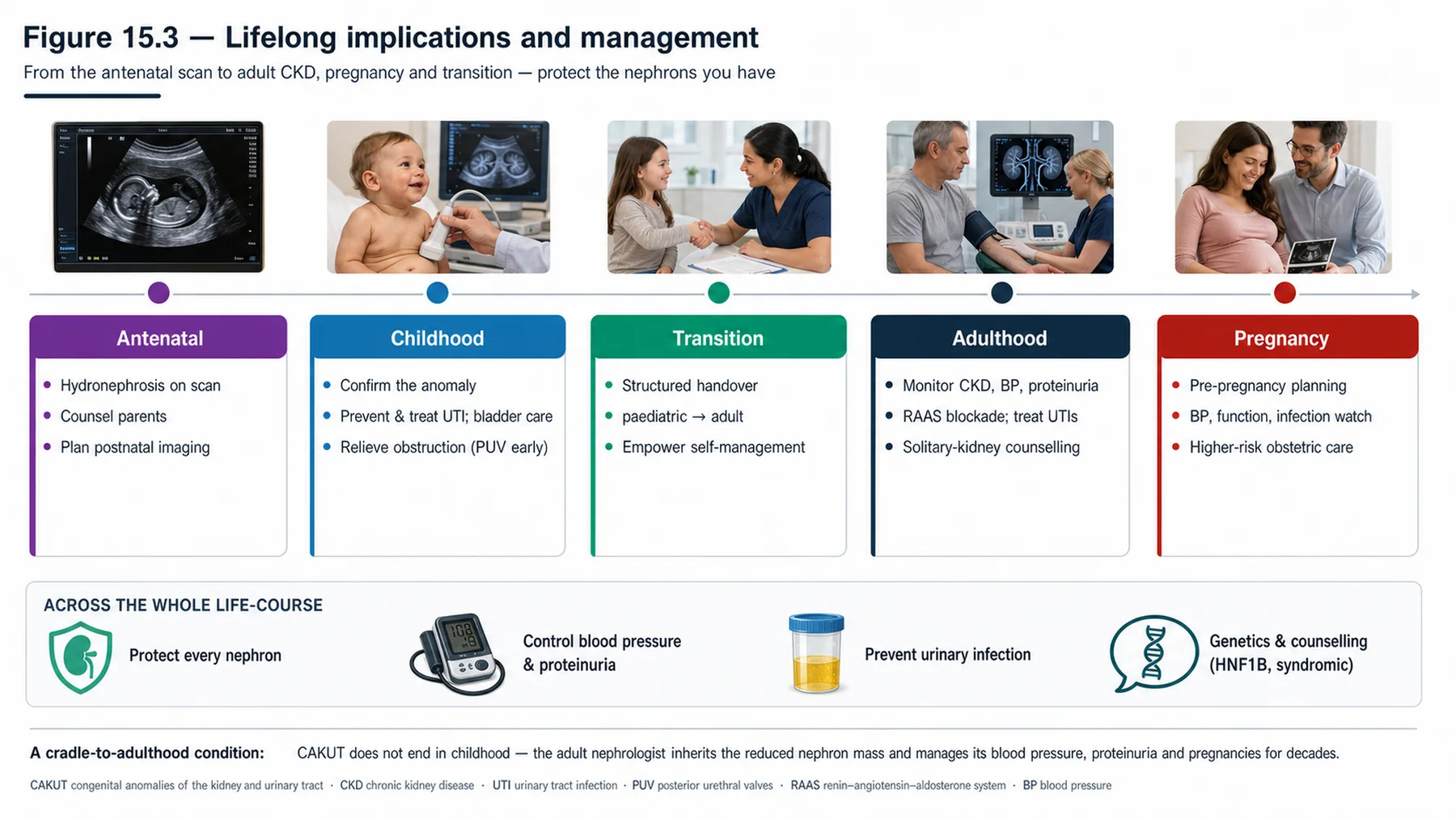
The unifying mechanism that links the CAKUT spectrum to its long-term outcome — and the reason CAKUT is a lifelong disease — is the reduced nephron number and its consequences. Many CAKUT lesions (hypoplasia, dysplasia, a solitary kidney from agenesis or nephrectomy, reflux nephropathy) leave the patient with fewer functioning nephrons than normal. The remaining nephrons compensate by hyperfiltration — each working harder — which maintains the GFR initially but, over years, causes glomerular hypertension within those nephrons, leading to a secondary, FSGS-like glomerulosclerosis, with hypertension and proteinuria, and progressive loss of the remaining nephrons — the Brenner hypothesis of the primary-hypertension chapter applied to congenital nephron deficit. This is why a CAKUT patient who appears 'compensated' in childhood, with a normal or near-normal GFR, can nonetheless progress to CKD and end-stage disease in adulthood: the hyperfiltration that compensates also slowly destroys. It also explains the hypertension and proteinuria that emerge over time. The practical consequence is that CAKUT requires lifelong nephrological follow-up and renal protection — blood-pressure control and RAAS blockade (to reduce the intraglomerular pressure and proteinuria) — not just childhood correction of the anatomical lesion. The anatomy is fixed in childhood, but the functional decline plays out over a lifetime.
— Diagnosis, management, and the lifelong view
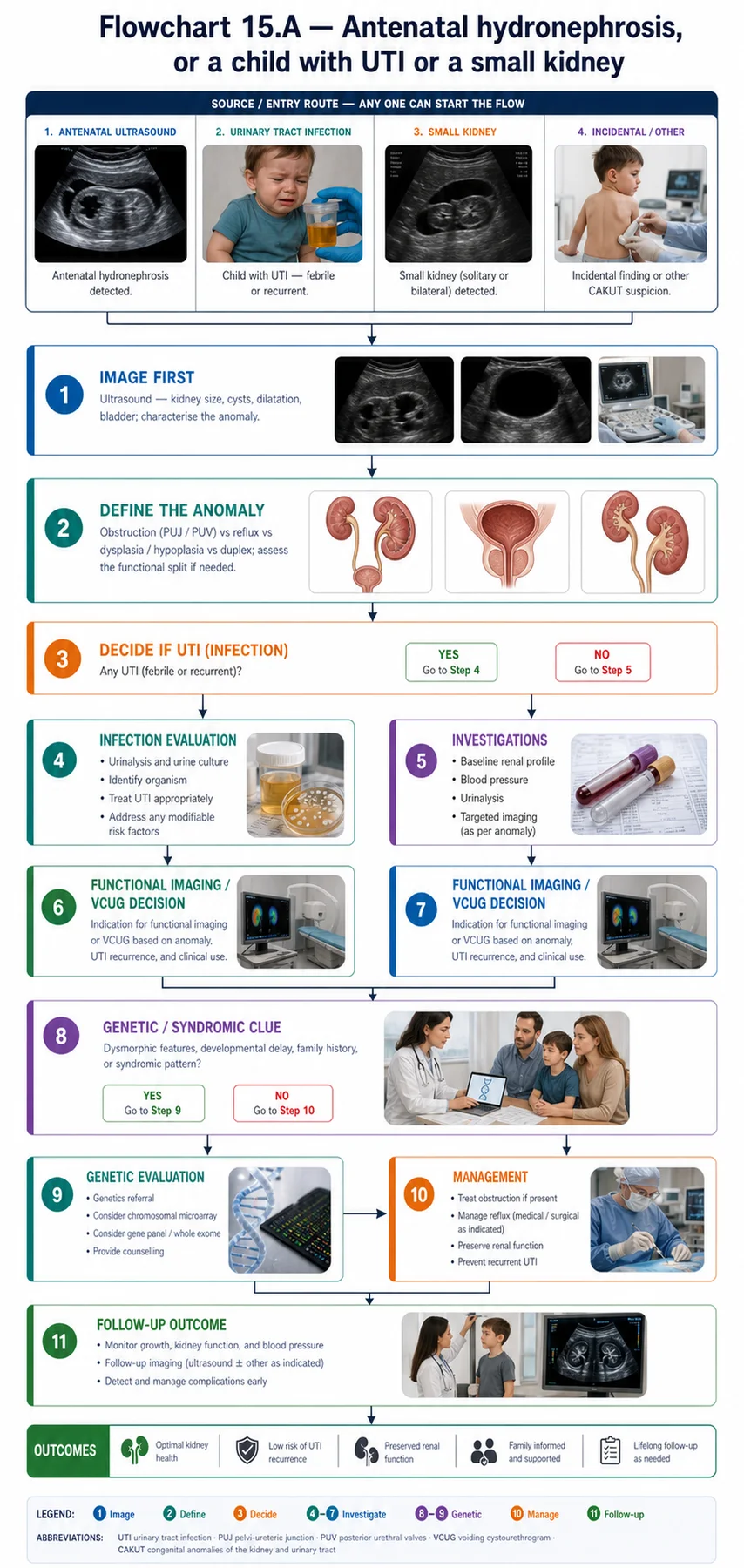
CAKUT is increasingly diagnosed antenatally: routine antenatal ultrasound detects hydronephrosis, oligohydramnios, or absent or abnormal kidneys, so many cases are recognised before birth, allowing planning. Postnatally, the work-up uses renal ultrasound (structure, hydronephrosis), a voiding cystourethrogram (for vesicoureteric reflux and posterior urethral valves), and a DMSA scan (for cortical scarring and differential function); a child with a urinary infection — especially atypical, recurrent, or with abnormal imaging — is investigated for reflux, and any child with CKD of uncertain cause should prompt consideration of CAKUT (the commonest cause), with genetic testing where the picture is syndromic or familial. Management spans the spectrum: relieve significant obstruction (endoscopic valve ablation for posterior urethral valves, pyeloplasty for pelvi-ureteric junction obstruction); manage reflux conservatively where it is low-grade and likely to resolve (treating infections, with antibiotic prophylaxis in selected high-risk children), reserving surgical correction for high-grade, breakthrough-infection, or non-resolving reflux with scarring; prevent and treat urinary infections to limit further scarring; and protect the kidney from the low-nephron-number progression with blood-pressure control and RAAS blockade. Bladder management is crucial in posterior-urethral-valve and other dysfunctional bladders, and the bladder must be optimised before transplantation (a poorly functioning bladder threatens a graft). And throughout, the view must be lifelong: CAKUT is the commonest cause of childhood kidney failure, but it does not end in childhood — it follows the patient into adulthood, with continuing risks of hypertension, proteinuria, progressive CKD, and (in women) pregnancy complications. The unifying lesson is that a kidney problem present from fetal life, through a reduced nephron number, becomes an adult CKD — so CAKUT demands lifelong follow-up and renal protection, not just the correction of its childhood anatomy.
| 04 | PHASE A · LEVEL 4 · ORIENTATION & KNOWLEDGE Reference Tables |
Table 15.1 — The CAKUT spectrum
| Category | Examples |
| Parenchymal | Agenesis, hypoplasia, dysplasia (multicystic dysplastic kidney), fusion/ectopia (horseshoe) |
| Urinary tract / obstruction | PUJ obstruction, vesicoureteric junction obstruction, posterior urethral valves, duplex systems |
| Reflux | Vesicoureteric reflux (primary/secondary) |
| Significance | Commonest cause of CKD/ESKD in children; often genetic/multifactorial |
Table 15.2 — Parenchymal anomalies
| Anomaly | Detail |
| Renal agenesis | Unilateral → solitary kidney (HTN/CKD risk); bilateral → lethal (Potter sequence) |
| Hypoplasia | Small kidney, reduced nephron number |
| Dysplasia | Disorganised tissue ± cysts; multicystic dysplastic kidney (non-functioning) |
| Fusion / ectopia | Horseshoe kidney, pelvic kidney |
Table 15.3 — Posterior urethral valves
| Aspect | Detail |
| What | Obstructing membrane in the posterior urethra of boys → bladder outlet obstruction |
| Consequences | Antenatal hydronephrosis, oligohydramnios (→ pulmonary hypoplasia), renal dysplasia, bladder dysfunction |
| Significance | Major cause of childhood CKD/ESKD in boys |
| Treatment | Endoscopic valve ablation + lifelong bladder management (dysplasia/bladder damage persist) |
Table 15.4 — Vesicoureteric reflux and reflux nephropathy
| Aspect | Detail |
| VUR | Retrograde urine flow (incompetent vesicoureteric junction); primary (resolves) or secondary; graded I–V |
| Danger | Predisposes to ascending UTI/pyelonephritis |
| Reflux nephropathy | Scarring — from infected reflux (acquired) AND congenital dysplasia (high-grade reflux) |
| Consequences | Hypertension, proteinuria, progressive CKD — often presents in young adults |
Table 15.5 — The low-nephron-number progression
| Step | Detail |
| Reduced nephron number | From hypoplasia, dysplasia, solitary kidney, reflux nephropathy |
| Hyperfiltration | Remaining nephrons compensate → glomerular hypertension |
| Consequence | Secondary FSGS-like sclerosis, hypertension, proteinuria, progressive CKD |
| Implication | 'Compensated' childhood CAKUT can progress to adult CKD (Brenner) |
Table 15.6 — Diagnosis and management
| Element | Detail |
| Diagnosis | Antenatal ultrasound; postnatal ultrasound, voiding cystourethrogram (reflux/PUV), DMSA (scarring) |
| Obstruction | Relieve — valve ablation (PUV), pyeloplasty (PUJ) |
| Reflux / infection | Low-grade resolves (treat UTIs ± prophylaxis); surgery for high-grade/non-resolving; prevent UTI |
| Renal protection | BP control, RAAS blockade; optimise bladder BEFORE transplant; lifelong follow-up |
| 05 | PHASE B · LEVEL 5 · VISUALISE & MAP Imaging & Flowchart Specifications |
| 06 | PHASE B · LEVEL 6 · VISUALISE & MAP Concept Maps |
Each chain runs from mechanism to a named clinical action; read the arrows as “leads to.”
CAKUT spectrum. Disrupted development → parenchymal (agenesis/hypoplasia/dysplasia) + tract (obstruction/reflux) anomalies → commonest childhood CKD → ACTION: consider CAKUT in any child with CKD of uncertain cause.
Posterior urethral valves. Posterior urethral membrane → bladder outlet obstruction → hydronephrosis/dysplasia/oligohydramnios/bladder dysfunction → ACTION: ablate the valves and manage the bladder lifelong (damage persists).
Reflux nephropathy. Vesicoureteric reflux → infected reflux (acquired scarring) + congenital dysplasia → reflux nephropathy → HTN, proteinuria, CKD → ACTION: manage reflux and infection, and protect the kidney.
Low nephron number. Reduced nephron number → hyperfiltration → glomerular hypertension → FSGS-like sclerosis/proteinuria/progressive CKD → ACTION: protect with BP control and RAAS blockade; expect lifelong progression.
Lifelong disease. Fetal-onset anatomy → 'compensated' childhood → adult CKD through hyperfiltration → ACTION: provide lifelong nephrological follow-up, not just childhood correction.
| 07 | PHASE B · LEVEL 7 · VISUALISE & MAP Decision Pathways |
| R1 | IF a child has CKD of uncertain cause, THEN consider CAKUT — the commonest cause of childhood kidney failure. |
| R2 | IF an antenatal ultrasound shows hydronephrosis, oligohydramnios, or abnormal/absent kidneys, THEN suspect CAKUT and plan postnatal investigation. |
| R3 | IF a boy has bladder outlet obstruction with antenatal hydronephrosis, THEN suspect posterior urethral valves — ablate the valves and manage the bladder lifelong. |
| R4 | IF a child has a urinary infection that is atypical, recurrent, or with abnormal imaging, THEN investigate for vesicoureteric reflux. |
| R5 | IF reflux is low-grade and primary, THEN expect spontaneous resolution — treat infections (± prophylaxis); reserve surgery for high-grade, breakthrough, or non-resolving reflux with scarring. |
| R6 | IF a young adult has hypertension, proteinuria, and renal scarring, THEN consider reflux nephropathy. |
| R7 | IF a patient has a reduced nephron number from CAKUT, THEN protect against the hyperfiltration progression with blood-pressure control and RAAS blockade. |
| R8 | IF a CAKUT patient with a dysfunctional bladder approaches transplantation, THEN optimise the bladder first — and provide lifelong follow-up. |
| 08 | PHASE C · LEVEL 8 · CLINICAL REASONING Clinical Cases |
| CASE 1 | VALVES IN A BOY Relieve, but the damage persists Posterior urethral valves |
Presentation
A male infant had antenatal bilateral hydronephrosis and oligohydramnios, and after birth is found to have posterior urethral valves with renal dysplasia and a thick-walled bladder. After valve ablation, the team expects the kidney problem to be resolved.
❖ Pause and reflect Does valve ablation resolve this boy's kidney problem? |
Analysis
No — valve ablation relieves the obstruction but does not undo the damage already done. Posterior urethral valves cause congenital bladder outlet obstruction in boys, and the back-pressure from fetal life has already produced bilateral hydronephrosis, renal dysplasia (an established developmental abnormality of the kidney tissue), and a thick-walled, dysfunctional bladder — with the oligohydramnios having risked pulmonary hypoplasia. Endoscopic ablation of the valves is essential to relieve the obstruction, but the renal dysplasia is fixed and the bladder dysfunction persists, so this boy has ongoing CKD risk and needs lifelong bladder management. Expecting the problem to be resolved by valve ablation misunderstands the disease: relieving the obstruction stops further obstructive damage but cannot reverse the developmental kidney and bladder injury already present. The lesson of posterior urethral valves is that the disease continues after the valves are gone.
Plan
Ablate the valves to relieve the obstruction, but recognise the established renal dysplasia and bladder dysfunction — provide lifelong bladder management and CKD follow-up rather than expecting resolution. Relieve the obstruction, but expect ongoing kidney and bladder disease.
Teaching point
Posterior urethral valves cause bladder outlet obstruction in boys; valve ablation relieves it but the renal dysplasia and bladder dysfunction persist — the disease continues lifelong.
Cross-reference
Exercises rules R2, R3, and R8; the PUV concept map; Figure 15.2; Tables 15.3, 15.6.
| CASE 2 | REFLUX AND SCARS Acquired and congenital Reflux nephropathy |
Presentation
A child with recurrent urinary infections is found to have high-grade vesicoureteric reflux and renal scarring on a DMSA scan. A clinician assumes all the scarring is from the infections and that controlling infection will prevent it.
❖ Pause and reflect Is all the renal scarring in this child acquired from infection? |
Analysis
No — reflux nephropathy has a dual origin, and not all the scarring is acquired from infection. Vesicoureteric reflux predisposes to ascending infection and pyelonephritis, and refluxing infected urine does cause acquired pyelonephritic scarring — so controlling infection is important. But, crucially, high-grade reflux is associated with congenital renal dysplasia, so part of the 'scarring' is a developmental abnormality present from birth, not acquired from infection. This dual origin (acquired infective scarring plus congenital dysplasia) explains why reflux nephropathy is not fully prevented just by treating infections, and why high-grade reflux carries the worst renal prognosis (more congenital dysplasia). So while preventing and treating infections is part of management, the clinician should not assume infection control alone will prevent the renal damage — the congenital component is already present. Reflux nephropathy causes hypertension, proteinuria, and progressive CKD, often into young adulthood, so this child needs reflux and infection management plus long-term renal protection.
Plan
Recognise the dual (acquired infective plus congenital dysplastic) origin of reflux nephropathy, manage the reflux and infections, and protect the kidney long-term — without assuming infection control alone will prevent the damage. Reflux nephropathy is partly congenital, not only infective.
Teaching point
Reflux nephropathy scarring is dual in origin — acquired (infected reflux) and congenital (dysplasia with high-grade reflux); infection control alone does not prevent the congenital component.
Cross-reference
Exercises rules R4, R5, and R6; the reflux-nephropathy concept map; Figure 15.3; Table 15.4.
| CASE 3 | COMMONEST, AND OVERLOOKED CKD of 'unknown cause' in a child Recognising CAKUT |
Presentation
A child has CKD recorded as 'of unknown cause,' with small kidneys on ultrasound and no glomerular features. CAKUT has not been considered.
❖ Pause and reflect What is the likely cause of CKD in this child? |
Analysis
CAKUT — the commonest cause of CKD in children — which has been overlooked. CAKUT (congenital anomalies of the kidney and urinary tract) is the leading cause of childhood CKD and end-stage disease, far more common in children than the glomerular diseases that dominate adult CKD, and the small kidneys with no glomerular features here fit a CAKUT parenchymal anomaly (hypoplasia or dysplasia). Recording the CKD as 'of unknown cause' without considering CAKUT misses the commonest diagnosis. The work-up should include imaging (ultrasound for structure, voiding cystourethrogram for reflux/valves, DMSA for scarring) and consideration of genetic testing (CAKUT genes such as HNF1B) where the picture is syndromic or familial. Recognising CAKUT matters because it carries specific implications: the reduced nephron number predicts progression through hyperfiltration into adulthood, so the child needs lifelong renal protection and follow-up, not a non-diagnosis.
Plan
Consider CAKUT as the commonest cause of this child's CKD, investigate with the appropriate imaging (and genetics if syndromic/familial), and institute renal protection and lifelong follow-up — rather than recording 'unknown cause.' CAKUT is the commonest childhood CKD — consider it.
Teaching point
CAKUT is the commonest cause of CKD in children — consider it (small kidneys, no glomerular features) rather than recording 'CKD of unknown cause.'
Cross-reference
Exercises rule R1; the CAKUT-spectrum concept map; Figure 15.1; Tables 15.1, 15.2, 15.6.
| CASE 4 | CHILDHOOD DISEASE, ADULT CKD The hyperfiltration progression Low nephron number |
Presentation
A young adult with a solitary kidney (from childhood unilateral agenesis or a dysplastic kidney), previously 'compensated' with a normal GFR, now develops hypertension, proteinuria, and a slowly declining GFR. The team is surprised, having considered the childhood problem resolved.
❖ Pause and reflect Why is this 'compensated' patient now progressing? |
Analysis
Because of the low-nephron-number, hyperfiltration progression — CAKUT is a lifelong, not a childhood, disease. This patient has a reduced nephron number (a solitary or dysplastic kidney), and the remaining nephrons have compensated by hyperfiltration, which maintained a normal GFR and made the patient appear 'compensated' in childhood. But over years, that hyperfiltration causes glomerular hypertension within the remaining nephrons, leading to a secondary, FSGS-like glomerulosclerosis with hypertension and proteinuria and progressive loss of nephrons — the Brenner mechanism of congenital nephron deficit. So the emergence of hypertension, proteinuria, and a declining GFR in this young adult is not a surprise but the expected long-term course: the hyperfiltration that compensated also slowly destroys. The team's assumption that the childhood problem was 'resolved' is the error — the anatomy was fixed, but the functional decline plays out over a lifetime. The patient needs renal protection (blood-pressure control and RAAS blockade to reduce the intraglomerular pressure and proteinuria) and lifelong follow-up.
Plan
Recognise the low-nephron-number hyperfiltration progression, protect the kidney with blood-pressure control and RAAS blockade (reducing intraglomerular pressure and proteinuria), and provide lifelong follow-up — understanding that CAKUT progresses from childhood into adult CKD. Protect against the hyperfiltration progression.
Teaching point
A reduced nephron number from CAKUT drives hyperfiltration that, over years, causes hypertension, proteinuria, and progressive CKD — so 'compensated' childhood CAKUT becomes adult CKD; protect with BP control and RAAS blockade.
Cross-reference
Exercises rules R7 and R8; the low-nephron-number and lifelong-disease concept maps; Figure 15.3; Table 15.5; the Brenner hypothesis in Volume 8.
| 09 | PHASE C · LEVEL 9 · CLINICAL REASONING Clinical Implications |
One triad per mechanism the narrative exposed: the physiology, why it matters, and the clinical move.
MECHANISM CAKUT is a spectrum of developmental anomalies of the kidney and urinary tract. |
WHY IT MATTERS It is the commonest cause of CKD and kidney failure in children. |
ACTION Consider CAKUT in any child with CKD of uncertain cause. |
MECHANISM Posterior urethral valves obstruct the bladder outlet from fetal life. |
WHY IT MATTERS They cause renal dysplasia and bladder dysfunction that persist after valve ablation. |
ACTION Ablate the valves but manage the bladder and the CKD lifelong. |
MECHANISM Reflux nephropathy scarring is partly acquired (infected reflux) and partly congenital (dysplasia). |
WHY IT MATTERS Infection control alone does not prevent the congenital component. |
ACTION Manage reflux and infection, and protect the kidney long-term. |
MECHANISM A reduced nephron number drives compensatory hyperfiltration. |
WHY IT MATTERS The hyperfiltration that compensates also slowly destroys the remaining nephrons. |
ACTION Protect with blood-pressure control and RAAS blockade. |
MECHANISM CAKUT anatomy is fixed in childhood but its function declines over a lifetime. |
WHY IT MATTERS 'Compensated' childhood CAKUT can become adult CKD. |
ACTION Provide lifelong nephrological follow-up, not just childhood correction. |
| 10 | PHASE C · LEVEL 10 · CLINICAL REASONING Clinical Pearls |
| CAKUT = congenital anomalies of the kidney and urinary tract. | Commonest cause of CKD/ESKD in children. |
| Parenchymal: agenesis, hypoplasia, dysplasia (multicystic dysplastic kidney), fusion/ectopia. | Bilateral agenesis = lethal (Potter sequence). |
| Tract: PUJ obstruction, posterior urethral valves, duplex, vesicoureteric reflux. | Posterior urethral valves: bladder outlet obstruction in BOYS. |
| PUV → hydronephrosis, oligohydramnios, dysplasia, bladder dysfunction. | Valve ablation relieves obstruction — but dysplasia/bladder damage PERSIST. |
| VUR: retrograde urine flow; primary (resolves) or secondary; graded I–V. | VUR predisposes to UTI/pyelonephritis. |
| Reflux nephropathy: scarring = acquired (infected reflux) + congenital (dysplasia). | Reflux nephropathy → HTN, proteinuria, CKD — often in young adults. |
| Low nephron number → hyperfiltration → progressive CKD (Brenner). | 'Compensated' childhood CAKUT becomes adult CKD. |
| Protect: BP control + RAAS blockade; optimise bladder BEFORE transplant. | CAKUT is a LIFELONG disease — not just paediatric. |
| 11 | PHASE D · LEVEL 11 · SAFETY & EVIDENCE Red Flags & Never-Do |
Panel A — Red flags
| ▲ | Antenatal hydronephrosis/oligohydramnios or abnormal kidneys — suspect CAKUT; investigate postnatally. |
| ▲ | A boy with bladder outlet obstruction — posterior urethral valves; ablate and manage the bladder. |
| ▲ | Atypical/recurrent childhood UTI — investigate for vesicoureteric reflux. |
| ▲ | A young adult with hypertension, proteinuria, and renal scarring — consider reflux nephropathy. |
| ▲ | A 'compensated' solitary or dysplastic kidney — expect the hyperfiltration progression; protect and follow up. |
Panel B — Never do
| ✖ NEVER — record childhood CKD as 'unknown cause' without considering CAKUT. |
| ✖ NEVER — assume valve ablation resolves a posterior-urethral-valve boy's kidney/bladder disease. |
| ✖ NEVER — assume infection control alone prevents reflux nephropathy (part is congenital). |
| ✖ NEVER — discharge a 'compensated' CAKUT patient — the disease is lifelong. |
| 12 | PHASE D · LEVEL 12 · SAFETY & EVIDENCE Common Pitfalls |
Pitfall 1 — Overlooking CAKUT
| ✖ | WRONG Recording childhood CKD as 'unknown cause'. |
| ✓ | RIGHT Considering CAKUT, the commonest childhood cause. |
| ✉ | WHY CAKUT dominates paediatric CKD. |
Pitfall 2 — 'Cured by valve ablation'
| ✖ | WRONG Assuming valve ablation resolves the PUV boy's disease. |
| ✓ | RIGHT Managing the persisting dysplasia and bladder dysfunction lifelong. |
| ✉ | WHY The developmental damage is established before ablation. |
Pitfall 3 — 'Infection alone causes the scars'
| ✖ | WRONG Assuming all reflux-nephropathy scarring is infective. |
| ✓ | RIGHT Recognising the congenital dysplastic component too. |
| ✉ | WHY High-grade reflux is associated with congenital dysplasia. |
Pitfall 4 — Ignoring the hyperfiltration progression
| ✖ | WRONG Treating a 'compensated' solitary/dysplastic kidney as stable. |
| ✓ | RIGHT Protecting against the hyperfiltration progression (BP control, RAAS blockade). |
| ✉ | WHY A reduced nephron number progresses through hyperfiltration. |
Pitfall 5 — Transplanting onto a bad bladder
| ✖ | WRONG Transplanting a CAKUT patient without optimising the bladder. |
| ✓ | RIGHT Optimising the dysfunctional bladder before transplantation. |
| ✉ | WHY A poorly functioning bladder threatens the graft. |
| 13 | PHASE D · LEVEL 13 · SAFETY & EVIDENCE Evidence Grading |
GRADE A HIGH CONFIDENCE The effect is real and the estimate is stable. RCTs at low risk of bias; multiple concordant prospective cohorts; meta-analyses. |
GRADE B MODERATE CONFIDENCE The effect is likely real but may shift with new data. Observational studies, registries, mechanistic human studies. |
GRADE C LOW CONFIDENCE Rests on physiology, reasoning, or consensus rather than outcomes. Pathophysiological reasoning; extrapolation; consensus without outcomes. |
Graded statements (by evidence type)
| Statement | Grade | Basis (evidence type) |
| CAKUT is the commonest cause of CKD/ESKD in children. | A | Registry and epidemiological data |
| Posterior urethral valves cause childhood CKD and bladder dysfunction. | A | Clinical cohort data |
| Reflux nephropathy has acquired and congenital components. | A | Clinical and pathological data |
| A reduced nephron number drives hyperfiltration and progressive CKD. | A | Physiology (Brenner) and cohort data |
| Most low-grade primary vesicoureteric reflux resolves spontaneously. | A | Cohort data |
| RAAS blockade and blood-pressure control protect the CAKUT kidney. | A | Clinical data |
| The bladder should be optimised before transplantation in CAKUT. | A | Transplant outcome data |
| 14 | PHASE E · LEVEL 14 · PATIENT DECISIONS Absolute Risk in Natural Frequency |
Natural-frequency estimates for orientation, from CAKUT cohorts; they vary with the anomaly. They convey the size of the decisions, expressed per 100 comparable patients.
| Per 100 children… | Outcome | Roughly how many | See |
| With CKD | Have CAKUT as the cause | A leading share — the commonest cause | L13 row 1 |
| With low-grade primary vesicoureteric reflux | Resolve spontaneously with growth | Many — hence conservative management | L13 row 5 |
| Boys with posterior urethral valves | Progress to CKD despite valve ablation | A substantial share — damage persists | L13 row 2 |
| With a reduced nephron number from CAKUT | Develop hypertension/proteinuria/CKD over time | More — hence lifelong protection | L13 row 4 |
★ How to read these Read these as orientation, not promises; outcomes vary with the anomaly. The stable signals: CAKUT dominates childhood CKD, low-grade reflux resolves, valve boys still progress, and a low nephron number brings adult CKD. Communicate them as people out of 100, not as a hazard ratio. |
| 17 | PHASE F · LEVEL 17 · APPLY & TEST Documentation Templates |
Paste-ready notes. Tick the boxes that apply and delete the rest; make the anomaly, the management, and the lifelong protection explicit.
Template 1 — CAKUT assessment
Template 2 — Management and lifelong protection
| 18 | PHASE F · LEVEL 18 · APPLY & TEST Cheat Sheet |
| CAKUT = congenital anomalies of kidney + urinary tract. | Commonest cause of childhood CKD/ESKD. |
| Parenchymal: agenesis, hypoplasia, dysplasia, fusion/ectopia. | Bilateral agenesis = lethal (Potter). |
| Tract: PUJ obstruction, posterior urethral valves, duplex, reflux. | PUV: bladder outlet obstruction in boys. |
| PUV → hydronephrosis/oligohydramnios/dysplasia/bladder dysfunction. | Valve ablation relieves obstruction — damage PERSISTS. |
| VUR: retrograde urine flow; primary resolves; graded I–V. | VUR → UTI/pyelonephritis. |
| Reflux nephropathy = infected-reflux (acquired) + congenital dysplasia. | Reflux nephropathy → HTN, proteinuria, CKD (young adults). |
| Low nephron number → hyperfiltration → progressive CKD. | 'Compensated' childhood CAKUT → adult CKD. |
| Protect: BP control + RAAS blockade; optimise bladder before transplant. | CAKUT = lifelong disease. |
| 19 | PHASE F · LEVEL 19 · APPLY & TEST Flashcards |
| CARD 1 | Q. What is CAKUT and why does it matter? A. Congenital anomalies of the kidney and urinary tract — a spectrum of developmental abnormalities (parenchymal and urinary-tract) arising from disrupted development — and the commonest cause of CKD and end-stage kidney disease in children. DETAILED. It often arises from genetic or multifactorial causes. CLINICAL. Consider CAKUT in any child with CKD of uncertain cause. |
| CARD 2 | Q. What are the parenchymal anomalies of CAKUT? A. Renal agenesis (unilateral leaving a solitary kidney with later HTN/CKD risk; bilateral being lethal with Potter sequence), hypoplasia (a small kidney with few nephrons), dysplasia (disorganised tissue, as in the multicystic dysplastic kidney), and fusion or ectopia (horseshoe or pelvic kidney). DETAILED. They reduce functioning renal tissue and nephron number. CLINICAL. Recognise the parenchymal anomalies as reducing nephron number. |
| CARD 3 | Q. What are posterior urethral valves and their consequences? A. An obstructing membrane in the posterior urethra of boys causing congenital bladder outlet obstruction, with antenatal bilateral hydronephrosis, oligohydramnios (and pulmonary hypoplasia), renal dysplasia, and bladder dysfunction — a major cause of childhood CKD in boys; treated by endoscopic valve ablation plus lifelong bladder management. DETAILED. The dysplasia and bladder damage persist after ablation. CLINICAL. Ablate the valves but manage the bladder and CKD lifelong. |
| CARD 4 | Q. What is reflux nephropathy and what causes its scarring? A. The renal scarring associated with vesicoureteric reflux, with a dual origin — acquired pyelonephritic scarring from refluxing infected urine, AND congenital renal dysplasia accompanying high-grade reflux — causing hypertension, proteinuria, and progressive CKD, often presenting in young adults. DETAILED. Infection control alone does not prevent the congenital component. CLINICAL. Manage reflux and infection, and protect the kidney long-term. |
| CARD 5 | Q. How does vesicoureteric reflux behave and how is it managed? A. Retrograde flow of urine from the bladder up the ureter from an incompetent vesicoureteric junction; primary (congenital, tending to resolve with growth, especially low grade) or secondary; most low-grade primary reflux is managed conservatively (treating infections, with prophylaxis in selected children), with surgical correction for high-grade, breakthrough, or non-resolving reflux with scarring. DETAILED. It predisposes to ascending infection. CLINICAL. Manage low-grade reflux conservatively; operate on high-grade/non-resolving disease. |
| CARD 6 | Q. How does a low nephron number cause progressive CKD? A. A reduced nephron number (from hypoplasia, dysplasia, a solitary kidney, or reflux nephropathy) drives compensatory hyperfiltration of the remaining nephrons, which over years causes glomerular hypertension, a secondary FSGS-like glomerulosclerosis, hypertension, proteinuria, and progressive CKD — the Brenner mechanism. DETAILED. The hyperfiltration that compensates also slowly destroys. CLINICAL. Protect with blood-pressure control and RAAS blockade. |
| CARD 7 | Q. Why is CAKUT a lifelong rather than a childhood disease? A. Because the anatomical anomaly is fixed in childhood, but the reduced nephron number drives a hyperfiltration progression over years, so a CAKUT patient who appears 'compensated' in childhood can develop hypertension, proteinuria, and CKD in adulthood — the functional decline plays out over a lifetime. DETAILED. It needs lifelong follow-up. CLINICAL. Provide lifelong nephrological follow-up, not just childhood correction. |
| CARD 8 | Q. How is CAKUT diagnosed and managed? A. Increasingly antenatally (hydronephrosis, oligohydramnios, abnormal kidneys on ultrasound), with postnatal ultrasound, voiding cystourethrogram, and DMSA scan; managed by relieving obstruction, managing reflux and infection, protecting the kidney with blood-pressure control and RAAS blockade, optimising the bladder before transplantation, and lifelong follow-up. DETAILED. Genetic testing helps in syndromic/familial cases. CLINICAL. Investigate appropriately and protect the kidney lifelong. |
| 20 | PHASE F · LEVEL 20 · APPLY & TEST One-Minute Preceptor |
| SCENE 1 | The intern who thinks ablation cured it |
GET A COMMITMENT. “You've told this PUV boy's family the kidney problem is fixed now the valves are ablated — is that right?”
PROBE FOR EVIDENCE. “The obstruction is relieved” — ask: “What about the renal dysplasia and the bladder — does ablation undo those?”
TEACH A GENERAL RULE. Valve ablation relieves the obstruction but the renal dysplasia and bladder dysfunction are already established and persist — these boys need lifelong bladder management and CKD follow-up.
REINFORCE WHAT WAS RIGHT. Relieving the obstruction was essential.
CORRECT A MISTAKE. Recognise the persisting kidney and bladder disease; follow up lifelong.
| SCENE 2 | The resident discharging the 'compensated' patient |
GET A COMMITMENT. “This young adult has a solitary dysplastic kidney with a normal GFR — you want to discharge them as compensated. Wise?”
PROBE FOR EVIDENCE. “The GFR is normal” — ask: “What is hyperfiltration doing to those remaining nephrons over time?”
TEACH A GENERAL RULE. A reduced nephron number drives hyperfiltration that, over years, causes hypertension, proteinuria, and progressive CKD — so 'compensated' childhood CAKUT becomes adult CKD; protect and follow up lifelong.
REINFORCE WHAT WAS RIGHT. Noting the normal GFR was reasonable.
CORRECT A MISTAKE. Don't discharge; protect with BP control/RAAS blockade and follow up.
| 22 | PHASE F · LEVEL 22 · APPLY & TEST Board-Style Questions |
| Q 01 | The commonest cause of CKD in children is: |
| A | Glomerulonephritis |
| B | CAKUT (congenital anomalies of the kidney and urinary tract) |
| C | Diabetic nephropathy |
| D | Hypertensive nephrosclerosis |
Rationale CAKUT is the commonest childhood CKD cause (case 3, Table 15.1). A, C, and D dominate adult CKD, not childhood. |
| Q 02 | Posterior urethral valves cause: |
| A | Bladder outlet obstruction in boys (with dysplasia and bladder dysfunction) |
| B | Reflux in girls |
| C | A glomerulonephritis |
| D | Renal stones |
Rationale PUV obstruct the bladder outlet in boys, causing dysplasia and bladder dysfunction (case 1, Table 15.3). A, C, and D are wrong. |
| Q 03 | After valve ablation for posterior urethral valves: |
| A | The kidney disease is cured |
| B | The renal dysplasia and bladder dysfunction persist, needing lifelong management |
| C | No follow-up is needed |
| D | Reflux always resolves |
Rationale Ablation relieves obstruction but the developmental damage persists (case 1, Table 15.3, rule R3). A, C, and D are incorrect. |
| Q 04 | Reflux nephropathy scarring is: |
| A | Entirely acquired from infection |
| B | Both acquired (infected reflux) and congenital (dysplasia) |
| C | Entirely congenital |
| D | Unrelated to reflux |
Rationale It has a dual origin (case 2, Table 15.4). A and C are partial; D is wrong. |
| Q 05 | Most low-grade primary vesicoureteric reflux: |
| A | Requires immediate surgery |
| B | Resolves spontaneously with growth (manage UTIs) |
| C | Always causes ESKD |
| D | Needs no follow-up |
Rationale Low-grade primary reflux usually resolves; manage conservatively (Table 15.4, rule R5). A, C, and D overstate it. |
| Q 06 | How does a reduced nephron number from CAKUT cause progressive CKD? |
| A | By immune injury |
| B | By compensatory hyperfiltration causing glomerular hypertension and sclerosis |
| C | By obstruction |
| D | By infection alone |
Rationale Hyperfiltration of the remaining nephrons drives progression (case 4, Figure 15.3, Table 15.5). A, C, and D are not the mechanism. |
| Q 07 | A 'compensated' childhood solitary or dysplastic kidney: |
| A | Will remain stable lifelong |
| B | Can progress to adult CKD through the hyperfiltration mechanism |
| C | Cannot cause hypertension |
| D | Needs no protection |
Rationale The low-nephron-number progression makes CAKUT a lifelong disease (case 4, Table 15.5, rule R7). A, C, and D are wrong. |
| Q 08 | Before transplanting a CAKUT patient with a dysfunctional bladder, you should: |
| A | Proceed without bladder assessment |
| B | Optimise the bladder first |
| C | Avoid transplantation entirely |
| D | Remove both native kidneys routinely |
Rationale A poorly functioning bladder threatens the graft, so it is optimised first (Table 15.6, rule R8). A, C, and D are incorrect. |