Chapter Preamble
Signals declared
Sig-D — Diagnostic (primary). Define resistant and refractory hypertension and exclude pseudoresistance — adherence, white-coat effect, suboptimal regimen, interfering substances, secondary causes.
Sig-T — Therapeutic (strong). Optimise the regimen, add the evidence-based fourth agent (a mineralocorticoid antagonist), and consider device therapy.
Sig-E — Preference-sensitive (strong). How far to escalate and whether to pursue device therapy are genuine values-driven decisions — control against burden, side effects, and an invasive procedure.
Sig-V — Evidence-dense (strong). The PATHWAY-2 spironolactone evidence and the evolving renal-denervation trials — graded and reflected on.
Levels populated and omitted
Populated (20): L1–L5, L7, L8, L10–L22. The preference and evidence signals fire the absolute-risk table (L14), the preference-sensitive map (L15), the shared-decision scripts (L16), and the reflective prompts (L21); the therapeutic signal fires the templates (L17); the diagnostic signal drives the tables, rules, cases, pitfalls, and board items.
L6 / L9 mechanism levels — omitted. No Sig-M; the relevant mechanisms (aldosterone, sympathetic drive) were built earlier, and this is a diagnostic, therapeutic, and decision chapter.
| 01 | PHASE A · LEVEL 1 · ORIENTATION & KNOWLEDGE Learning Objectives |
By the end of this chapter you should be able to:
Define resistant and refractory hypertension.
Exclude pseudoresistance — non-adherence, white-coat effect, suboptimal regimen, interfering substances.
Screen for the secondary causes common in resistant hypertension.
Optimise the foundational regimen and ensure appropriate diuresis.
Add a mineralocorticoid antagonist as the evidence-based fourth agent (PATHWAY-2).
Describe renal denervation and the evolution of its evidence.
Recognise that escalation and device therapy are preference-sensitive decisions.
Conduct a shared decision about escalation and device therapy.
| 02 | PHASE A · LEVEL 2 · ORIENTATION & KNOWLEDGE Executive Summary |
Resistant hypertension is blood pressure above target despite three antihypertensives of different classes (including a diuretic) at optimal doses, or controlled but requiring four or more drugs.
Refractory hypertension is a rarer, extreme subset — uncontrolled despite five or more agents including a mineralocorticoid antagonist and a diuretic — thought to be sympathetically driven.
Before labelling true resistance, pseudoresistance must be excluded.
Non-adherence is the commonest cause and is often hidden, so it is sought actively, sometimes with objective testing such as drug levels or pharmacy records.
The white-coat effect, measurement error, a suboptimal regimen (wrong drugs, submaximal doses, no diuretic or the wrong diuretic), interfering substances, and lifestyle factors are the other causes of pseudoresistance.
Secondary causes — especially primary aldosteronism, obstructive sleep apnoea, and renovascular disease — are common in resistant hypertension and are screened for.
Only after these are excluded is the hypertension truly resistant.
Treatment optimises the foundational regimen — a RAAS blocker, a calcium-channel blocker, and an appropriate diuretic at optimal doses, with sodium restriction — since under-treated volume is a frequent culprit.
The evidence-based fourth agent is a mineralocorticoid antagonist, spironolactone, shown in PATHWAY-2 to be superior to other add-ons — reflecting the role of aldosterone and volume — with hyperkalaemia the main caution.
Further agents include beta-blockers, alpha-blockers, centrally-acting drugs, and direct vasodilators.
Device therapy — renal denervation, which ablates the renal sympathetic nerves — produces modest but real blood-pressure reductions in recent sham-controlled trials and is now an option for selected patients.
How far to escalate, and whether to pursue device therapy, are preference-sensitive decisions weighing control against burden, side effects, and an invasive procedure.
Shared decision-making therefore guides the management of the truly difficult case.
| 03 | PHASE A · LEVEL 3 · ORIENTATION & KNOWLEDGE Main Narrative |
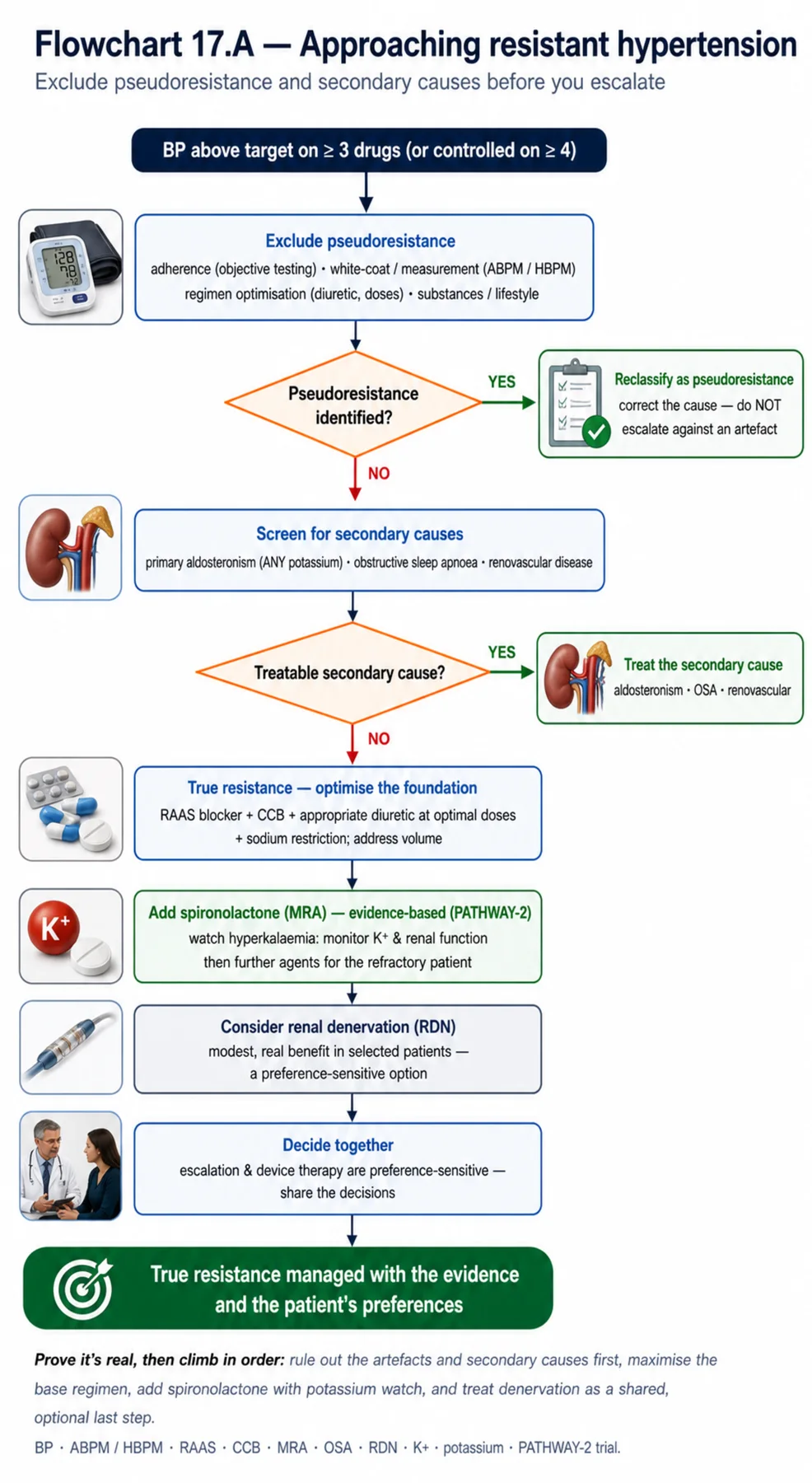
Resistant hypertension is the difficult case — and the first task with the difficult case is to be sure it is real. Most apparent resistance is pseudoresistance: poor adherence, a white-coat effect, an inadequate regimen, an interfering drug, or an unrecognised secondary cause. Only when these are excluded is the hypertension truly resistant, and then a clear evidence-based step (a mineralocorticoid antagonist) and, increasingly, device therapy come into play — along with genuinely preference-sensitive choices about how hard to push. This chapter works through the definition, the work-up, the treatment, and the decisions.
— Definitions: resistant and refractory
Resistant hypertension has a specific definition: blood pressure above target despite three antihypertensive drugs of different classes — including a diuretic — at optimal or maximally tolerated doses, or blood pressure that is controlled but requires four or more drugs. The two parts of the definition matter: it is not 'resistant' to be above target on two drugs (that is undertreatment), and it is resistant to need four drugs even if controlled. Refractory hypertension is a rarer, more extreme subset — hypertension that remains uncontrolled despite five or more agents including a mineralocorticoid antagonist and a long-acting diuretic — representing truly treatment-resistant disease that is thought to be predominantly sympathetically driven (in contrast to the more volume- and aldosterone-driven resistant hypertension). These definitions frame the problem, but the crucial first move is not to accept the label at face value, because most apparent resistance is not true resistance at all.
— Excluding pseudoresistance
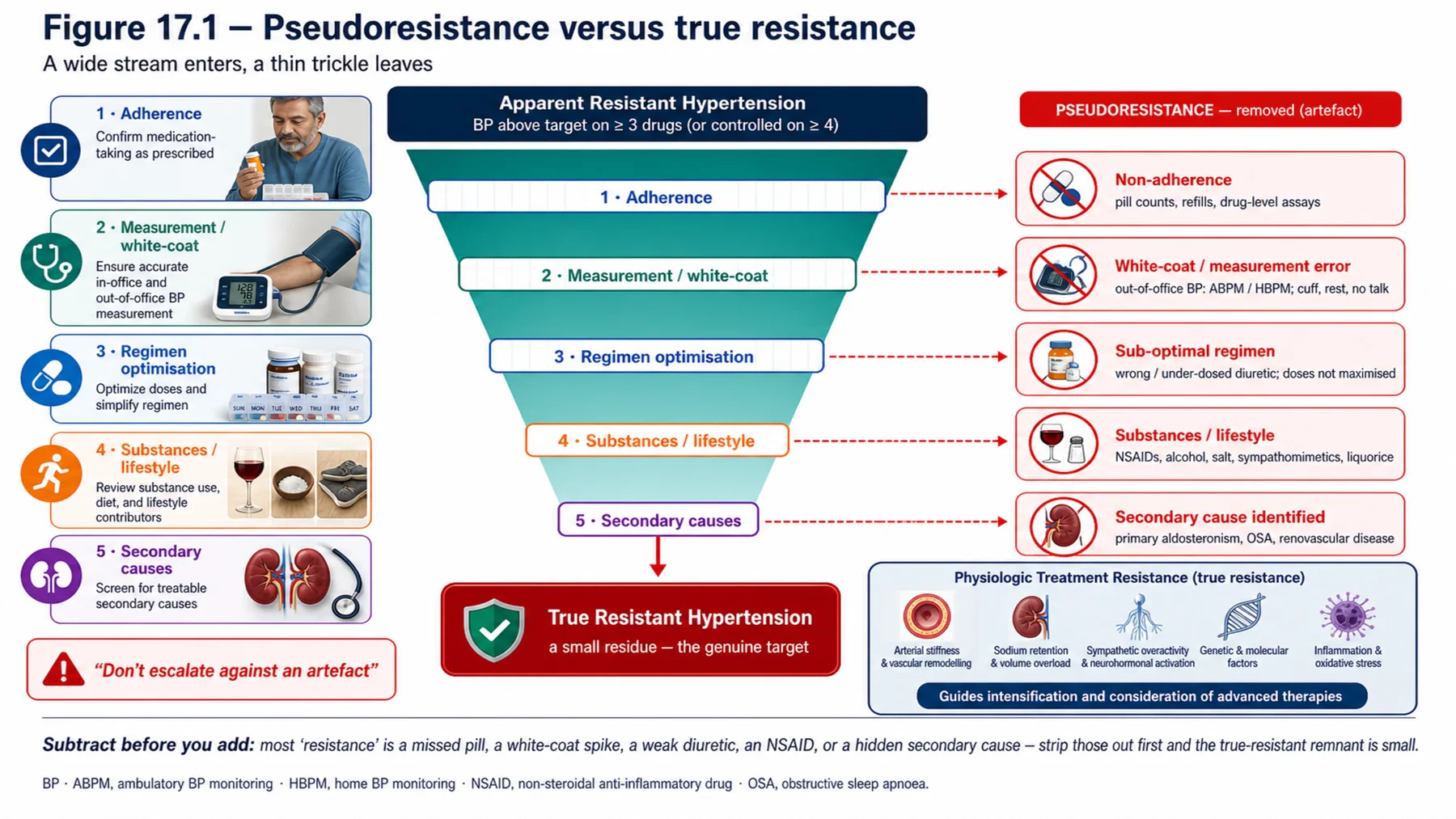
Before a patient is labelled truly resistant, pseudoresistance — the appearance of resistance from causes other than genuinely treatment-resistant disease — must be excluded, and there are five contributors. First and commonest is non-adherence: a large fraction of apparently resistant patients are not taking their medications as prescribed, and because this is often hidden (patients may not disclose it), it is sought actively, sometimes with objective testing — drug-level measurement, pharmacy refill records, or witnessed dosing. Second is the white-coat effect and measurement error, addressed by out-of-office monitoring (the measurement chapter). Third is a suboptimal regimen — the wrong drugs, submaximal doses, no diuretic, or the wrong diuretic (a thiazide in advanced CKD where a loop is needed) — the clinical inertia of the combination-therapy chapter. Fourth are interfering substances (NSAIDs and others) and lifestyle factors (high salt, alcohol, obesity). Fifth are unrecognised secondary causes. Working systematically through these five — adherence, measurement, regimen, substances, secondary causes — is the essential first step, because each is correctable and each, if missed, leads to escalating treatment against an artefact. Only when all are excluded is the hypertension truly resistant.
— Screening for secondary causes
Secondary causes deserve emphasis because they are disproportionately common in resistant hypertension and treating them can resolve it. Primary aldosteronism in particular is common in resistant hypertension — far more than is generally appreciated — and should be screened for with the aldosterone-to-renin ratio regardless of the potassium (the endocrine chapter); its recognition is doubly important here because the evidence-based fourth-line drug (a mineralocorticoid antagonist) is precisely the treatment for aldosterone excess, so much resistant hypertension responds to spironolactone because it reflects unrecognised aldosteronism. Obstructive sleep apnoea is the other very common contributor (the sympathetic, non-dipping, resistant pattern of the earlier chapter), and renovascular disease should be considered too. So the work-up of resistant hypertension folds in the secondary-cause screening of the earlier part of the volume: a truly resistant patient warrants screening for aldosteronism, sleep apnoea, and renovascular disease before being committed to ever-escalating drug therapy. Finding and treating a secondary cause is often the resolution.
— Optimising therapy and the fourth agent
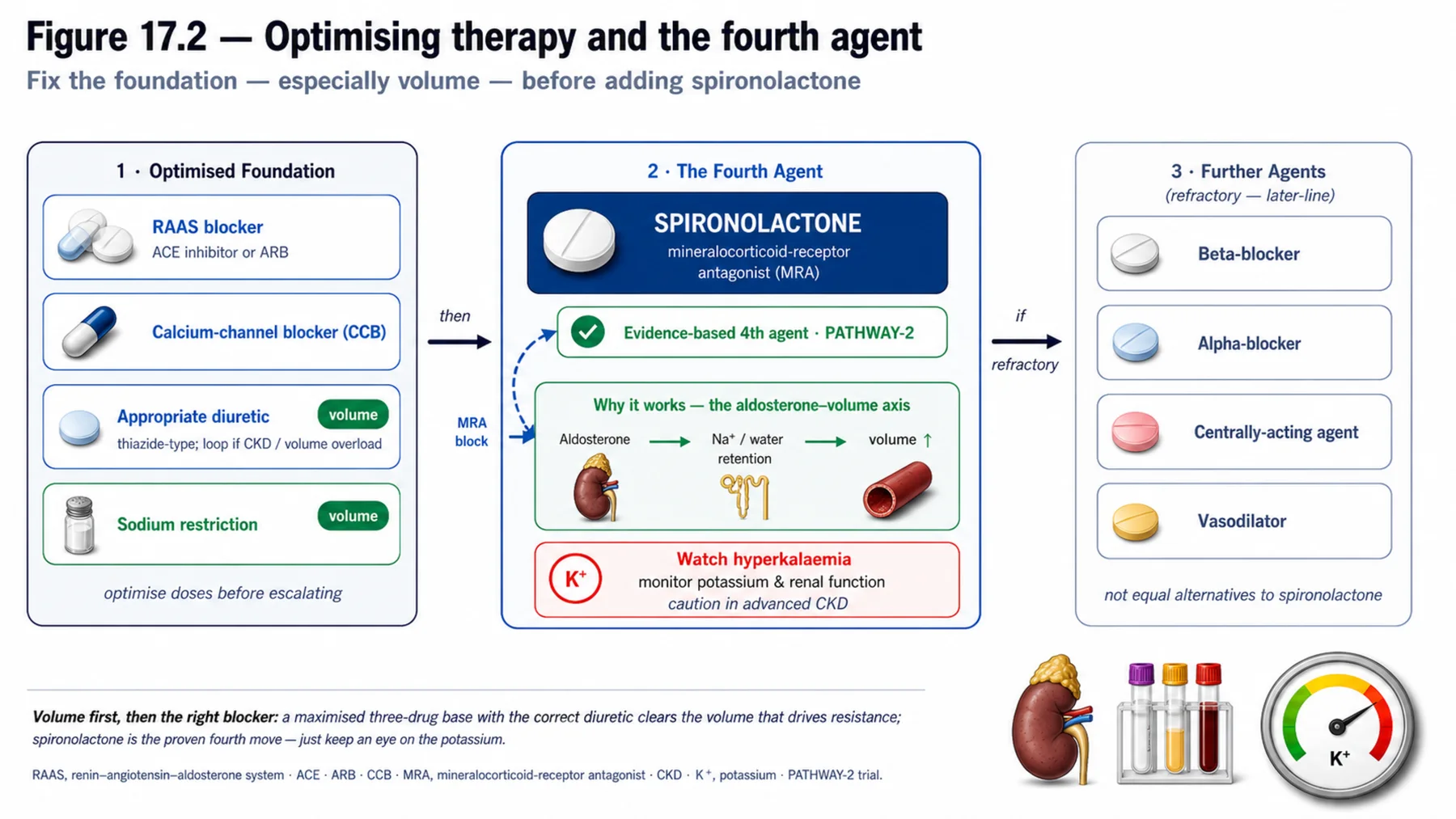
For the genuinely resistant patient, treatment proceeds in two steps. First, optimise the foundation: ensure the patient is on a RAAS blocker, a calcium-channel blocker, and an appropriate diuretic at optimal doses, with sodium restriction — and pay particular attention to the diuretic and to volume, because under-treated volume (an inadequate or wrong diuretic, high salt intake) is one of the most frequent reasons hypertension remains resistant. Second, add the evidence-based fourth agent: a mineralocorticoid antagonist (spironolactone). The PATHWAY-2 trial established this clearly, showing spironolactone superior to the other candidate add-ons (a beta-blocker, an alpha-blocker) for resistant hypertension — a result that reflects the central role of aldosterone and volume in resistant hypertension (and the frequency of unrecognised aldosteronism). Spironolactone (or eplerenone, or amiloride as an alternative) is therefore the standard fourth-line drug, with hyperkalaemia the main caution, especially in CKD. Beyond the fourth agent, further options — a beta-blocker, an alpha-blocker, a centrally-acting drug such as clonidine, and direct vasodilators (hydralazine, minoxidil) — are added in sequence for the refractory patient. But the key, evidence-based step after the foundational three is spironolactone.
— Device therapy: renal denervation
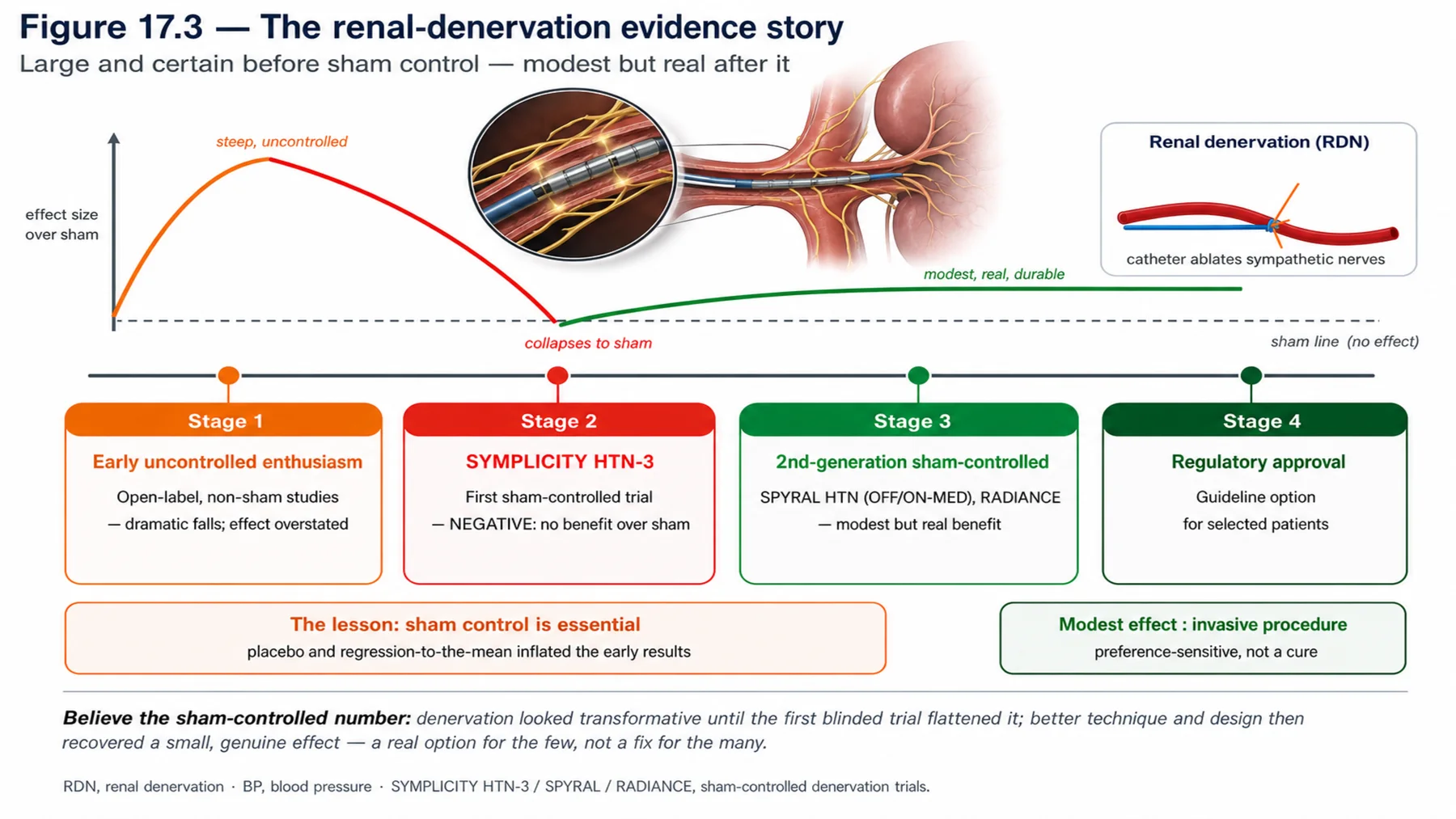
Device therapy has re-emerged as an option, with a evidence story worth understanding. Renal denervation — a catheter-based ablation of the renal sympathetic nerves, aiming to reduce the sympathetic drive to the kidney — was initially promising but then dealt a blow when the first rigorous sham-controlled trial (SYMPLICITY HTN-3) was negative, showing no benefit over a sham procedure and tempering enthusiasm. However, a second generation of carefully designed sham-controlled trials (the SPYRAL and RADIANCE programmes) subsequently demonstrated modest but real and statistically robust blood-pressure reductions, leading to regulatory approval and to renal denervation becoming a guideline option for selected patients with resistant or uncontrolled hypertension. The effect is modest (a few mmHg, not a cure), it is an invasive procedure, and its place is still being defined — but it is now a legitimate option, particularly for patients who cannot tolerate, will not take, or do not respond adequately to drugs. (Other devices, such as baroreflex activation therapy, remain investigational.) The renal-denervation story is also a lesson in the importance of sham-controlled trials: the initial uncontrolled enthusiasm, the negative rigorous trial, and the eventual modest positive result.
— The preference-sensitive difficult case
Once true resistance is established and the foundational and fourth-line drugs are in place, the management of the difficult case involves genuinely preference-sensitive decisions, which is where shared decision-making enters. How far to escalate the drug regimen — adding a fifth, sixth, or seventh agent — trades blood-pressure control against the burden and side effects of polypharmacy, and different patients weigh this differently. Whether to pursue device therapy (renal denervation) is a values-driven choice: it offers a modest, real blood-pressure reduction without adding pills, but it is an invasive procedure with a modest effect, so it suits the patient who cannot tolerate or will not take many drugs, or who prefers a procedure to lifelong escalating medication, more than the patient comfortable with their tablets. And the intensity of the target itself, in a patient struggling with side effects, is a trade-off. The clinician's role in the difficult case is therefore not only to optimise and escalate the regimen and to screen rigorously for reversible and secondary causes, but — once the genuinely difficult, truly resistant case remains — to share the decisions about further escalation and device therapy honestly with the patient, weighing control against burden, side effects, and the invasiveness of a procedure. The truly resistant case is managed both with the evidence (exclude pseudoresistance, screen for secondary causes, add spironolactone, consider renal denervation) and with the patient (sharing the preference-sensitive escalation decisions).
| 04 | PHASE A · LEVEL 4 · ORIENTATION & KNOWLEDGE Reference Tables |
Table 17.1 — Definitions
| Term | Definition |
| Resistant hypertension | Above target despite 3 drugs (incl. a diuretic) at optimal doses, OR controlled on ≥ 4 |
| Refractory hypertension | Uncontrolled despite ≥ 5 agents including an MRA and a diuretic (rare; sympathetically driven) |
| First move | Don't accept the label — exclude pseudoresistance first |
| Most apparent resistance | Is pseudoresistance, not true resistance |
Table 17.2 — Excluding pseudoresistance
| Cause | Detail |
| Non-adherence | The commonest — often hidden; seek actively (drug levels, pharmacy records, witnessed dosing) |
| White-coat / measurement | Confirm out of office (Chapter 2) |
| Suboptimal regimen / inertia | Wrong drugs, submaximal doses, no/wrong diuretic (thiazide in advanced CKD) |
| Substances / lifestyle | NSAIDs, alcohol, high salt, obesity |
| Secondary causes | Screen — especially primary aldosteronism, OSA, renovascular |
Table 17.3 — Secondary causes in resistant hypertension
| Cause | Note |
| Primary aldosteronism | Common in resistant HTN; screen (aldosterone-to-renin ratio, any potassium) |
| Obstructive sleep apnoea | Common; sympathetic, non-dipping, resistant pattern |
| Renovascular disease | Consider; image if clues present |
| Key link | Aldosteronism is why spironolactone is the evidence-based 4th agent |
Table 17.4 — Optimising therapy and the fourth agent
| Step | Detail |
| Optimise the foundation | RAAS blocker + CCB + appropriate diuretic at optimal doses; sodium restriction |
| Address volume | Under-treated volume (wrong/inadequate diuretic, high salt) is a frequent culprit |
| Fourth agent | Spironolactone (MRA) — superior to other add-ons (PATHWAY-2); watch hyperkalaemia |
| Further agents | Beta-blocker, alpha-blocker, centrally-acting, direct vasodilator (refractory) |
Table 17.5 — Device therapy: renal denervation
| Point | Detail |
| What | Catheter-based ablation of renal sympathetic nerves |
| Evidence evolution | SYMPLICITY HTN-3 (sham-controlled) negative → SPYRAL/RADIANCE positive (modest, real) |
| Status | Approved / guideline option for selected resistant or uncontrolled hypertension |
| Place | Modest effect, invasive — suits the drug-intolerant/non-adherent; baroreflex activation investigational |
Table 17.6 — The preference-sensitive decisions
| Decision | Trade-off |
| How far to escalate drugs | Blood-pressure control vs polypharmacy burden and side effects |
| Whether to pursue device therapy | A modest drug-free reduction vs an invasive procedure |
| Target intensity with side effects | Control vs tolerability and quality of life |
| The approach | Share these decisions with the patient (after excluding pseudoresistance/secondary causes) |
| 05 | PHASE B · LEVEL 5 · VISUALISE & MAP Imaging & Flowchart Specifications |
| 08 | PHASE C · LEVEL 8 · CLINICAL REASONING Clinical Cases |
| CASE 1 | IS IT EVEN REAL? Exclude pseudoresistance Apparent resistance |
Presentation
A patient labelled 'resistant' is above target on three drugs, and a clinician is about to add a fourth. On questioning, the patient admits to frequently missing doses, the office readings far exceed the home readings, and they take regular NSAIDs.
❖ Pause and reflect Is this true resistant hypertension? |
Analysis
No — this is pseudoresistance on several counts, and adding a fourth drug would be escalating against an artefact. The patient is non-adherent (the commonest cause of apparent resistance), has a marked white-coat effect (office readings far exceeding home readings), and is taking an interfering substance (NSAIDs). Each of these is a correctable cause of apparent resistance, and none has been addressed. Before labelling true resistance and escalating, the five contributors to pseudoresistance — adherence, measurement, regimen, substances, and secondary causes — must be excluded. Here, improving adherence, confirming the true (home) blood pressure, and stopping the NSAID may resolve the apparent resistance entirely, without a fourth drug.
Plan
Address the pseudoresistance — support adherence (with objective confirmation), use the home readings, and stop the NSAID — before considering a fourth drug; reassess. Exclude pseudoresistance before labelling and escalating.
Teaching point
Most apparent resistance is pseudoresistance — exclude non-adherence, white-coat effect, suboptimal regimen, and interfering substances before escalating.
Cross-reference
Exercises the pseudoresistance content; Figure 17.1; Tables 17.1, 17.2; adherence in Chapter 7; measurement in Chapter 2.
| CASE 2 | ADD SPIRONOLACTONE The evidence-based fourth agent True resistant hypertension |
Presentation
A genuinely resistant patient — adherent, confirmed by home readings, on optimised A+C+D — remains above target. A clinician is unsure which fourth drug to add and is considering a beta-blocker.
❖ Pause and reflect What is the evidence-based fourth-line agent here? |
Analysis
The evidence-based fourth agent is spironolactone, not a beta-blocker. The PATHWAY-2 trial directly compared candidate add-ons in resistant hypertension and found spironolactone superior to a beta-blocker and an alpha-blocker — a result that reflects the central role of aldosterone and volume in resistant hypertension (and the frequency of unrecognised aldosteronism). So in this genuinely resistant patient on optimised foundational therapy, the next step is a mineralocorticoid antagonist (spironolactone, or eplerenone), with monitoring for hyperkalaemia (especially if there is CKD). A beta-blocker would be a later addition. The PATHWAY-2 evidence makes spironolactone the clear fourth-line choice.
Plan
Add spironolactone as the evidence-based fourth agent (PATHWAY-2), monitoring the potassium (especially in CKD), rather than a beta-blocker; reserve further agents for the refractory case. Use spironolactone as the fourth-line drug in true resistance.
Teaching point
Spironolactone is the evidence-based fourth-line agent for resistant hypertension (PATHWAY-2) — reflecting the role of aldosterone and volume; watch hyperkalaemia.
Cross-reference
Exercises the optimising-therapy content; Figure 17.2; Tables 17.3, 17.4; aldosteronism in Chapter 10.
| CASE 3 | THE HIDDEN CAUSE Screen the resistant patient Secondary cause in resistance |
Presentation
A patient with true resistant hypertension has not been screened for a secondary cause; the team has simply been adding drugs. The patient is obese and snores, and the potassium is at the low end of normal.
❖ Pause and reflect What should be done before escalating drug therapy further? |
Analysis
Screen for secondary causes — they are disproportionately common in resistant hypertension and treating them can resolve it. This patient has clues pointing two ways: the obesity and snoring suggest obstructive sleep apnoea, and the low-normal potassium (with resistant hypertension) suggests primary aldosteronism — which is common in resistant hypertension and should be screened for with the aldosterone-to-renin ratio regardless of the potassium. Renovascular disease should also be considered. Simply adding more drugs without screening misses a potentially treatable cause; indeed, the responsiveness of resistant hypertension to spironolactone often reflects unrecognised aldosteronism. The resistant patient warrants the secondary-cause work-up before ever-escalating therapy.
Plan
Screen for secondary causes — primary aldosteronism (aldosterone-to-renin ratio), obstructive sleep apnoea (sleep study), and renovascular disease — and treat any found, rather than only adding drugs. Screen the truly resistant patient for secondary causes.
Teaching point
Secondary causes (especially primary aldosteronism and sleep apnoea) are common in resistant hypertension — screen before escalating; treating them can resolve it.
Cross-reference
Exercises the secondary-cause content; Table 17.3; the secondary chapters (8–11).
| CASE 4 | PROCEDURE OR MORE PILLS? A preference-sensitive choice Renal denervation |
Presentation
A patient with true resistant hypertension, optimised drugs including spironolactone, and secondary causes excluded, struggles with the burden and side effects of multiple medications and asks about alternatives. Renal denervation is raised.
❖ Pause and reflect How should the choice about renal denervation be approached? |
Analysis
As a preference-sensitive decision, shared with the patient. Renal denervation — catheter-based ablation of the renal sympathetic nerves — produces a modest but real blood-pressure reduction in the recent sham-controlled trials (SPYRAL, RADIANCE) and is now an approved option for selected resistant patients; but its effect is modest (not a cure), it is an invasive procedure, and it does not replace all the drugs. So the choice is a genuine trade-off: a modest, drug-free reduction from a one-time procedure versus the burden and side effects of escalating medication. It suits this patient — burdened by and struggling with multiple drugs — better than a patient comfortable with their tablets. The clinician should lay out the modest expected benefit, the invasiveness, and the uncertainty, and decide with the patient according to how they weigh a procedure against more pills.
Plan
Discuss renal denervation as a preference-sensitive option — its modest real benefit, its invasiveness, and that it supplements rather than replaces drugs — and decide with the patient given their struggle with medication burden. Share the device-therapy decision.
Teaching point
Renal denervation gives a modest, real blood-pressure reduction and is a preference-sensitive option in selected resistant patients — weigh a procedure against more pills, with the patient.
Cross-reference
Exercises the device-therapy and preference content; Figure 17.3; the preference map (L15) and SDM scripts (L16); Tables 17.5, 17.6.
| 10 | PHASE C · LEVEL 10 · CLINICAL REASONING Clinical Pearls |
| Resistant HTN: above target on 3 drugs (incl. a diuretic) at optimal doses, OR controlled on ≥ 4. | Refractory HTN: uncontrolled despite ≥ 5 agents (incl. MRA + diuretic) — rare, sympathetic. |
| Most apparent resistance is PSEUDORESISTANCE — exclude it first. | Non-adherence is the commonest cause (often hidden; test objectively). |
| White-coat/measurement — confirm out of office. | Suboptimal regimen/inertia — wrong drugs, submaximal doses, no/wrong diuretic. |
| Interfering substances (NSAIDs), lifestyle (salt, alcohol, obesity). | Screen for secondary causes — aldosteronism (common!), OSA, renovascular. |
| Optimise foundation: RAAS blocker + CCB + appropriate diuretic + sodium restriction. | Under-treated VOLUME is a frequent culprit. |
| Fourth agent: SPIRONOLACTONE (PATHWAY-2 — superior to other add-ons). | Spironolactone's efficacy reflects aldosterone/volume (and hidden aldosteronism). |
| Watch hyperkalaemia (esp CKD); eplerenone/amiloride alternatives. | Renal denervation: SYMPLICITY HTN-3 negative → SPYRAL/RADIANCE modest positive. |
| Renal denervation: approved option, modest effect, invasive — preference-sensitive. | Escalation and device therapy are preference-sensitive — decide WITH the patient. |
| 11 | PHASE D · LEVEL 11 · SAFETY & EVIDENCE Red Flags & Never-Do |
Panel A — Red flags
| ▲ | 'Resistant' hypertension with poor adherence or a white-coat effect — pseudoresistance; don't escalate against an artefact. |
| ▲ | A resistant patient never screened for a secondary cause — aldosteronism and sleep apnoea are common; screen. |
| ▲ | A resistant patient without an optimised diuretic — under-treated volume is a frequent culprit. |
| ▲ | A resistant patient not on spironolactone — the evidence-based fourth agent (PATHWAY-2) is missing. |
| ▲ | A patient burdened by drugs asking about alternatives — device therapy is a preference-sensitive option; discuss it. |
Panel B — Never do
| ✖ NEVER — accept the label of resistant hypertension without excluding pseudoresistance. |
| ✖ NEVER — escalate drugs in resistance without screening for secondary causes. |
| ✖ NEVER — reach for a beta-blocker as the fourth agent before spironolactone. |
| ✖ NEVER — present device therapy as a cure or impose it without sharing the trade-off. |
| 12 | PHASE D · LEVEL 12 · SAFETY & EVIDENCE Common Pitfalls |
Pitfall 1 — Escalating against an artefact
| ✖ | WRONG Adding a fourth drug to apparent resistance without a work-up. |
| ✓ | RIGHT Excluding pseudoresistance (adherence, measurement, regimen, substances) first. |
| ✉ | WHY Most apparent resistance is pseudoresistance. |
Pitfall 2 — Skipping the secondary screen
| ✖ | WRONG Only adding drugs in resistant hypertension. |
| ✓ | RIGHT Screening for aldosteronism, sleep apnoea, and renovascular disease. |
| ✉ | WHY Secondary causes are disproportionately common and treatable. |
Pitfall 3 — Wrong fourth agent
| ✖ | WRONG Adding a beta-blocker as the fourth drug. |
| ✓ | RIGHT Adding spironolactone (the evidence-based fourth agent). |
| ✉ | WHY PATHWAY-2 showed spironolactone superior to other add-ons. |
Pitfall 4 — Neglecting volume
| ✖ | WRONG Leaving the diuretic suboptimal in a resistant patient. |
| ✓ | RIGHT Optimising the diuretic and addressing volume and sodium. |
| ✉ | WHY Under-treated volume is a frequent cause of resistance. |
Pitfall 5 — Mishandling device therapy
| ✖ | WRONG Presenting renal denervation as a cure or dismissing it outright. |
| ✓ | RIGHT Framing it as a modest, real, preference-sensitive option and deciding with the patient. |
| ✉ | WHY Its benefit is modest and real, and the choice is values-driven. |
| 13 | PHASE D · LEVEL 13 · SAFETY & EVIDENCE Evidence Grading |
GRADE A HIGH CONFIDENCE The effect is real and the estimate is stable. RCTs at low risk of bias; multiple concordant prospective cohorts; meta-analyses. |
GRADE B MODERATE CONFIDENCE The effect is likely real but may shift with new data. Observational studies, registries, mechanistic human studies. |
GRADE C LOW CONFIDENCE Rests on physiology, reasoning, or consensus rather than outcomes. Pathophysiological reasoning; extrapolation; consensus without outcomes. |
Graded statements (by evidence type)
| Statement | Grade | Basis (evidence type) |
| Most apparent resistance is pseudoresistance. | A | Clinical and adherence data |
| Non-adherence is the commonest cause of apparent resistance. | A | Objective adherence studies |
| Primary aldosteronism is common in resistant hypertension. | A | Prevalence studies |
| Spironolactone is the most effective fourth-line agent. | A | RCT (PATHWAY-2) |
| Early sham-controlled renal denervation (SYMPLICITY HTN-3) was negative. | A | RCT |
| Second-generation sham-controlled trials show a modest real effect. | A | RCTs (SPYRAL, RADIANCE) |
| Escalation and device therapy involve preference-sensitive trade-offs. | A | Decision science and guideline consensus |
| 14 | PHASE E · LEVEL 14 · PATIENT DECISIONS Absolute Risk in Natural Frequency |
Natural-frequency estimates for orientation, from the resistant-hypertension evidence; they vary with the population. They convey the size of the decisions, expressed per 100 comparable patients.
| Per 100 patients… | Outcome | Roughly how many | See |
| Labelled 'resistant' | Actually have pseudoresistance | A large share — hence exclude it first | L13 row 1 |
| With resistant hypertension | Have an unrecognised secondary cause (esp aldosteronism) | More than generally appreciated — hence screen | L13 row 3 |
| Given spironolactone vs another fourth agent | Reach target | More with spironolactone | L13 row 4 |
| Undergoing renal denervation | Gain a blood-pressure reduction | A modest, real fall — not a cure | L13 row 6 |
★ How to read these Read these as orientation, not promises; the proportions vary with the population. The stable signals: much resistance is pseudoresistance, secondary causes are common, spironolactone is the best fourth agent, and renal denervation gives a modest real effect. Communicate them as people out of 100, not as a hazard ratio. |
| 15 | PHASE E · LEVEL 15 · PATIENT DECISIONS Preference-Sensitive Decisions |
Once true resistance is confirmed (pseudoresistance and secondary causes excluded) and the fourth agent is in place, the further management involves genuine trade-offs. The table maps the options to what each prioritises; none is the single right answer.
| Choice | Prioritises | Trades off / suits |
| Escalate drugs further (5th, 6th agent) | Maximum blood-pressure control | More pills, side effects, burden — suits the patient who tolerates medication and prioritises control |
| Renal denervation | A modest, drug-free reduction | An invasive procedure, modest effect — suits the drug-intolerant, non-adherent, or procedure-preferring patient |
| Accept a higher pressure (relax) | Tolerability, quality of life, fewer harms | A higher cardiovascular risk — suits the patient overwhelmed by side effects or with limited benefit |
| Intensify despite side effects | Control in a high-risk patient | Quality of life — suits the patient at high cardiovascular risk who accepts the burden |
❖ Using this map Only after pseudoresistance and secondary causes are excluded does this map apply. Elicit how the patient weighs blood-pressure control against medication burden, side effects, and the prospect of a procedure — and let their weighting, not a reflex to escalate, choose the path. |
| 16 | PHASE E · LEVEL 16 · PATIENT DECISIONS Shared Decision-Making |
Scripts for the preference-sensitive conversation in the truly resistant case. Adapt the wording; the structure is to share the options and the trade-off honestly and decide together.
Script 1 — How far to escalate the drugs
Frame the choice. “We've made sure this is genuinely resistant — you're taking the tablets, the readings are accurate, and we've looked for hidden causes. Now there's a choice: we can keep adding tablets to push the pressure lower, which protects you more but means more medication and possibly more side effects — or we can hold where we are and accept a slightly higher pressure for fewer tablets.”
Elicit values. “How are you finding the medications you're on — and how do you feel about adding more to get the pressure a bit lower?”
Decide together. “Given what you've said, it sounds like [adding another tablet / holding where we are] fits you. We can change course if it doesn't suit you.”
Script 2 — Considering renal denervation
Set expectations. “There's a procedure — renal denervation — that uses a catheter to calm the nerves to the kidneys. It lowers the pressure by a modest amount, not a cure, and it doesn't replace all your tablets — but for someone struggling with medication, it can help without adding more pills.”
Be honest about the trade-off. “It's an invasive procedure with a modest effect, and its exact place is still being worked out. The trade-off is a one-time procedure with a modest benefit versus continuing to escalate tablets.”
Decide together. “Given how much the tablets are weighing on you, is a procedure like this something you'd want to explore, or would you rather keep adjusting the medication?”
| 17 | PHASE F · LEVEL 17 · APPLY & TEST Documentation Templates |
Paste-ready notes. Tick the boxes that apply and delete the rest; make the pseudoresistance work-up, the fourth agent, and the shared decision explicit.
Template 1 — Resistant-hypertension work-up
Template 2 — Treatment and shared decision
| 18 | PHASE F · LEVEL 18 · APPLY & TEST Cheat Sheet |
| Resistant: above target on 3 drugs (incl. diuretic) at optimal doses, OR controlled on ≥ 4. | Refractory: uncontrolled despite ≥ 5 (incl. MRA + diuretic) — rare, sympathetic. |
| Most apparent resistance = PSEUDORESISTANCE. | Exclude: adherence (commonest), white-coat, regimen, substances. |
| Test adherence objectively (drug levels, pharmacy records). | Screen secondary causes: aldosteronism (common!), OSA, renovascular. |
| Optimise: RAAS blocker + CCB + appropriate diuretic + sodium restriction. | Under-treated VOLUME is a frequent culprit. |
| Fourth agent: SPIRONOLACTONE (PATHWAY-2). | Reflects aldosterone/volume (and hidden aldosteronism). |
| Watch hyperkalaemia (CKD); eplerenone/amiloride alternatives. | Further: beta-blocker, alpha-blocker, central agent, vasodilator. |
| Renal denervation: SYMPLICITY HTN-3 negative → SPYRAL/RADIANCE modest positive. | Renal denervation: approved, modest effect, invasive — preference-sensitive. |
| Escalation + device = preference-sensitive — decide WITH the patient. | Manage with the evidence AND the patient's preferences. |
| 19 | PHASE F · LEVEL 19 · APPLY & TEST Flashcards |
| CARD 1 | Q. How are resistant and refractory hypertension defined? A. Resistant hypertension is blood pressure above target despite three drugs of different classes (including a diuretic) at optimal doses, or controlled but needing four or more; refractory hypertension is the rarer extreme — uncontrolled despite five or more agents including a mineralocorticoid antagonist and a diuretic, thought to be sympathetically driven. DETAILED. Most apparent resistance is not true resistance. CLINICAL. Exclude pseudoresistance before accepting the label. |
| CARD 2 | Q. What are the causes of pseudoresistance? A. Non-adherence (the commonest, often hidden), the white-coat effect and measurement error, a suboptimal regimen (wrong drugs, submaximal doses, no or wrong diuretic), interfering substances and lifestyle factors, and unrecognised secondary causes — all correctable. DETAILED. Each, if missed, leads to escalating against an artefact. CLINICAL. Work through all five before labelling true resistance. |
| CARD 3 | Q. Why screen for secondary causes in resistant hypertension? A. Because they are disproportionately common — especially primary aldosteronism (screened with the aldosterone-to-renin ratio regardless of potassium), obstructive sleep apnoea, and renovascular disease — and treating them can resolve the resistance. DETAILED. Aldosteronism explains much of the response to spironolactone. CLINICAL. Screen the truly resistant patient before escalating. |
| CARD 4 | Q. What is the evidence-based fourth-line agent, and why? A. Spironolactone, a mineralocorticoid antagonist — the PATHWAY-2 trial showed it superior to a beta-blocker and an alpha-blocker as an add-on for resistant hypertension, reflecting the central role of aldosterone and volume (and frequent unrecognised aldosteronism). DETAILED. Hyperkalaemia is the main caution, especially in CKD. CLINICAL. Add spironolactone as the fourth agent in true resistance. |
| CARD 5 | Q. What is the role of volume in resistant hypertension? A. Under-treated volume — an inadequate or wrong diuretic (a thiazide in advanced CKD), high salt intake — is one of the most frequent reasons hypertension remains resistant, which is why optimising the diuretic and restricting sodium is central. DETAILED. Spironolactone also acts in part on volume. CLINICAL. Optimise the diuretic and address volume and sodium. |
| CARD 6 | Q. What is the evidence story for renal denervation? A. Catheter-based ablation of the renal sympathetic nerves was promising, then negative in the first rigorous sham-controlled trial (SYMPLICITY HTN-3), then shown to produce a modest but real blood-pressure reduction in second-generation sham-controlled trials (SPYRAL, RADIANCE) — now an approved option for selected patients. DETAILED. It is a lesson in the value of sham-controlled trials. CLINICAL. Consider renal denervation in selected resistant patients as a modest, real option. |
| CARD 7 | Q. Why are escalation and device therapy preference-sensitive? A. Because once true resistance is established, how far to escalate the drug regimen trades control against burden and side effects, and whether to pursue renal denervation trades a modest drug-free reduction against an invasive procedure — trade-offs different patients weigh differently. DETAILED. There is no single right answer. CLINICAL. Share the escalation and device decisions with the patient. |
| CARD 8 | Q. What is the overall approach to resistant hypertension? A. Exclude pseudoresistance (adherence, measurement, regimen, substances), screen for secondary causes, optimise the foundational regimen and address volume, add spironolactone as the fourth agent, consider renal denervation in selected patients, and share the preference-sensitive escalation and device decisions. DETAILED. Manage with the evidence and with the patient. CLINICAL. Confirm true resistance, treat by the evidence, decide the rest together. |
| 20 | PHASE F · LEVEL 20 · APPLY & TEST One-Minute Preceptor |
| SCENE 1 | The intern escalating apparent resistance |
GET A COMMITMENT. “You want to add a fourth drug to this 'resistant' patient — what have you ruled out first?”
PROBE FOR EVIDENCE. “They're above target on three drugs” — ask: “Are they taking them, are the readings accurate, and have you screened for a secondary cause?”
TEACH A GENERAL RULE. Most apparent resistance is pseudoresistance — exclude non-adherence, white-coat effect, a suboptimal regimen, interfering substances, and secondary causes before escalating.
REINFORCE WHAT WAS RIGHT. Recognising the poor control was correct.
CORRECT A MISTAKE. Work through pseudoresistance and screen for secondary causes before adding a drug.
| SCENE 2 | The resident reaching for a beta-blocker |
GET A COMMITMENT. “This genuinely resistant patient is on optimised A+C+D — you want to add a beta-blocker next. Why?”
PROBE FOR EVIDENCE. “It'll lower the pressure” — ask: “What did PATHWAY-2 show was the best fourth-line agent?”
TEACH A GENERAL RULE. PATHWAY-2 showed spironolactone superior to a beta-blocker and an alpha-blocker as the fourth agent in resistant hypertension — add spironolactone, watching the potassium.
REINFORCE WHAT WAS RIGHT. Recognising the need for a fourth agent was correct.
CORRECT A MISTAKE. Add spironolactone, not a beta-blocker, as the fourth-line drug.
| 21 | PHASE F · LEVEL 21 · APPLY & TEST Reflective Prompts |
Genuine tensions this evidence and these values leave open; sit with them rather than resolving them too quickly.
Most 'resistant' hypertension turns out to be non-adherence — yet objectively testing adherence can feel like distrust. How do you investigate adherence without damaging the relationship?
Renal denervation was hailed, then debunked by a sham-controlled trial, then partly redeemed. What does that arc teach about how readily we adopt devices before rigorous testing?
The effect of renal denervation is modest and real — a few mmHg. How do you counsel a patient about an invasive procedure whose benefit is genuine but small?
Spironolactone works in resistant hypertension partly because so much of it is unrecognised aldosteronism. How much 'essential resistant hypertension' is really undiagnosed secondary disease?
After all the drugs and the procedure, some hypertension remains uncontrolled. How do you decide, with the patient, when to stop escalating and accept a higher pressure?
| 22 | PHASE F · LEVEL 22 · APPLY & TEST Board-Style Questions |
| Q 01 | Resistant hypertension is defined as blood pressure above target despite: |
| A | Two drugs |
| B | Three drugs of different classes (including a diuretic) at optimal doses, or controlled on ≥ 4 |
| C | One drug |
| D | Lifestyle measures alone |
Rationale The definition requires three optimised drugs including a diuretic (or ≥ 4 to control) (Table 17.1). A, C, and D are undertreatment. |
| Q 02 | Before labelling a patient truly resistant, you must first exclude: |
| A | Nothing |
| B | Pseudoresistance — non-adherence, white-coat effect, suboptimal regimen, interfering substances |
| C | Only the white-coat effect |
| D | Only non-adherence |
Rationale Most apparent resistance is pseudoresistance, which must be excluded (case 1, Figure 17.1, Table 17.2). A, C, and D are incomplete. |
| Q 03 | The commonest cause of apparent (pseudo)resistance is: |
| A | A secondary cause |
| B | Non-adherence |
| C | A wrong diagnosis |
| D | Genetic |
Rationale Non-adherence is the commonest cause and is often hidden (Table 17.2, L13 row 2). A, C, and D are less common. |
| Q 04 | Which secondary cause is especially common in resistant hypertension? |
| A | Phaeochromocytoma |
| B | Primary aldosteronism |
| C | Coarctation |
| D | Cushing's syndrome |
Rationale Primary aldosteronism is common in resistant hypertension and should be screened for (case 3, Table 17.3). A, C, and D are less common here. |
| Q 05 | The evidence-based fourth-line agent for resistant hypertension is: |
| A | A beta-blocker |
| B | Spironolactone (a mineralocorticoid antagonist) |
| C | An alpha-blocker |
| D | A second calcium-channel blocker |
Rationale PATHWAY-2 showed spironolactone superior to a beta-blocker and an alpha-blocker (case 2, Figure 17.2, Table 17.4). A, C, and D are later or wrong. |
| Q 06 | A frequent under-addressed contributor to resistance is: |
| A | Too much diuretic |
| B | Under-treated volume (inadequate/wrong diuretic, high salt) |
| C | A calcium-channel blocker |
| D | RAAS blockade |
Rationale Under-treated volume is a frequent culprit, so the diuretic and sodium must be optimised (Table 17.4). A, C, and D are incorrect. |
| Q 07 | The renal-denervation evidence shows: |
| A | A consistent large benefit |
| B | An initial negative sham-controlled trial, then a modest real effect in later sham-controlled trials |
| C | No effect ever |
| D | A cure for hypertension |
Rationale SYMPLICITY HTN-3 was negative; SPYRAL/RADIANCE showed a modest real effect (Figure 17.3, Table 17.5). A, C, and D overstate or understate it. |
| Q 08 | How should the decision about renal denervation be made? |
| A | Imposed by the clinician |
| B | As a preference-sensitive decision shared with the patient (modest benefit vs an invasive procedure) |
| C | Always declined |
| D | Always pursued |
Rationale It is a values-driven trade-off decided with the patient (case 4, Table 17.6, L15–L16). A, C, and D ignore the preference-sensitivity. |