Chapter Preamble
Signals declared
Sig-D — Diagnostic (primary). Screen with the aldosterone-to-renin ratio, confirm, subtype with adrenal vein sampling, and recognise phaeochromocytoma and Cushing's.
Sig-T — Therapeutic (strong). Adrenalectomy for lateralised aldosteronism, a mineralocorticoid antagonist for bilateral disease, and the alpha-before-beta rule for phaeochromocytoma.
Sig-M — Mechanistic (strong). Autonomous aldosterone excess and its direct harm, the catecholamine physiology of phaeochromocytoma, and the cortisol-mediated hypertension of Cushing's.
Levels populated and omitted
Populated (19): L1–L14, L17–L20, L22. The mechanistic signal fires the concept maps (L6) and triads (L9); the therapeutic signal fires the absolute-risk table (L14) and templates (L17); the diagnostic signal drives the tables, rules, cases, pitfalls, and board items.
L15 / L16 preference-sensitive map and SDM scripts — omitted. No Sig-E; diagnosing and treating endocrine hypertension is effective, protocol-driven care.
L21 reflective prompts — omitted. No Sig-E/V; the chapter's tensions (the underdiagnosis of aldosteronism) are worked through the cases and pitfalls.
| 01 | PHASE A · LEVEL 1 · ORIENTATION & KNOWLEDGE Learning Objectives |
By the end of this chapter you should be able to:
Explain the pathophysiology of primary aldosteronism and its biochemical signature.
Distinguish bilateral hyperplasia from a unilateral aldosterone-producing adenoma.
Screen for primary aldosteronism with the aldosterone-to-renin ratio, confirm it, and subtype it.
Explain why adrenal vein sampling is needed and CT alone is unreliable for subtyping.
Treat aldosteronism by adrenalectomy or a mineralocorticoid antagonist as appropriate.
Explain aldosterone's direct cardiovascular and renal harm beyond blood pressure.
Diagnose phaeochromocytoma and apply the alpha-before-beta blockade rule.
Recognise Cushing's syndrome and other endocrine causes of hypertension.
| 02 | PHASE A · LEVEL 2 · ORIENTATION & KNOWLEDGE Executive Summary |
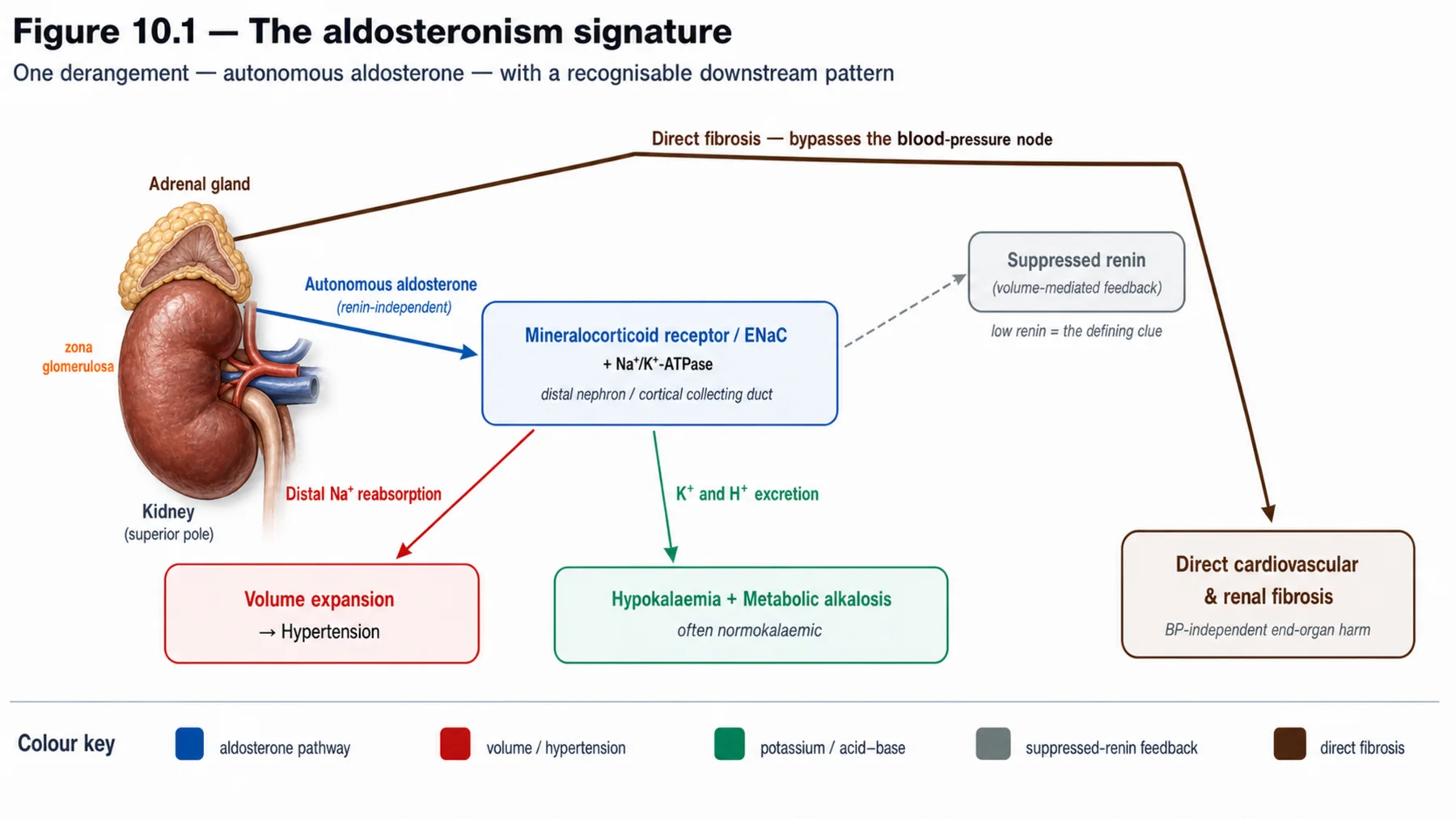
Primary aldosteronism is autonomous aldosterone excess, independent of renin, causing sodium retention, potassium and hydrogen-ion loss, hypertension, often hypokalaemia and a metabolic alkalosis, and a suppressed renin.
It is the commonest endocrine cause of hypertension, is frequently normokalaemic, and is underdiagnosed.
Aldosterone also causes direct cardiovascular and renal fibrosis beyond its blood-pressure effect, so treating it specifically matters.
The two main subtypes are bilateral adrenal hyperplasia (the commoner, treated medically) and a unilateral aldosterone-producing adenoma (treated surgically).
Screening is by the aldosterone-to-renin ratio — an elevated aldosterone with a suppressed renin.
A positive screen is followed by a confirmatory test in which aldosterone fails to suppress, then by subtyping.
Subtyping uses adrenal CT and, critically, adrenal vein sampling to determine whether the excess is lateralised.
CT alone is unreliable for subtyping — non-functioning adenomas and microadenomas mislead — so adrenal vein sampling is the reference standard before surgery.
A lateralised, unilateral source is treated by adrenalectomy, which cures or improves the hypertension and normalises the potassium.
Bilateral disease is treated with a mineralocorticoid receptor antagonist — spironolactone or eplerenone.
Phaeochromocytoma is a catecholamine-secreting tumour causing episodic hypertension with headache, palpitations, and sweating, diagnosed by plasma or urinary metanephrines and then localised.
It is treated by surgical resection after blockade — alpha-blockade first, then beta-blockade; giving a beta-blocker first risks a hypertensive crisis from unopposed alpha stimulation.
Cushing's syndrome causes hypertension through cortisol excess and is screened with dexamethasone suppression, salivary cortisol, or urinary free cortisol.
Thyroid disease, hyperparathyroidism, and acromegaly are further endocrine causes.
| 03 | PHASE A · LEVEL 3 · ORIENTATION & KNOWLEDGE Main Narrative |
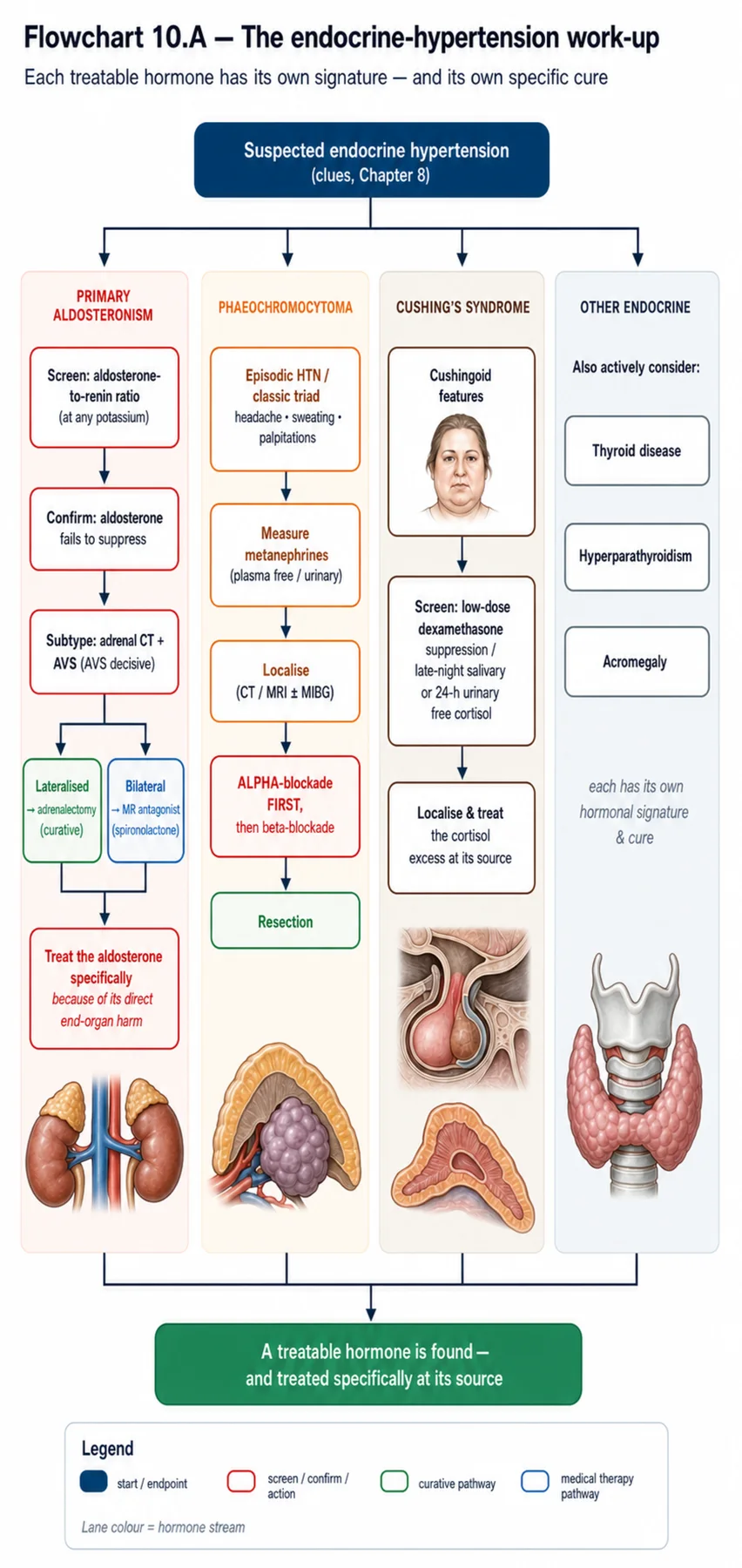
Endocrine hypertension is where a hormone, secreted autonomously, drives the blood pressure — and where finding the hormone can cure the hypertension. Primary aldosteronism is the dominant and most underdiagnosed example, important enough to occupy most of this chapter; phaeochromocytoma and Cushing's syndrome complete it. The unifying theme is a recognisable biochemical signature that leads to a specific, often curative treatment — and, in the case of aldosteronism, harm that goes beyond the blood pressure itself.
— Primary aldosteronism: the pathophysiology
Primary aldosteronism is the autonomous overproduction of aldosterone, independent of the renin that normally controls it. The excess aldosterone drives sodium and water reabsorption (raising volume and blood pressure) and the excretion of potassium and hydrogen ions (producing hypokalaemia and a metabolic alkalosis), while the volume expansion suppresses renin — giving the characteristic signature of a high aldosterone with a low renin. Two features make it important. First, it is the commonest endocrine cause of hypertension and is substantially underdiagnosed, partly because of the persistent myth that it requires hypokalaemia: in fact most cases are normokalaemic, so a normal potassium must not be allowed to exclude it. Second, aldosterone is not merely a blood-pressure hormone — it causes direct cardiovascular and renal fibrosis (myocardial and vascular remodelling, renal injury) over and above its pressure effect, so patients with aldosteronism have excess cardiovascular and renal harm for a given blood pressure, and treating the aldosterone specifically (not just the pressure) addresses that harm. Recognising aldosteronism therefore matters both for cure and for targeted protection.
— Diagnosing aldosteronism: screen, confirm, subtype
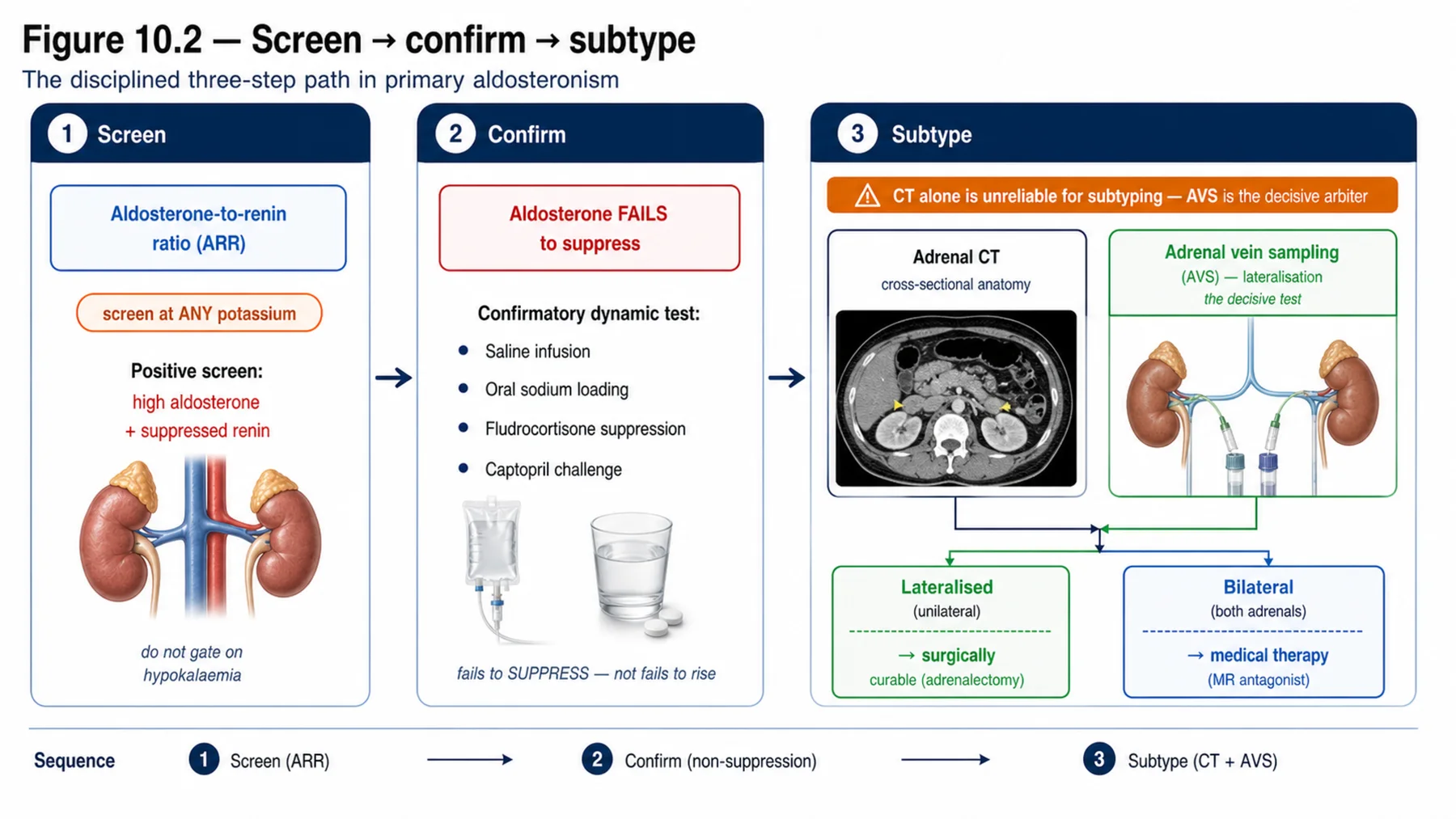
The diagnosis proceeds in three steps. The screening test is the aldosterone-to-renin ratio: an elevated aldosterone with a suppressed renin produces a high ratio, which (with attention to interfering drugs and conditions) flags the diagnosis — and, crucially, is performed whenever a screening trigger is present regardless of the potassium. A positive screen is confirmed with a confirmatory test — a saline infusion, oral salt loading, or similar — in which the autonomous aldosterone fails to suppress as it should, distinguishing true aldosteronism from a borderline ratio. The third step, once aldosteronism is confirmed, is subtyping, because the treatment depends entirely on whether the excess is unilateral (surgically curable) or bilateral (medically treated). Subtyping uses adrenal CT and — critically — adrenal vein sampling, which measures aldosterone from each adrenal vein to determine whether the excess lateralises to one side. This three-step sequence — screen, confirm, subtype — is the backbone of the diagnosis, and skipping the confirmation or the subtyping leads to error.
— Why adrenal vein sampling, not CT alone
The single most important diagnostic point in aldosteronism, after screening regardless of potassium, is that CT alone is unreliable for subtyping and adrenal vein sampling is the reference standard before surgery. The temptation is to image the adrenals, find an adenoma on one side, and operate — but this leads to error in a substantial proportion of cases: a CT-visible adenoma may be non-functioning (an incidentaloma) while the true aldosterone excess is bilateral or arises from the other (CT-normal) side, and microadenomas producing aldosterone may be below CT resolution. The discordance between CT and the functional source is common, especially in older patients in whom non-functioning adrenal nodules are frequent. Adrenal vein sampling resolves this by directly measuring which adrenal is secreting the aldosterone, lateralising the source and so determining whether adrenalectomy will help. Operating on the basis of CT alone risks removing a normal adrenal while leaving bilateral disease untreated — which is why adrenal vein sampling is performed before adrenalectomy in those who are surgical candidates. (It may be omitted in the young patient with a clear unilateral adenoma and classic features, but the default is to sample.)
— Treating aldosteronism
Treatment follows the subtype. A lateralised, unilateral source — an aldosterone-producing adenoma or unilateral hyperplasia confirmed on adrenal vein sampling — is treated by laparoscopic adrenalectomy, which cures or substantially improves the hypertension, normalises the potassium, and removes the source of the direct aldosterone harm. Bilateral disease (bilateral adrenal hyperplasia, the commoner subtype) is not surgically curable and is treated medically with a mineralocorticoid receptor antagonist — spironolactone or the more selective eplerenone — which blocks aldosterone's action, controls the blood pressure and potassium, and addresses the direct fibrotic harm. The key therapeutic point, shared across subtypes, is that treating the aldosterone specifically (by removing its source or blocking its receptor) is better than simply controlling the blood pressure with other agents, because it addresses the cardiovascular and renal harm aldosterone causes independently of the pressure. The mineralocorticoid antagonist is also, as the resistant-hypertension chapter will show, the key add-on drug in resistant hypertension — reflecting how often unrecognised aldosterone excess underlies it.
— Phaeochromocytoma: the alpha-before-beta rule
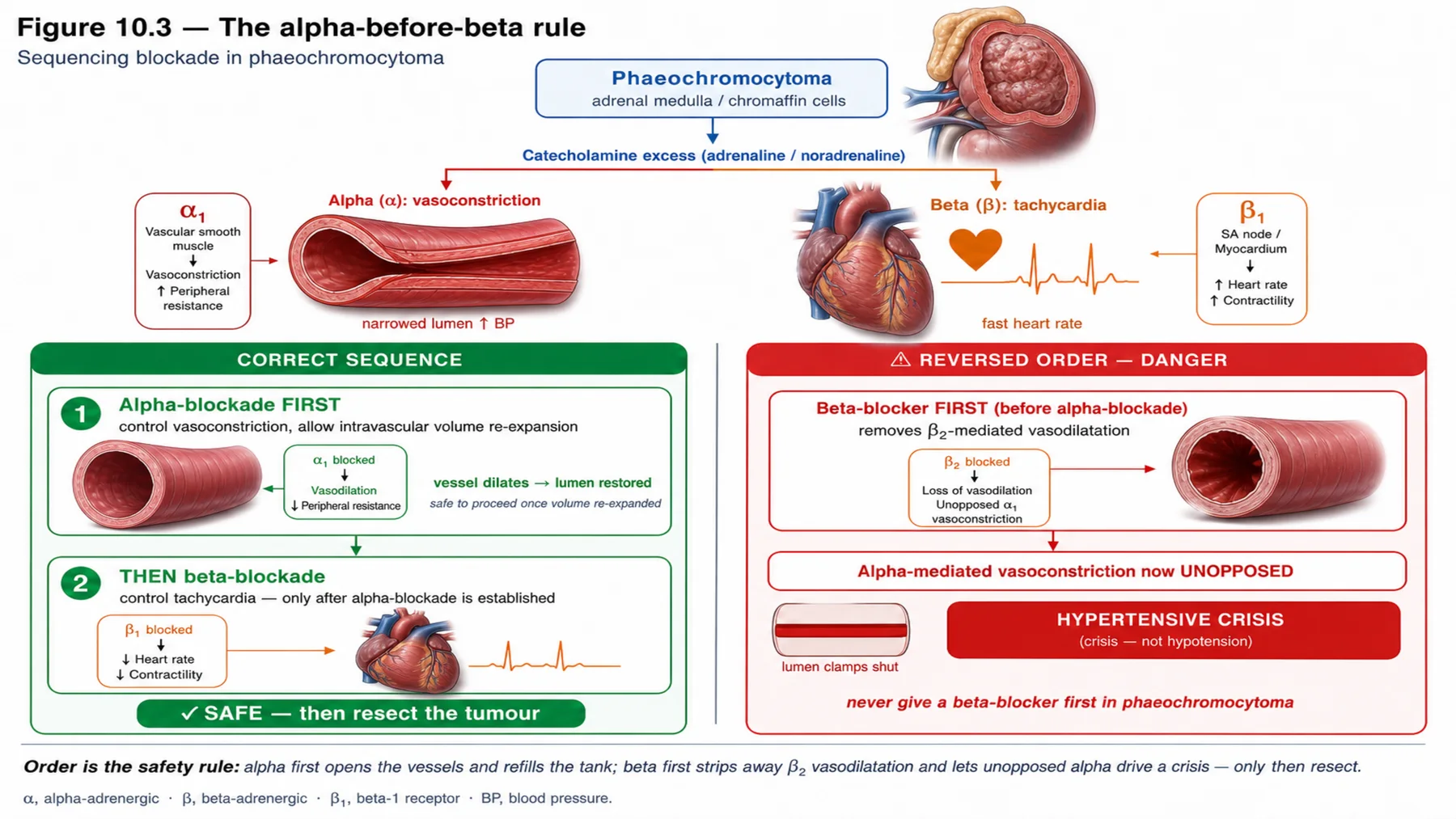
Phaeochromocytoma is a catecholamine-secreting tumour — of the adrenal medulla, or extra-adrenal (paraganglioma) — that causes episodic catecholamine excess and the classic paroxysmal hypertension with the triad of headache, palpitations, and sweating; a substantial minority are hereditary. It is diagnosed by demonstrating excess catecholamine metabolites — plasma free or 24-hour urinary metanephrines, which are highly sensitive — and then localised with CT or MRI and functional imaging. Its treatment carries one cardinal rule that must never be forgotten: blockade is alpha-first, then beta. Alpha-adrenergic blockade (phenoxybenzamine or doxazosin) is started first to control the vasoconstriction and allow the contracted intravascular volume to re-expand, and only once alpha-blockade is established is a beta-blocker added (for the tachycardia). Giving a beta-blocker first is dangerous: blocking the beta-mediated vasodilation while the alpha-mediated vasoconstriction is unopposed can precipitate a severe hypertensive crisis. After adequate blockade and volume expansion, the tumour is resected surgically. The alpha-before-beta sequence is one of the most important safety rules in endocrine hypertension.
— Cushing's, the other causes, and the synthesis
Cushing's syndrome — cortisol excess — causes hypertension through cortisol's mineralocorticoid activity at high levels (overwhelming the enzyme that normally protects the mineralocorticoid receptor) and other mechanisms, alongside the recognisable cushingoid features; it is screened with the overnight dexamethasone suppression test, late-night salivary cortisol, or 24-hour urinary free cortisol, and then localised and treated at its source. The remaining endocrine causes round out the differential: hyperthyroidism (systolic hypertension with a wide pulse pressure), hypothyroidism (diastolic hypertension), primary hyperparathyroidism, and acromegaly. The synthesis of the chapter is that endocrine hypertension is defined by an autonomously secreted hormone with a recognisable biochemical signature, and that finding it offers a specific, often curative treatment: for aldosteronism, screen by the aldosterone-to-renin ratio (regardless of potassium), confirm, subtype by adrenal vein sampling (not CT alone), and treat by adrenalectomy or a mineralocorticoid antagonist — addressing the direct aldosterone harm; for phaeochromocytoma, diagnose by metanephrines and block alpha-before-beta before resection; and for Cushing's, screen and treat the cortisol excess. The recurring lesson is that a treatable hormone hides behind a fraction of hypertension, and looking for it — especially for aldosteronism — is high-yield.
| 04 | PHASE A · LEVEL 4 · ORIENTATION & KNOWLEDGE Reference Tables |
Table 10.1 — Primary aldosteronism: pathophysiology and features
| Aspect | Detail |
| Mechanism | Autonomous aldosterone (renin-independent) → Na retention, K/H+ loss |
| Signature | High aldosterone, suppressed renin; hypertension, ± hypokalaemia, metabolic alkalosis |
| Key point | Commonest endocrine cause; often normokalaemic; underdiagnosed |
| Beyond BP | Direct cardiovascular and renal fibrosis — treat the aldosterone specifically |
Table 10.2 — Diagnosing primary aldosteronism
| Step | Detail |
| 1. Screen | Aldosterone-to-renin ratio (high aldosterone + suppressed renin) — regardless of potassium |
| 2. Confirm | Confirmatory test (saline/salt loading) — aldosterone fails to suppress |
| 3. Subtype | Adrenal CT + adrenal vein sampling — lateralised or bilateral? |
| CT alone | Unreliable for subtyping — non-functioning/microadenomas mislead |
Table 10.3 — Subtypes and treatment
| Subtype | Treatment |
| Unilateral (adenoma; lateralised on AVS) | Laparoscopic adrenalectomy — cures/improves HTN, normalises K |
| Bilateral hyperplasia (commoner) | Mineralocorticoid receptor antagonist (spironolactone/eplerenone) |
| Either | Treat the aldosterone specifically — addresses direct fibrotic harm |
| Resistant hypertension link | MRA is the key add-on in resistant hypertension (Chapter 17) |
Table 10.4 — Phaeochromocytoma
| Aspect | Detail |
| Mechanism | Catecholamine-secreting tumour (adrenal medulla / paraganglioma) |
| Presentation | Episodic HTN; headache, palpitations, sweating triad; ~30% hereditary |
| Diagnosis | Plasma free or 24-hour urinary metanephrines; then CT/MRI ± functional imaging |
| Treatment | ALPHA-blockade FIRST, then beta-blockade; then resection (never beta first) |
Table 10.5 — Cushing's and other endocrine causes
| Cause | Detail |
| Cushing's syndrome | Cortisol excess — HTN; screen (dexamethasone suppression, salivary/urinary cortisol) |
| Hyperthyroidism | Systolic hypertension, wide pulse pressure |
| Hypothyroidism | Diastolic hypertension |
| Hyperparathyroidism / acromegaly | Further endocrine causes |
Table 10.6 — The endocrine-hypertension principle
| Point | Detail |
| Defined by | An autonomously secreted hormone with a recognisable signature |
| Yield | Finding it offers a specific, often curative treatment |
| Aldosteronism | Screen (ARR, any potassium) → confirm → AVS → surgery or MRA |
| Phaeochromocytoma / Cushing's | Metanephrines + alpha-before-beta; cortisol screen + treat the source |
| 05 | PHASE B · LEVEL 5 · VISUALISE & MAP Imaging & Flowchart Specifications |
| 06 | PHASE B · LEVEL 6 · VISUALISE & MAP Concept Maps |
Each chain runs from mechanism to a named bedside action; read the arrows as “leads to.”
Aldosteronism pathophysiology. Autonomous aldosterone → sodium retention (hypertension) + potassium/hydrogen loss (± hypokalaemia, alkalosis) + suppressed renin → ACTION: recognise the high-aldosterone, low-renin signature — and screen regardless of potassium.
Screen-confirm-subtype. Aldosterone-to-renin ratio → confirmatory test → subtyping → ACTION: follow the three steps; the subtype determines surgery versus medical therapy.
Subtype → treatment. Unilateral (lateralised on AVS) → adrenalectomy (curative); bilateral → mineralocorticoid antagonist → ACTION: lateralise with adrenal vein sampling, not CT alone, before operating.
Aldosterone's direct harm. Aldosterone → myocardial/vascular/renal fibrosis beyond BP → excess cardiovascular/renal harm → ACTION: treat the aldosterone specifically (surgery or MRA), not just the blood pressure.
Phaeochromocytoma. Catecholamine excess → alpha (vasoconstriction) + beta (tachycardia) → beta-blocker first leaves unopposed alpha → crisis → ACTION: block alpha first, then beta, before resection.
| 07 | PHASE B · LEVEL 7 · VISUALISE & MAP Decision Pathways |
| R1 | IF a screening trigger for secondary hypertension is present, THEN screen for primary aldosteronism with the aldosterone-to-renin ratio — regardless of the potassium. |
| R2 | IF the aldosterone-to-renin ratio is positive, THEN confirm with a suppression test before proceeding — a positive screen alone is not the diagnosis. |
| R3 | IF aldosteronism is confirmed and surgery is considered, THEN subtype with adrenal vein sampling — do not operate on CT alone. |
| R4 | IF the source is lateralised, THEN offer adrenalectomy; IF bilateral, THEN treat with a mineralocorticoid receptor antagonist. |
| R5 | IF treating aldosteronism, THEN treat the aldosterone specifically (surgery or MRA) to address its direct cardiovascular and renal harm. |
| R6 | IF phaeochromocytoma is suspected, THEN measure plasma or urinary metanephrines and localise the tumour. |
| R7 | IF blocking a phaeochromocytoma, THEN give alpha-blockade FIRST and add beta-blockade only afterward — never a beta-blocker first. |
| R8 | IF Cushing's syndrome is suspected, THEN screen with dexamethasone suppression, salivary cortisol, or urinary free cortisol, then localise and treat the source. |
| 08 | PHASE C · LEVEL 8 · CLINICAL REASONING Clinical Cases |
| CASE 1 | SCREEN DESPITE NORMAL POTASSIUM Aldosterone-to-renin first Diagnosing primary aldosteronism |
Presentation
A patient with resistant hypertension has a normal potassium. A clinician declines to screen for primary aldosteronism, reasoning that 'the potassium is normal, so it can't be Conn's.'
❖ Pause and reflect Does a normal potassium exclude primary aldosteronism? |
Analysis
No — this is the most important misconception about aldosteronism. Most cases of primary aldosteronism are normokalaemic; hypokalaemia is a clue when present but is absent in the majority, so a normal potassium does not exclude the diagnosis. Primary aldosteronism is the commonest endocrine cause of hypertension and is substantially underdiagnosed precisely because clinicians wait for hypokalaemia. This patient, with resistant hypertension (a screening trigger), should be screened with the aldosterone-to-renin ratio regardless of the potassium — a high aldosterone with a suppressed renin would flag the diagnosis, which is then confirmed and subtyped.
Plan
Screen for primary aldosteronism with the aldosterone-to-renin ratio despite the normal potassium, then confirm and subtype if positive. Never let a normal potassium exclude aldosteronism.
Teaching point
Most primary aldosteronism is normokalaemic — screen with the aldosterone-to-renin ratio regardless of the potassium.
Cross-reference
Exercises rules R1 and R2; the aldosteronism-signature concept map; Figure 10.1; Tables 10.1, 10.2; the same point in Chapter 8.
| CASE 2 | DON'T OPERATE ON THE CT Adrenal vein sampling Subtyping aldosteronism |
Presentation
A patient with confirmed primary aldosteronism has an adrenal CT showing a small nodule on the right. A surgeon proposes right adrenalectomy on the basis of the CT alone.
❖ Pause and reflect Is the CT enough to decide on adrenalectomy? |
Analysis
No — CT alone is unreliable for subtyping aldosteronism, and adrenal vein sampling should be done first. The CT-visible nodule may be a non-functioning incidentaloma while the true aldosterone excess is bilateral or arises from the CT-normal left adrenal; conversely, an aldosterone-producing microadenoma may be below CT resolution. Operating on the CT alone risks removing a normal adrenal and leaving the actual disease (often bilateral) untreated. Adrenal vein sampling directly measures which adrenal secretes the aldosterone, lateralising the source and determining whether adrenalectomy will help. This patient needs adrenal vein sampling before any decision to operate.
Plan
Perform adrenal vein sampling to lateralise the aldosterone source before deciding on adrenalectomy, rather than operating on the CT alone; treat by the AVS result (surgery if lateralised, mineralocorticoid antagonist if bilateral). Subtype with AVS before surgery.
Teaching point
CT alone is unreliable for subtyping aldosteronism — use adrenal vein sampling to lateralise before adrenalectomy.
Cross-reference
Exercises rules R3 and R4; the screen-confirm-subtype concept map; Figure 10.2; Tables 10.2, 10.3.
| CASE 3 | ALPHA BEFORE BETA The cardinal phaeo rule Phaeochromocytoma blockade |
Presentation
A patient with episodic hypertension, headache, palpitations, and sweating is found to have elevated metanephrines and an adrenal mass. A clinician, seeing the tachycardia, plans to start a beta-blocker first.
❖ Pause and reflect Is starting with a beta-blocker safe in this phaeochromocytoma? |
Analysis
No — this is the cardinal and dangerous error in phaeochromocytoma. Giving a beta-blocker first blocks the beta-mediated vasodilation while leaving the alpha-mediated vasoconstriction unopposed, which can precipitate a severe hypertensive crisis. The correct sequence is alpha-blockade first (phenoxybenzamine or doxazosin) to control the vasoconstriction and allow the contracted intravascular volume to re-expand, and only once alpha-blockade is established is a beta-blocker added for the tachycardia. After adequate blockade and volume expansion, the tumour is resected. The alpha-before-beta rule exists precisely to prevent the unopposed-alpha crisis this plan would risk.
Plan
Start alpha-blockade first to control the vasoconstriction and re-expand volume, add a beta-blocker only afterward for the tachycardia, and proceed to surgical resection after adequate blockade; never give a beta-blocker first. Block alpha before beta.
Teaching point
In phaeochromocytoma, block alpha before beta — a beta-blocker first leaves unopposed alpha vasoconstriction and risks a hypertensive crisis.
Cross-reference
Exercises rules R6 and R7; the phaeochromocytoma concept map; Figure 10.3; Table 10.4.
| CASE 4 | TREAT THE HORMONE, NOT JUST THE PRESSURE Aldosterone's direct harm Specific treatment of aldosteronism |
Presentation
A patient with confirmed bilateral primary aldosteronism has the blood pressure controlled on a calcium-channel blocker and a diuretic, and a clinician sees no need to add a mineralocorticoid antagonist since 'the pressure is fine.'
❖ Pause and reflect Is controlling the blood pressure enough in primary aldosteronism? |
Analysis
No — treating the aldosterone specifically matters beyond the blood pressure. Aldosterone causes direct cardiovascular and renal fibrosis (myocardial and vascular remodelling, renal injury) over and above its pressure effect, so patients with aldosteronism carry excess cardiovascular and renal risk for a given blood pressure. Controlling the pressure with agents that do not block aldosterone leaves that direct harm unopposed. The bilateral disease should be treated with a mineralocorticoid receptor antagonist (spironolactone or eplerenone), which blocks aldosterone's action and addresses the fibrotic harm, not merely the pressure. Treating the hormone, not just the number, is the principle.
Plan
Add a mineralocorticoid receptor antagonist to treat the aldosterone specifically — addressing its direct cardiovascular and renal harm — rather than relying on blood-pressure control alone. Treat the aldosterone, not just the pressure.
Teaching point
Aldosterone causes direct cardiovascular and renal harm beyond blood pressure — treat it specifically (MRA or surgery), not just the pressure.
Cross-reference
Exercises rule R5; the aldosterone-harm concept map; Tables 10.1, 10.3; resistant hypertension in Chapter 17.
| 09 | PHASE C · LEVEL 9 · CLINICAL REASONING Clinical Implications |
One triad per mechanism the narrative exposed: the physiology, why it matters, and the bedside move.
MECHANISM Autonomous aldosterone raises sodium and blood pressure while suppressing renin, often without hypokalaemia. |
WHY IT MATTERS Waiting for hypokalaemia misses most cases of the commonest endocrine cause. |
ACTION Screen with the aldosterone-to-renin ratio regardless of the potassium. |
MECHANISM The aldosterone excess is unilateral in some patients and bilateral in others. |
WHY IT MATTERS The subtype determines whether surgery cures it or medical therapy is needed. |
ACTION Confirm, then subtype with adrenal vein sampling, before deciding on surgery. |
MECHANISM A CT-visible adrenal nodule may be non-functioning while the true source lies elsewhere. |
WHY IT MATTERS Operating on CT alone removes a normal adrenal and leaves the disease untreated. |
ACTION Use adrenal vein sampling, not CT alone, to lateralise before adrenalectomy. |
MECHANISM Aldosterone causes direct cardiovascular and renal fibrosis beyond its pressure effect. |
WHY IT MATTERS Controlling the blood pressure with other agents leaves that harm unopposed. |
ACTION Treat the aldosterone specifically with surgery or a mineralocorticoid antagonist. |
MECHANISM A beta-blocker first leaves the alpha-mediated vasoconstriction of phaeochromocytoma unopposed. |
WHY IT MATTERS This can precipitate a severe hypertensive crisis. |
ACTION Block alpha before beta, then resect the tumour. |
| 10 | PHASE C · LEVEL 10 · CLINICAL REASONING Clinical Pearls |
| Primary aldosteronism = autonomous, renin-independent aldosterone excess. | Signature: high aldosterone, suppressed renin; HTN ± hypokalaemia, alkalosis. |
| Commonest endocrine cause; OFTEN NORMOKALAEMIC; underdiagnosed. | Screen with the aldosterone-to-renin ratio — regardless of potassium. |
| Confirm with a suppression test (aldosterone fails to suppress). | Subtype with adrenal CT + adrenal vein sampling. |
| CT alone is UNRELIABLE for subtyping — AVS is the reference standard. | Unilateral (lateralised on AVS) → adrenalectomy (cures/improves, normalises K). |
| Bilateral hyperplasia → mineralocorticoid antagonist (spironolactone/eplerenone). | Aldosterone causes direct cardiovascular/renal fibrosis beyond BP. |
| Treat the aldosterone specifically — not just the pressure. | MRA is the key add-on in resistant hypertension (Chapter 17). |
| Phaeochromocytoma: episodic HTN; headache/palpitations/sweating; metanephrines. | Phaeo blockade: ALPHA first, then beta — never beta first (crisis). |
| Cushing's: cortisol excess → HTN; screen dexamethasone/salivary/urinary cortisol. | Endocrine HTN = a treatable hormone with a recognisable signature. |
| 11 | PHASE D · LEVEL 11 · SAFETY & EVIDENCE Red Flags & Never-Do |
Panel A — Red flags
| ▲ | Resistant hypertension — screen for primary aldosteronism with the aldosterone-to-renin ratio (even if normokalaemic). |
| ▲ | A planned adrenalectomy based on CT alone — do adrenal vein sampling first. |
| ▲ | A beta-blocker being started first in phaeochromocytoma — unopposed-alpha crisis risk; alpha first. |
| ▲ | Controlled blood pressure in aldosteronism without a mineralocorticoid antagonist — the direct harm is unopposed. |
| ▲ | Episodic hypertension with headache, palpitations, and sweating — measure metanephrines for phaeochromocytoma. |
Panel B — Never do
| ✖ NEVER — exclude primary aldosteronism because the potassium is normal. |
| ✖ NEVER — perform adrenalectomy for aldosteronism on CT alone. |
| ✖ NEVER — start a beta-blocker before alpha-blockade in phaeochromocytoma. |
| ✖ NEVER — treat aldosteronism with blood-pressure control alone, ignoring the direct harm. |
| 12 | PHASE D · LEVEL 12 · SAFETY & EVIDENCE Common Pitfalls |
Pitfall 1 — Requiring hypokalaemia
| ✖ | WRONG Not screening for aldosteronism because the potassium is normal. |
| ✓ | RIGHT Screening with the aldosterone-to-renin ratio regardless. |
| ✉ | WHY Most primary aldosteronism is normokalaemic. |
Pitfall 2 — Operating on the CT
| ✖ | WRONG Performing adrenalectomy on the basis of a CT nodule alone. |
| ✓ | RIGHT Lateralising with adrenal vein sampling first. |
| ✉ | WHY CT-visible nodules may be non-functioning and the source elsewhere. |
Pitfall 3 — Beta-blocker first
| ✖ | WRONG Starting a beta-blocker first for phaeochromocytoma tachycardia. |
| ✓ | RIGHT Blocking alpha first, then adding beta. |
| ✉ | WHY A beta-blocker first leaves unopposed alpha and risks a crisis. |
Pitfall 4 — Pressure control alone
| ✖ | WRONG Relying on blood-pressure control in aldosteronism without an MRA. |
| ✓ | RIGHT Treating the aldosterone specifically (surgery or MRA). |
| ✉ | WHY Aldosterone causes direct cardiovascular and renal harm beyond BP. |
Pitfall 5 — Skipping confirmation
| ✖ | WRONG Diagnosing aldosteronism on a positive screen alone. |
| ✓ | RIGHT Confirming with a suppression test before subtyping. |
| ✉ | WHY A positive aldosterone-to-renin ratio is a screen, not the diagnosis. |
| 13 | PHASE D · LEVEL 13 · SAFETY & EVIDENCE Evidence Grading |
GRADE A HIGH CONFIDENCE The effect is real and the estimate is stable. RCTs at low risk of bias; multiple concordant prospective cohorts; meta-analyses. |
GRADE B MODERATE CONFIDENCE The effect is likely real but may shift with new data. Observational studies, registries, mechanistic human studies. |
GRADE C LOW CONFIDENCE Rests on physiology, reasoning, or consensus rather than outcomes. Pathophysiological reasoning; extrapolation; consensus without outcomes. |
Graded statements (by evidence type)
| Statement | Grade | Basis (evidence type) |
| Primary aldosteronism is the commonest endocrine cause and often normokalaemic. | A | Prevalence studies |
| The aldosterone-to-renin ratio is the screening test. | A | Guideline consensus |
| Adrenal vein sampling is the reference standard for subtyping. | A | Comparative studies and guidelines |
| Aldosterone causes direct cardiovascular and renal harm beyond blood pressure. | A | Mechanistic and clinical data |
| Adrenalectomy cures or improves lateralised aldosteronism. | A | Outcome studies |
| Alpha-blockade must precede beta-blockade in phaeochromocytoma. | A | Established pharmacology and clinical data |
| Cushing's syndrome causes hypertension through cortisol excess. | A | Established physiology |
| 14 | PHASE E · LEVEL 14 · PATIENT DECISIONS Absolute Risk in Natural Frequency |
Natural-frequency estimates for orientation, from the endocrine-hypertension literature; they vary with the population. They convey the size of the decisions, expressed per 100 comparable patients.
| Per 100 patients… | Outcome | Roughly how many | See |
| With primary aldosteronism | Are normokalaemic | The majority — hence screen regardless | L13 row 1 |
| Subtyped by CT alone vs adrenal vein sampling | Are misclassified by CT | A substantial share — hence AVS | L13 row 3 |
| With lateralised aldosteronism given adrenalectomy | Are cured or improved | Most | L13 row 5 |
| Phaeochromocytoma given a beta-blocker first | Risk a hypertensive crisis | More — hence alpha first | L13 row 6 |
★ How to read these Read these as orientation, not promises; outcomes vary with the population. The stable signals: most aldosteronism is normokalaemic, CT misclassifies a substantial share, adrenalectomy cures lateralised disease, and a beta-blocker first risks a phaeochromocytoma crisis. Communicate them as people out of 100, not as a hazard ratio. |
| 17 | PHASE F · LEVEL 17 · APPLY & TEST Documentation Templates |
Paste-ready notes. Tick the boxes that apply and delete the rest; make the three-step aldosteronism work-up and the alpha-before-beta rule explicit.
Template 1 — Primary aldosteronism work-up and treatment
Template 2 — Phaeochromocytoma and Cushing's
| 18 | PHASE F · LEVEL 18 · APPLY & TEST Cheat Sheet |
| Primary aldosteronism = autonomous aldosterone (renin-independent). | Signature: high aldosterone, suppressed renin; ± hypokalaemia/alkalosis. |
| Commonest endocrine cause; OFTEN NORMOKALAEMIC. | Screen: aldosterone-to-renin ratio — regardless of potassium. |
| Confirm: suppression test (aldosterone fails to suppress). | Subtype: adrenal CT + adrenal vein sampling. |
| CT alone UNRELIABLE — AVS is the reference standard. | Unilateral (lateralised) → adrenalectomy. |
| Bilateral → mineralocorticoid antagonist (spironolactone/eplerenone). | Aldosterone → direct fibrotic harm beyond BP. |
| Treat the aldosterone specifically, not just the pressure. | MRA = key add-on in resistant hypertension. |
| Phaeo: episodic HTN; triad; metanephrines. | Phaeo blockade: ALPHA first, then beta (never beta first — crisis). |
| Cushing's: cortisol excess; screen dexamethasone/salivary/urinary cortisol. | Endocrine HTN = treatable hormone with a recognisable signature. |
| 19 | PHASE F · LEVEL 19 · APPLY & TEST Flashcards |
| CARD 1 | Q. What is the biochemical signature of primary aldosteronism? A. An elevated aldosterone with a suppressed renin, from autonomous renin-independent aldosterone excess, causing sodium retention and hypertension with potassium and hydrogen-ion loss (hypokalaemia and metabolic alkalosis when present). DETAILED. Most cases are normokalaemic. CLINICAL. Screen with the aldosterone-to-renin ratio regardless of the potassium. |
| CARD 2 | Q. Why must a normal potassium not exclude aldosteronism? A. Because most cases of primary aldosteronism are normokalaemic; hypokalaemia is a clue when present but is absent in the majority, so requiring it misses most cases of the commonest endocrine cause of hypertension. DETAILED. Underdiagnosis follows from waiting for hypokalaemia. CLINICAL. Screen regardless of the potassium. |
| CARD 3 | Q. What are the three diagnostic steps in aldosteronism? A. Screen (aldosterone-to-renin ratio), confirm (a suppression test in which aldosterone fails to suppress), and subtype (adrenal CT plus adrenal vein sampling to determine whether the excess is lateralised). DETAILED. The subtype determines surgery versus medical therapy. CLINICAL. Follow screen-confirm-subtype before treating. |
| CARD 4 | Q. Why is adrenal vein sampling needed rather than CT alone? A. Because a CT-visible adrenal nodule may be non-functioning while the true aldosterone source is bilateral or on the other side, and aldosterone-producing microadenomas may be below CT resolution; adrenal vein sampling directly lateralises the source. DETAILED. Operating on CT alone removes a normal adrenal and leaves the disease. CLINICAL. Use adrenal vein sampling before adrenalectomy. |
| CARD 5 | Q. How is aldosteronism treated by subtype? A. A lateralised, unilateral source is treated by adrenalectomy (curing or improving the hypertension and normalising the potassium); bilateral disease is treated with a mineralocorticoid receptor antagonist (spironolactone or eplerenone). DETAILED. Treating the aldosterone also addresses its direct fibrotic harm. CLINICAL. Match the treatment to the subtype and treat the hormone specifically. |
| CARD 6 | Q. Why treat the aldosterone specifically, not just the blood pressure? A. Because aldosterone causes direct cardiovascular and renal fibrosis beyond its pressure effect, so patients carry excess risk for a given blood pressure; controlling the pressure with other agents leaves that harm unopposed. DETAILED. Surgery or a mineralocorticoid antagonist addresses it. CLINICAL. Treat the aldosterone, not just the number. |
| CARD 7 | Q. How is phaeochromocytoma diagnosed and blocked? A. Diagnosed by plasma or 24-hour urinary metanephrines (then localised by imaging); blocked with alpha-blockade first to control vasoconstriction and re-expand volume, then beta-blockade for tachycardia, before surgical resection. DETAILED. A beta-blocker first leaves unopposed alpha and risks a crisis. CLINICAL. Measure metanephrines and block alpha before beta. |
| CARD 8 | Q. How does Cushing's syndrome cause hypertension and how is it screened? A. Through cortisol excess (cortisol's mineralocorticoid activity at high levels, among other mechanisms); screened with the overnight dexamethasone suppression test, late-night salivary cortisol, or 24-hour urinary free cortisol, then localised and treated at its source. DETAILED. It presents with cushingoid features. CLINICAL. Screen with the standard cortisol tests and treat the cause. |
| 20 | PHASE F · LEVEL 20 · APPLY & TEST One-Minute Preceptor |
| SCENE 1 | The intern waiting for low potassium |
GET A COMMITMENT. “You won't screen this resistant hypertensive for aldosteronism because the potassium is normal — why?”
PROBE FOR EVIDENCE. “Aldosteronism causes hypokalaemia” — ask: “What fraction of primary aldosteronism is actually normokalaemic?”
TEACH A GENERAL RULE. Most primary aldosteronism is normokalaemic, so a normal potassium does not exclude it — screen with the aldosterone-to-renin ratio whenever a trigger is present.
REINFORCE WHAT WAS RIGHT. Recognising the resistant hypertension as a trigger was correct.
CORRECT A MISTAKE. Screen with the aldosterone-to-renin ratio regardless of the potassium.
| SCENE 2 | The resident reaching for the beta-blocker |
GET A COMMITMENT. “You want to start a beta-blocker first for this phaeochromocytoma's tachycardia — is that safe?”
PROBE FOR EVIDENCE. “The heart rate is high” — ask: “What happens to the alpha-mediated vasoconstriction if you block beta first?”
TEACH A GENERAL RULE. A beta-blocker first leaves the alpha vasoconstriction unopposed and can precipitate a hypertensive crisis — block alpha first, then add beta.
REINFORCE WHAT WAS RIGHT. Noticing the tachycardia was correct.
CORRECT A MISTAKE. Start alpha-blockade first, then add the beta-blocker.
| 22 | PHASE F · LEVEL 22 · APPLY & TEST Board-Style Questions |
| Q 01 | The biochemical signature of primary aldosteronism is: |
| A | Low aldosterone, high renin |
| B | High aldosterone, suppressed renin |
| C | High aldosterone, high renin |
| D | Low aldosterone, low renin |
Rationale Autonomous aldosterone with a suppressed renin gives a high aldosterone-to-renin ratio (Figure 10.1, Table 10.1). A, C, and D are other patterns. |
| Q 02 | A normal serum potassium in a patient with resistant hypertension: |
| A | Excludes primary aldosteronism |
| B | Does not exclude it — most cases are normokalaemic, so screen with the aldosterone-to-renin ratio |
| C | Means no further work-up |
| D | Confirms primary hypertension |
Rationale Most primary aldosteronism is normokalaemic, so screen regardless of the potassium (case 1, rule R1). A, C, and D are wrong. |
| Q 03 | After a positive aldosterone-to-renin ratio, the next step is: |
| A | Immediate adrenalectomy |
| B | A confirmatory suppression test, then subtyping |
| C | A beta-blocker |
| D | Nothing further |
Rationale A positive screen is confirmed before subtyping (Figure 10.2, rule R2). A skips confirmation/subtyping; C and D are wrong. |
| Q 04 | Why is adrenal vein sampling used to subtype aldosteronism? |
| A | CT is always accurate |
| B | CT alone is unreliable — nodules may be non-functioning and the source elsewhere |
| C | It is cheaper than CT |
| D | It treats the disease |
Rationale AVS lateralises the functional source, which CT cannot reliably do (case 2, Table 10.2, rule R3). A, C, and D are incorrect. |
| Q 05 | A lateralised aldosterone-producing adenoma is best treated by: |
| A | A mineralocorticoid antagonist only |
| B | Laparoscopic adrenalectomy |
| C | A beta-blocker |
| D | Observation |
Rationale Lateralised disease is cured or improved by adrenalectomy (Table 10.3, rule R4). A is for bilateral disease; C and D are wrong. |
| Q 06 | Why treat the aldosterone specifically in aldosteronism, not just the blood pressure? |
| A | It is cheaper |
| B | Aldosterone causes direct cardiovascular and renal harm beyond its pressure effect |
| C | The pressure does not matter |
| D | To raise the potassium |
Rationale Aldosterone causes direct fibrotic harm, so specific treatment (surgery or MRA) is needed (case 4, rule R5). A, C, and D are incorrect. |
| Q 07 | In phaeochromocytoma, the correct blockade sequence is: |
| A | Beta-blockade first, then alpha |
| B | Alpha-blockade first, then beta |
| C | Beta-blockade alone |
| D | Neither |
Rationale Alpha-blockade comes first; a beta-blocker first leaves unopposed alpha and risks a crisis (case 3, Figure 10.3, rule R7). A is dangerous; C and D are wrong. |
| Q 08 | Cushing's syndrome is screened for with: |
| A | The aldosterone-to-renin ratio |
| B | Dexamethasone suppression, late-night salivary cortisol, or urinary free cortisol |
| C | Plasma metanephrines |
| D | Adrenal vein sampling |
Rationale These are the cortisol screening tests for Cushing's (Table 10.5, rule R8). A is for aldosteronism, C for phaeochromocytoma, D for aldosteronism subtyping. |