Chapter Preamble
Signals declared
Sig-D — Diagnostic (primary). Measure blood pressure correctly and use office, home, and ambulatory readings to identify the blood-pressure phenotypes.
Sig-V — Evidence-dense (strong). The evidence that out-of-office monitoring predicts outcomes better than office readings, and that nocturnal blood pressure is the strongest predictor — graded and reflected on.
Levels populated and omitted
Populated (17): L1–L5, L7, L8, L10–L14, L18–L22. The evidence signal fires the absolute-risk table (L14) and the reflective prompts (L21); the diagnostic signal drives the tables, rules, cases, pitfalls, and board items.
L6 / L9 mechanism levels — omitted. No Sig-M; the regulatory mechanisms were built in Chapter 1, and this is a measurement and evidence chapter.
L15 / L16 preference-sensitive map and SDM scripts — omitted. No Sig-E; measuring blood pressure accurately is a technical and evidential matter, not a values-driven choice.
L17 documentation templates — omitted. No Sig-P/T; the management templates belong with the treatment chapters.
| 01 | PHASE A · LEVEL 1 · ORIENTATION & KNOWLEDGE Learning Objectives |
By the end of this chapter you should be able to:
Measure office blood pressure correctly, including cuff size and patient preparation.
Recognise the common measurement errors that falsely raise blood pressure.
Describe automated office, home, and ambulatory monitoring and their uses.
State the diagnostic thresholds for each measurement method.
Identify white-coat, masked, sustained, and nocturnal hypertension.
Explain the prognostic importance of nocturnal blood pressure and dipping.
Summarise the evidence that out-of-office monitoring predicts outcomes better than office readings.
Use out-of-office monitoring to confirm a diagnosis and avoid over- and under-treatment.
| 02 | PHASE A · LEVEL 2 · ORIENTATION & KNOWLEDGE Executive Summary |
Accurate measurement is the foundation of hypertension diagnosis and management, yet office blood pressure is frequently mismeasured.
Correct technique requires an appropriately sized cuff, a rested and properly positioned patient, no talking, and the average of multiple readings.
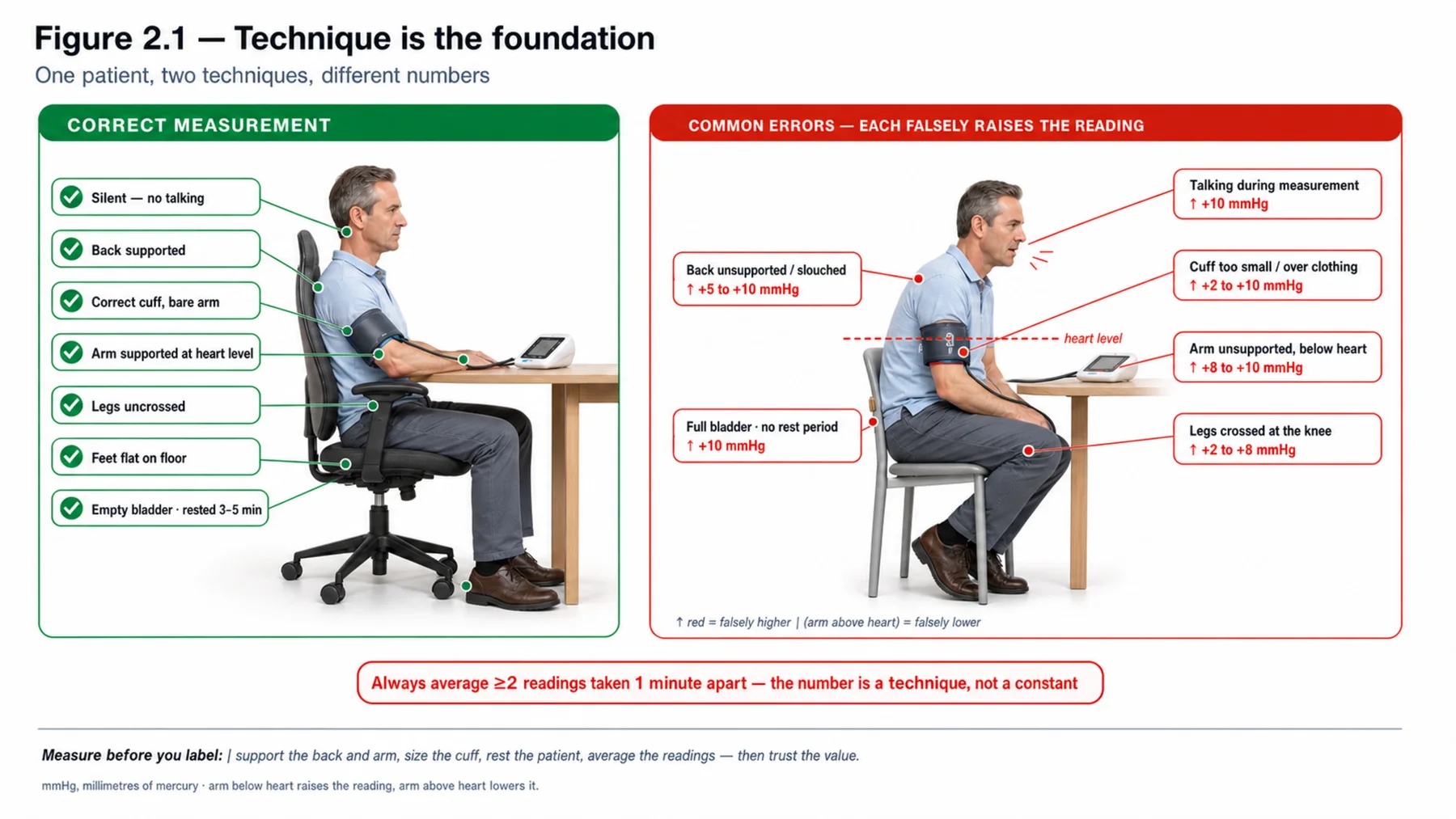
The commonest errors — an undersized cuff, an unsupported back or arm, talking, a full bladder, recent caffeine, and single readings — falsely raise the blood pressure.
Automated office blood pressure, taken unattended as a series of readings, reduces the white-coat effect and gives lower, more reliable values.
Home blood-pressure monitoring uses a validated device and repeated readings over several days and correlates with outcomes better than office readings.
Ambulatory blood-pressure monitoring records over 24 hours and is the reference method, giving daytime, nighttime, and 24-hour averages and the nocturnal dipping pattern.
The diagnostic thresholds differ by method: office at or above 140/90, home and daytime ambulatory at or above 135/85, 24-hour ambulatory at or above 130/80, and nighttime at or above 120/70.
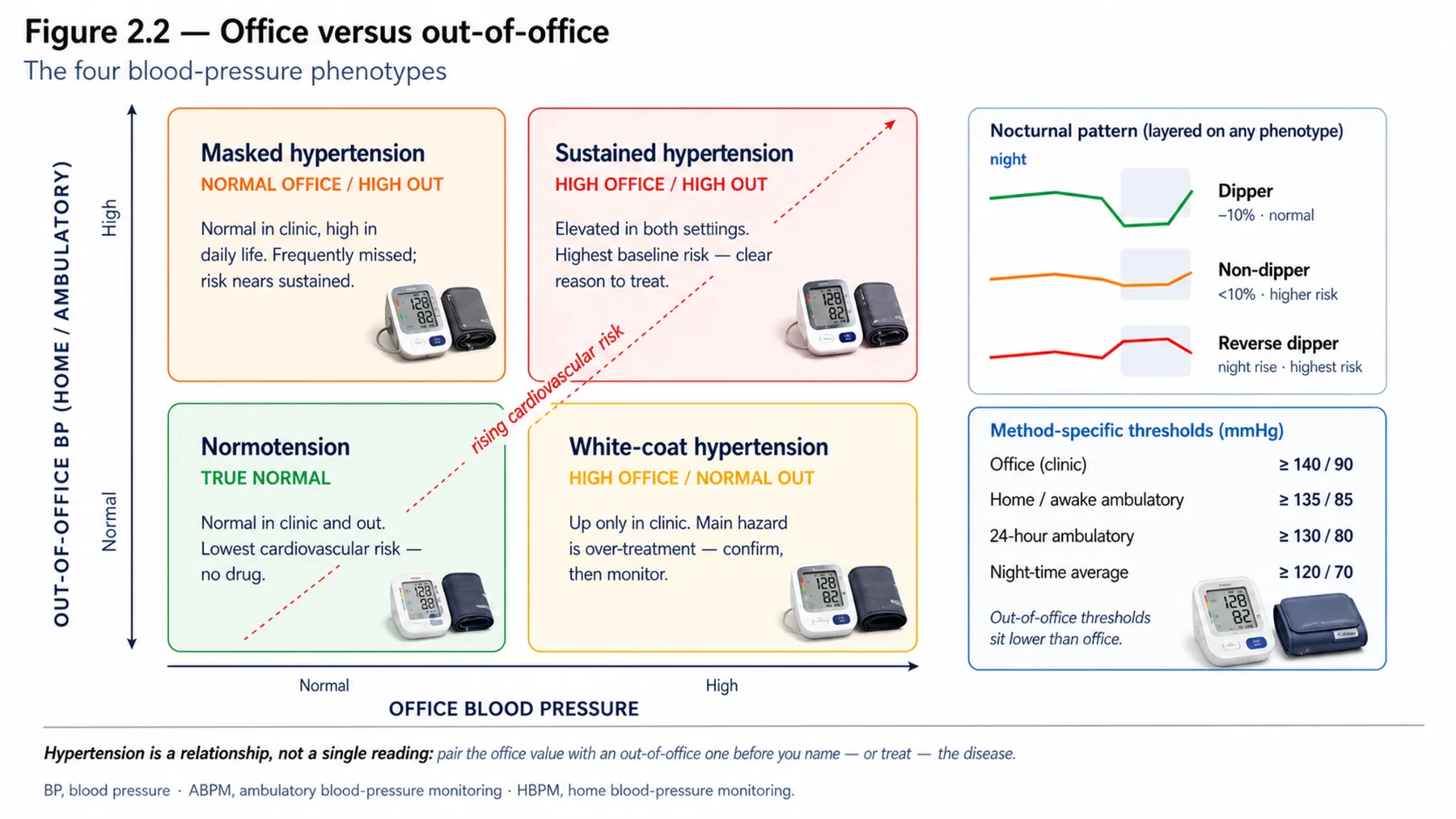
Out-of-office monitoring reveals the blood-pressure phenotypes.
White-coat hypertension is high in the office but normal out of the office — lower risk but not entirely benign — and recognising it avoids over-treatment.
Masked hypertension is normal in the office but high out of the office — a higher-risk, under-recognised phenotype that must be caught.
Nocturnal hypertension and non-dipping — a failure of the normal night-time fall in pressure — carry higher cardiovascular and renal risk, particularly in CKD, diabetes, and sleep apnoea.
Out-of-office blood pressure predicts outcomes better than office blood pressure, and nighttime pressure is the strongest predictor of all.
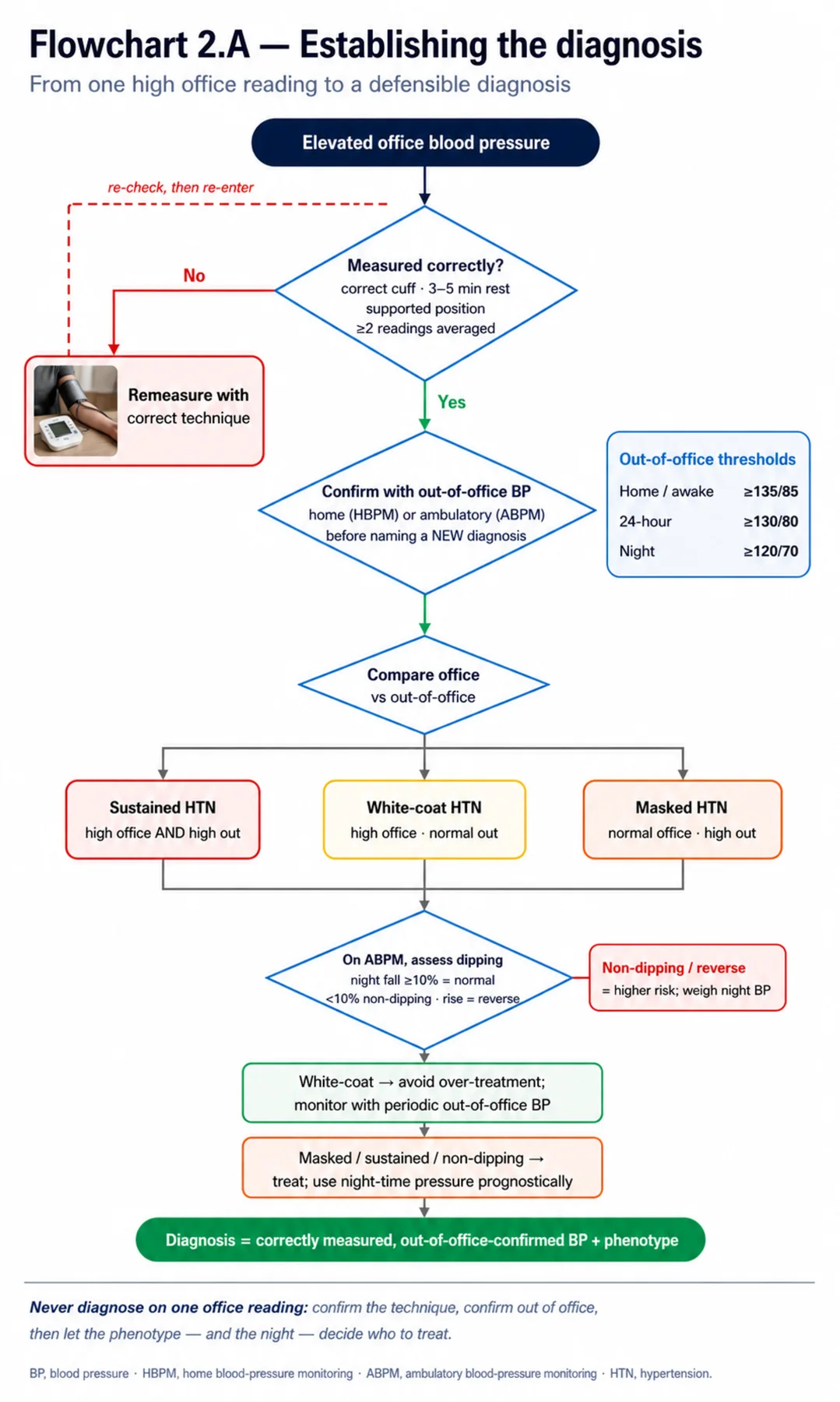
Guidelines therefore recommend confirming a new diagnosis with home or ambulatory monitoring.
| 03 | PHASE A · LEVEL 3 · ORIENTATION & KNOWLEDGE Main Narrative |
Everything in hypertension management rests on a number, and the number is only as good as the way it was measured. Office blood pressure is among the most error-prone measurements in medicine — mismeasured routinely, and capable of misleading in both directions. This chapter covers how to measure blood pressure correctly, and why out-of-office monitoring, which predicts outcomes better than the office reading, has become essential to confirming the diagnosis and revealing the phenotypes the office cannot see.
— Measuring office blood pressure correctly
Correct office measurement is unglamorous but decisive. The cuff must fit: the bladder should encircle about 80% of the arm, and an undersized cuff overestimates the pressure (a common error in larger arms), while an oversized one underestimates it. The patient should sit for several minutes' rest, back supported, feet flat and uncrossed, the arm supported at heart level, with no talking during the reading and no caffeine, smoking, or exercise beforehand and an empty bladder. Several readings should be taken a minute or two apart and averaged, and at the first visit both arms should be measured, using the higher-reading arm thereafter. Each element matters because each error shifts the number: an unsupported back raises the diastolic, an arm below heart level raises both, crossed legs and a full bladder raise the pressure, and talking raises it further. Done carelessly — a single reading, a small cuff, an unrested talking patient — office blood pressure can be off by 10 to 20 mmHg, enough to misdiagnose or mistreat. Measurement technique is not a formality; it is the foundation.
— Automated office and the white-coat effect
Even perfectly measured, attended office blood pressure carries the white-coat effect — the rise in pressure from the clinical encounter itself. Automated office blood pressure addresses this: an oscillometric device takes a series of readings with the patient resting alone (unattended), removing the observer and the encounter effect and yielding lower, more reproducible values. This is more than a technical refinement — it changes the numbers, and the major intensive-treatment trial that lowered target blood pressures used unattended automated office readings, which run several mmHg lower than routine office measurement. The practical implication is that the method must be specified when interpreting a target: a target derived from unattended automated readings is not the same as one applied to a hurried attended office reading. Automated office blood pressure is increasingly the office standard precisely because it reduces the white-coat effect that ordinary office measurement cannot.
— Home and ambulatory monitoring
The decisive advance, however, is moving the measurement out of the office. Home blood-pressure monitoring uses a validated upper-arm oscillometric device, with the patient taking duplicate readings morning and evening over several days (discarding the first day and averaging the rest); it engages the patient, samples many readings, and correlates with outcomes better than office measurement. Ambulatory blood-pressure monitoring goes further: a worn device records automatically over 24 hours — every 15 to 30 minutes by day, less often at night — and is the reference standard, providing the 24-hour, daytime (awake), and nighttime (asleep) averages and, crucially, the nocturnal dipping pattern that no other method captures. Each out-of-office method has its own diagnostic thresholds, which are lower than the office threshold because they average away the white-coat effect: roughly, office at or above 140/90, home and daytime ambulatory at or above 135/85, 24-hour ambulatory at or above 130/80, and nighttime at or above 120/70. Applying the office threshold to an ambulatory average, or vice versa, is a classic error.
— The phenotypes the office cannot see
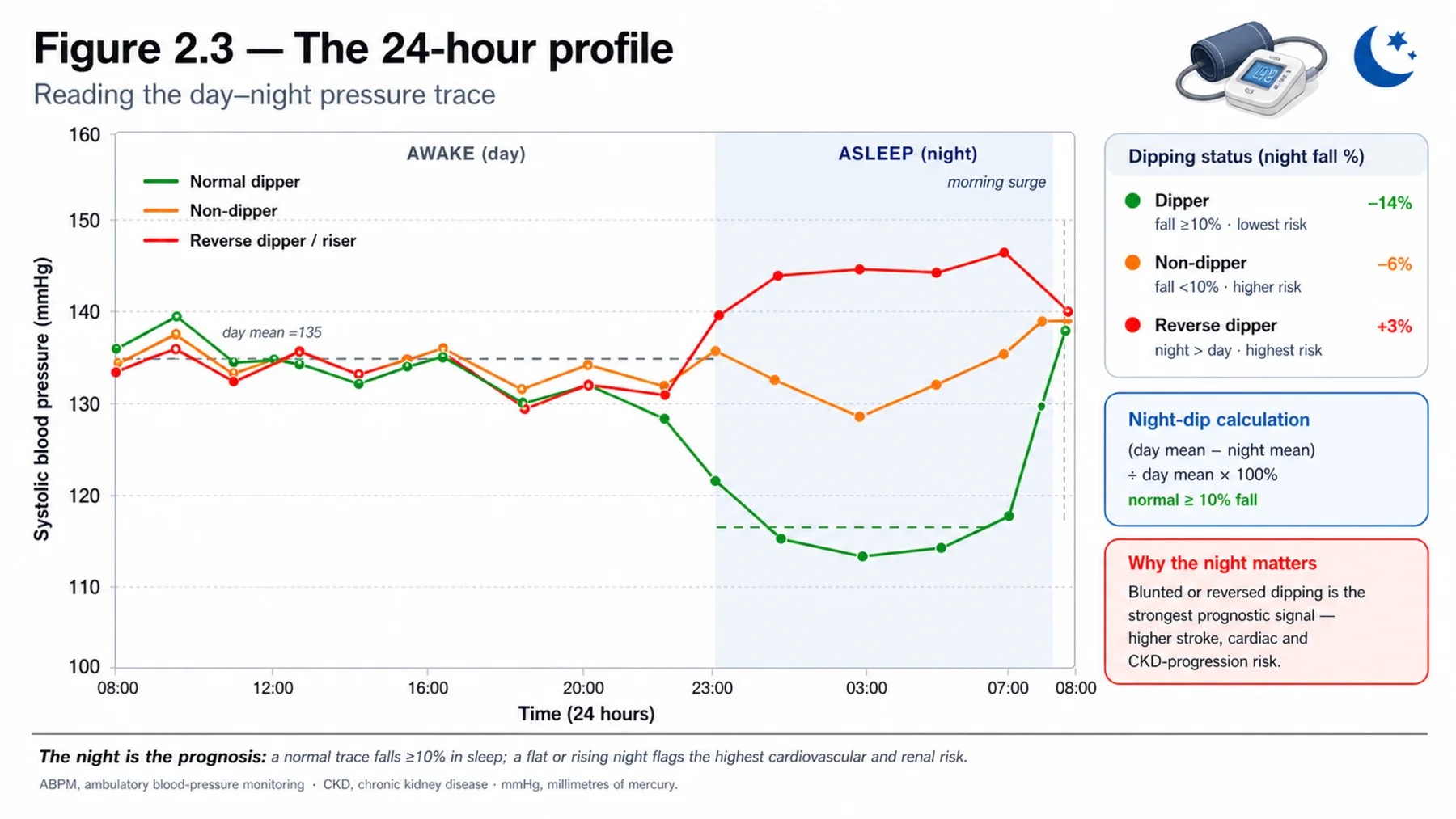
Out-of-office monitoring exists chiefly because the office reading alone misclassifies a large fraction of patients, and only comparing office to out-of-office readings reveals the true phenotype. Four phenotypes emerge. Sustained hypertension is high both in and out of the office — unambiguous. White-coat hypertension is high in the office but normal out of it: it carries lower risk than sustained hypertension (though it is not entirely benign, as some progress), and recognising it prevents over-treatment of a patient who is normotensive in daily life. Masked hypertension is the opposite and the more dangerous — normal in the office but high out of it: its risk approaches that of sustained hypertension, it is systematically under-recognised (because the office reassures), and catching it (suspected with high-normal office readings, in diabetes, in CKD) is one of the main reasons to monitor out of the office. And nocturnal hypertension with non-dipping — a failure of the normal 10 to 20% night-time fall in pressure, or even a paradoxical night-time rise — carries particularly high cardiovascular and renal risk and is common in CKD, sleep apnoea, diabetes, and autonomic dysfunction. These phenotypes are invisible to the office alone, and missing them means over-treating the white-coat patient and under-treating the masked and the non-dipper.
— The evidence: out-of-office predicts outcomes
The case for out-of-office monitoring is, at bottom, prognostic. A large body of evidence shows that out-of-office blood pressure — home and especially ambulatory — predicts cardiovascular and renal outcomes better than office blood pressure, because it samples the pressure the patient actually lives at, free of the white-coat effect and across the full day and night. Within that, the nighttime ambulatory pressure is the single strongest predictor of outcome, and the dipping pattern adds further prognostic information — the non-dipper and reverse-dipper are at higher risk independent of the average. This evidence is why guidelines now recommend confirming a new diagnosis of hypertension with out-of-office measurement (home or ambulatory) rather than relying on the office alone: to avoid labelling and treating the white-coat patient, to catch the masked patient the office misses, and to capture the nocturnal pattern that carries the greatest risk. The evidence is strong and consistent, though the precise role and thresholds continue to be refined, and access to ambulatory monitoring varies.
— Putting measurement at the foundation
The discipline of this chapter is to treat measurement as the foundation it is. A hypertension diagnosis and its entire downstream management — drugs, targets, monitoring, the labelling of a patient as hypertensive for life — rest on the blood-pressure number, so that number must be obtained correctly (proper office technique, the right cuff, multiple readings) and, for a new diagnosis, confirmed out of the office (home or ambulatory) to establish the true phenotype. Doing so prevents the two opposite errors the office alone produces: over-treating the white-coat patient who is normotensive in life, and under-treating the masked patient and the non-dipper whose office readings falsely reassure. As the volume moves to defining, classifying, and treating hypertension in the chapters ahead, every threshold and target it discusses presupposes that the blood pressure was measured properly and confirmed out of the office — because a target applied to a mismeasured number is worthless. Measurement is where the management of hypertension begins, and where it most often goes wrong.
| 04 | PHASE A · LEVEL 4 · ORIENTATION & KNOWLEDGE Reference Tables |
Table 2.1 — Correct office measurement
| Element | Detail |
| Cuff size | Bladder encircles ~80% of the arm — undersized overestimates, oversized underestimates |
| Preparation | Several minutes' rest; no caffeine/smoking/exercise beforehand; empty bladder |
| Position | Seated, back supported, feet flat and uncrossed, arm supported at heart level |
| During | No talking |
| Readings | Average several; both arms at first visit — use the higher-reading arm |
Table 2.2 — Errors that falsely raise blood pressure
| Error | Effect |
| Undersized cuff | Overestimates the pressure |
| Unsupported back | Raises the diastolic |
| Arm below heart level / unsupported | Raises both |
| Crossed legs, full bladder, talking, recent caffeine | Raise the pressure |
| Single reading / white-coat effect | Misleading — average and confirm out of office |
Table 2.3 — The measurement methods
| Method | Detail |
| Office (attended) | Standard but error-prone; white-coat effect |
| Automated office (unattended) | Series of readings, patient alone — reduces white-coat (used in SPRINT) |
| Home (HBPM) | Validated device, duplicate readings AM/PM over days — better outcome correlation |
| Ambulatory (ABPM) | 24-hour automated — reference standard; gives day/night/24-h and dipping |
Table 2.4 — The blood-pressure phenotypes
| Phenotype | Office vs out-of-office | Significance |
| Sustained | High both | Unambiguous hypertension |
| White-coat | High office, normal out | Lower risk (not benign) — avoid over-treatment |
| Masked | Normal office, high out | Higher risk, under-recognised — must catch |
| Nocturnal / non-dipping | Night BP doesn't fall | High CV/renal risk — CKD, OSA, diabetes |
Table 2.5 — Diagnostic thresholds by method
| Method | Hypertension threshold (approx.) |
| Office | ≥ 140/90 |
| Home / daytime ambulatory | ≥ 135/85 |
| 24-hour ambulatory | ≥ 130/80 |
| Nighttime ambulatory | ≥ 120/70 |
Table 2.6 — The evidence for out-of-office monitoring
| Finding | Detail |
| Better prognosis | Out-of-office BP predicts outcomes better than office BP |
| Nighttime strongest | Nocturnal ambulatory pressure is the strongest single predictor |
| Dipping adds information | Non-dipping/reverse-dipping is higher-risk independent of the average |
| Guideline recommendation | Confirm a new diagnosis with home or ambulatory monitoring |
| 05 | PHASE B · LEVEL 5 · VISUALISE & MAP Imaging & Flowchart Specifications |
| 08 | PHASE C · LEVEL 8 · CLINICAL REASONING Clinical Cases |
| CASE 1 | HIGH ONLY HERE Confirm out of office White-coat hypertension |
Presentation
A patient has repeatedly elevated office blood pressures but feels well and has no target-organ damage. Ambulatory monitoring shows normal daytime and nighttime averages. The team is about to start two antihypertensives based on the office readings.
❖ Pause and reflect Should this patient be treated on the office readings alone? |
Analysis
No — this is white-coat hypertension. The office readings are high but the ambulatory averages are normal, meaning the patient is normotensive in daily life and the office elevation reflects the white-coat effect. White-coat hypertension carries lower risk than sustained hypertension (though it is not entirely benign and warrants monitoring for progression), and treating it on the office readings alone would over-treat a patient who is normotensive out of the office, risking hypotension and unnecessary medication. Confirming out of the office prevented exactly that error.
Plan
Diagnose white-coat hypertension, avoid antihypertensive over-treatment, and monitor with periodic out-of-office measurement for progression to sustained hypertension. Confirm before committing a patient to lifelong therapy.
Teaching point
Confirm a new diagnosis out of the office — white-coat hypertension (high office, normal out) should not be over-treated.
Cross-reference
Exercises the confirm-out-of-office principle; Figure 2.2; Tables 2.4, 2.6.
| CASE 2 | NORMAL ONLY HERE The dangerous opposite Masked hypertension |
Presentation
A patient with diabetes has normal office blood pressures but is found, on home monitoring done for another reason, to have consistently elevated home readings and early target-organ damage.
❖ Pause and reflect What does the discordance between normal office and high home readings mean? |
Analysis
This is masked hypertension — normal in the office but high out of it — the dangerous opposite of white-coat. Its risk approaches that of sustained hypertension, and it is systematically under-recognised because the reassuring office reading leads clinicians to stop looking. It is more common in diabetes, CKD, and patients with high-normal office readings, and the early target-organ damage here confirms it is doing harm. Without the home monitoring, this patient's hypertension would have been missed and untreated. Catching the masked phenotype is one of the main reasons to monitor out of the office.
Plan
Diagnose and treat the masked hypertension, guided by the out-of-office readings, and recognise the higher risk it carries; screen for it out of the office in high-risk groups (diabetes, CKD, high-normal office). Do not be reassured by a normal office reading alone.
Teaching point
Masked hypertension (normal office, high out) carries high risk and is under-recognised — a normal office reading does not exclude hypertension.
Cross-reference
Exercises the out-of-office principle; Figure 2.2; Tables 2.4, 2.6.
| CASE 3 | THE CUFF WAS TOO SMALL Technique first Measurement error |
Presentation
A patient with a large arm is labelled hypertensive on office readings taken with a standard cuff while talking, with an unsupported arm. Repeat measurement with the correct large cuff, after rest and proper positioning, gives a normal blood pressure.
❖ Pause and reflect Was this patient truly hypertensive? |
Analysis
No — the original readings were falsely elevated by measurement error. An undersized cuff on a large arm overestimates the pressure, and talking with an unsupported arm raises it further; together these can add 10 to 20 mmHg, enough to misdiagnose. Repeating with the correct cuff, after rest and with proper positioning and silence, revealed the true normal pressure. This is the most basic and most common error in hypertension: a wrong diagnosis from a mismeasured number, before any question of phenotype even arises. Technique comes first.
Plan
Correct the technique — right cuff size, rest, proper positioning, no talking, multiple readings — before diagnosing or treating; here the corrected measurement is normal. Always ensure correct technique before acting on a blood pressure.
Teaching point
Measurement technique comes first — an undersized cuff and poor positioning falsely raise the pressure and can misdiagnose hypertension.
Cross-reference
Exercises the technique principle; Figure 2.1; Tables 2.1, 2.2.
| CASE 4 | THE NIGHT TELLS THE STORY Read the dipping Nocturnal non-dipping |
Presentation
A patient with CKD has acceptable daytime blood pressures, but ambulatory monitoring shows the nighttime pressure failing to fall — a non-dipping pattern — with the nighttime average elevated.
❖ Pause and reflect What does the non-dipping pattern add to the assessment? |
Analysis
It adds important prognostic information that the daytime readings miss. Normally the blood pressure falls by 10 to 20% at night; a failure to dip (non-dipping), common in CKD, sleep apnoea, diabetes, and autonomic dysfunction, carries higher cardiovascular and renal risk independent of the daytime average — and the nighttime pressure is the single strongest predictor of outcome. This patient's acceptable daytime readings are falsely reassuring; the elevated, non-dipping nighttime pressure reveals the true risk and the inadequacy of control. Only ambulatory monitoring captures this.
Plan
Recognise the non-dipping nocturnal hypertension as higher-risk and inadequately controlled, intensify and time therapy to address the nighttime pressure, and evaluate for contributors (sleep apnoea). Use the ambulatory nighttime pressure and dipping pattern prognostically.
Teaching point
Nocturnal non-dipping carries high risk and is captured only by ambulatory monitoring — the nighttime pressure is the strongest predictor.
Cross-reference
Exercises the nocturnal principle; Figure 2.3; Tables 2.4, 2.6; CKD hypertension in Chapter 14.
| 10 | PHASE C · LEVEL 10 · CLINICAL REASONING Clinical Pearls |
| Measurement is the foundation — office BP is frequently mismeasured. | Cuff bladder ~80% of arm; undersized overestimates, oversized underestimates. |
| Rest, back/arm supported, feet flat, arm at heart level, no talking, empty bladder. | Average multiple readings; both arms at first visit (use the higher). |
| Errors that raise BP: small cuff, unsupported back/arm, crossed legs, talking, full bladder, caffeine. | Automated office BP (unattended) reduces white-coat (used in SPRINT — lower numbers). |
| Home BP: validated device, duplicate AM/PM over days — better outcome correlation. | Ambulatory BP: 24-h reference standard — day/night/24-h + dipping. |
| Thresholds: office ≥140/90; home/daytime ≥135/85; 24-h ≥130/80; night ≥120/70. | Confirm a new diagnosis out of the office. |
| White-coat: high office, normal out — lower risk, avoid over-treatment. | Masked: normal office, high out — higher risk, under-recognised, must catch. |
| Sustained: high both. | Normal night dip ≥10%; non-dipping/reverse-dipping = higher risk. |
| Out-of-office BP predicts outcomes better than office. | Nighttime BP is the strongest single predictor. |
| 11 | PHASE D · LEVEL 11 · SAFETY & EVIDENCE Red Flags & Never-Do |
Panel A — Red flags
| ▲ | A hypertension diagnosis from a single office reading — confirm out of the office before labelling and treating. |
| ▲ | A normal office reading in a diabetic or CKD patient with target-organ damage — suspect masked hypertension; monitor out of office. |
| ▲ | A standard cuff on a large arm — falsely high; use the correct cuff size. |
| ▲ | Acceptable daytime BP but a non-dipping nocturnal pattern — higher risk and inadequate control. |
| ▲ | An ambulatory average judged against the office threshold — use the method-specific threshold. |
Panel B — Never do
| ✖ NEVER — diagnose hypertension on a single, casually measured office reading. |
| ✖ NEVER — be reassured by a normal office reading without considering masked hypertension. |
| ✖ NEVER — apply the office threshold to an out-of-office average. |
| ✖ NEVER — over-treat white-coat hypertension confirmed normal out of the office. |
| 12 | PHASE D · LEVEL 12 · SAFETY & EVIDENCE Common Pitfalls |
Pitfall 1 — Poor technique
| ✖ | WRONG Acting on a casually measured office reading. |
| ✓ | RIGHT Measuring correctly — right cuff, rest, position, multiple readings. |
| ✉ | WHY Technique errors shift the number by 10–20 mmHg. |
Pitfall 2 — Over-treating white-coat
| ✖ | WRONG Treating high office readings without out-of-office confirmation. |
| ✓ | RIGHT Confirming out of the office to identify white-coat hypertension. |
| ✉ | WHY White-coat patients are normotensive in daily life. |
Pitfall 3 — Missing masked
| ✖ | WRONG Being reassured by a normal office reading. |
| ✓ | RIGHT Monitoring out of the office in high-risk patients. |
| ✉ | WHY Masked hypertension is high-risk and the office misses it. |
Pitfall 4 — Wrong threshold
| ✖ | WRONG Judging an ambulatory average against 140/90. |
| ✓ | RIGHT Using the method-specific threshold (lower out of office). |
| ✉ | WHY Out-of-office averages exclude the white-coat effect. |
Pitfall 5 — Ignoring the night
| ✖ | WRONG Judging control from daytime readings alone. |
| ✓ | RIGHT Assessing the nocturnal pressure and dipping on ambulatory monitoring. |
| ✉ | WHY Nighttime pressure is the strongest predictor of outcome. |
| 13 | PHASE D · LEVEL 13 · SAFETY & EVIDENCE Evidence Grading |
GRADE A HIGH CONFIDENCE The effect is real and the estimate is stable. RCTs at low risk of bias; multiple concordant prospective cohorts; meta-analyses. |
GRADE B MODERATE CONFIDENCE The effect is likely real but may shift with new data. Observational studies, registries, mechanistic human studies. |
GRADE C LOW CONFIDENCE Rests on physiology, reasoning, or consensus rather than outcomes. Pathophysiological reasoning; extrapolation; consensus without outcomes. |
Graded statements (by evidence type)
| Statement | Grade | Basis (evidence type) |
| Measurement technique substantially affects the recorded blood pressure. | A | Measurement studies |
| Automated office blood pressure reduces the white-coat effect. | A | Clinical and trial data (SPRINT) |
| Out-of-office blood pressure predicts outcomes better than office. | A | Large prospective cohorts |
| Nighttime ambulatory pressure is the strongest single predictor. | A | Prospective cohort data |
| Masked hypertension carries risk approaching sustained hypertension. | B | Cohort data |
| White-coat hypertension carries lower but non-zero risk. | B | Cohort data |
| Confirming a new diagnosis out of office is recommended. | A | Guideline consensus |
| 14 | PHASE E · LEVEL 14 · PATIENT DECISIONS Absolute Risk in Natural Frequency |
Natural-frequency estimates for orientation, from the measurement literature; they vary with population and method. They convey the size of the decisions, expressed per 100 comparable patients.
| Per 100 patients… | Outcome | Roughly how many | See |
| With elevated office readings | Have white-coat hypertension (normal out of office) | A substantial share — hence confirm | L13 row 6 |
| With normal office readings (high-risk groups) | Have masked hypertension (high out of office) | A meaningful share — hence screen | L13 row 5 |
| Compared by method | Reclassified by out-of-office vs office BP | Many — the office misclassifies | L13 row 3 |
| With non-dipping nocturnal BP | Are at higher CV/renal risk | More than dippers at the same daytime average | L13 row 4 |
★ How to read these Read these as orientation, not promises; the proportions vary with population and method. The stable signals: the office misclassifies a large fraction (white-coat and masked), out-of-office monitoring reclassifies them, and non-dipping adds risk. Communicate them as people out of 100, not as a hazard ratio. |
| 18 | PHASE F · LEVEL 18 · APPLY & TEST Cheat Sheet |
| Measurement is the foundation — office BP is often wrong. | Cuff ~80% of arm; small overestimates, large underestimates. |
| Rest, supported back/arm, feet flat, arm at heart, no talking. | Average multiple readings; both arms first visit. |
| Errors ↑ BP: small cuff, unsupported, crossed legs, talking, caffeine. | Automated office (unattended) reduces white-coat (SPRINT). |
| Home BP: validated device, AM/PM over days. | Ambulatory BP: 24-h reference — day/night/24-h + dipping. |
| Thresholds: office 140/90; home/day 135/85; 24-h 130/80; night 120/70. | Confirm new diagnosis OUT OF OFFICE. |
| White-coat: high office, normal out — don't over-treat. | Masked: normal office, high out — higher risk, catch it. |
| Sustained: high both. | Night dip ≥10% normal; non-dipping = higher risk. |
| Out-of-office predicts outcomes better than office. | Nighttime BP = strongest predictor. |
| 19 | PHASE F · LEVEL 19 · APPLY & TEST Flashcards |
| CARD 1 | Q. Why does measurement technique matter so much? A. Office blood pressure is frequently mismeasured, and errors — an undersized cuff, an unsupported back or arm, talking, a full bladder, a single reading — can shift the number by 10 to 20 mmHg, enough to misdiagnose or mistreat. DETAILED. The entire downstream management rests on the number. CLINICAL. Measure correctly before acting on a blood pressure. |
| CARD 2 | Q. How should office blood pressure be measured? A. With an appropriately sized cuff (bladder ~80% of the arm), after several minutes' rest, the patient seated with back and arm supported and feet flat, no talking, no prior caffeine or smoking, and the average of multiple readings. DETAILED. Both arms are checked at the first visit. CLINICAL. Follow correct technique and average readings. |
| CARD 3 | Q. What is automated office blood pressure? A. An oscillometric device takes a series of readings with the patient resting alone (unattended), reducing the white-coat effect and giving lower, more reproducible values — the method used in the major intensive-treatment trial. DETAILED. Its numbers run several mmHg below routine attended office readings. CLINICAL. Specify the method when interpreting a target. |
| CARD 4 | Q. What do home and ambulatory monitoring add? A. Home monitoring samples many readings over days and correlates with outcomes better than office; ambulatory monitoring records over 24 hours and is the reference standard, giving daytime, nighttime, and 24-hour averages and the dipping pattern. DETAILED. Out-of-office measurement reveals the true phenotype. CLINICAL. Confirm a new diagnosis out of the office. |
| CARD 5 | Q. What are the four blood-pressure phenotypes? A. Sustained (high both), white-coat (high office, normal out — lower risk), masked (normal office, high out — higher risk), and nocturnal/non-dipping (night BP fails to fall — high risk). DETAILED. Only comparing office to out-of-office readings reveals them. CLINICAL. Identify the phenotype before deciding treatment. |
| CARD 6 | Q. Why is masked hypertension dangerous? A. It is normal in the office but high out of it, so its risk approaches sustained hypertension yet it is under-recognised because the office reassures — especially in diabetes, CKD, and high-normal office readings. DETAILED. A normal office reading does not exclude hypertension. CLINICAL. Screen for it out of the office in high-risk groups. |
| CARD 7 | Q. What is the significance of nocturnal dipping? A. Blood pressure normally falls 10 to 20% at night; a failure to dip (non-dipping) or a paradoxical rise (reverse-dipping) carries higher cardiovascular and renal risk independent of the daytime average, and the nighttime pressure is the strongest predictor of outcome. DETAILED. It is common in CKD, sleep apnoea, and diabetes. CLINICAL. Assess dipping on ambulatory monitoring and act on the nighttime pressure. |
| CARD 8 | Q. What does the evidence say about out-of-office monitoring? A. Out-of-office blood pressure (home and especially ambulatory) predicts cardiovascular and renal outcomes better than office blood pressure, so guidelines recommend confirming a new diagnosis with home or ambulatory measurement. DETAILED. It avoids over-treating white-coat and catches masked hypertension. CLINICAL. Confirm the diagnosis out of the office. |
| 20 | PHASE F · LEVEL 20 · APPLY & TEST One-Minute Preceptor |
| SCENE 1 | The intern starting drugs on office readings |
GET A COMMITMENT. “You're starting two antihypertensives on these high office readings — are you sure?”
PROBE FOR EVIDENCE. “The office BP is high” — ask: “Have you confirmed it out of the office, and could this be white-coat hypertension?”
TEACH A GENERAL RULE. A new diagnosis should be confirmed out of the office — white-coat hypertension is high in the office but normal in life and shouldn't be over-treated.
REINFORCE WHAT WAS RIGHT. Noticing the high office readings was the trigger to investigate.
CORRECT A MISTAKE. Confirm with home or ambulatory monitoring before committing to therapy.
| SCENE 2 | The resident reassured by a normal office BP |
GET A COMMITMENT. “You've cleared this diabetic patient because the office BP is normal — any concern?”
PROBE FOR EVIDENCE. “The office reading is fine” — ask: “Given the target-organ damage, could this be masked hypertension?”
TEACH A GENERAL RULE. A normal office reading doesn't exclude hypertension — masked hypertension is high out of the office and high-risk, especially in diabetes and CKD.
REINFORCE WHAT WAS RIGHT. Checking the office BP was a reasonable start.
CORRECT A MISTAKE. Monitor out of the office before concluding the BP is controlled.
| 21 | PHASE F · LEVEL 21 · APPLY & TEST Reflective Prompts |
Genuine tensions this evidence leaves open; sit with them rather than resolving them too quickly.
The most consequential number in hypertension is also one of the most error-prone measurements in medicine. Why is careful technique so hard to sustain in a busy clinic, and what would it take to fix?
Out-of-office monitoring predicts outcomes better than the office reading, yet much of the world still diagnoses on a single office number. How should access constraints shape what we recommend?
White-coat and masked hypertension pull in opposite directions — one toward less treatment, one toward more. How do you hold both possibilities in mind for the same office number?
The nighttime pressure is the strongest predictor, yet it is the least convenient to measure. How much should prognostic value outweigh practicality in deciding what to monitor?
Treatment targets derived from unattended automated readings are applied, in practice, to hurried attended ones. How much harm comes from that quiet mismatch of method?
| 22 | PHASE F · LEVEL 22 · APPLY & TEST Board-Style Questions |
| Q 01 | An undersized blood-pressure cuff on a large arm will: |
| A | Underestimate the pressure |
| B | Overestimate the pressure |
| C | Have no effect |
| D | Only affect the diastolic |
Rationale An undersized cuff overestimates blood pressure; an oversized one underestimates it (case 3, Tables 2.1–2.2). A is the reverse; C and D are wrong. |
| Q 02 | What is the main advantage of automated (unattended) office blood pressure? |
| A | It is faster |
| B | It reduces the white-coat effect, giving lower, more reproducible values |
| C | It needs no cuff |
| D | It measures nighttime pressure |
Rationale Unattended automated readings remove the observer/encounter effect (Table 2.3; used in SPRINT). A, C, and D are incorrect. |
| Q 03 | A patient with high office but normal ambulatory blood pressure has: |
| A | Sustained hypertension |
| B | White-coat hypertension |
| C | Masked hypertension |
| D | Nocturnal hypertension |
Rationale High office with normal out-of-office readings is white-coat hypertension (case 1, Figure 2.2). A is high both; C is the reverse; D is a nocturnal pattern. |
| Q 04 | A diabetic patient with normal office but high home blood pressure has: |
| A | White-coat hypertension |
| B | Masked hypertension |
| C | Normotension |
| D | Sustained hypertension |
Rationale Normal office with high out-of-office readings is masked hypertension — higher-risk and under-recognised (case 2, Figure 2.2). A is the reverse; C and D are wrong. |
| Q 05 | Which is the strongest single predictor of cardiovascular outcome? |
| A | Office systolic pressure |
| B | Nighttime ambulatory pressure |
| C | Daytime peak pressure |
| D | Pulse pressure |
Rationale Nighttime ambulatory pressure is the strongest single predictor (Table 2.6, case 4). A, C, and D predict less well. |
| Q 06 | The ambulatory 24-hour hypertension threshold is approximately: |
| A | ≥ 140/90 |
| B | ≥ 130/80 |
| C | ≥ 120/70 |
| D | ≥ 135/85 |
Rationale The 24-hour ambulatory threshold is ~130/80; office is 140/90, nighttime ~120/70, home/daytime ~135/85 (Table 2.5). A, C, and D are the other methods' thresholds. |
| Q 07 | A non-dipping nocturnal blood-pressure pattern indicates: |
| A | Lower risk |
| B | Higher cardiovascular and renal risk |
| C | White-coat hypertension |
| D | A measurement error |
Rationale Failure of the normal night-time fall carries higher risk independent of the daytime average (case 4, Table 2.4). A, C, and D are incorrect. |
| Q 08 | How should a new diagnosis of hypertension be confirmed? |
| A | A single office reading |
| B | Out-of-office monitoring (home or ambulatory) |
| C | Symptoms alone |
| D | Family history |
Rationale Out-of-office measurement confirms the diagnosis, avoids over-treating white-coat, and catches masked hypertension (Table 2.6, rule on confirmation). A, C, and D are inadequate. |