Chapter Preamble
Signals declared
Sig-D — Diagnostic (primary). Recognise primary hypertension as a multifactorial diagnosis of exclusion, and let the contributing mechanisms inform individualised treatment.
Sig-M — Mechanistic (strong). The interacting mechanisms — renal sodium handling, the sympathetic system, RAAS, vascular and metabolic factors, and genetics — all converging on the pressure-natriuresis shift.
Levels populated and omitted
Populated (17): L1–L13, L18–L20, L22. The mechanistic signal fires the concept maps (L6) and triads (L9); the diagnostic signal drives the tables, rules, cases, pitfalls, and board items.
L14 absolute-risk — omitted. No Sig-T/E/V; this is a pathogenesis chapter, with treatment outcomes quantified in the management chapters.
L15 / L16 preference-sensitive map and SDM scripts — omitted. No Sig-E; understanding the mechanisms of hypertension is foundational knowledge.
L17 documentation templates — omitted. No Sig-P/T; the management templates belong with the treatment chapters.
| 01 | PHASE A · LEVEL 1 · ORIENTATION & KNOWLEDGE Learning Objectives |
By the end of this chapter you should be able to:
Define primary (essential) hypertension and explain why it is multifactorial.
Explain the central role of renal sodium handling and salt sensitivity, including nephron number.
Describe the contributions of the RAAS and the sympathetic nervous system.
Describe the vascular mechanisms — endothelial dysfunction and arterial stiffening.
Explain the obesity-hypertension link and its metabolic mechanisms.
Summarise the genetic basis of primary hypertension.
Explain how the mechanisms converge on the pressure-natriuresis shift (the mosaic).
Recognise primary hypertension as a diagnosis of exclusion and use the mechanisms to guide treatment.
| 02 | PHASE A · LEVEL 2 · ORIENTATION & KNOWLEDGE Executive Summary |
Primary (essential) hypertension — about 90 to 95% of all hypertension — has no single identifiable secondary cause and is multifactorial, arising from interacting genetic and environmental mechanisms.
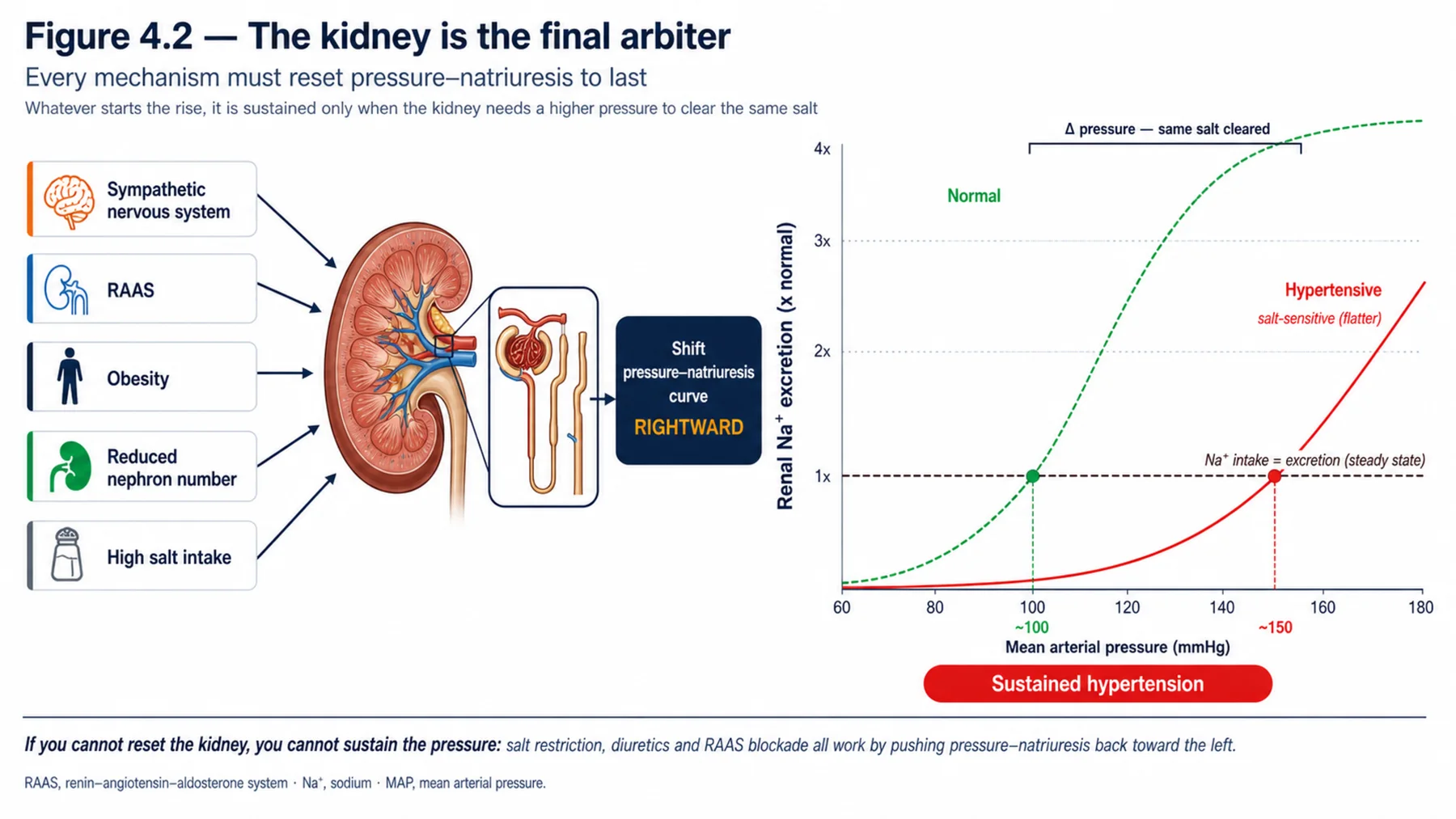
Renal sodium handling is central: impaired sodium excretion shifts the pressure-natriuresis relationship rightward, so the kidney requires a higher pressure to excrete a given sodium load.
Salt sensitivity reflects this, and a reduced nephron number (as after low birthweight) predisposes to it.
The RAAS contributes through inappropriate or relatively elevated activity, including the intrarenal system.
Sympathetic nervous system overactivity raises vascular tone, renin, and sodium retention, driven by stress, obesity, and sleep apnoea.
Vascular mechanisms — endothelial dysfunction with reduced nitric oxide and increased endothelin, and arterial stiffening and remodelling — raise systemic vascular resistance.
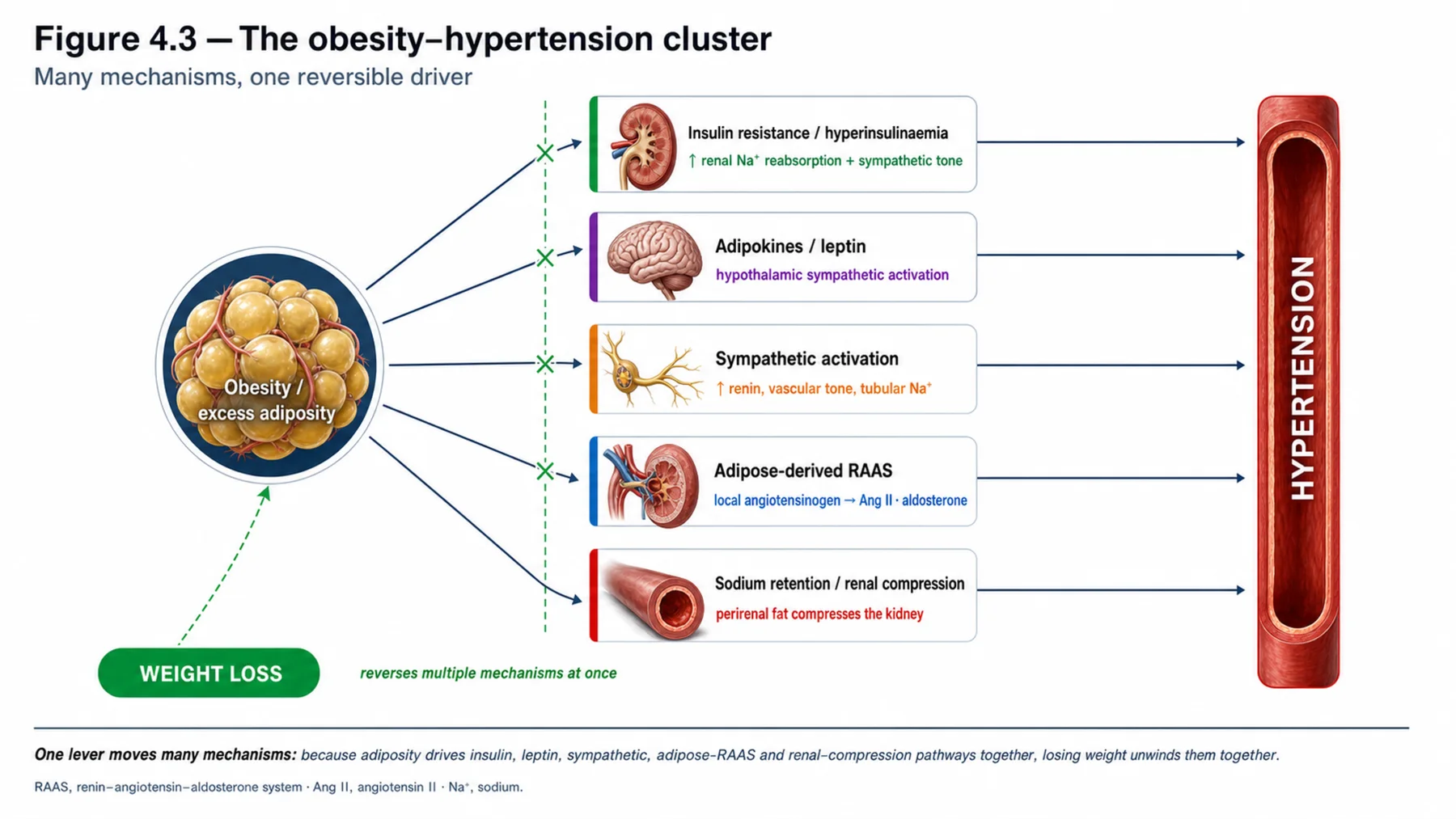
Obesity drives hypertension through insulin resistance, adipokines, sympathetic activation, sodium retention, and an adipose-derived RAAS.
The genetic basis is largely polygenic — many common variants of small effect — with rare monogenic forms considered separately.
Ageing stiffens the arteries, producing isolated systolic hypertension, and low potassium intake and alcohol contribute.
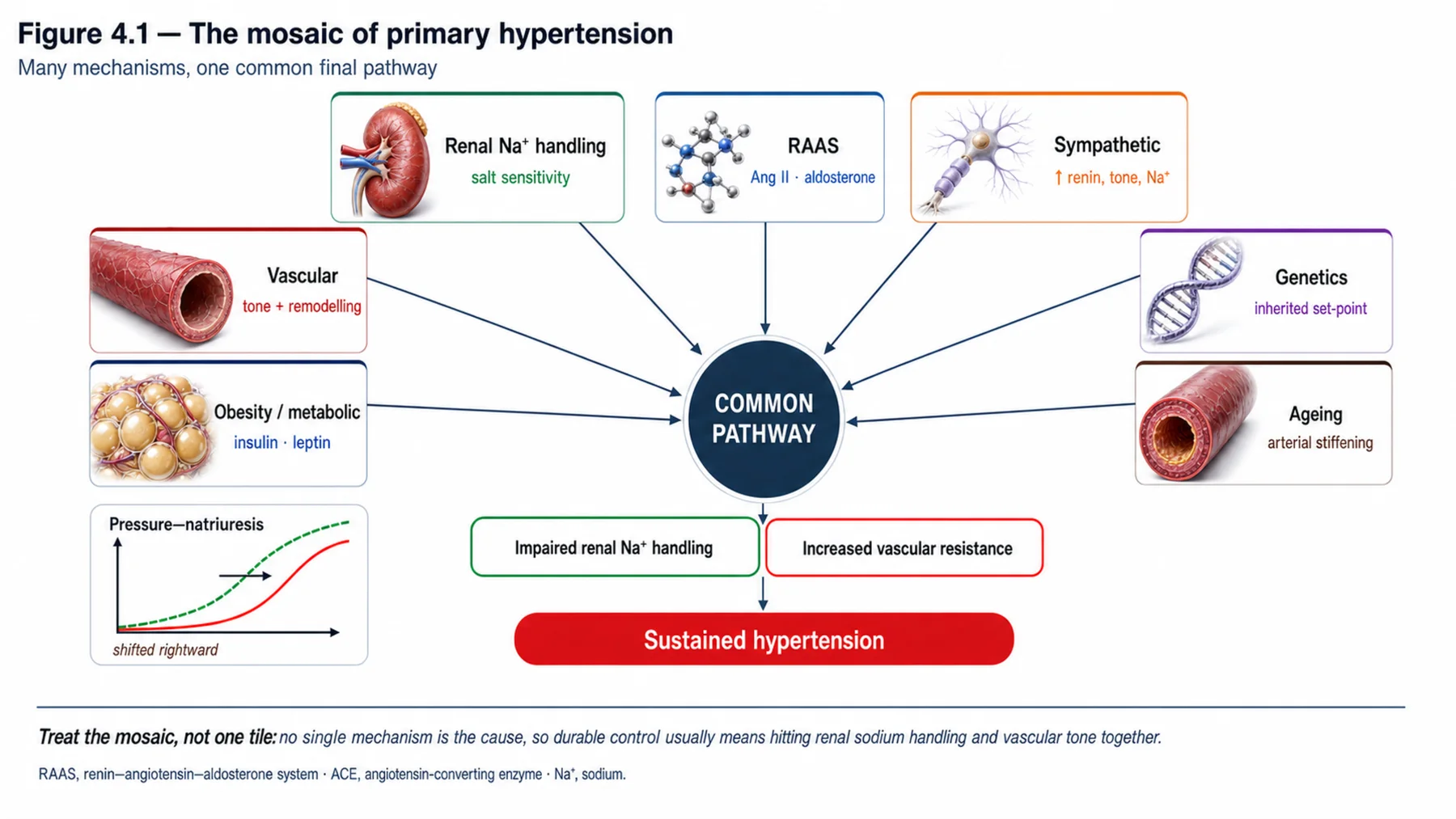
No single mechanism explains primary hypertension; it is a mosaic of interacting factors.
Crucially, they all converge on the same final pathway: impaired renal sodium handling and increased vascular resistance — the rightward-shifted pressure-natriuresis of the opening chapter.
Primary hypertension is a diagnosis of exclusion, made after secondary causes have been considered.
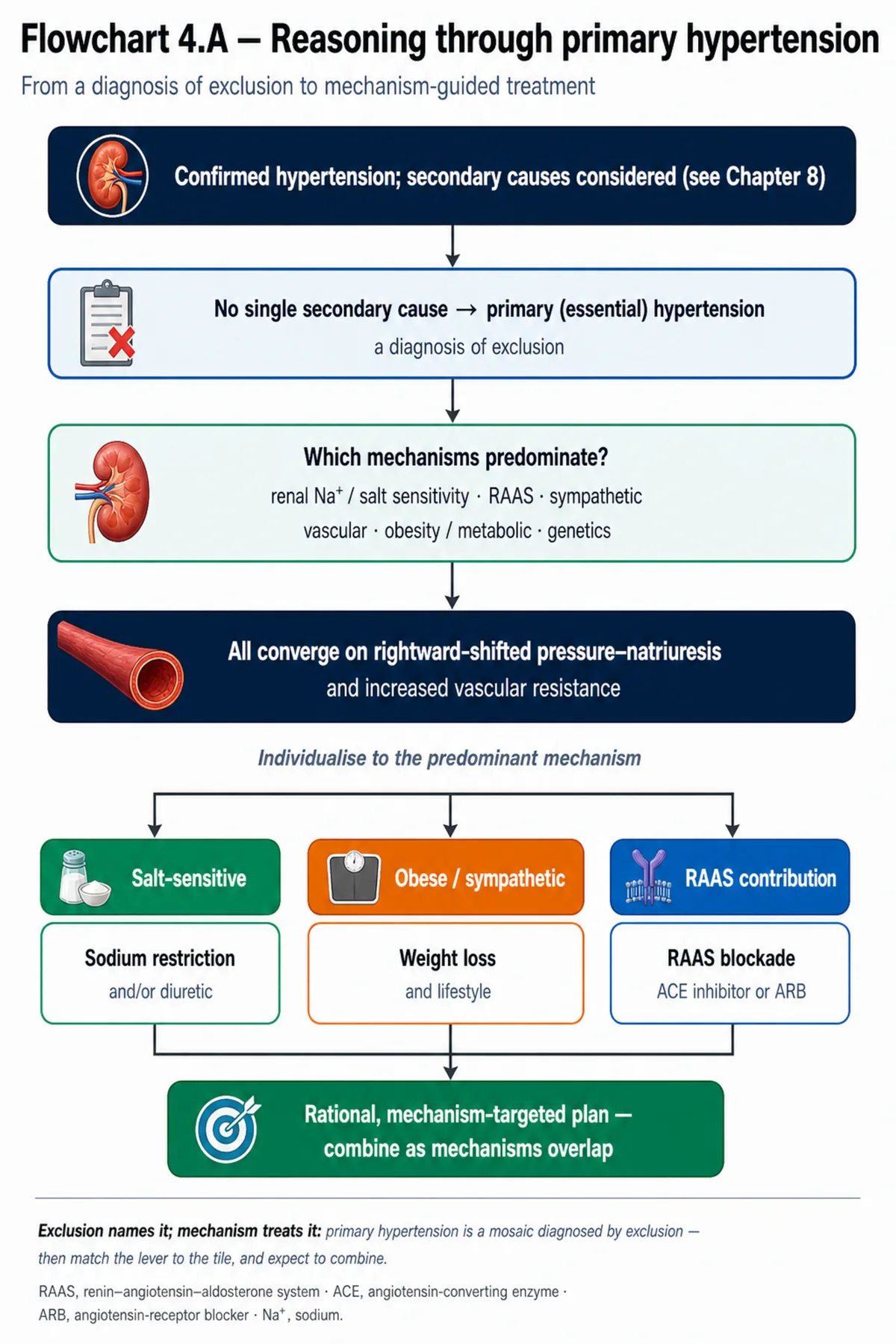
Recognising which mechanisms predominate in a given patient — salt sensitivity, sympathetic or obesity drive — helps individualise treatment.
Understanding the mechanisms makes the management chapters that follow coherent.
| 03 | PHASE A · LEVEL 3 · ORIENTATION & KNOWLEDGE Main Narrative |
Most hypertension — nine in ten cases — is primary, or essential, meaning no single secondary cause can be found. But 'no single cause' does not mean 'no cause': primary hypertension is multifactorial, the product of many interacting mechanisms, genetic and environmental, that converge on the same final pathway the opening chapter described — a rightward-shifted pressure-natriuresis relationship and increased vascular resistance. This chapter surveys those mechanisms and shows how they form a mosaic that, despite its complexity, points back to the kidney and the vessels.
— The kidney at the centre: sodium handling and salt sensitivity
Renal sodium handling is the central mechanism, as the regulatory physiology of the opening chapter implies. Because the kidney sets the long-term blood pressure through pressure-natriuresis, sustained hypertension requires the kidney to handle sodium abnormally — to require a higher pressure to excrete a given sodium load (a rightward-shifted curve). Salt sensitivity is this seen clinically: the salt-sensitive patient's blood pressure rises with sodium intake because their kidney cannot excrete the load without a higher pressure. A reduced nephron number predisposes to this — the Brenner hypothesis proposes that a low nephron endowment (as after low birthweight or intrauterine growth restriction) leaves fewer nephrons to handle the sodium load, raising the pressure needed to excrete it and predisposing to hypertension across life. High dietary salt and low potassium intake load the system further. So the kidney's handling of sodium is not one mechanism among many but the common final pathway through which the others ultimately act.
— The neurohormonal drivers: RAAS and the sympathetic system
Two neurohormonal systems drive primary hypertension. The renin-angiotensin-aldosterone system contributes through inappropriate or relatively elevated activity — a renin or aldosterone level that is 'normal' but inappropriately high for the patient's sodium status — and through the intrarenal RAAS acting locally on sodium handling and tone; this is why RAAS blockade lowers pressure even in patients without overt aldosterone excess. The sympathetic nervous system is the other major driver: increased sympathetic outflow raises vascular tone, stimulates renin, and promotes renal sodium retention, and is itself driven by stress, obesity, sleep apnoea, and baroreceptor resetting. Sympathetic overactivity is prominent in younger, obese, and sleep-apnoeic hypertensives, and is the rationale for the interest in sympathetic-targeted therapies. Both systems act, in the end, on the same levers — vascular tone and renal sodium — that the kidney integrates into the long-term pressure.
— The vascular mechanisms
Hypertension is also a disease of the blood vessels, both as cause and consequence. Endothelial dysfunction — reduced production of the vasodilator nitric oxide and increased production of the vasoconstrictor endothelin — raises vascular tone and resistance. Arterial stiffening and remodelling, with thickening of the vessel wall and loss of elastic compliance, raise resistance further and, in the large arteries, raise the systolic pressure and widen the pulse pressure (the isolated systolic hypertension of ageing). These vascular changes are partly a cause of hypertension (raising resistance) and partly a consequence of it (hypertension damages and stiffens vessels), creating a self-reinforcing loop. The vascular mechanisms explain why systemic vascular resistance is typically raised in established primary hypertension and why vasodilating agents (calcium-channel blockers) are effective, and they connect to the target-organ damage and vascular disease developed later in the volume.
— Obesity, metabolism, and the modern epidemic
Obesity is among the most important and most modifiable contributors, and the obesity-hypertension link is central to the modern epidemic of hypertension. Excess adiposity raises blood pressure through several mechanisms at once: insulin resistance and hyperinsulinaemia (promoting sodium retention and sympathetic activity), leptin and other adipokines (activating the sympathetic system), direct sympathetic activation, an adipose-derived RAAS, and the physical and inflammatory effects of fat. The result is a salt-retaining, sympathetically-driven, RAAS-activated state — several of the chapter's mechanisms operating together. The obesity-hypertension link is why weight loss is among the most effective non-pharmacological treatments (the next chapter), why obesity-associated hypertension is often salt-sensitive and sympathetically driven, and why the rising prevalence of obesity drives the rising prevalence of hypertension. It is the clearest example of multiple mechanisms converging in one patient.
— Genetics and the other contributors
Primary hypertension is heritable — blood pressure runs in families, with a heritability of roughly a third to a half — but the genetic architecture is overwhelmingly polygenic: hundreds of common genetic variants, each of small effect, identified by genome-wide association studies, that together influence blood pressure through the very mechanisms already described (sodium handling, vascular tone, the neurohormonal systems). This polygenic basis is quite different from the rare monogenic hypertensions (Liddle syndrome and others), in which a single gene defect in tubular sodium transport causes hypertension and which are considered with the secondary causes later in the volume. Beyond genetics, ageing (arterial stiffening), low dietary potassium, excess alcohol, and fetal programming (the developmental origin of the reduced nephron number) all contribute. The picture is of many small influences — genetic and environmental — summing to raise the blood pressure, rather than a single dominant cause.
— The mosaic, and what it means for practice
The unifying concept — captured historically in Page's 'mosaic theory' — is that primary hypertension results from many interacting factors rather than a single cause, and that these factors converge on a common final pathway: impaired renal sodium handling and increased vascular resistance, the rightward-shifted pressure-natriuresis of the opening chapter. This has two practical consequences. First, primary hypertension is a diagnosis of exclusion: it is made after secondary causes have been considered (the approach of the secondary-hypertension chapters), because there is no positive test for it — it is what remains when a single cause is not found. Second, although there is no single cause to target, recognising which mechanisms predominate in a given patient helps individualise treatment: the salt-sensitive patient (often with obesity, CKD, or older age) benefits most from sodium restriction and diuretics; the sympathetically-driven, obese patient benefits most from weight loss and lifestyle change; the patient with a strong RAAS contribution from RAAS blockade. So the mechanisms, though they cannot be untangled into a single cause, are not merely academic — they inform the choice of treatment, which is where the next chapters turn.
| 04 | PHASE A · LEVEL 4 · ORIENTATION & KNOWLEDGE Reference Tables |
Table 4.1 — The contributing mechanisms
| Mechanism | Detail |
| Renal sodium handling | Impaired excretion → rightward-shifted pressure-natriuresis (central) |
| RAAS | Inappropriate/relative activation; intrarenal RAAS |
| Sympathetic system | Increased tone, renin, sodium retention (stress, obesity, OSA) |
| Vascular | Endothelial dysfunction, arterial stiffening, raised resistance |
| Obesity/metabolic | Insulin resistance, adipokines, sympathetic, adipose RAAS |
Table 4.2 — Renal sodium handling and salt sensitivity
| Aspect | Detail |
| Central role | The kidney sets long-term BP — sustained HTN needs a sodium-handling shift |
| Salt sensitivity | BP rises with sodium intake — impaired excretion |
| Nephron number | Low endowment (Brenner) — low birthweight predisposes |
| Dietary | High salt, low potassium load the system |
Table 4.3 — The neurohormonal drivers
| Driver | Detail |
| RAAS | Relatively elevated activity; intrarenal system; responds to RAAS blockade |
| Sympathetic | Raised tone, renin, sodium retention; stress/obesity/OSA |
| Prominent in | Younger, obese, sleep-apnoeic patients (sympathetic) |
| Common levers | Vascular tone and renal sodium — integrated by the kidney |
Table 4.4 — Vascular and obesity mechanisms
| Mechanism | Detail |
| Endothelial dysfunction | Reduced nitric oxide, increased endothelin → raised tone |
| Arterial stiffening | Remodelling → raised resistance, systolic pressure (isolated systolic HTN) |
| Obesity | Insulin resistance, adipokines, sympathetic, adipose RAAS, sodium retention |
| Self-reinforcing | Vascular changes are both cause and consequence of hypertension |
Table 4.5 — Genetics and other contributors
| Factor | Detail |
| Polygenic | Many common small-effect variants (GWAS); heritability ~30–50% |
| Monogenic | Rare single-gene tubular defects — considered with secondary causes |
| Ageing | Arterial stiffening → isolated systolic hypertension |
| Other | Low potassium, alcohol, fetal programming |
Table 4.6 — The mosaic and its implications
| Point | Detail |
| The mosaic | Many interacting factors, no single cause (Page) |
| Common final pathway | Impaired renal sodium handling + increased vascular resistance |
| Diagnosis of exclusion | Made after considering secondary causes |
| Mechanism-guided treatment | Salt-sensitive → diuretic/salt restriction; obese/sympathetic → weight/lifestyle; RAAS → RAAS blockade |
| 05 | PHASE B · LEVEL 5 · VISUALISE & MAP Imaging & Flowchart Specifications |
| 06 | PHASE B · LEVEL 6 · VISUALISE & MAP Concept Maps |
Each chain runs from mechanism to a named clinical insight; read the arrows as “leads to.”
Renal sodium handling. Impaired sodium excretion (salt sensitivity, low nephron number, high salt) → rightward-shifted pressure-natriuresis → sustained hypertension → ACTION: the kidney is the common final pathway — restrict sodium and use diuretics in the salt-sensitive.
Neurohormonal drivers. RAAS (relative activation) and sympathetic overactivity (stress/obesity/OSA) → raised tone, renin, sodium retention → ACTION: target the RAAS (blockade) and the sympathetic/obesity drivers (lifestyle).
Vascular. Endothelial dysfunction (↓NO, ↑endothelin) + arterial stiffening/remodelling → increased systemic vascular resistance → ACTION: recognise the raised resistance and use vasodilators (calcium-channel blockers).
Obesity-metabolic. Obesity → insulin resistance + adipokines + sympathetic + adipose RAAS + sodium retention → several mechanisms at once → ACTION: prioritise weight loss — it reverses multiple drivers.
The mosaic. Many small genetic and environmental influences → no single cause → convergence on renal sodium handling and vascular resistance → ACTION: diagnose by exclusion and individualise by the predominant mechanism.
| 07 | PHASE B · LEVEL 7 · VISUALISE & MAP Decision Pathways |
| R1 | IF hypertension has no single secondary cause, THEN diagnose primary (essential) hypertension — a multifactorial diagnosis of exclusion. |
| R2 | IF blood pressure rises with sodium intake, THEN recognise salt sensitivity — impaired renal sodium handling — and restrict sodium and consider a diuretic. |
| R3 | IF a patient had low birthweight or growth restriction, THEN consider a reduced nephron endowment as a lifelong predisposition to hypertension. |
| R4 | IF a patient is young, obese, or sleep-apnoeic, THEN expect a prominent sympathetic contribution and address obesity and sleep apnoea. |
| R5 | IF systemic vascular resistance is raised (endothelial dysfunction, stiffening), THEN expect vasodilators (calcium-channel blockers) to be effective. |
| R6 | IF a patient is obese, THEN recognise that several hypertensive mechanisms operate together and prioritise weight loss. |
| R7 | IF a family history of hypertension is present, THEN recognise the polygenic heritability — but do not mistake it for a single-gene cause. |
| R8 | IF treating primary hypertension, THEN individualise by the predominant mechanism rather than seeking a single cause. |
| 08 | PHASE C · LEVEL 8 · CLINICAL REASONING Clinical Cases |
| CASE 1 | THE SALT-SENSITIVE KIDNEY Impaired sodium handling Salt sensitivity |
Presentation
An older patient with a history of low birthweight has hypertension whose blood pressure rises markedly with dietary salt and falls with sodium restriction. The team is unsure why this patient is so salt-responsive.
❖ Pause and reflect Why is this patient's blood pressure so sensitive to salt? |
Analysis
This is salt-sensitive hypertension from impaired renal sodium handling, the central mechanism. The blood pressure rises with salt because the kidney cannot excrete a sodium load without a higher pressure — a rightward-shifted pressure-natriuresis. The history of low birthweight points to a reduced nephron endowment (the Brenner hypothesis): fewer nephrons to handle the sodium load means a higher pressure is needed to excrete it, predisposing to salt-sensitive hypertension across life. This patient's mechanism is predominantly renal sodium handling, which is exactly why sodium restriction and a diuretic are so effective.
Plan
Restrict dietary sodium and use a diuretic, which directly address the impaired sodium handling driving this salt-sensitive hypertension. Recognise the renal sodium mechanism and target it.
Teaching point
Salt sensitivity reflects impaired renal sodium handling (predisposed by a low nephron number) — treat with sodium restriction and diuretics.
Cross-reference
Exercises rules R2 and R3; the renal-sodium concept map; Figure 4.2; Tables 4.2, 4.6; pressure-natriuresis in Chapter 1.
| CASE 2 | DRIVEN FROM ABOVE Sympathetic and obesity Sympathetically-driven hypertension |
Presentation
A young, obese patient with obstructive sleep apnoea has hypertension with a high resting heart rate and signs of sympathetic overactivity. The team is considering how the obesity and sleep apnoea relate to the blood pressure.
❖ Pause and reflect What mechanisms link obesity and sleep apnoea to this hypertension? |
Analysis
Several, operating together. Obesity raises blood pressure through insulin resistance, adipokines, an adipose-derived RAAS, sodium retention, and — prominently here — sympathetic activation, and obstructive sleep apnoea adds further sympathetic overactivity (the high heart rate reflects it). This patient illustrates the obesity-hypertension cluster, in which several of the chapter's mechanisms act at once, with the sympathetic drive prominent in a young, obese, sleep-apnoeic patient. Because multiple mechanisms converge on the obesity, addressing the obesity and the sleep apnoea targets them all simultaneously.
Plan
Prioritise weight loss and treatment of the sleep apnoea, which reverse several hypertensive mechanisms at once, alongside antihypertensive therapy; the sympathetic and obesity drivers are the leverage points. Address the obesity and sleep apnoea, not just the blood pressure.
Teaching point
In the young, obese, sleep-apnoeic patient, sympathetic and obesity-driven mechanisms predominate — weight loss and sleep-apnoea treatment target several at once.
Cross-reference
Exercises rules R4 and R6; the neurohormonal and obesity concept maps; Figure 4.3; Tables 4.3, 4.4.
| CASE 3 | NO SINGLE CAUSE The diagnosis of exclusion Primary hypertension as a mosaic |
Presentation
A middle-aged patient with a family history of hypertension, mild obesity, and a gradual onset of high blood pressure has a negative secondary-hypertension screen. A trainee keeps searching for the single underlying cause.
❖ Pause and reflect Is there a single cause to find here? |
Analysis
No — this is primary (essential) hypertension, which is multifactorial and has no single cause to find. The family history (polygenic heritability), the mild obesity (metabolic and sympathetic mechanisms), the gradual middle-age onset, and the negative secondary screen together describe the typical mosaic: many interacting genetic and environmental factors summing to raise the blood pressure, with no single dominant lesion. Continuing to search for one cause is futile; primary hypertension is a diagnosis of exclusion, made when secondary causes have been reasonably considered and not found. The task shifts from finding a cause to managing the risk and the predominant mechanisms.
Plan
Diagnose primary hypertension once secondary causes are reasonably excluded, stop searching for a single cause, and manage by total cardiovascular risk and the predominant mechanisms (here, obesity and lifestyle). Accept the multifactorial nature and treat accordingly.
Teaching point
Primary hypertension is a multifactorial diagnosis of exclusion — a mosaic with no single cause to find.
Cross-reference
Exercises rules R1 and R7; the mosaic concept map; Figure 4.1; Table 4.6; secondary hypertension in Chapter 8.
| CASE 4 | MATCH THE MECHANISM Individualised therapy Mechanism-guided treatment |
Presentation
Three patients with primary hypertension differ in their predominant mechanism: one is clearly salt-sensitive, one is obese with sympathetic overactivity, and one has a strong RAAS contribution. A trainee proposes the same first-line drug for all three.
❖ Pause and reflect Should the predominant mechanism influence the treatment choice? |
Analysis
Yes — although primary hypertension has no single cause, recognising the predominant mechanism helps individualise treatment. The salt-sensitive patient (impaired sodium handling) benefits most from sodium restriction and a diuretic; the obese, sympathetically-driven patient from weight loss and lifestyle change (which reverse several mechanisms); and the patient with a strong RAAS contribution from RAAS blockade. While guidelines allow several first-line options, matching the agent to the predominant mechanism — and to other factors such as age and ethnicity, developed in the pharmacotherapy chapters — makes the choice rational rather than arbitrary.
Plan
Individualise the first-line choice by the predominant mechanism — diuretic/salt restriction for the salt-sensitive, weight loss/lifestyle for the obese, RAAS blockade for the RAAS-driven — within the guideline framework developed later. Match the treatment to the mechanism.
Teaching point
Recognising the predominant mechanism — salt sensitivity, sympathetic/obesity, RAAS — individualises treatment even in multifactorial primary hypertension.
Cross-reference
Exercises rule R8; the mosaic concept map; Table 4.6; pharmacotherapy in Chapters 6–7.
| 09 | PHASE C · LEVEL 9 · CLINICAL REASONING Clinical Implications |
One triad per mechanism the narrative exposed: the physiology, why it matters, and the clinical move.
MECHANISM The kidney sets the long-term pressure, so sustained hypertension requires impaired renal sodium handling. |
WHY IT MATTERS Salt sensitivity and a low nephron number predispose to it. |
ACTION Restrict sodium and use a diuretic in the salt-sensitive patient. |
MECHANISM The RAAS and the sympathetic system raise vascular tone, renin, and sodium retention. |
WHY IT MATTERS These neurohormonal drivers are prominent in many primary hypertensives. |
ACTION Target the RAAS with blockade and the sympathetic/obesity drivers with lifestyle. |
MECHANISM Endothelial dysfunction and arterial stiffening raise systemic vascular resistance. |
WHY IT MATTERS Raised resistance is typical of established primary hypertension. |
ACTION Recognise the vascular contribution and use vasodilators where appropriate. |
MECHANISM Obesity activates insulin resistance, adipokines, the sympathetic system, and an adipose RAAS. |
WHY IT MATTERS Several hypertensive mechanisms operate together in the obese patient. |
ACTION Prioritise weight loss — it reverses multiple drivers at once. |
MECHANISM Many small genetic and environmental influences sum to raise blood pressure. |
WHY IT MATTERS There is no single cause to find — primary hypertension is a mosaic. |
ACTION Diagnose by exclusion and individualise by the predominant mechanism. |
| 10 | PHASE C · LEVEL 10 · CLINICAL REASONING Clinical Pearls |
| Primary (essential) hypertension = ~90–95%, multifactorial, no single cause. | Renal sodium handling is the central, common final pathway. |
| Salt sensitivity = impaired sodium excretion (rightward-shifted pressure-natriuresis). | Low nephron number (low birthweight — Brenner) predisposes lifelong. |
| RAAS: relative activation; intrarenal system; responds to blockade. | Sympathetic overactivity: tone, renin, sodium retention (stress/obesity/OSA). |
| Vascular: endothelial dysfunction (↓NO, ↑endothelin), arterial stiffening. | Raised systemic vascular resistance is typical of established HTN. |
| Obesity activates insulin resistance, adipokines, sympathetic, adipose RAAS. | Obesity-hypertension link drives the modern epidemic. |
| Weight loss reverses several mechanisms at once. | Genetics: polygenic (many small-effect variants); heritability ~30–50%. |
| Monogenic forms are rare (considered with secondary causes). | Ageing → arterial stiffening → isolated systolic hypertension. |
| The mosaic: many factors converge on sodium handling + vascular resistance. | Diagnosis of exclusion; individualise by the predominant mechanism. |
| 11 | PHASE D · LEVEL 11 · SAFETY & EVIDENCE Red Flags & Never-Do |
Panel A — Red flags
| ▲ | A salt-responsive blood pressure — salt sensitivity from impaired renal sodium handling; restrict sodium, use a diuretic. |
| ▲ | A young, obese, sleep-apnoeic hypertensive — prominent sympathetic/obesity drive; address weight and sleep apnoea. |
| ▲ | An endless search for a single cause of primary hypertension — it is a multifactorial diagnosis of exclusion. |
| ▲ | A low-birthweight history — a reduced nephron endowment predisposing to hypertension. |
| ▲ | Severe or early-onset hypertension — reconsider a secondary or monogenic cause (later chapters). |
Panel B — Never do
| ✖ NEVER — search indefinitely for a single cause of multifactorial primary hypertension. |
| ✖ NEVER — overlook obesity and sleep apnoea as drivers in the young hypertensive. |
| ✖ NEVER — ignore the predominant mechanism when individualising treatment. |
| ✖ NEVER — mistake the polygenic family history for a single-gene cause. |
| 12 | PHASE D · LEVEL 12 · SAFETY & EVIDENCE Common Pitfalls |
Pitfall 1 — Hunting one cause
| ✖ | WRONG Searching endlessly for a single cause of primary hypertension. |
| ✓ | RIGHT Recognising it as a multifactorial diagnosis of exclusion. |
| ✉ | WHY Primary hypertension is a mosaic with no single dominant lesion. |
Pitfall 2 — Ignoring obesity
| ✖ | WRONG Treating an obese hypertensive with drugs alone. |
| ✓ | RIGHT Prioritising weight loss alongside therapy. |
| ✉ | WHY Obesity activates several hypertensive mechanisms at once. |
Pitfall 3 — One drug for all
| ✖ | WRONG Using the same first-line drug regardless of the patient. |
| ✓ | RIGHT Individualising by the predominant mechanism (and other factors). |
| ✉ | WHY Salt-sensitive, sympathetic, and RAAS-driven patients differ. |
Pitfall 4 — Forgetting the kidney
| ✖ | WRONG Treating primary hypertension as a purely vascular disease. |
| ✓ | RIGHT Recognising renal sodium handling as the common final pathway. |
| ✉ | WHY Sustained hypertension requires a renal sodium-handling shift. |
Pitfall 5 — Missing the secondary clue
| ✖ | WRONG Labelling severe or early-onset hypertension as primary without thought. |
| ✓ | RIGHT Reconsidering a secondary or monogenic cause when features suggest it. |
| ✉ | WHY Primary hypertension is a diagnosis of exclusion, not a default. |
| 13 | PHASE D · LEVEL 13 · SAFETY & EVIDENCE Evidence Grading |
GRADE A HIGH CONFIDENCE The effect is real and the estimate is stable. RCTs at low risk of bias; multiple concordant prospective cohorts; meta-analyses. |
GRADE B MODERATE CONFIDENCE The effect is likely real but may shift with new data. Observational studies, registries, mechanistic human studies. |
GRADE C LOW CONFIDENCE Rests on physiology, reasoning, or consensus rather than outcomes. Pathophysiological reasoning; extrapolation; consensus without outcomes. |
Graded statements (by evidence type)
| Statement | Grade | Basis (evidence type) |
| Primary hypertension is multifactorial with no single cause. | A | Established physiology and epidemiology |
| Impaired renal sodium handling is the central mechanism. | A | Established physiology |
| A reduced nephron number predisposes to hypertension. | B | Observational and mechanistic data (Brenner) |
| Sympathetic overactivity contributes, especially in obesity/OSA. | A | Physiological and clinical data |
| Obesity raises blood pressure through multiple mechanisms. | A | Strong clinical and mechanistic data |
| Primary hypertension is largely polygenic. | A | Genome-wide association studies |
| The mechanisms converge on the pressure-natriuresis shift. | A | Established physiology |
| 18 | PHASE F · LEVEL 18 · APPLY & TEST Cheat Sheet |
| Primary HTN = ~90–95%, multifactorial, diagnosis of exclusion. | Renal sodium handling = central, common final pathway. |
| Salt sensitivity = impaired Na excretion (pressure-natriuresis shift). | Low nephron number (Brenner) predisposes. |
| RAAS: relative activation; intrarenal; responds to blockade. | Sympathetic: tone/renin/Na retention (stress/obesity/OSA). |
| Vascular: endothelial dysfunction (↓NO, ↑endothelin), stiffening. | Raised systemic vascular resistance typical. |
| Obesity: insulin resistance + adipokines + sympathetic + adipose RAAS. | Obesity-HTN drives the modern epidemic; weight loss reverses several. |
| Genetics: polygenic (GWAS); heritability ~30–50%. | Monogenic forms rare (with secondary causes). |
| Ageing → stiffening → isolated systolic HTN. | The mosaic: many factors → sodium handling + vascular resistance. |
| Diagnosis of exclusion. | Individualise by the predominant mechanism. |
| 19 | PHASE F · LEVEL 19 · APPLY & TEST Flashcards |
| CARD 1 | Q. What is primary (essential) hypertension? A. Hypertension with no single identifiable secondary cause — about 90 to 95% of all hypertension — arising from many interacting genetic and environmental mechanisms rather than one lesion. DETAILED. It is a multifactorial diagnosis of exclusion. CLINICAL. Diagnose it after considering secondary causes; don't hunt for one cause. |
| CARD 2 | Q. Why is renal sodium handling the central mechanism? A. Because the kidney sets the long-term blood pressure through pressure-natriuresis, so sustained hypertension requires the kidney to handle sodium abnormally — to need a higher pressure to excrete a given load (a rightward-shifted curve). DETAILED. Salt sensitivity and a low nephron number predispose to it. CLINICAL. Restrict sodium and use a diuretic in the salt-sensitive. |
| CARD 3 | Q. What is the Brenner hypothesis? A. That a reduced nephron endowment — as after low birthweight or intrauterine growth restriction — leaves fewer nephrons to handle the sodium load, raising the pressure needed to excrete it and predisposing to hypertension across life. DETAILED. It links fetal programming to adult hypertension. CLINICAL. Consider a low nephron number in patients with a low-birthweight history. |
| CARD 4 | Q. How do the neurohormonal systems contribute? A. The RAAS contributes through inappropriate or relatively elevated activity and the intrarenal system, and the sympathetic nervous system through increased tone, renin, and sodium retention — prominent in young, obese, and sleep-apnoeic patients. DETAILED. Both act on vascular tone and renal sodium. CLINICAL. Target the RAAS with blockade and the sympathetic drivers with lifestyle. |
| CARD 5 | Q. How does obesity raise blood pressure? A. Through insulin resistance and hyperinsulinaemia, adipokines such as leptin, direct sympathetic activation, an adipose-derived RAAS, and sodium retention — several hypertensive mechanisms operating together. DETAILED. It is the central driver of the modern hypertension epidemic. CLINICAL. Prioritise weight loss — it reverses multiple mechanisms. |
| CARD 6 | Q. What are the vascular mechanisms? A. Endothelial dysfunction (reduced nitric oxide, increased endothelin) raising tone, and arterial stiffening and remodelling raising resistance and systolic pressure — both a cause and a consequence of hypertension. DETAILED. Raised systemic vascular resistance is typical of established disease. CLINICAL. Use vasodilators where the vascular contribution predominates. |
| CARD 7 | Q. What is the genetic basis of primary hypertension? A. Largely polygenic — hundreds of common variants of small effect identified by genome-wide association studies, with a heritability of about a third to a half — quite distinct from the rare monogenic forms. DETAILED. Family history reflects this polygenic inheritance. CLINICAL. Recognise the heritability without mistaking it for a single-gene cause. |
| CARD 8 | Q. What does the mosaic theory mean for practice? A. That primary hypertension results from many interacting factors converging on impaired renal sodium handling and increased vascular resistance, so it is a diagnosis of exclusion, but recognising the predominant mechanism helps individualise treatment. DETAILED. There is no single cause to target. CLINICAL. Diagnose by exclusion and treat by the predominant mechanism. |
| 20 | PHASE F · LEVEL 20 · APPLY & TEST One-Minute Preceptor |
| SCENE 1 | The intern hunting one cause |
GET A COMMITMENT. “You've run an extensive workup looking for the cause of this primary hypertension — what are you expecting to find?”
PROBE FOR EVIDENCE. “There must be a cause” — ask: “If the secondary screen is negative, is there a single cause of primary hypertension to find?”
TEACH A GENERAL RULE. Primary hypertension is multifactorial — a mosaic of many small influences converging on the kidney and vessels — so it's a diagnosis of exclusion, not a single lesion to uncover.
REINFORCE WHAT WAS RIGHT. Considering secondary causes was appropriate.
CORRECT A MISTAKE. Stop hunting one cause; manage by risk and the predominant mechanism.
| SCENE 2 | The resident ignoring the obesity |
GET A COMMITMENT. “You've started a drug for this obese, sleep-apnoeic hypertensive — is that enough?”
PROBE FOR EVIDENCE. “The drug will lower the pressure” — ask: “How many hypertensive mechanisms does the obesity activate, and what would weight loss do?”
TEACH A GENERAL RULE. Obesity activates insulin resistance, adipokines, the sympathetic system, and an adipose RAAS at once, so weight loss and sleep-apnoea treatment reverse several drivers — not just one.
REINFORCE WHAT WAS RIGHT. Starting therapy was reasonable.
CORRECT A MISTAKE. Prioritise weight loss and sleep-apnoea treatment alongside the drug.
| 22 | PHASE F · LEVEL 22 · APPLY & TEST Board-Style Questions |
| Q 01 | Primary (essential) hypertension is best described as: |
| A | A single-gene disorder |
| B | A multifactorial condition with no single secondary cause |
| C | Always due to renal artery stenosis |
| D | A disease only of the blood vessels |
Rationale Primary hypertension is multifactorial with no single cause — a diagnosis of exclusion (case 3, Table 4.6). A, C, and D are incorrect. |
| Q 02 | Why is renal sodium handling the central mechanism? |
| A | The kidney is irrelevant to BP |
| B | The kidney sets long-term BP, so sustained HTN requires a sodium-handling shift |
| C | Only the heart matters |
| D | Sodium has no role |
Rationale Because the kidney sets the long-term pressure through pressure-natriuresis (Figure 4.2, Table 4.2). A, C, and D contradict the physiology. |
| Q 03 | The Brenner hypothesis links hypertension to: |
| A | A high nephron number |
| B | A reduced nephron endowment (e.g. low birthweight) |
| C | Excess potassium |
| D | A single gene |
Rationale A reduced nephron number leaves fewer nephrons to handle sodium, predisposing to hypertension (case 1, Table 4.2). A is the reverse; C and D are wrong. |
| Q 04 | In a young, obese, sleep-apnoeic hypertensive, the predominant mechanisms are: |
| A | Pure vascular stiffening |
| B | Sympathetic overactivity and obesity-related mechanisms |
| C | A monogenic defect |
| D | Renal artery stenosis |
Rationale Sympathetic and obesity-driven mechanisms predominate in this profile (case 2, Figure 4.3, Table 4.3). A, C, and D do not fit. |
| Q 05 | How does obesity raise blood pressure? |
| A | By a single mechanism |
| B | Through insulin resistance, adipokines, sympathetic activation, and an adipose RAAS |
| C | Only by sodium retention |
| D | It does not |
Rationale Obesity activates several mechanisms at once (Figure 4.3, Table 4.4). A and C are partial; D is false. |
| Q 06 | The genetic basis of primary hypertension is mainly: |
| A | A single dominant gene |
| B | Polygenic — many common small-effect variants |
| C | Entirely environmental |
| D | Mitochondrial |
Rationale Primary hypertension is largely polygenic, with monogenic forms rare (Table 4.5). A, C, and D are incorrect. |
| Q 07 | The vascular mechanisms of hypertension include: |
| A | Increased nitric oxide |
| B | Endothelial dysfunction and arterial stiffening raising resistance |
| C | Reduced endothelin |
| D | Vasodilation |
Rationale Reduced nitric oxide, increased endothelin, and stiffening raise resistance (Table 4.4). A, C, and D are the opposite. |
| Q 08 | What does the mosaic theory imply for management? |
| A | Find and treat the single cause |
| B | Diagnose by exclusion and individualise by the predominant mechanism |
| C | Treat all patients identically |
| D | Avoid treatment |
Rationale With no single cause, management is by exclusion and by the predominant mechanism (case 4, Table 4.6, rule R8). A, C, and D are incorrect. |