Chapter Preamble
Signals declared
Sig-D — Diagnostic (primary). Recognise the distinctive physiology of older age — isolated systolic hypertension, orthostasis, frailty heterogeneity — and measure accordingly.
Sig-T — Therapeutic (strong). Treat to benefit while avoiding the harms of older age — falls, orthostasis, polypharmacy — starting low and going slow, and deprescribing when appropriate.
Sig-E — Preference-sensitive (strong). The intensity of treatment in the elderly is a genuine values-driven trade-off — cardiovascular benefit against falls, burden, and quality of life — calling for shared decision-making.
Levels populated and omitted
Populated (20): L1–L5, L7, L8, L10–L22. The preference signal fires the absolute-risk table (L14), the preference-sensitive map (L15), the shared-decision scripts (L16), and the reflective prompts (L21); the therapeutic signal fires the templates (L17); the diagnostic signal drives the tables, rules, cases, pitfalls, and board items.
L6 / L9 mechanism levels — omitted. No Sig-M; the relevant mechanisms (arterial stiffening, baroreflex) were built in earlier chapters, and this is a management and decision chapter.
| 01 | PHASE A · LEVEL 1 · ORIENTATION & KNOWLEDGE Learning Objectives |
By the end of this chapter you should be able to:
Describe the distinctive features of hypertension in older age.
Recognise orthostatic hypotension (and supine hypertension) and measure standing blood pressure.
Summarise the evidence that treating hypertension benefits the elderly (HYVET, SPRINT).
Name the harms of antihypertensive treatment in older and frail patients.
Distinguish biological age and frailty from chronological age.
Explain why the intensity of treatment in the elderly is preference-sensitive.
Conduct a shared decision about treatment intensity and deprescribing.
Start low and go slow, and deprescribe appropriately in the frail.
| 02 | PHASE A · LEVEL 2 · ORIENTATION & KNOWLEDGE Executive Summary |
Hypertension in older age is dominated by isolated systolic hypertension from arterial stiffening, with a wide pulse pressure.
Orthostatic hypotension is common (from baroreflex impairment) and may coexist with supine hypertension, so standing blood pressure must be measured.
Treating hypertension in the elderly reduces stroke, cardiovascular events, and mortality — HYVET showed benefit even in those over 80, and the SPRINT elderly subgroup showed benefit from intensive control in ambulatory older adults.
But antihypertensive treatment in older and frail patients carries real harms: orthostatic hypotension, falls, syncope, dizziness, acute kidney injury, electrolyte disturbance, and the burdens of polypharmacy.
The trials largely studied fit, ambulatory elderly; the very frail, the institutionalised, the cognitively impaired, and those with limited life expectancy were under-represented, so their benefit is less certain and their harm greater.
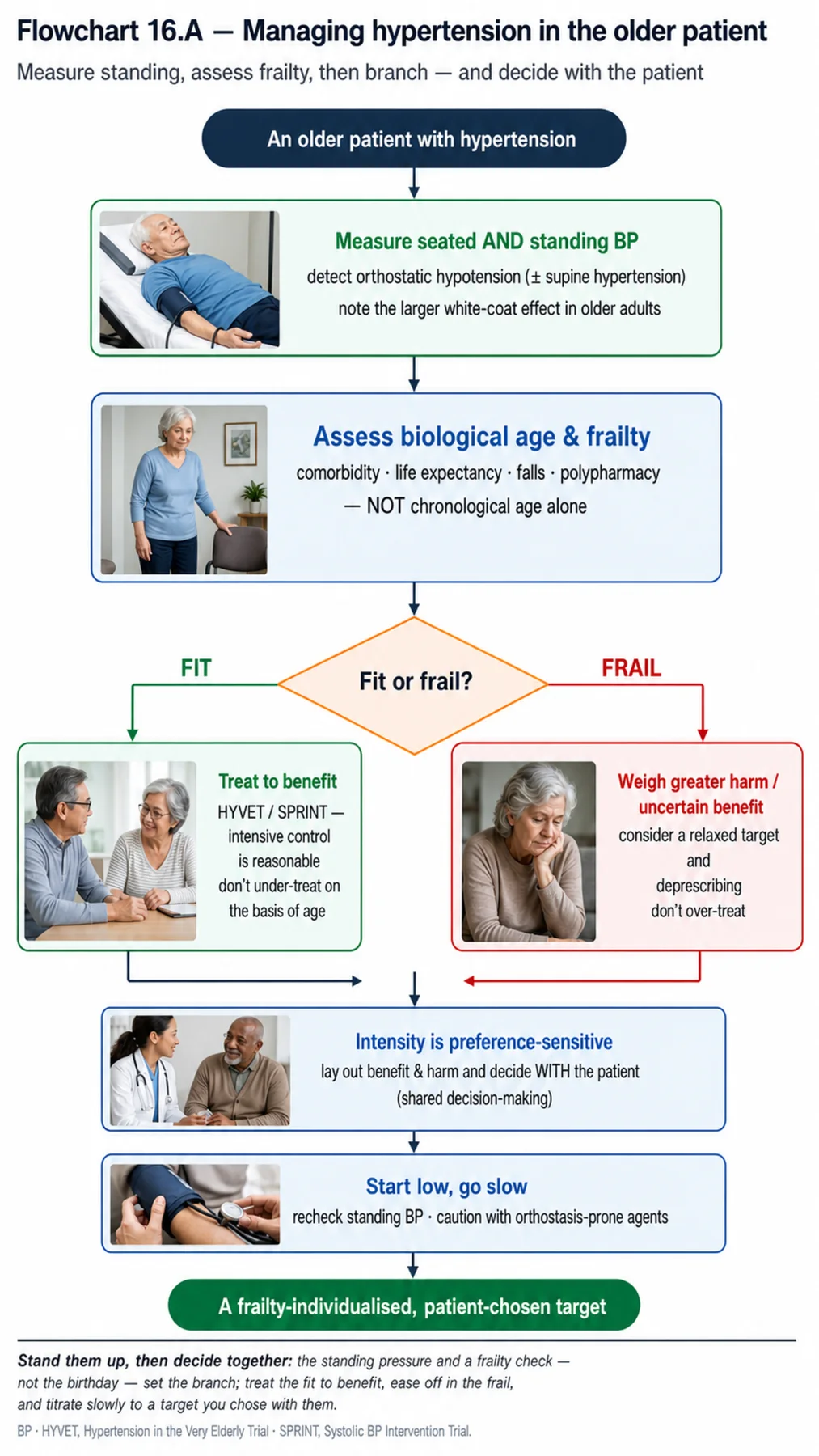
Management is therefore individualised by biological age and frailty — not chronological age alone — along with comorbidity, life expectancy, falls and orthostasis, and polypharmacy.
The intensity of treatment is genuinely preference-sensitive: a fit older patient may benefit from intensive control much as a younger one, while a frail, fall-prone patient with limited life expectancy may be better served by a relaxed target and fewer drugs.
This is a true trade-off between cardiovascular benefit and the harms of falls, orthostasis, burden, and quality of life, which different patients weigh differently.
Shared decision-making is therefore central, and deprescribing — relaxing targets and reducing the drug burden — is an appropriate, evidence-supported option in the frail and the very old.
Practically, treatment is started low and titrated slowly, with attention to standing blood pressure and the avoidance of orthostatic hypotension.
The fit elderly are not under-treated out of misplaced caution, and the frail are not over-treated out of reflex.
Chronological age alone should not decide; the whole person should.
| 03 | PHASE A · LEVEL 3 · ORIENTATION & KNOWLEDGE Main Narrative |
Treating hypertension in older age is where the evidence and the individual most often pull apart. The trials show clear benefit, even past 80 — yet the very frail, fall-prone patient with limited life expectancy may be harmed more than helped by the same treatment. This chapter holds both truths: the elderly benefit from treatment, and the intensity must be individualised, because the trade-off between cardiovascular benefit and the harms of falls, orthostasis, and burden is genuinely preference-sensitive. It is the volume's first chapter where shared decision-making, not a target alone, decides.
— The distinctive physiology
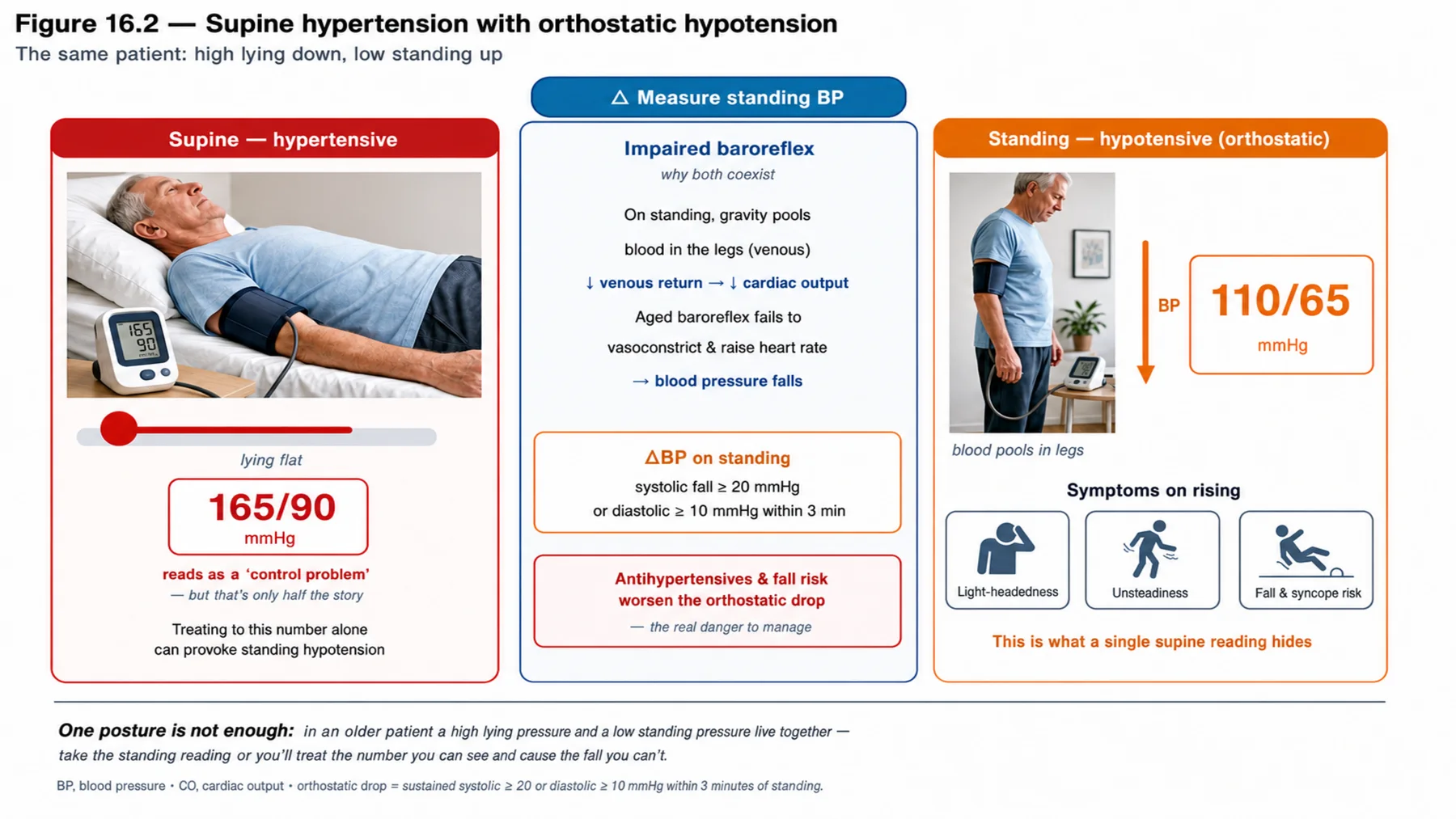
Hypertension in older age has a characteristic physiology. Arterial stiffening (the loss of large-artery compliance with age) raises the systolic pressure while the diastolic falls or plateaus, so isolated systolic hypertension predominates and the pulse pressure widens — and, as the classification chapter stressed, this is a real, treatable cardiovascular risk, not benign ageing. At the same time, the baroreflex that buffers postural changes is impaired, so orthostatic hypotension is common — and, strikingly, can coexist with supine hypertension in the same patient (the autonomic dysfunction cuts both ways), so a patient may be hypertensive lying down and hypotensive standing up. This makes measuring the standing blood pressure essential, not optional, in the older patient, both to detect the orthostatic drop (which falls and antihypertensives can worsen) and to avoid treating a supine reading without knowing what happens on standing. The white-coat effect is also larger in the elderly. The distinctive physiology — isolated systolic hypertension, orthostasis with possible supine hypertension — shapes both the measurement and the treatment.
— The evidence: treatment benefits the elderly
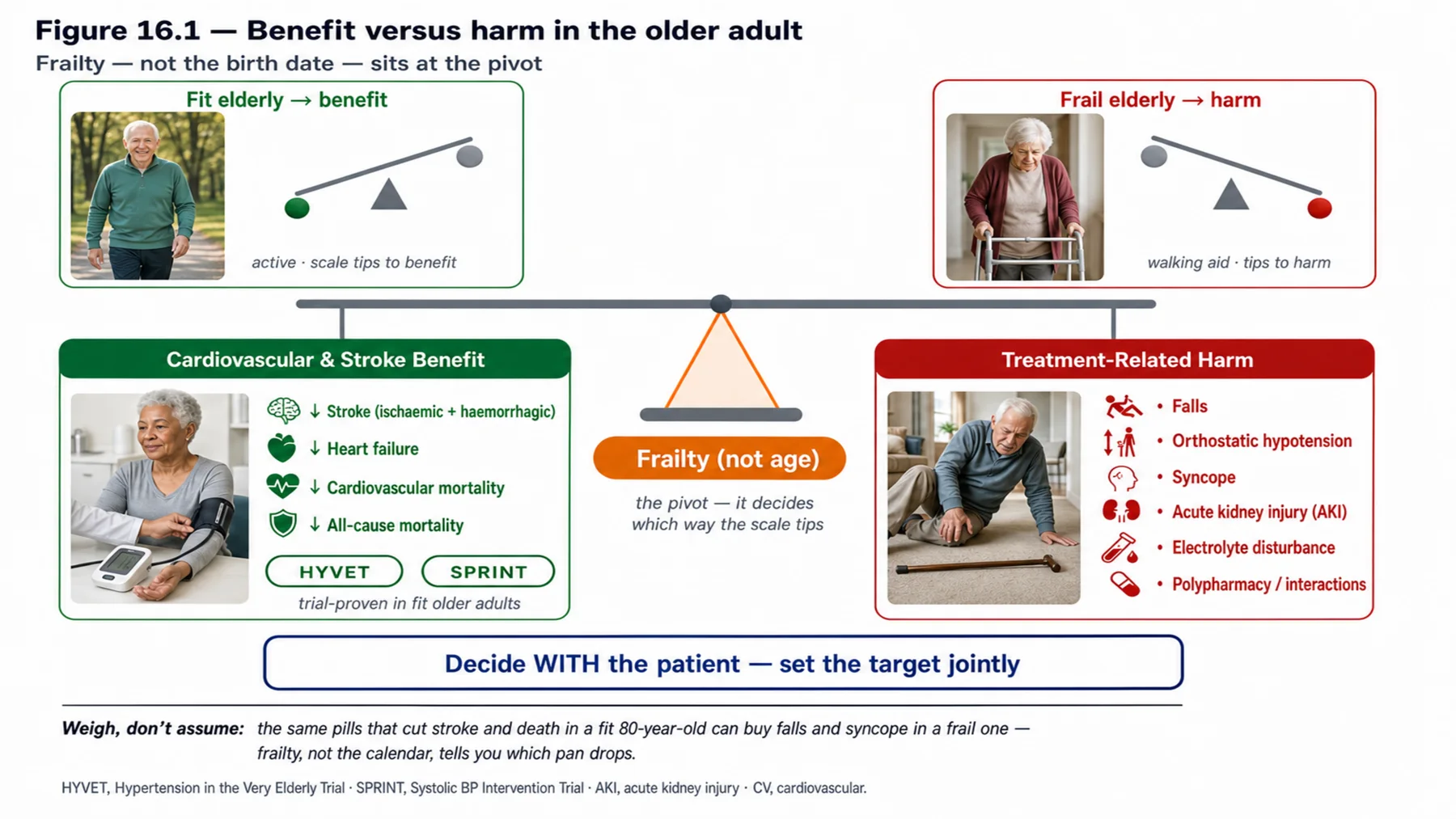
The evidence is clear that treating hypertension benefits older patients, including the very old. HYVET treated patients over 80 to a target of around 150/80 and reduced stroke, heart failure, cardiovascular events, and all-cause mortality — establishing that even the very old benefit from treatment, dispelling an earlier reluctance to treat hypertension past a certain age. The SPRINT elderly subgroup (those 75 and over) went further, showing that intensive control (the standardised below-120 target) reduced cardiovascular events and mortality even in ambulatory older adults, including some with frailty and slow gait speed — so the benefit of treatment, and even of intensive treatment, extends into older age and into some degree of frailty. The clear message from the trials is that age alone is not a reason to withhold treatment, and that the fit older patient should not be under-treated out of misplaced caution. But — and this is the crux — the trials studied a particular population, and the picture changes for the frailest.
— The harms, and who was not studied
Against the benefit must be set the harms, which are greater in the old and especially the frail. Antihypertensive treatment in older patients causes orthostatic hypotension, falls (themselves a major cause of morbidity and mortality in the elderly), syncope, dizziness, acute kidney injury, electrolyte disturbance, and the cumulative burden and interactions of polypharmacy. And crucially, the trials that showed benefit largely enrolled fit, ambulatory, community-dwelling elderly — the very frail, the institutionalised, the cognitively impaired, and those with limited life expectancy were under-represented or excluded. So the benefit demonstrated in the fit elderly cannot simply be assumed in the frail, in whom the cardiovascular benefit is smaller (less time to accrue, competing risks) and the harms (falls, orthostasis) are larger. This asymmetry — robust benefit in the fit elderly, uncertain benefit and greater harm in the frail — is the reason the intensity of treatment cannot be decided by age alone, and is where the individualisation and the preference-sensitivity enter.
— Individualising by frailty, not age
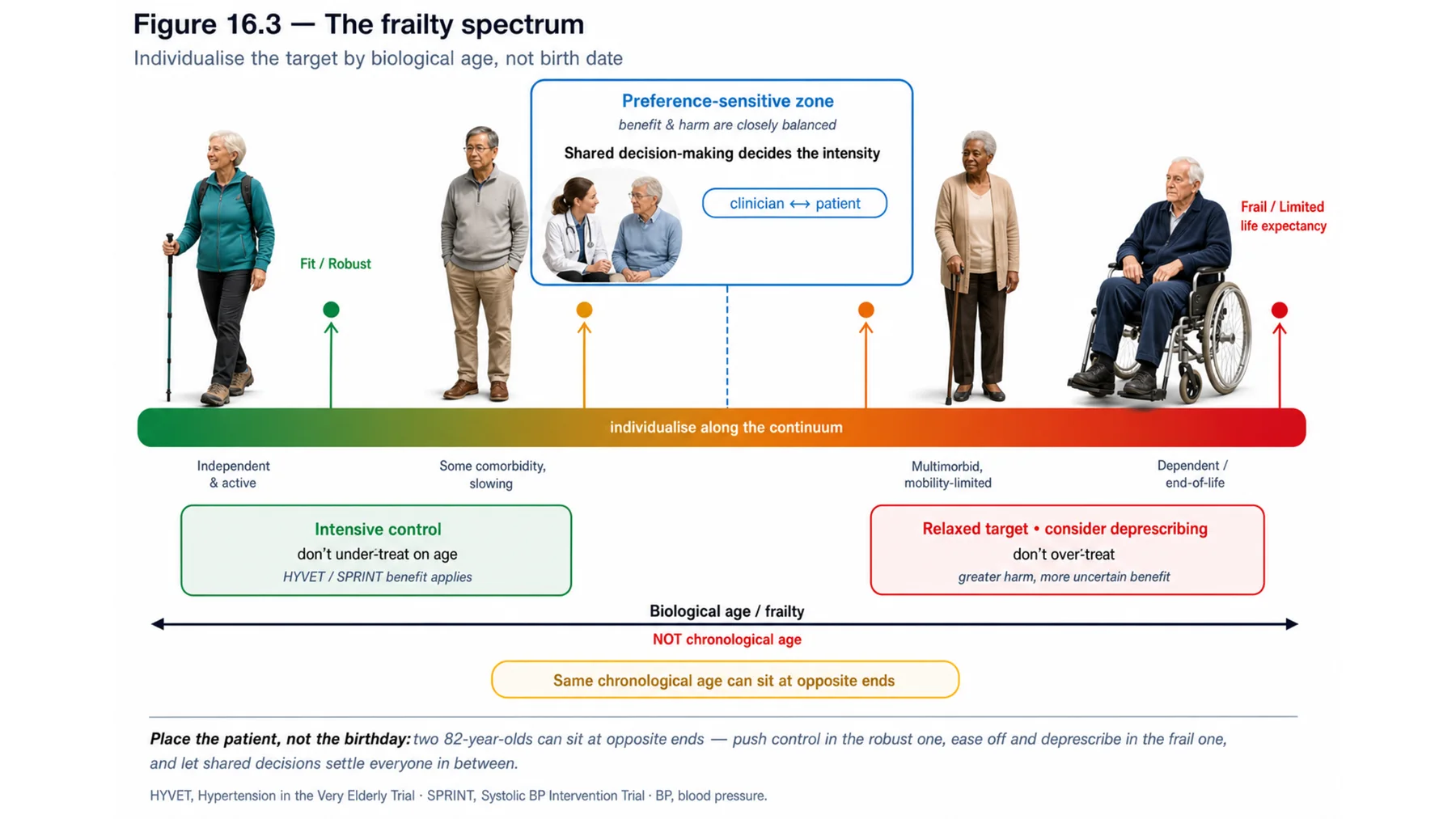
The decisive principle is to individualise treatment by biological age and frailty, not by chronological age. A fit, robust 85-year-old with a long life expectancy resembles, for treatment purposes, a younger patient and may benefit from intensive control; a frail, fall-prone 75-year-old with multiple comorbidities, polypharmacy, and limited life expectancy is a very different patient in whom intensive treatment may do more harm than good. Chronological age is a poor guide; frailty, functional status, comorbidity, life expectancy, falls and orthostasis, and the existing drug burden are the relevant variables. This is why a formal or informal assessment of frailty is part of the hypertension assessment in the elderly, and why two patients of the same age may rightly be treated very differently. The fit elderly should not be under-treated, and the frail should not be over-treated — and telling them apart requires looking past the birth date to the person.
— The preference-sensitive trade-off
Even after assessing frailty, the intensity of treatment in the elderly remains, for many patients, genuinely preference-sensitive — a values-driven trade-off rather than a single right answer. The trade-off is between the cardiovascular and stroke benefit of tighter control and the harms of that control: falls, orthostasis, dizziness, the burden of multiple medications, and the effect on quality of life and independence. Different patients weigh these differently: one older patient, having seen a relative disabled by stroke, may prioritise the cardiovascular benefit and accept a higher pill burden and some dizziness; another may prioritise staying on their feet and independent, fearing a fall more than a future stroke, and prefer a relaxed target and fewer drugs. Neither is wrong — they are weighing genuine, competing harms according to their own values. This is the definition of a preference-sensitive decision, and it means the target and intensity should be set with the patient, not for them. The clinician's role is to lay out the trade-off honestly — the benefit, the harms, the uncertainty in the frail — and to decide together, which is the substance of the shared-decision scripts that follow.
— Deprescribing, and the practical approach
Deprescribing — deliberately relaxing targets and reducing the number or dose of antihypertensives — is the option that follows when the trade-off favours fewer harms, and it deserves to be named as a legitimate, evidence-supported choice rather than a failure. In the frail, the very old with orthostasis or falls, those with limited life expectancy, and those over-treated to a low pressure (especially with orthostatic hypotension), deprescribing can reduce falls and burden without meaningful loss of benefit, and trials of deprescribing in older patients have supported its safety in selected groups. It is a values-driven, shared decision like the target itself. Practically, across the whole elderly spectrum, treatment is started low and titrated slowly (older patients are more sensitive to both the antihypertensive effect and the adverse effects), the standing blood pressure is checked to detect and avoid orthostatic hypotension, and agents prone to causing orthostasis are used cautiously where falls are a concern. The synthesis of the chapter is that the elderly benefit from treating hypertension — so do not withhold it on age alone — but the intensity must be individualised by frailty and decided with the patient, with deprescribing a legitimate option in the frail; chronological age does not decide, the whole person does.
| 04 | PHASE A · LEVEL 4 · ORIENTATION & KNOWLEDGE Reference Tables |
Table 16.1 — Distinctive physiology in older age
| Feature | Detail |
| Isolated systolic hypertension | Arterial stiffening → high systolic, low/normal diastolic, wide pulse pressure |
| Orthostatic hypotension | Baroreflex impairment — common; may coexist with supine hypertension |
| Measurement | Measure STANDING blood pressure; larger white-coat effect |
| Implication | The physiology shapes both measurement and treatment |
Table 16.2 — The evidence: benefit of treatment
| Trial | Finding |
| HYVET (> 80) | Target ~150/80 reduced stroke, heart failure, CV events, and mortality |
| SPRINT elderly (≥ 75) | Intensive (< 120, standardised) reduced CV events/mortality, incl. some frailty |
| Message | Age alone is not a reason to withhold treatment — don't under-treat the fit elderly |
| Caveat | Trials studied fit/ambulatory elderly (see harms) |
Table 16.3 — The harms and the under-studied
| Aspect | Detail |
| Harms | Orthostatic hypotension, falls, syncope, dizziness, AKI, electrolyte, polypharmacy |
| Under-studied | Very frail, institutionalised, cognitively impaired, limited life expectancy |
| The asymmetry | Robust benefit in the fit; uncertain benefit and greater harm in the frail |
| Consequence | Cannot decide intensity by age alone |
Table 16.4 — Individualise by frailty, not age
| Variable | Why it matters |
| Biological age / frailty | The key variable — chronological age is a poor guide |
| Comorbidity / life expectancy | Less benefit (competing risks, less time) when limited |
| Falls / orthostasis | Greater harm from treatment |
| Polypharmacy | Burden and interactions — favour fewer drugs |
Table 16.5 — The practical approach
| Principle | Detail |
| Start low, go slow | Older patients are more sensitive to effect and adverse effect |
| Standing blood pressure | Check to detect and avoid orthostatic hypotension |
| Agent choice | Use orthostasis-prone agents cautiously where falls are a concern |
| Deprescribing | A legitimate, evidence-supported option in the frail — not a failure |
Table 16.6 — The two ends of the spectrum
| Patient | Reasonable approach |
| Fit, robust, long life expectancy | Intensive control much as a younger patient — don't under-treat |
| Frail, fall-prone, limited life expectancy | Relaxed target, fewer drugs, deprescribe — don't over-treat |
| In between | Individualise and decide with the patient |
| The decision | Preference-sensitive — set the target WITH the patient |
| 05 | PHASE B · LEVEL 5 · VISUALISE & MAP Imaging & Flowchart Specifications |
| 08 | PHASE C · LEVEL 8 · CLINICAL REASONING Clinical Cases |
| CASE 1 | DON'T UNDER-TREAT THE FIT Age alone is not a reason to withhold The fit elderly |
Presentation
A fit, independent, cognitively intact 84-year-old with isolated systolic hypertension and a long life expectancy is left untreated by a clinician who feels she is 'too old to bother treating.'
❖ Pause and reflect Is age a good reason to withhold treatment here? |
Analysis
No — age alone is not a reason to withhold treatment, and this fit patient should be treated. HYVET established that treating hypertension even in those over 80 reduces stroke, heart failure, cardiovascular events, and mortality, and the SPRINT elderly subgroup showed benefit from intensive control in ambulatory older adults. This patient — fit, independent, cognitively intact, with a long life expectancy — resembles, for treatment purposes, a younger patient and stands to benefit substantially, including from fairly intensive control. Withholding treatment because of her chronological age is the error of under-treating the fit elderly out of misplaced caution. Her isolated systolic hypertension is a real, treatable risk.
Plan
Treat the hypertension (the isolated systolic elevation is a real risk), aiming for good control as her fitness and life expectancy warrant, starting low and going slow with attention to standing blood pressure. Don't withhold treatment on age alone in the fit elderly.
Teaching point
Age alone is not a reason to withhold treatment — the fit elderly benefit (HYVET, SPRINT); don't under-treat them out of misplaced caution.
Cross-reference
Exercises the evidence content; Figure 16.1; Tables 16.2, 16.6; isolated systolic hypertension in Chapter 3.
| CASE 2 | DON'T OVER-TREAT THE FRAIL Relax and deprescribe The frail elderly |
Presentation
A frail, fall-prone 86-year-old with dementia, multiple comorbidities, limited life expectancy, and six other medications is on three antihypertensives driving the pressure low, with orthostatic hypotension and recent falls.
❖ Pause and reflect Is intensive blood-pressure control serving this patient? |
Analysis
No — this frail patient is being over-treated, and the trade-off favours relaxing and deprescribing. The cardiovascular benefit of intensive control is small here (limited life expectancy, competing risks, and a population the trials under-studied), while the harms are large and manifest — orthostatic hypotension and falls (a major cause of morbidity and mortality), the burden of polypharmacy, and the low pressure itself. This is the asymmetry of the frail: uncertain benefit, clear harm. Deprescribing — relaxing the target and reducing the antihypertensive burden — is an appropriate, evidence-supported choice that can reduce the falls and orthostasis without meaningful loss of benefit, and it should be framed as a legitimate decision, not a failure.
Plan
Relax the blood-pressure target and deprescribe the antihypertensives to reduce the orthostatic hypotension and falls, framing this as an appropriate values-driven choice given the frailty and limited life expectancy; check standing blood pressure. Don't over-treat the frail — deprescribe when the trade-off favours it.
Teaching point
The frail, fall-prone, limited-life-expectancy patient is often over-treated — relax the target and deprescribe; it is a legitimate, evidence-supported choice.
Cross-reference
Exercises the harms/individualisation content; Figure 16.1, 16.3; Tables 16.3, 16.5, 16.6; the preference map (L15).
| CASE 3 | STAND THEM UP Orthostasis and supine hypertension Measuring in the elderly |
Presentation
An older patient has a high seated blood pressure, and a clinician plans to intensify treatment based on that reading alone, without measuring the standing pressure. The patient has been having dizzy spells on standing.
❖ Pause and reflect What essential measurement is missing before intensifying treatment? |
Analysis
The standing blood pressure. In older patients the baroreflex is impaired, so orthostatic hypotension is common — and can coexist with supine (or seated) hypertension in the same patient, who may be hypertensive sitting and hypotensive standing. The dizzy spells on standing strongly suggest an orthostatic drop. Intensifying treatment on the seated reading alone, without knowing the standing pressure, risks worsening the orthostatic hypotension and precipitating falls or syncope. The standing blood pressure must be measured before intensifying: it may reveal that the patient, though hypertensive when seated, drops dangerously on standing, in which case the treatment should be adjusted (not intensified) and orthostasis-prone agents avoided.
Plan
Measure the standing blood pressure before any change; if there is orthostatic hypotension, adjust rather than intensify treatment, avoid orthostasis-prone agents, and start low and go slow. Always measure standing blood pressure in the elderly.
Teaching point
Measure the standing blood pressure in older patients — orthostatic hypotension (which may coexist with supine hypertension) must be detected before intensifying treatment.
Cross-reference
Exercises the physiology content; Figure 16.2; Tables 16.1, 16.5; baroreflex in Chapter 1.
| CASE 4 | DECIDE TOGETHER The preference-sensitive choice Shared decision-making |
Presentation
Two older patients of similar age and moderate frailty face a choice between tighter control (more cardiovascular benefit, more pills and some dizziness) and a relaxed target (fewer drugs, less dizziness, slightly higher cardiovascular risk). A clinician wants to apply a single target to both.
❖ Pause and reflect Should the same target be imposed on both patients? |
Analysis
No — this is a preference-sensitive decision, and the two patients may rightly choose differently. The trade-off is genuine: tighter control buys cardiovascular and stroke benefit at the cost of more medication, dizziness, and fall risk; a relaxed target accepts a slightly higher cardiovascular risk for fewer harms and burden. One patient, fearing stroke (perhaps having seen a relative disabled by one), may prioritise the cardiovascular benefit and accept the harms; the other, fearing a fall and valuing independence, may prefer the relaxed target. Neither is wrong — they weigh competing harms by their own values. The clinician's role is to lay out the benefit, the harms, and the uncertainty honestly and to decide with each patient, not to impose a single target. This is shared decision-making, and it is the right process for a preference-sensitive choice.
Plan
Conduct a shared decision with each patient — presenting the cardiovascular benefit, the harms (pills, dizziness, falls), and the uncertainty — and set the target according to each patient's values, rather than imposing one target on both. Decide the intensity with the patient.
Teaching point
Treatment intensity in the older patient is preference-sensitive — a genuine benefit-versus-harm trade-off; decide it WITH the patient, not for them.
Cross-reference
Exercises the preference content; Figure 16.3; the preference map (L15) and SDM scripts (L16); Table 16.6.
| 10 | PHASE C · LEVEL 10 · CLINICAL REASONING Clinical Pearls |
| Isolated systolic hypertension predominates in older age (arterial stiffening). | Orthostatic hypotension is common (baroreflex impairment). |
| Supine hypertension and orthostatic hypotension can coexist. | Always measure the STANDING blood pressure in the elderly. |
| HYVET: treating those > 80 (target ~150/80) reduced events and mortality. | SPRINT elderly (≥ 75): intensive control benefits ambulatory older adults. |
| Age alone is NOT a reason to withhold treatment — don't under-treat the fit. | Harms: orthostatic hypotension, falls, syncope, AKI, electrolyte, polypharmacy. |
| Trials studied fit/ambulatory elderly — the very frail were under-studied. | Frail patients: less benefit, more harm. |
| Individualise by biological age/frailty, NOT chronological age. | Treatment intensity is PREFERENCE-SENSITIVE (cardiovascular benefit vs falls/burden). |
| Decide the target WITH the patient (shared decision-making). | Deprescribing is a legitimate, evidence-supported option in the frail. |
| Start low, go slow; older patients are more sensitive. | Don't under-treat the fit; don't over-treat the frail. |
| 11 | PHASE D · LEVEL 11 · SAFETY & EVIDENCE Red Flags & Never-Do |
Panel A — Red flags
| ▲ | A fit, independent older patient left untreated 'because of age' — don't under-treat; the fit elderly benefit. |
| ▲ | A frail, fall-prone patient on multiple antihypertensives with orthostatic hypotension — over-treated; relax and deprescribe. |
| ▲ | Intensifying treatment on a seated reading without the standing blood pressure — measure standing first. |
| ▲ | Dizzy spells or falls on antihypertensives — orthostatic hypotension; reassess and consider deprescribing. |
| ▲ | Imposing a single target regardless of the patient's values — the intensity is preference-sensitive; decide together. |
Panel B — Never do
| ✖ NEVER — withhold treatment from a fit older patient on chronological age alone. |
| ✖ NEVER — intensify treatment in the elderly without the standing blood pressure. |
| ✖ NEVER — treat the frail to an intensive target reflexively, ignoring falls and life expectancy. |
| ✖ NEVER — impose a target without sharing the benefit-versus-harm trade-off with the patient. |
| 12 | PHASE D · LEVEL 12 · SAFETY & EVIDENCE Common Pitfalls |
Pitfall 1 — Under-treating the fit
| ✖ | WRONG Withholding treatment from a fit older patient because of age. |
| ✓ | RIGHT Treating to benefit, as the trials support. |
| ✉ | WHY Age alone is not a reason to withhold; the fit elderly benefit. |
Pitfall 2 — Over-treating the frail
| ✖ | WRONG Driving a frail patient's pressure low with multiple drugs. |
| ✓ | RIGHT Relaxing the target and deprescribing. |
| ✉ | WHY In the frail the benefit is uncertain and the harm is large. |
Pitfall 3 — Skipping the standing pressure
| ✖ | WRONG Intensifying treatment on the seated reading alone. |
| ✓ | RIGHT Measuring the standing blood pressure first. |
| ✉ | WHY Orthostatic hypotension (with possible supine hypertension) must be detected. |
Pitfall 4 — Deciding by age
| ✖ | WRONG Setting the target by chronological age. |
| ✓ | RIGHT Individualising by biological age and frailty. |
| ✉ | WHY Chronological age is a poor guide; frailty is the key variable. |
Pitfall 5 — Imposing a target
| ✖ | WRONG Imposing a single target regardless of the patient's values. |
| ✓ | RIGHT Deciding the intensity with the patient. |
| ✉ | WHY The trade-off is genuinely preference-sensitive. |
| 13 | PHASE D · LEVEL 13 · SAFETY & EVIDENCE Evidence Grading |
GRADE A HIGH CONFIDENCE The effect is real and the estimate is stable. RCTs at low risk of bias; multiple concordant prospective cohorts; meta-analyses. |
GRADE B MODERATE CONFIDENCE The effect is likely real but may shift with new data. Observational studies, registries, mechanistic human studies. |
GRADE C LOW CONFIDENCE Rests on physiology, reasoning, or consensus rather than outcomes. Pathophysiological reasoning; extrapolation; consensus without outcomes. |
Graded statements (by evidence type)
| Statement | Grade | Basis (evidence type) |
| Treating hypertension in those over 80 reduces events and mortality. | A | RCT (HYVET) |
| Intensive control benefits ambulatory older adults. | A | RCT (SPRINT elderly subgroup) |
| Antihypertensive treatment increases falls and orthostatic hypotension in the elderly. | A | Clinical data |
| The very frail were under-represented in the benefit trials. | A | Trial-population data |
| Treatment should be individualised by frailty, not chronological age. | A | Guideline consensus |
| Deprescribing is safe and appropriate in selected frail older patients. | B | Trials of deprescribing (e.g. OPTIMISE) |
| Treatment intensity in the elderly is preference-sensitive. | A | Decision science and guideline consensus |
| 14 | PHASE E · LEVEL 14 · PATIENT DECISIONS Absolute Risk in Natural Frequency |
Natural-frequency estimates for orientation, from the elderly-hypertension evidence; they vary with fitness and frailty. They convey the size of the decisions, expressed per 100 comparable patients.
| Per 100 patients… | Outcome | Roughly how many | See |
| Fit elderly treated vs untreated | Avoid a stroke or cardiovascular event | More with treatment | L13 rows 1–2 |
| Frail elderly treated intensively | Suffer falls / orthostatic hypotension | More than the relaxed/deprescribed | L13 row 3 |
| Frail elderly deprescribed (selected) | Maintain control while reducing harm | Most | L13 row 6 |
| Older patients given a shared decision | Receive a target matching their values | More than those given an imposed target | L13 row 7 |
★ How to read these Read these as orientation, not promises; outcomes depend heavily on fitness and frailty. The stable signals: the fit elderly benefit, intensive treatment harms the frail, deprescribing is safe in selected frail patients, and shared decisions better match the patient's values. Communicate them as people out of 100, not as a hazard ratio. |
| 15 | PHASE E · LEVEL 15 · PATIENT DECISIONS Preference-Sensitive Decisions |
The intensity of treatment in the older patient is genuinely preference-sensitive. The table maps the spectrum of reasonable choices to what each prioritises and trades off; none is the single right answer.
| Choice | Prioritises | Trades off / suits |
| Intensive control (e.g. lower target) | Maximum cardiovascular and stroke prevention | More pills, dizziness, fall risk — suits the fit, stroke-averse, long life expectancy |
| Standard control | A balance of benefit and harm | A middle path — suits moderate fitness/frailty |
| Relaxed target | Fewer harms, less burden, independence | A slightly higher cardiovascular risk — suits the frail, fall-averse, limited life expectancy |
| Deprescribing | Reducing falls, orthostasis, and polypharmacy | Accepting a higher pressure — suits the frail, over-treated, or those with orthostatic hypotension |
❖ Using this map Locate the patient on the frailty spectrum, then elicit which harms they most want to avoid (a future stroke, or a fall and lost independence). The right choice is the one that matches the patient's own weighting of these genuine, competing harms — not a single guideline number. |
| 16 | PHASE E · LEVEL 16 · PATIENT DECISIONS Shared Decision-Making |
Scripts for the preference-sensitive conversation about treatment intensity and deprescribing in the older patient. Adapt the wording; the structure is to share the trade-off honestly and decide together.
Script 1 — Choosing the target intensity
Frame the choice. “There's a real choice here about how hard to push your blood pressure down. Tighter control lowers your risk of a stroke a bit more, but it usually means more tablets and a higher chance of dizziness or a fall. A more relaxed target means fewer of those problems, with a small increase in stroke risk. Neither is simply right — it depends on what matters most to you.”
Elicit values. “When you think about it, which worries you more — the thought of a stroke, or the thought of a fall and losing your independence?”
Decide together. “Given what you've told me, it sounds like [a tighter / a more relaxed] target fits you better. We can always revisit it if things change.”
Script 2 — Proposing deprescribing
Normalise it. “You're on several blood-pressure tablets, and your pressure is quite low, with the dizziness and the falls we've talked about. Reducing some of them isn't giving up — in someone in your situation, fewer tablets can mean fewer falls without losing much benefit.”
Address the worry. “I know it can feel risky to stop a medication. We'd do it gradually, check your pressure and how you feel standing up, and adjust as we go.”
Agree the plan. “Shall we try reducing one tablet and see how you do, with a plan to review? You're in control of this, and we can stop or change course any time.”
| 17 | PHASE F · LEVEL 17 · APPLY & TEST Documentation Templates |
Paste-ready notes. Tick the boxes that apply and delete the rest; make the frailty assessment, the standing blood pressure, and the shared decision explicit.
Template 1 — Assessment of the older hypertensive
Template 2 — Shared decision and plan
| 18 | PHASE F · LEVEL 18 · APPLY & TEST Cheat Sheet |
| Isolated systolic hypertension predominates (arterial stiffening). | Orthostatic hypotension common; may coexist with supine hypertension. |
| Always measure STANDING blood pressure. | HYVET (> 80): treatment reduces events/mortality. |
| SPRINT elderly (≥ 75): intensive control benefits the ambulatory. | Age alone is NOT a reason to withhold — don't under-treat the fit. |
| Harms: falls, orthostasis, syncope, AKI, polypharmacy. | Trials under-studied the very frail. |
| Frail: less benefit, more harm. | Individualise by FRAILTY, not chronological age. |
| Intensity is PREFERENCE-SENSITIVE. | Decide the target WITH the patient (SDM). |
| Deprescribing is a legitimate option in the frail. | Start low, go slow. |
| Don't under-treat the fit; don't over-treat the frail. | Chronological age doesn't decide — the whole person does. |
| 19 | PHASE F · LEVEL 19 · APPLY & TEST Flashcards |
| CARD 1 | Q. What is the distinctive physiology of hypertension in older age? A. Isolated systolic hypertension from arterial stiffening (high systolic, low/normal diastolic, wide pulse pressure), and a common orthostatic hypotension from baroreflex impairment that can coexist with supine hypertension. DETAILED. Standing blood pressure must be measured. CLINICAL. Read the physiology and measure standing BP in the elderly. |
| CARD 2 | Q. What does the evidence show about treating hypertension in the elderly? A. It benefits them: HYVET showed treating those over 80 reduces stroke, heart failure, cardiovascular events, and mortality, and the SPRINT elderly subgroup showed intensive control benefits ambulatory older adults. DETAILED. Age alone is not a reason to withhold treatment. CLINICAL. Don't under-treat the fit elderly on age alone. |
| CARD 3 | Q. What are the harms of treatment in older and frail patients? A. Orthostatic hypotension, falls, syncope, dizziness, acute kidney injury, electrolyte disturbance, and the burden of polypharmacy — and the very frail (under-represented in the trials) have less benefit and greater harm. DETAILED. Falls are a major cause of morbidity and mortality. CLINICAL. Weigh the harms, which are greater in the frail. |
| CARD 4 | Q. Why individualise by frailty rather than chronological age? A. Because a fit 85-year-old resembles a younger patient and may benefit from intensive control, while a frail 75-year-old with limited life expectancy may be harmed by it — biological age, frailty, comorbidity, life expectancy, falls, and polypharmacy are the relevant variables. DETAILED. Chronological age is a poor guide. CLINICAL. Individualise by frailty, not birth date. |
| CARD 5 | Q. Why is treatment intensity in the elderly preference-sensitive? A. Because it is a genuine trade-off between the cardiovascular and stroke benefit of tighter control and the harms (falls, orthostasis, burden, quality of life), which different patients weigh differently — there is no single right answer. DETAILED. One patient fears stroke, another fears falls. CLINICAL. Decide the intensity with the patient. |
| CARD 6 | Q. What is deprescribing, and when is it appropriate? A. Deliberately relaxing the target and reducing the number or dose of antihypertensives — an appropriate, evidence-supported choice in the frail, the very old with orthostasis or falls, those with limited life expectancy, and the over-treated, where it reduces harm without meaningful loss of benefit. DETAILED. It is a legitimate decision, not a failure. CLINICAL. Consider deprescribing when the trade-off favours fewer harms. |
| CARD 7 | Q. How should the standing blood pressure inform management? A. It detects orthostatic hypotension (which may coexist with seated/supine hypertension), so it must be measured before intensifying treatment — intensifying on a seated reading alone risks worsening the orthostatic drop and causing falls or syncope. DETAILED. Dizziness on standing is a clue. CLINICAL. Measure standing BP before intensifying treatment in the elderly. |
| CARD 8 | Q. What is the overall approach to hypertension in older age? A. Treat the fit elderly to benefit (don't under-treat on age), individualise by frailty (don't over-treat the frail), decide the intensity with the patient as a preference-sensitive trade-off, consider deprescribing in the frail, and start low and go slow with standing-BP monitoring. DETAILED. Chronological age does not decide; the whole person does. CLINICAL. Individualise by frailty and decide with the patient. |
| 20 | PHASE F · LEVEL 20 · APPLY & TEST One-Minute Preceptor |
| SCENE 1 | The intern who won't treat the fit elderly |
GET A COMMITMENT. “You're not treating this fit, independent 84-year-old's hypertension — why?”
PROBE FOR EVIDENCE. “She's too old to bother” — ask: “What did HYVET show about treating hypertension in those over 80?”
TEACH A GENERAL RULE. Age alone is not a reason to withhold treatment — the fit elderly benefit (HYVET, SPRINT); don't under-treat them out of misplaced caution.
REINFORCE WHAT WAS RIGHT. Considering her age and fitness was reasonable.
CORRECT A MISTAKE. Treat her hypertension to benefit, starting low and checking standing BP.
| SCENE 2 | The resident over-treating the frail |
GET A COMMITMENT. “This frail, fall-prone patient with dementia is on three antihypertensives and a low pressure — is that right?”
PROBE FOR EVIDENCE. “Her blood pressure is well controlled” — ask: “What is the benefit of that control given her frailty and life expectancy, and what are the falls costing her?”
TEACH A GENERAL RULE. In the frail the cardiovascular benefit is uncertain and the harms (falls, orthostasis) are large — relaxing the target and deprescribing is an appropriate, evidence-supported choice.
REINFORCE WHAT WAS RIGHT. Achieving control was well-intentioned.
CORRECT A MISTAKE. Relax the target and deprescribe to reduce the falls.
| 21 | PHASE F · LEVEL 21 · APPLY & TEST Reflective Prompts |
Genuine tensions this evidence and these values leave open; sit with them rather than resolving them too quickly.
The trials show the elderly benefit, yet they studied the fit and excluded the frailest — the very patients in front of us most often. How do you apply evidence to people the evidence did not study?
A future stroke and a fall tomorrow are both real harms, but they fall differently across time and on different parts of a life. How do you help a patient weigh a distant catastrophe against an imminent one?
Deprescribing asks the clinician to do less, which can feel like neglect when the culture rewards doing more. How do you make 'fewer tablets' feel like good care rather than giving up?
Chronological age is a crude and unfair basis for decisions, yet frailty is hard to measure and easy to assume. How do you avoid both ageism and a false precision about who is 'frail'?
Shared decision-making assumes a patient who can weigh trade-offs — but many older patients have cognitive impairment or defer entirely to the doctor. How do you share a decision that the patient cannot fully share?
| 22 | PHASE F · LEVEL 22 · APPLY & TEST Board-Style Questions |
| Q 01 | Which blood-pressure pattern predominates in older age? |
| A | Isolated diastolic hypertension |
| B | Isolated systolic hypertension (arterial stiffening) |
| C | Normal blood pressure |
| D | Hypotension |
Rationale Arterial stiffening produces isolated systolic hypertension with a wide pulse pressure (Table 16.1). A, C, and D are incorrect. |
| Q 02 | What did HYVET show? |
| A | Treating those over 80 is harmful |
| B | Treating those over 80 reduces stroke, heart failure, events, and mortality |
| C | Age over 80 should not be treated |
| D | Only diastolic matters |
Rationale HYVET established benefit of treatment in those over 80 (case 1, Table 16.2). A, C, and D are wrong. |
| Q 03 | Why must the standing blood pressure be measured in the elderly? |
| A | It is never necessary |
| B | Orthostatic hypotension is common and may coexist with supine hypertension |
| C | Only seated readings matter |
| D | Standing readings are always higher |
Rationale Baroreflex impairment causes orthostatic hypotension that must be detected (case 3, Figure 16.2, Table 16.1). A, C, and D are incorrect. |
| Q 04 | Management of hypertension in the elderly should be individualised by: |
| A | Chronological age alone |
| B | Biological age and frailty (with comorbidity, life expectancy, falls, polypharmacy) |
| C | Blood pressure alone |
| D | Sex |
Rationale Frailty, not chronological age, is the key variable (Table 16.4, Figure 16.3). A, C, and D are inadequate. |
| Q 05 | Why is treatment intensity in the elderly preference-sensitive? |
| A | There is one correct target |
| B | It is a genuine trade-off between cardiovascular benefit and harms (falls/burden) that patients weigh differently |
| C | Patients have no preferences |
| D | Only the doctor decides |
Rationale The benefit-versus-harm trade-off is values-driven, so the target is decided with the patient (case 4, Figure 16.1, L15). A, C, and D are wrong. |
| Q 06 | In a frail, fall-prone patient with limited life expectancy on multiple antihypertensives and orthostatic hypotension, an appropriate option is: |
| A | Intensify control further |
| B | Relax the target and deprescribe |
| C | Add a fourth drug |
| D | Ignore the falls |
Rationale The trade-off favours relaxing and deprescribing — a legitimate, evidence-supported choice (case 2, Table 16.6, L15). A, C, and D worsen harm. |
| Q 07 | The benefit trials in the elderly largely studied: |
| A | The very frail and institutionalised |
| B | Fit, ambulatory, community-dwelling older adults |
| C | Only those under 70 |
| D | Patients with dementia |
Rationale The trials enrolled fit, ambulatory elderly, so the frail are under-represented (Table 16.3). A, C, and D are incorrect. |
| Q 08 | Deprescribing antihypertensives in selected frail older patients is: |
| A | Always negligent |
| B | A legitimate, evidence-supported option that can reduce harm |
| C | Never appropriate |
| D | Only for those under 65 |
Rationale Deprescribing is appropriate and supported in selected frail patients (Table 16.5, L13 row 6). A, C, and D are wrong. |