Chapter Preamble
Signals declared
Sig-D — Diagnostic (primary). Classify hypertension in pregnancy and diagnose pre-eclampsia (which no longer requires proteinuria).
Sig-T — Therapeutic (strong). Use the safe antihypertensives, avoid the contraindicated ones, give magnesium for eclampsia, deliver for cure, and prevent with aspirin.
Sig-M — Mechanistic (strong). The normal pregnancy blood-pressure fall and the two-stage pathophysiology of pre-eclampsia.
Levels populated and omitted
Populated (19): L1–L14, L17–L20, L22. The mechanistic signal fires the concept maps (L6) and triads (L9); the therapeutic signal fires the absolute-risk table (L14) and templates (L17); the diagnostic signal drives the tables, rules, cases, pitfalls, and board items.
L15 / L16 preference-sensitive map and SDM scripts — omitted. No Sig-E; the management of hypertension in pregnancy is protocol-driven, time-critical care.
L21 reflective prompts — omitted. No Sig-E/V; the chapter's tensions (treating two patients at once) are worked through the cases and pitfalls.
| 01 | PHASE A · LEVEL 1 · ORIENTATION & KNOWLEDGE Learning Objectives |
By the end of this chapter you should be able to:
Describe the normal blood-pressure changes of pregnancy.
Classify hypertension in pregnancy into its four categories.
Diagnose pre-eclampsia, recognising that proteinuria is no longer required.
Explain the two-stage pathophysiology of pre-eclampsia.
Choose safe antihypertensives and avoid the contraindicated ones.
Manage pre-eclampsia and eclampsia, including the role of magnesium and delivery.
Use low-dose aspirin to prevent pre-eclampsia in high-risk women.
Recognise the long-term cardiovascular and renal risk after pre-eclampsia.
| 02 | PHASE A · LEVEL 2 · ORIENTATION & KNOWLEDGE Executive Summary |
In normal pregnancy the blood pressure falls in the first and second trimesters (from systemic vasodilation) and rises toward term.
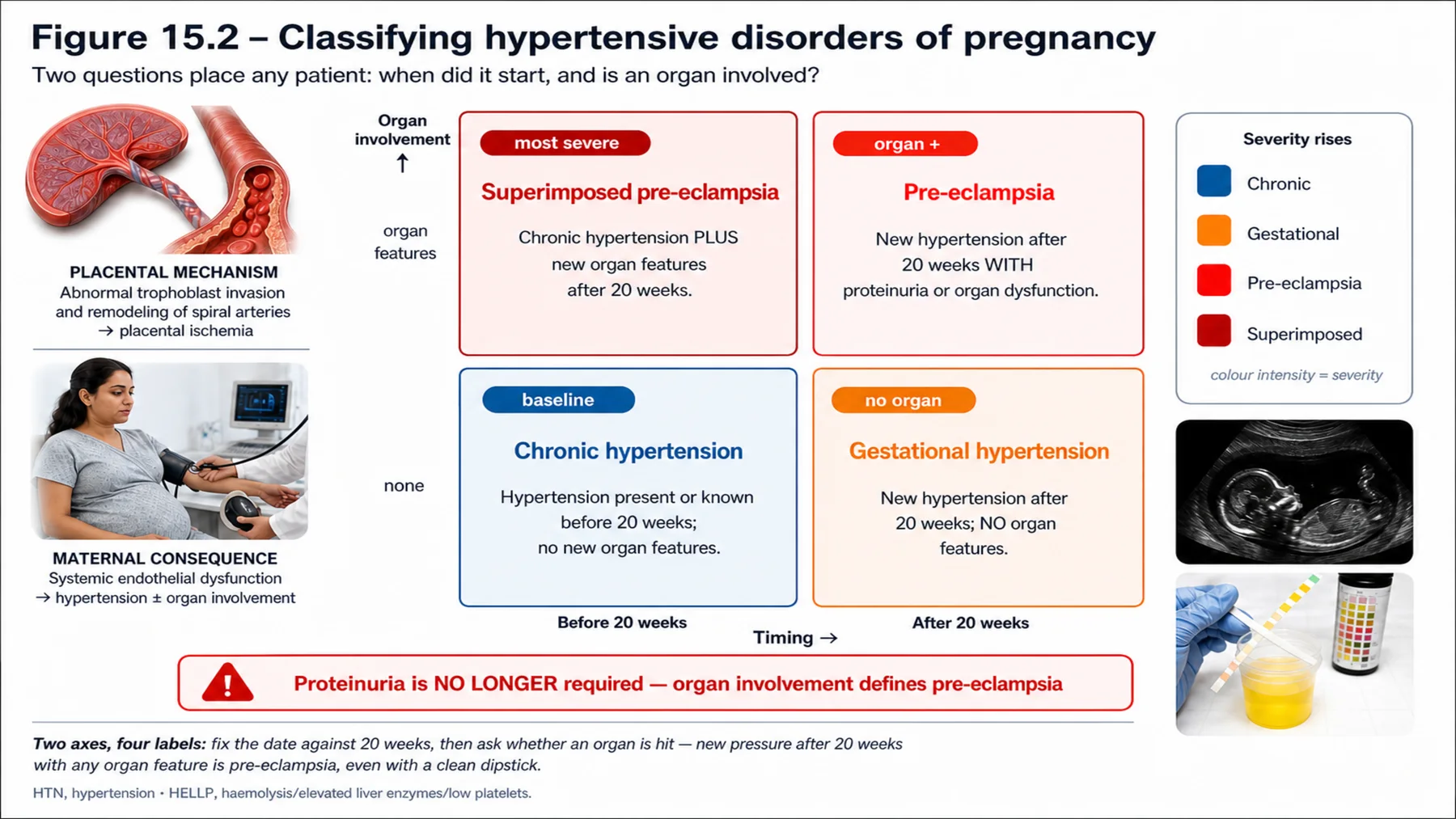
Hypertension in pregnancy has four categories: chronic hypertension (before 20 weeks or pre-existing), gestational hypertension (new after 20 weeks without organ features), pre-eclampsia, and chronic hypertension with superimposed pre-eclampsia.
Pre-eclampsia is new hypertension after 20 weeks with either proteinuria or end-organ dysfunction — and proteinuria is no longer required, so it can be diagnosed on organ features such as thrombocytopenia, renal or hepatic involvement, pulmonary oedema, or cerebral or visual symptoms.
Eclampsia is the occurrence of seizures, and HELLP is the syndrome of haemolysis, elevated liver enzymes, and low platelets.
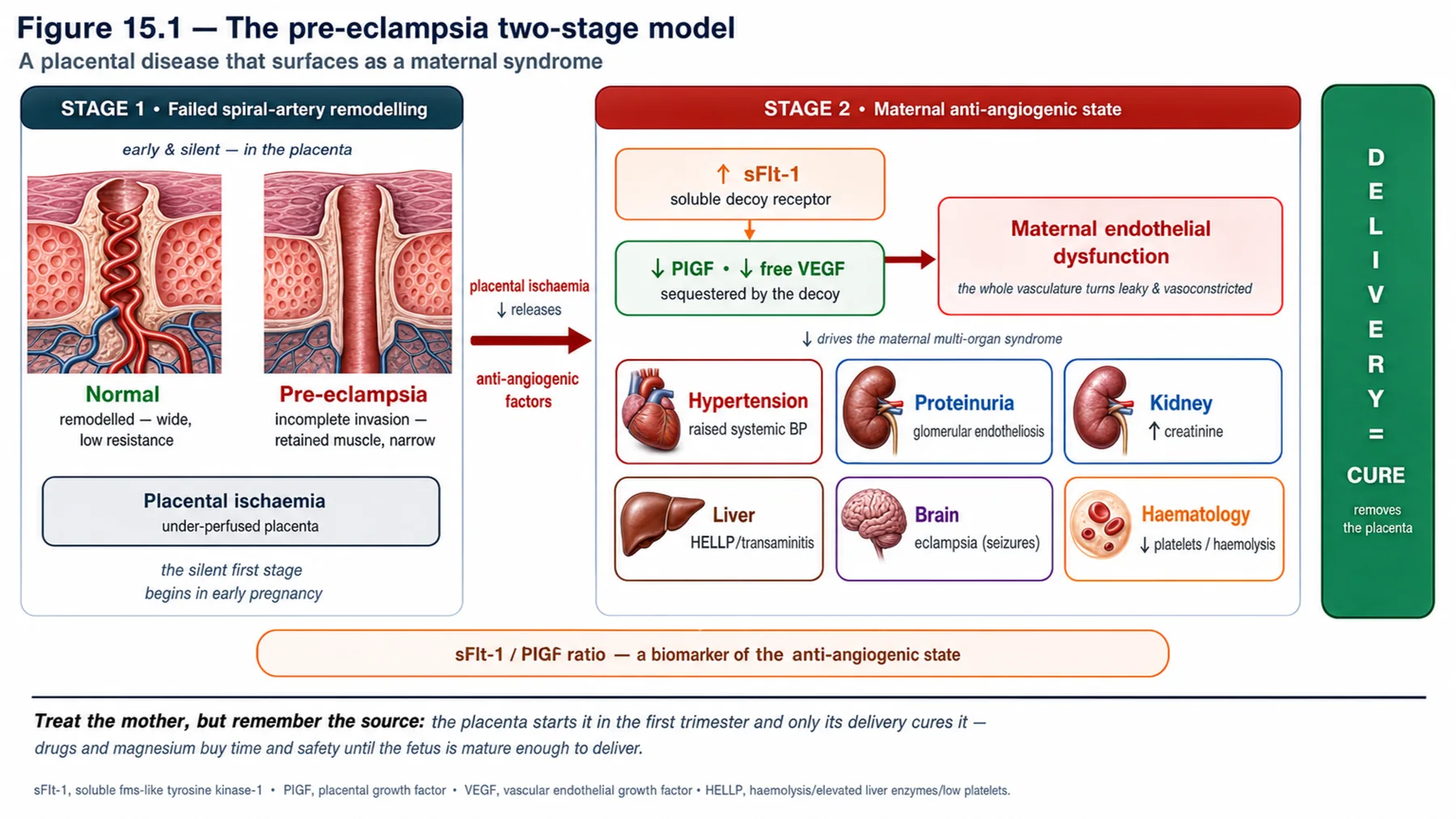
Pre-eclampsia arises in two stages: abnormal placentation with poor spiral-artery remodelling causes placental ischaemia, which releases anti-angiogenic factors (a high sFlt-1 and low PlGF) that cause maternal endothelial dysfunction — the hypertension, proteinuria, and multi-organ involvement.
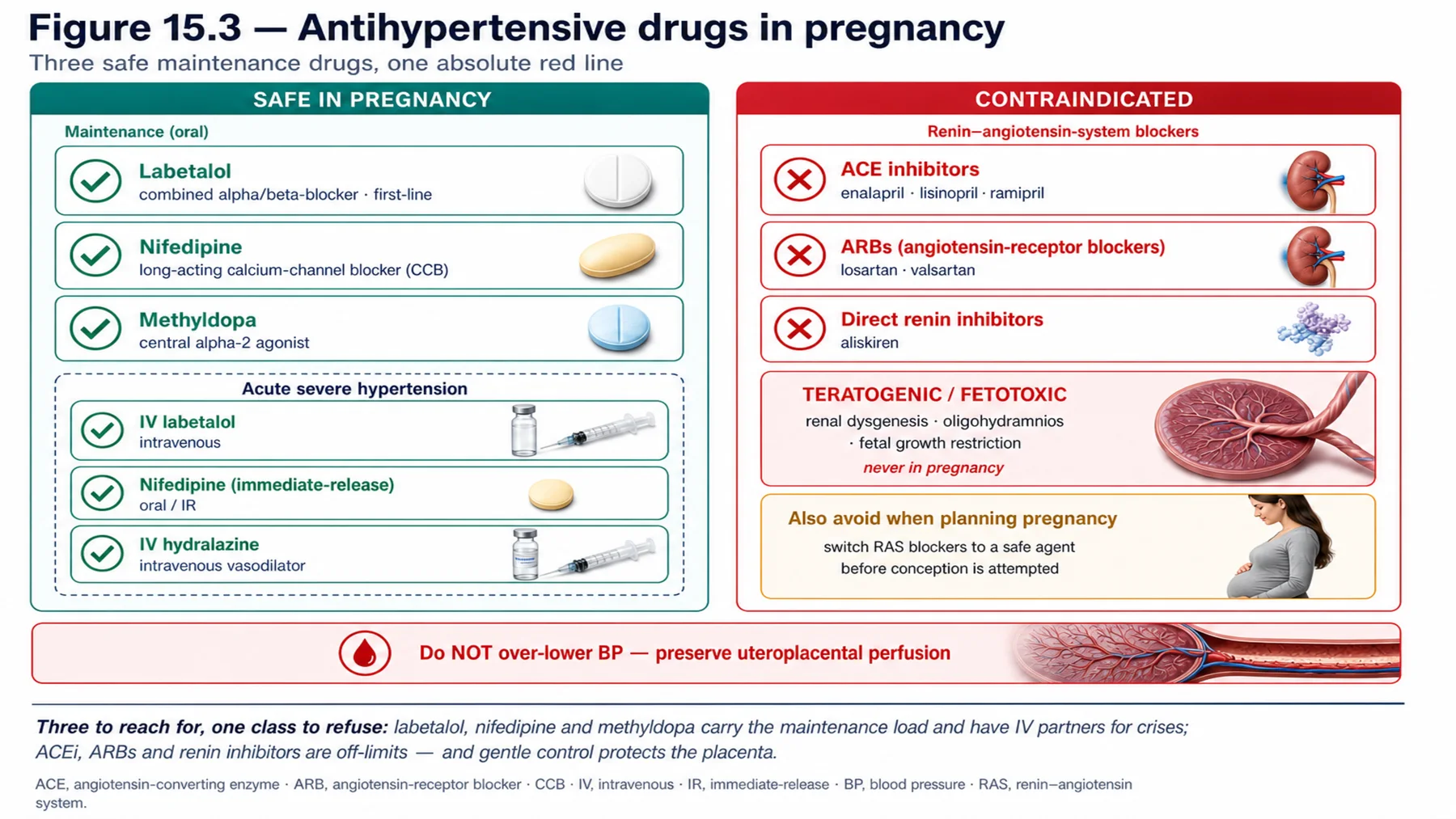
Safe antihypertensives in pregnancy are labetalol, nifedipine, and methyldopa, with intravenous labetalol, nifedipine, or hydralazine for acute severe hypertension.
ACE inhibitors, ARBs, and direct renin inhibitors are contraindicated — they are teratogenic and fetotoxic — and are also avoided in women planning pregnancy.
Blood pressure is controlled but not over-lowered, to preserve uteroplacental perfusion.
The only cure for pre-eclampsia is delivery, timed to balance the maternal and fetal risks.
Magnesium sulphate is given for severe features and eclampsia — it both treats and prevents seizures and is superior to other anticonvulsants.
Low-dose aspirin from early in the second trimester reduces pre-eclampsia in high-risk women.
Pre-eclampsia is a marker of substantially increased lifetime cardiovascular and renal risk, warranting long-term follow-up.
Throughout, two patients are being treated at once — mother and fetus — and their interests must be balanced.
The reset osmostat and other normal pregnancy adaptations must not be mistaken for disease.
| 03 | PHASE A · LEVEL 3 · ORIENTATION & KNOWLEDGE Main Narrative |
Hypertension in pregnancy is distinctive in every dimension: the normal physiology shifts the baseline, pre-eclampsia is a disease found nowhere else, the safe and unsafe drugs differ from the rest of medicine, and the clinician treats two patients at once. This chapter sets out the classification, the two-stage pathophysiology of pre-eclampsia, the drugs that are safe and those that are forbidden, the central roles of magnesium and delivery, and the long shadow pre-eclampsia casts over a woman's later cardiovascular and renal health.
— The normal pregnancy baseline and the classification
Normal pregnancy lowers the blood pressure: systemic vasodilation reduces vascular resistance, so the pressure falls through the first and second trimesters to a mid-pregnancy nadir before rising toward term, on a background of plasma-volume expansion, an increased GFR, and an activated-but-balanced RAAS (with the reset osmostat of the electrolyte volume). Against this baseline, hypertension in pregnancy falls into four categories. Chronic hypertension is pre-existing or present before 20 weeks (and persists postpartum). Gestational hypertension is new hypertension after 20 weeks without proteinuria or organ features (and resolves postpartum), though a meaningful fraction progresses to pre-eclampsia. Pre-eclampsia is new hypertension after 20 weeks with end-organ involvement (detailed below). And chronic hypertension with superimposed pre-eclampsia is the development of pre-eclampsia features on a background of chronic hypertension. Classifying the hypertension correctly — by timing (before or after 20 weeks) and by the presence of organ involvement — is the first step, because it determines the monitoring and management.
— Diagnosing pre-eclampsia: proteinuria no longer required
Pre-eclampsia deserves careful definition because the criteria have changed. It is new hypertension after 20 weeks of gestation accompanied by either proteinuria or, crucially, end-organ dysfunction — and the key modern point is that proteinuria is no longer required: pre-eclampsia can be diagnosed on the basis of organ involvement even when proteinuria is absent. The qualifying organ features include thrombocytopenia, renal insufficiency (a rising creatinine), hepatic involvement (elevated transaminases), pulmonary oedema, and cerebral or visual symptoms (headache, visual disturbance) — any of which, with new hypertension after 20 weeks, makes the diagnosis. Severe features (very high blood pressure, severe thrombocytopenia, marked organ dysfunction, cerebral or visual symptoms) define severe pre-eclampsia. HELLP syndrome — haemolysis, elevated liver enzymes, and low platelets — is a severe variant, and eclampsia is the occurrence of seizures. The practical danger of the old, proteinuria-centred definition was missing pre-eclampsia in the woman with new hypertension and organ dysfunction but no proteinuria; the modern criteria correct this. Diagnose pre-eclampsia on hypertension plus organ involvement, with or without proteinuria.
— The two-stage pathophysiology
Pre-eclampsia is best understood through its two-stage model, which links the placenta to the maternal disease. In stage one, the placenta is abnormally formed: the trophoblast fails to remodel the maternal spiral arteries adequately, so the placenta is under-perfused and becomes ischaemic. In stage two, the ischaemic placenta releases anti-angiogenic factors into the maternal circulation — chiefly a soluble receptor (soluble fms-like tyrosine kinase-1, sFlt-1) that mops up pro-angiogenic factors, and reduced placental growth factor (PlGF) — and this anti-angiogenic imbalance causes widespread maternal endothelial dysfunction, which produces the hypertension, the proteinuria, and the multi-organ involvement. So pre-eclampsia is fundamentally a placental disease with systemic maternal consequences mediated by an anti-angiogenic state. This model explains the clinical features (a generalised endothelial disease, not just high blood pressure), explains why delivery (removing the placenta) is the cure, and has yielded a biomarker — the sFlt-1/PlGF ratio — useful in prediction and in ruling out pre-eclampsia in the short term. The placental origin is the key to understanding the whole syndrome.
— Safe and contraindicated drugs
Drug selection in pregnancy differs sharply from the rest of hypertension management, and getting it right is essential. The safe antihypertensives are labetalol, nifedipine (extended-release), and methyldopa for ongoing control, with intravenous labetalol, nifedipine, or hydralazine for acute severe hypertension. The contraindicated drugs are the RAAS blockers — ACE inhibitors, ARBs, and direct renin inhibitors — which are teratogenic and fetotoxic (causing renal dysgenesis, oligohydramnios, and fetal demise) and must be avoided not only during pregnancy but in women planning pregnancy (the teratogenicity met in the pharmacotherapy chapter). A further principle distinct to pregnancy is not to over-lower the blood pressure: the uteroplacental circulation depends on maternal perfusion, so excessive lowering can compromise the fetus — the aim is to control the hypertension (treating the severe range urgently) without driving the pressure too low. The combination — use labetalol, nifedipine, or methyldopa; never an ACE inhibitor or ARB; and do not over-lower — is the safe-prescribing core of the chapter.
— Magnesium, delivery, and prevention
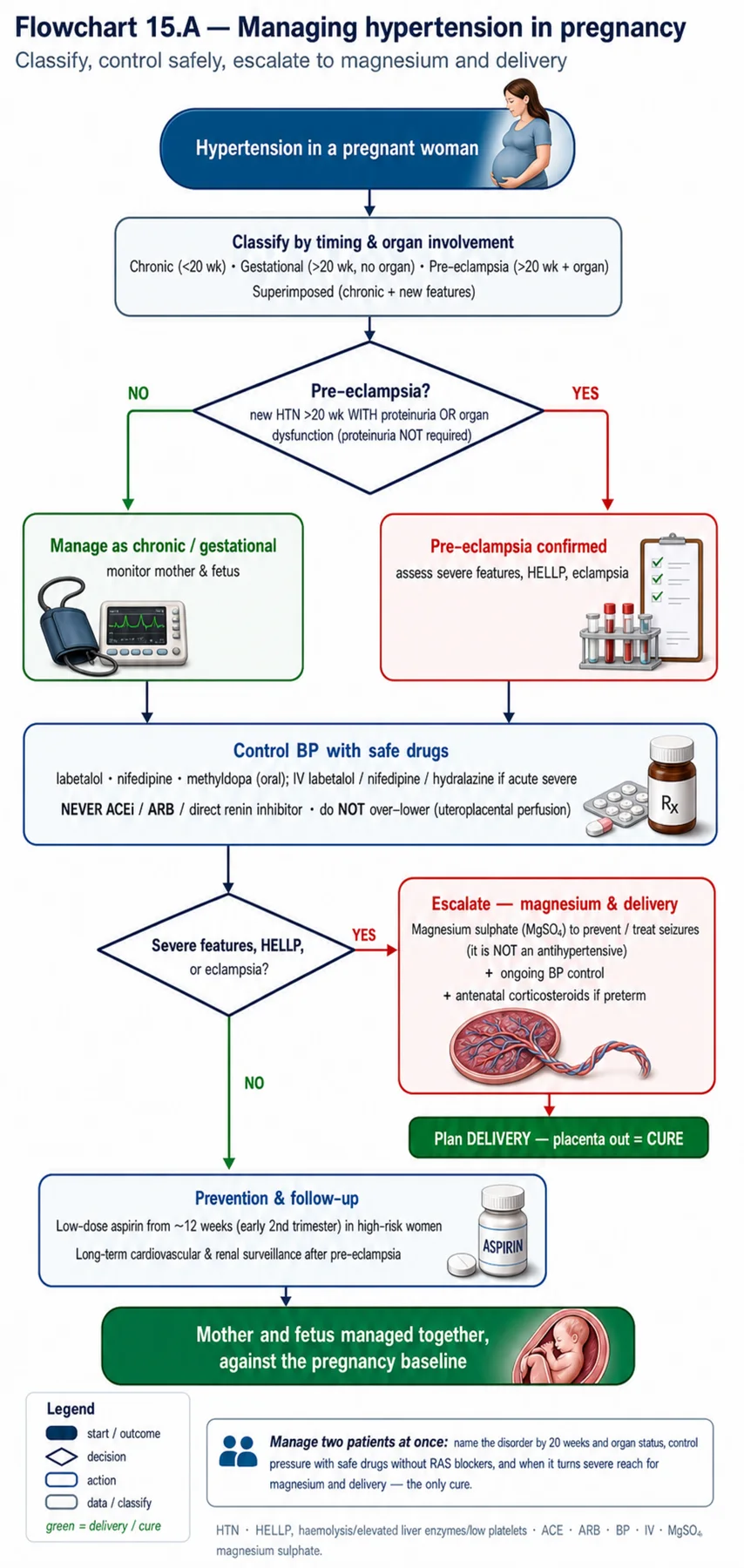
Three interventions are central to pre-eclampsia and eclampsia. First, the only cure for pre-eclampsia is delivery — removing the placenta removes the source of the disease — with the timing balancing the maternal risk (worsening pre-eclampsia) against the fetal risk (prematurity), often supported by antenatal corticosteroids for fetal lung maturity if preterm delivery is needed. Second, magnesium sulphate is the agent for severe features and eclampsia: it both prevents seizures (in severe pre-eclampsia) and treats them (in eclampsia), and is superior to other anticonvulsants for this purpose — so a woman with severe pre-eclampsia or eclampsia receives magnesium alongside blood-pressure control and delivery. Third, prevention: low-dose aspirin started early in the second trimester (before about 16 weeks) in high-risk women reduces the incidence of pre-eclampsia, and calcium supplementation helps in low-calcium populations. So the management of severe pre-eclampsia and eclampsia rests on three pillars — control the blood pressure (safe drugs), give magnesium (for seizures), and deliver (the cure) — with aspirin as the preventive measure beforehand.
— The long shadow, and treating two patients
Two final themes complete the chapter. The first is the long-term significance: pre-eclampsia is not merely an event of pregnancy but a marker of substantially increased lifetime cardiovascular and renal risk — a kind of failed cardiovascular 'stress test' that unmasks a predisposition — so women who have had pre-eclampsia warrant long-term cardiovascular and renal follow-up and risk-factor management, a point often neglected once the pregnancy ends. The second is the overarching principle that runs through the whole chapter: the clinician is treating two patients at once, the mother and the fetus, whose interests must be balanced — controlling the maternal blood pressure without compromising uteroplacental perfusion, timing delivery to balance maternal and fetal risk, and choosing drugs safe for both. And the normal adaptations of pregnancy (the blood-pressure fall, the reset osmostat, the increased GFR) must not be mistaken for disease, just as the abnormal must not be missed. Hypertension in pregnancy is, in sum, a distinct field — its own physiology, its own disease in pre-eclampsia, its own pharmacology, and its own long-term implications — requiring the clinician to read the pregnant patient against the pregnancy baseline and to hold mother and fetus in mind together.
| 04 | PHASE A · LEVEL 4 · ORIENTATION & KNOWLEDGE Reference Tables |
Table 15.1 — Normal pregnancy blood-pressure physiology
| Aspect | Detail |
| Blood pressure | Falls in 1st–2nd trimester (vasodilation, ↓ SVR); rises toward term |
| Volume / GFR | Plasma volume expanded; GFR increased |
| RAAS / osmostat | RAAS activated but balanced; osmostat reset (lower normal sodium) |
| Key point | Read against the pregnancy baseline — don't treat normal adaptations as disease |
Table 15.2 — Classification of hypertension in pregnancy
| Category | Definition |
| Chronic hypertension | Pre-existing or before 20 weeks; persists postpartum |
| Gestational hypertension | New after 20 weeks; no proteinuria/organ features; resolves postpartum |
| Pre-eclampsia | New HTN after 20 weeks + proteinuria OR end-organ dysfunction |
| Superimposed pre-eclampsia | Pre-eclampsia features on a background of chronic hypertension |
Table 15.3 — Pre-eclampsia: pathophysiology and features
| Aspect | Detail |
| Stage 1 | Abnormal placentation (poor spiral-artery remodelling) → placental ischaemia |
| Stage 2 | Anti-angiogenic factors (↑ sFlt-1, ↓ PlGF) → maternal endothelial dysfunction |
| Diagnosis | New HTN > 20 weeks + proteinuria OR organ features (proteinuria NOT required) |
| Organ features / variants | Thrombocytopenia, ↑ creatinine, ↑ transaminases, pulmonary oedema, cerebral/visual; HELLP; eclampsia (seizures) |
Table 15.4 — Safe and contraindicated drugs
| Category | Agents |
| Safe (maintenance) | Labetalol, nifedipine (extended-release), methyldopa |
| Safe (acute severe) | IV labetalol, nifedipine, or hydralazine |
| CONTRAINDICATED | ACE inhibitors, ARBs, direct renin inhibitors (teratogenic/fetotoxic) |
| Principle | Do NOT over-lower — preserve uteroplacental perfusion |
Table 15.5 — Pre-eclampsia / eclampsia management
| Element | Detail |
| Cure | Delivery (remove the placenta) — timed to balance maternal/fetal risk |
| Magnesium sulphate | Prevents (severe pre-eclampsia) and treats (eclampsia) seizures — superior to alternatives |
| Blood pressure | Control with safe drugs; treat the severe range urgently |
| Supportive | Antenatal corticosteroids for fetal lung maturity if preterm |
Table 15.6 — Prevention and long-term risk
| Aspect | Detail |
| Prevention | Low-dose aspirin from early 2nd trimester (< ~16 weeks) in high-risk women |
| Also | Calcium supplementation in low-calcium populations |
| Long-term | Pre-eclampsia → increased lifetime cardiovascular and renal risk |
| Action | Long-term cardiovascular/renal follow-up and risk-factor management |
| 05 | PHASE B · LEVEL 5 · VISUALISE & MAP Imaging & Flowchart Specifications |
| 06 | PHASE B · LEVEL 6 · VISUALISE & MAP Concept Maps |
Each chain runs from mechanism to a named bedside action; read the arrows as “leads to.”
Normal pregnancy. Systemic vasodilation → blood pressure falls (1st–2nd trimester) → rises toward term; reset osmostat → ACTION: read against the pregnancy baseline and don't treat normal adaptations as disease.
Pre-eclampsia two-stage. Abnormal placentation → placental ischaemia → anti-angiogenic factors (↑ sFlt-1, ↓ PlGF) → maternal endothelial dysfunction → hypertension + organ involvement → ACTION: recognise the placental origin — delivery is the cure.
Classification. Timing (before/after 20 weeks) + organ involvement → chronic / gestational / pre-eclampsia / superimposed → ACTION: classify to guide monitoring; diagnose pre-eclampsia on organ features (proteinuria not required).
Safe vs unsafe drugs. Labetalol/nifedipine/methyldopa safe; ACE inhibitors/ARBs teratogenic → ACTION: use the safe drugs, never RAAS blockers, and do not over-lower (uteroplacental perfusion).
Magnesium / delivery. Severe pre-eclampsia/eclampsia → magnesium sulphate (prevent/treat seizures) + BP control + delivery (the cure) → ACTION: give magnesium and plan delivery for severe disease.
| 07 | PHASE B · LEVEL 7 · VISUALISE & MAP Decision Pathways |
| R1 | IF assessing a pregnant woman's blood pressure, THEN read it against the pregnancy baseline (which falls in the first and second trimesters) and classify by timing and organ involvement. |
| R2 | IF new hypertension occurs after 20 weeks with proteinuria OR end-organ dysfunction, THEN diagnose pre-eclampsia — proteinuria is not required. |
| R3 | IF managing hypertension in pregnancy, THEN use labetalol, nifedipine, or methyldopa — and never an ACE inhibitor, ARB, or direct renin inhibitor. |
| R4 | IF treating the blood pressure in pregnancy, THEN control it without over-lowering, to preserve uteroplacental perfusion. |
| R5 | IF there are severe features or eclampsia, THEN give magnesium sulphate to prevent or treat seizures, alongside blood-pressure control. |
| R6 | IF pre-eclampsia is established, THEN plan delivery — the only cure — timing it to balance the maternal and fetal risks. |
| R7 | IF a woman is at high risk of pre-eclampsia, THEN start low-dose aspirin early in the second trimester. |
| R8 | IF a woman has had pre-eclampsia, THEN arrange long-term cardiovascular and renal follow-up — it marks increased lifetime risk. |
| 08 | PHASE C · LEVEL 8 · CLINICAL REASONING Clinical Cases |
| CASE 1 | NO PROTEIN, STILL PRE-ECLAMPSIA Diagnose on organ features Pre-eclampsia diagnosis |
Presentation
A woman at 32 weeks develops new hypertension with thrombocytopenia and a rising creatinine, but no proteinuria. A clinician hesitates to diagnose pre-eclampsia 'because there's no proteinuria.'
❖ Pause and reflect Can pre-eclampsia be diagnosed without proteinuria? |
Analysis
Yes — proteinuria is no longer required to diagnose pre-eclampsia. Under the modern criteria, new hypertension after 20 weeks with end-organ dysfunction makes the diagnosis even without proteinuria, and this woman has two qualifying organ features — thrombocytopenia and a rising creatinine — with new hypertension at 32 weeks. The old proteinuria-centred definition risked exactly this error: missing pre-eclampsia in a woman with new hypertension and organ involvement but no proteinuria. The qualifying features include thrombocytopenia, renal insufficiency, hepatic involvement, pulmonary oedema, and cerebral or visual symptoms — any one suffices. This is pre-eclampsia, and it should be managed as such.
Plan
Diagnose pre-eclampsia on the basis of the new hypertension plus the organ features (thrombocytopenia, rising creatinine), despite the absence of proteinuria, and manage accordingly. Diagnose pre-eclampsia on organ involvement, not proteinuria alone.
Teaching point
Pre-eclampsia is diagnosed by new hypertension after 20 weeks plus organ dysfunction — proteinuria is no longer required.
Cross-reference
Exercises rule R2; the classification concept map; Figure 15.2; Tables 15.2, 15.3.
| CASE 2 | STOP THE ACE INHIBITOR Safe and unsafe drugs Drug choice in pregnancy |
Presentation
A woman with chronic hypertension on an ACE inhibitor becomes pregnant, and a clinician is unsure whether to continue it and what to use instead.
❖ Pause and reflect Should the ACE inhibitor be continued, and what is safe? |
Analysis
No — the ACE inhibitor must be stopped, because it is contraindicated in pregnancy. ACE inhibitors, ARBs, and direct renin inhibitors are teratogenic and fetotoxic (causing renal dysgenesis, oligohydramnios, and fetal demise) and must be avoided in pregnancy — indeed in women planning pregnancy. The safe antihypertensives for ongoing control are labetalol, nifedipine (extended-release), and methyldopa, so the ACE inhibitor should be switched to one of these. A further principle is not to over-lower the blood pressure, to preserve uteroplacental perfusion. Ideally this switch would have been made before conception; once pregnant, it must be done promptly.
Plan
Stop the ACE inhibitor immediately and switch to a safe agent (labetalol, nifedipine, or methyldopa), controlling the blood pressure without over-lowering; counsel about pre-pregnancy drug review in future. Never use ACE inhibitors or ARBs in pregnancy.
Teaching point
ACE inhibitors and ARBs are contraindicated in pregnancy (teratogenic) — use labetalol, nifedipine, or methyldopa, and don't over-lower.
Cross-reference
Exercises rules R3 and R4; the safe-vs-unsafe concept map; Figure 15.3; Table 15.4; teratogenicity in Chapter 6.
| CASE 3 | SEIZING Magnesium and delivery Eclampsia |
Presentation
A woman at 36 weeks with severe pre-eclampsia has a generalised seizure. A clinician reaches for a standard anticonvulsant.
❖ Pause and reflect What is the correct anticonvulsant, and what else is needed? |
Analysis
This is eclampsia, and the correct agent is magnesium sulphate — not a standard anticonvulsant. Magnesium sulphate both treats and prevents eclamptic seizures and is superior to other anticonvulsants for this specific purpose, so it is the drug of choice. Beyond the magnesium, the woman needs blood-pressure control with a safe agent and — critically — delivery, which is the only cure for the underlying pre-eclampsia (removing the placenta removes the source); at 36 weeks, delivery is appropriate. So eclampsia is managed on three fronts: magnesium for the seizures, control of the blood pressure, and delivery. Reaching for a standard anticonvulsant instead of magnesium is the error.
Plan
Give magnesium sulphate to treat and prevent further seizures, control the blood pressure with a safe agent, and proceed to delivery (the cure); manage in a monitored setting. Use magnesium for eclampsia, and deliver.
Teaching point
Eclamptic seizures are treated and prevented with magnesium sulphate (superior to other anticonvulsants), alongside blood-pressure control and delivery.
Cross-reference
Exercises rules R5 and R6; the magnesium/delivery concept map; Table 15.5; eclampsia in Chapter 13 and magnesium in Vol 7.
| CASE 4 | AFTER THE PREGNANCY Prevention and the long shadow Aspirin and long-term risk |
Presentation
A woman with a previous pregnancy complicated by pre-eclampsia is planning another pregnancy, and after delivery her clinicians considered the pre-eclampsia a closed chapter with no further implications.
❖ Pause and reflect What preventive and long-term steps does her history warrant? |
Analysis
Two things were missed. For the next pregnancy, her prior pre-eclampsia makes her high-risk, so she should receive low-dose aspirin started early in the second trimester (before about 16 weeks), which reduces the recurrence of pre-eclampsia. And for her own long-term health, pre-eclampsia is not a closed chapter: it is a marker of substantially increased lifetime cardiovascular and renal risk — a kind of failed cardiovascular stress test — so she warrants long-term cardiovascular and renal follow-up and risk-factor management, which is too often neglected once the pregnancy ends. Both the preventive (aspirin) and the long-term (follow-up) implications of her history should be acted on.
Plan
Prescribe low-dose aspirin from early in the next pregnancy (high-risk by her history) and arrange long-term cardiovascular and renal follow-up and risk-factor management, recognising pre-eclampsia as a lifelong risk marker. Act on both the preventive and the long-term implications.
Teaching point
Prior pre-eclampsia warrants low-dose aspirin in the next pregnancy and long-term cardiovascular/renal follow-up — it is a lifelong risk marker, not a closed chapter.
Cross-reference
Exercises rules R7 and R8; Table 15.6.
| 09 | PHASE C · LEVEL 9 · CLINICAL REASONING Clinical Implications |
One triad per mechanism the narrative exposed: the physiology, why it matters, and the bedside move.
MECHANISM Normal pregnancy lowers the blood pressure in the first and second trimesters. |
WHY IT MATTERS The pregnancy baseline differs from the standard adult one. |
ACTION Read the pregnant patient against the pregnancy baseline. |
MECHANISM Pre-eclampsia begins with abnormal placentation and an anti-angiogenic maternal state. |
WHY IT MATTERS It is a placental disease with systemic maternal endothelial dysfunction. |
ACTION Recognise the placental origin — delivery removes the source and cures it. |
MECHANISM Pre-eclampsia causes end-organ dysfunction with or without proteinuria. |
WHY IT MATTERS The proteinuria-centred definition missed cases with organ involvement alone. |
ACTION Diagnose pre-eclampsia on hypertension plus organ features, proteinuria or not. |
MECHANISM ACE inhibitors and ARBs are teratogenic and fetotoxic. |
WHY IT MATTERS They cause renal dysgenesis, oligohydramnios, and fetal demise. |
ACTION Use labetalol, nifedipine, or methyldopa — never a RAAS blocker — and avoid over-lowering. |
MECHANISM Pre-eclampsia unmasks a cardiovascular and renal predisposition. |
WHY IT MATTERS It is a marker of increased lifetime cardiovascular and renal risk. |
ACTION Arrange long-term follow-up after pre-eclampsia, and aspirin for prevention. |
| 10 | PHASE C · LEVEL 10 · CLINICAL REASONING Clinical Pearls |
| Normal pregnancy: BP falls in 1st–2nd trimester (vasodilation), rises toward term. | Read against the pregnancy baseline — don't treat normal adaptations as disease. |
| Chronic HTN: pre-existing / before 20 weeks. | Gestational HTN: new after 20 weeks, no organ features. |
| Pre-eclampsia: new HTN > 20 weeks + proteinuria OR organ dysfunction. | PROTEINURIA NO LONGER REQUIRED for pre-eclampsia. |
| Organ features: thrombocytopenia, ↑creatinine, ↑transaminases, pulmonary oedema, cerebral/visual. | HELLP (haemolysis, ↑ liver enzymes, low platelets); eclampsia = seizures. |
| Two-stage: abnormal placentation → ischaemia → anti-angiogenic (↑sFlt-1, ↓PlGF) → endothelial dysfunction. | Safe drugs: labetalol, nifedipine, methyldopa; IV labetalol/nifedipine/hydralazine (acute). |
| CONTRAINDICATED: ACE inhibitors, ARBs, direct renin inhibitors (teratogenic). | Don't over-lower (preserve uteroplacental perfusion). |
| Delivery is the only CURE for pre-eclampsia. | Magnesium sulphate prevents/treats eclamptic seizures (superior to alternatives). |
| Low-dose aspirin from early 2nd trimester prevents pre-eclampsia in high-risk women. | Pre-eclampsia → increased lifetime cardiovascular and renal risk (follow up). |
| 11 | PHASE D · LEVEL 11 · SAFETY & EVIDENCE Red Flags & Never-Do |
Panel A — Red flags
| ▲ | New hypertension after 20 weeks with organ dysfunction but no proteinuria — still pre-eclampsia. |
| ▲ | A pregnant woman on an ACE inhibitor or ARB — teratogenic; stop and switch to a safe agent. |
| ▲ | A seizure in severe pre-eclampsia — eclampsia; give magnesium sulphate, not a standard anticonvulsant. |
| ▲ | Severe-range blood pressure in pregnancy — treat urgently with a safe IV agent (labetalol, nifedipine, hydralazine). |
| ▲ | A history of pre-eclampsia — high-risk for the next pregnancy (aspirin) and increased lifetime cardiovascular/renal risk. |
Panel B — Never do
| ✖ NEVER — use an ACE inhibitor, ARB, or direct renin inhibitor in pregnancy. |
| ✖ NEVER — require proteinuria to diagnose pre-eclampsia. |
| ✖ NEVER — treat eclamptic seizures with a standard anticonvulsant instead of magnesium. |
| ✖ NEVER — over-lower the blood pressure and compromise uteroplacental perfusion. |
| 12 | PHASE D · LEVEL 12 · SAFETY & EVIDENCE Common Pitfalls |
Pitfall 1 — Requiring proteinuria
| ✖ | WRONG Withholding the diagnosis of pre-eclampsia because there is no proteinuria. |
| ✓ | RIGHT Diagnosing it on new hypertension plus organ dysfunction. |
| ✉ | WHY Proteinuria is no longer required. |
Pitfall 2 — RAAS blocker in pregnancy
| ✖ | WRONG Continuing an ACE inhibitor or ARB in a pregnant woman. |
| ✓ | RIGHT Switching to labetalol, nifedipine, or methyldopa. |
| ✉ | WHY RAAS blockers are teratogenic and fetotoxic. |
Pitfall 3 — Wrong anticonvulsant
| ✖ | WRONG Treating eclamptic seizures with a standard anticonvulsant. |
| ✓ | RIGHT Using magnesium sulphate. |
| ✉ | WHY Magnesium is superior for eclamptic seizures. |
Pitfall 4 — Over-lowering
| ✖ | WRONG Driving the blood pressure too low in pregnancy. |
| ✓ | RIGHT Controlling it without over-lowering. |
| ✉ | WHY The uteroplacental circulation depends on maternal perfusion. |
Pitfall 5 — Closing the chapter
| ✖ | WRONG Treating pre-eclampsia as a closed chapter after delivery. |
| ✓ | RIGHT Arranging aspirin for future pregnancies and long-term follow-up. |
| ✉ | WHY Pre-eclampsia marks increased lifetime cardiovascular and renal risk. |
| 13 | PHASE D · LEVEL 13 · SAFETY & EVIDENCE Evidence Grading |
GRADE A HIGH CONFIDENCE The effect is real and the estimate is stable. RCTs at low risk of bias; multiple concordant prospective cohorts; meta-analyses. |
GRADE B MODERATE CONFIDENCE The effect is likely real but may shift with new data. Observational studies, registries, mechanistic human studies. |
GRADE C LOW CONFIDENCE Rests on physiology, reasoning, or consensus rather than outcomes. Pathophysiological reasoning; extrapolation; consensus without outcomes. |
Graded statements (by evidence type)
| Statement | Grade | Basis (evidence type) |
| Pre-eclampsia can be diagnosed without proteinuria (on organ features). | A | Guideline consensus |
| Pre-eclampsia arises from abnormal placentation and an anti-angiogenic state. | A | Mechanistic and clinical data |
| ACE inhibitors and ARBs are teratogenic and contraindicated in pregnancy. | A | Clinical data |
| Magnesium sulphate prevents and treats eclamptic seizures. | A | RCTs (Magpie and others) |
| Delivery is the definitive treatment of pre-eclampsia. | A | Established clinical data |
| Low-dose aspirin reduces pre-eclampsia in high-risk women. | A | RCTs (ASPRE and others) |
| Pre-eclampsia increases lifetime cardiovascular and renal risk. | A | Cohort data |
| 14 | PHASE E · LEVEL 14 · PATIENT DECISIONS Absolute Risk in Natural Frequency |
Natural-frequency estimates for orientation, from the pregnancy-hypertension evidence; they vary with the population. They convey the size of the decisions, expressed per 100 comparable patients.
| Per 100 patients… | Outcome | Roughly how many | See |
| High-risk women given vs not given aspirin | Develop pre-eclampsia | Fewer with aspirin | L13 row 6 |
| Severe pre-eclampsia given vs not given magnesium | Have an eclamptic seizure | Fewer with magnesium | L13 row 4 |
| Women with prior pre-eclampsia | Have higher lifetime cardiovascular/renal risk | More than those without — hence follow-up | L13 row 7 |
| Pregnancies on an ACE inhibitor/ARB | Suffer fetal harm | More — hence the contraindication | L13 row 3 |
★ How to read these Read these as orientation, not promises; outcomes vary with the population. The stable signals: aspirin prevents pre-eclampsia in high-risk women, magnesium prevents eclamptic seizures, prior pre-eclampsia raises lifetime risk, and RAAS blockers harm the fetus. Communicate them as people out of 100, not as a hazard ratio. |
| 17 | PHASE F · LEVEL 17 · APPLY & TEST Documentation Templates |
Paste-ready notes. Tick the boxes that apply and delete the rest; make the classification, the safe drugs, and the magnesium/delivery plan explicit.
Template 1 — Classification and drug selection
Template 2 — Severe pre-eclampsia / eclampsia & follow-up
| 18 | PHASE F · LEVEL 18 · APPLY & TEST Cheat Sheet |
| Normal pregnancy: BP falls 1st–2nd trimester, rises toward term. | Read against the pregnancy baseline. |
| Chronic: before 20 weeks. Gestational: after 20 weeks, no organ features. | Pre-eclampsia: new HTN > 20 weeks + proteinuria OR organ dysfunction. |
| PROTEINURIA NOT REQUIRED. | Organ features: low platelets, ↑Cr, ↑transaminases, pulmonary oedema, cerebral/visual. |
| HELLP; eclampsia = seizures. | Two-stage: placental ischaemia → ↑sFlt-1/↓PlGF → endothelial dysfunction. |
| Safe: labetalol, nifedipine, methyldopa (IV labetalol/nifedipine/hydralazine acute). | CONTRAINDICATED: ACE inhibitors, ARBs, direct renin inhibitors. |
| Don't over-lower (uteroplacental perfusion). | Delivery = the only CURE. |
| Magnesium sulphate: prevents/treats eclamptic seizures. | Aspirin from early 2nd trimester (high-risk) prevents pre-eclampsia. |
| Pre-eclampsia → lifetime CV/renal risk (follow up). | Treating two patients — mother and fetus. |
| 19 | PHASE F · LEVEL 19 · APPLY & TEST Flashcards |
| CARD 1 | Q. What happens to blood pressure in normal pregnancy? A. It falls through the first and second trimesters (from systemic vasodilation and reduced vascular resistance) to a mid-pregnancy nadir, then rises toward term, on a background of plasma-volume expansion, increased GFR, and a reset osmostat. DETAILED. The pregnancy baseline differs from the standard adult one. CLINICAL. Read the pregnant patient against the pregnancy baseline. |
| CARD 2 | Q. What are the four categories of hypertension in pregnancy? A. Chronic hypertension (pre-existing or before 20 weeks), gestational hypertension (new after 20 weeks without organ features), pre-eclampsia (new hypertension after 20 weeks with organ involvement), and chronic hypertension with superimposed pre-eclampsia. DETAILED. Classify by timing and organ involvement. CLINICAL. Classify to guide monitoring and management. |
| CARD 3 | Q. How is pre-eclampsia diagnosed, and is proteinuria required? A. By new hypertension after 20 weeks with either proteinuria or end-organ dysfunction (thrombocytopenia, renal or hepatic involvement, pulmonary oedema, cerebral or visual symptoms) — and proteinuria is no longer required, so organ features alone suffice. DETAILED. The old proteinuria-centred definition missed cases. CLINICAL. Diagnose on hypertension plus organ features, with or without proteinuria. |
| CARD 4 | Q. What is the two-stage pathophysiology of pre-eclampsia? A. Stage one is abnormal placentation (poor spiral-artery remodelling causing placental ischaemia); stage two is the release of anti-angiogenic factors (high sFlt-1, low PlGF) causing maternal endothelial dysfunction — the hypertension, proteinuria, and multi-organ involvement. DETAILED. It is a placental disease with systemic maternal effects. CLINICAL. Recognise the placental origin — delivery cures it. |
| CARD 5 | Q. Which antihypertensives are safe and which are contraindicated in pregnancy? A. Safe: labetalol, nifedipine, and methyldopa (with intravenous labetalol, nifedipine, or hydralazine for acute severe hypertension). Contraindicated: ACE inhibitors, ARBs, and direct renin inhibitors — teratogenic and fetotoxic. DETAILED. Avoid RAAS blockers even when planning pregnancy. CLINICAL. Use labetalol/nifedipine/methyldopa; never a RAAS blocker; don't over-lower. |
| CARD 6 | Q. What are the central treatments for pre-eclampsia and eclampsia? A. Delivery is the only cure (removing the placenta); magnesium sulphate prevents seizures in severe pre-eclampsia and treats them in eclampsia (superior to other anticonvulsants); and the blood pressure is controlled with safe agents, with corticosteroids for fetal lung maturity if preterm. DETAILED. Three pillars: control, magnesium, deliver. CLINICAL. Give magnesium for severe disease and plan delivery. |
| CARD 7 | Q. How is pre-eclampsia prevented in high-risk women? A. With low-dose aspirin started early in the second trimester (before about 16 weeks), which reduces the incidence of pre-eclampsia; calcium supplementation helps in low-calcium populations. DETAILED. A prior pre-eclampsia makes a woman high-risk. CLINICAL. Prescribe low-dose aspirin from early in pregnancy in high-risk women. |
| CARD 8 | Q. What is the long-term significance of pre-eclampsia? A. It is a marker of substantially increased lifetime cardiovascular and renal risk — a kind of failed cardiovascular stress test — so women who have had pre-eclampsia warrant long-term cardiovascular and renal follow-up and risk-factor management. DETAILED. It is not a closed chapter after delivery. CLINICAL. Arrange long-term follow-up after pre-eclampsia. |
| 20 | PHASE F · LEVEL 20 · APPLY & TEST One-Minute Preceptor |
| SCENE 1 | The intern requiring proteinuria |
GET A COMMITMENT. “You won't call this pre-eclampsia because there's no proteinuria, despite new hypertension, low platelets, and a rising creatinine — why?”
PROBE FOR EVIDENCE. “Pre-eclampsia needs proteinuria” — ask: “Do the current criteria still require proteinuria, or do organ features suffice?”
TEACH A GENERAL RULE. Proteinuria is no longer required — new hypertension after 20 weeks with end-organ dysfunction (thrombocytopenia, renal, hepatic, pulmonary, cerebral/visual) makes the diagnosis.
REINFORCE WHAT WAS RIGHT. Recognising the abnormalities was correct.
CORRECT A MISTAKE. Diagnose pre-eclampsia on the organ features and manage it.
| SCENE 2 | The resident continuing the ACE inhibitor |
GET A COMMITMENT. “This newly pregnant woman is on an ACE inhibitor and you plan to continue it — is that safe?”
PROBE FOR EVIDENCE. “It controls her blood pressure” — ask: “What do ACE inhibitors do to the fetus?”
TEACH A GENERAL RULE. ACE inhibitors and ARBs are teratogenic and fetotoxic and are contraindicated in pregnancy — switch to labetalol, nifedipine, or methyldopa.
REINFORCE WHAT WAS RIGHT. Wanting to control her blood pressure was right.
CORRECT A MISTAKE. Stop the ACE inhibitor now and switch to a safe agent.
| 22 | PHASE F · LEVEL 22 · APPLY & TEST Board-Style Questions |
| Q 01 | Pre-eclampsia is diagnosed by new hypertension after 20 weeks plus: |
| A | Proteinuria only |
| B | Proteinuria OR end-organ dysfunction (proteinuria not required) |
| C | A high blood pressure alone |
| D | Oedema |
Rationale Proteinuria is no longer required — organ dysfunction suffices (case 1, Table 15.2–15.3, rule R2). A is outdated; C and D are insufficient. |
| Q 02 | The two-stage pathophysiology of pre-eclampsia involves: |
| A | A primary cardiac defect |
| B | Abnormal placentation → ischaemia → anti-angiogenic factors → maternal endothelial dysfunction |
| C | A renal artery stenosis |
| D | An adrenal tumour |
Rationale Placental ischaemia drives an anti-angiogenic state and maternal endothelial dysfunction (Figure 15.1, Table 15.3). A, C, and D are wrong. |
| Q 03 | Which antihypertensive is CONTRAINDICATED in pregnancy? |
| A | Labetalol |
| B | An ACE inhibitor |
| C | Nifedipine |
| D | Methyldopa |
Rationale ACE inhibitors (and ARBs) are teratogenic and contraindicated (case 2, Figure 15.3, rule R3). A, C, and D are safe. |
| Q 04 | The anticonvulsant of choice for eclamptic seizures is: |
| A | A benzodiazepine |
| B | Magnesium sulphate |
| C | Phenytoin |
| D | Levetiracetam |
Rationale Magnesium sulphate treats and prevents eclamptic seizures and is superior to other anticonvulsants (case 3, Table 15.5, rule R5). A, C, and D are inferior here. |
| Q 05 | The only cure for pre-eclampsia is: |
| A | Magnesium sulphate |
| B | Delivery (removing the placenta) |
| C | An ACE inhibitor |
| D | Bed rest |
Rationale Delivery removes the placenta, the source of the disease (case 3, Table 15.5, rule R6). A treats seizures; C is contraindicated; D is not curative. |
| Q 06 | Pre-eclampsia is prevented in high-risk women with: |
| A | A statin |
| B | Low-dose aspirin from early in the second trimester |
| C | An ARB |
| D | No intervention |
Rationale Low-dose aspirin started early reduces pre-eclampsia in high-risk women (case 4, Table 15.6, rule R7). A, C, and D are wrong. |
| Q 07 | Why should the blood pressure not be over-lowered in pregnancy? |
| A | It is always safe to lower it |
| B | To preserve uteroplacental perfusion |
| C | Because drugs are weak |
| D | It does not matter |
Rationale The uteroplacental circulation depends on maternal perfusion, so over-lowering can harm the fetus (Table 15.4, rule R4). A, C, and D are incorrect. |
| Q 08 | What is the long-term significance of a history of pre-eclampsia? |
| A | None |
| B | Increased lifetime cardiovascular and renal risk — warranting follow-up |
| C | It guarantees recurrence |
| D | It only affects the next pregnancy |
Rationale Pre-eclampsia marks increased lifetime cardiovascular and renal risk (case 4, Table 15.6, rule R8). A, C, and D are wrong. |