Chapter Preamble
Signals declared
Sig-D — Diagnostic (primary). Recognise renal parenchymal disease, obstructive sleep apnoea, drug- and substance-induced hypertension, and the monogenic syndromes from their features.
Sig-T — Therapeutic (strong). Treat each cause specifically — RAAS blockade and diuretics for parenchymal disease, CPAP for sleep apnoea, withdrawal of the offending drug, and the targeted treatments of the monogenic syndromes.
Sig-M — Mechanistic (strong). How each cause raises blood pressure, and how the monogenic syndromes converge on distal sodium handling — confirming the kidney's central role.
Levels populated and omitted
Populated (19): L1–L14, L17–L20, L22. The mechanistic signal fires the concept maps (L6) and triads (L9); the therapeutic signal fires the absolute-risk table (L14) and templates (L17); the diagnostic signal drives the tables, rules, cases, pitfalls, and board items.
L15 / L16 preference-sensitive map and SDM scripts — omitted. No Sig-E; identifying and treating these causes is effective care.
L21 reflective prompts — omitted. No Sig-E/V; the chapter's tensions are worked through the cases and pitfalls.
| 01 | PHASE A · LEVEL 1 · ORIENTATION & KNOWLEDGE Learning Objectives |
By the end of this chapter you should be able to:
Explain how renal parenchymal disease causes hypertension and how to treat it.
Describe how obstructive sleep apnoea raises blood pressure, and recognise and treat it.
Detail the major drug- and substance-induced causes and their mechanisms.
Recognise the monogenic hypertension syndromes and their targeted treatments.
Explain why the monogenic syndromes converge on distal sodium handling.
Distinguish Liddle syndrome from aldosteronism and treat it with amiloride, not spironolactone.
Recognise apparent mineralocorticoid excess (and the liquorice mechanism).
Recognise Gordon syndrome with its hyperkalaemia and treat it with a thiazide.
| 02 | PHASE A · LEVEL 2 · ORIENTATION & KNOWLEDGE Executive Summary |
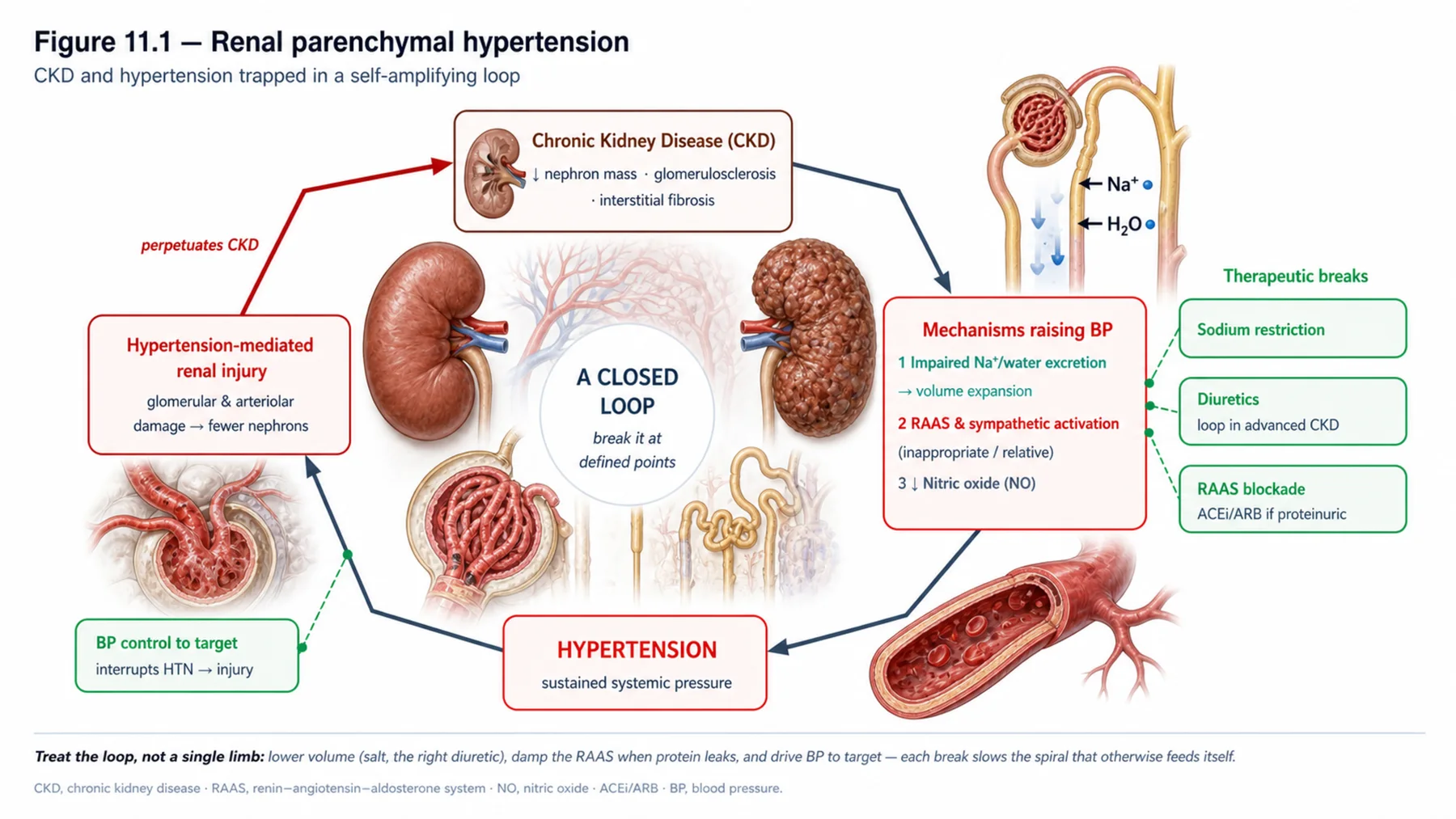
Renal parenchymal disease (CKD) is the commonest secondary cause of hypertension, raising blood pressure through impaired sodium excretion, RAAS and sympathetic activation, and reduced nitric oxide, in a bidirectional vicious cycle with the kidney damage.
It is treated with sodium restriction, diuretics (loop diuretics in advanced CKD), RAAS blockade (renoprotective when proteinuric), and blood-pressure control.
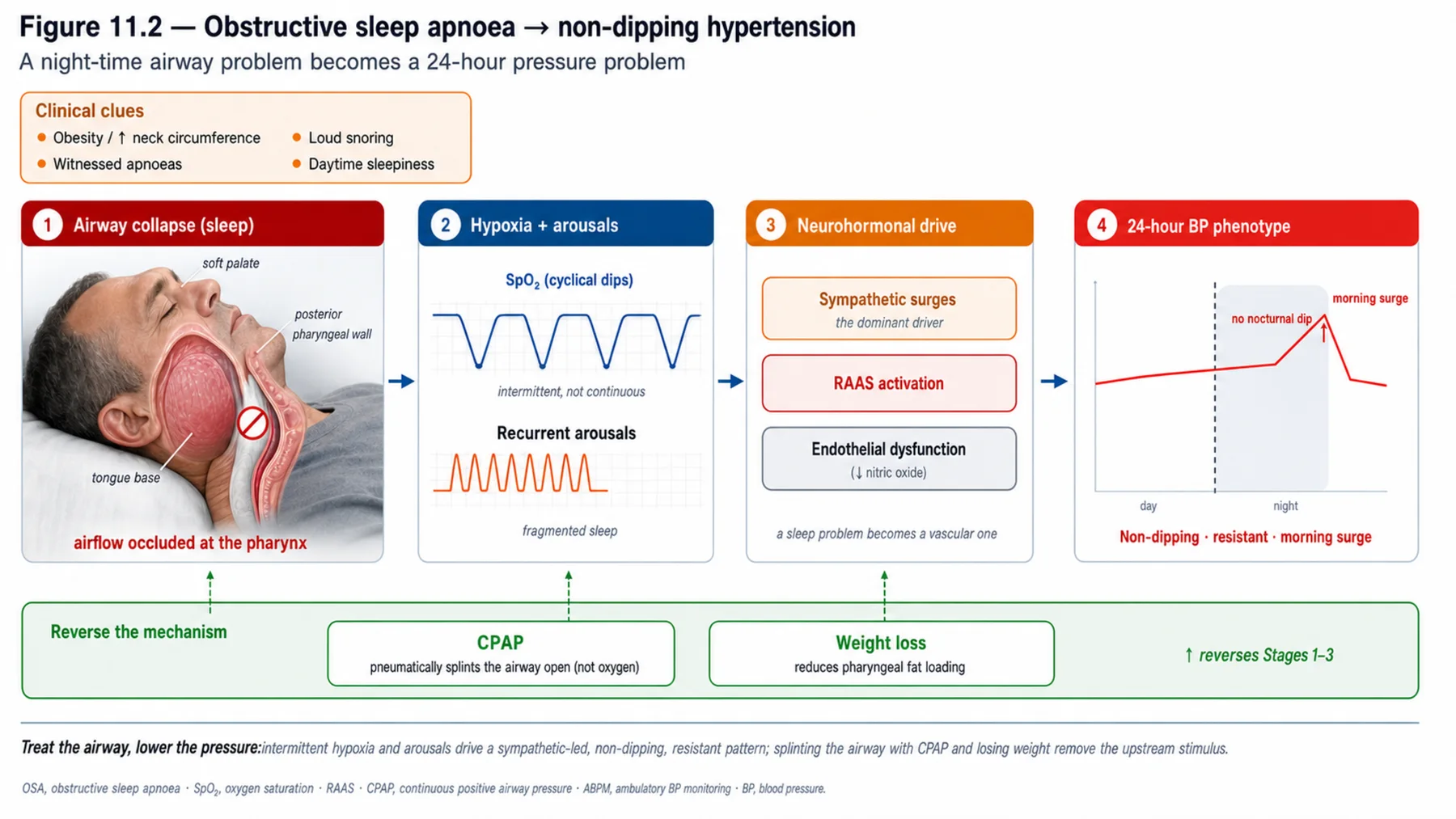
Obstructive sleep apnoea is a common, under-diagnosed cause: repetitive airway collapse causes intermittent hypoxia that activates the sympathetic system and RAAS, producing hypertension that is often non-dipping, resistant, and worst in the morning.
It is diagnosed by a sleep study and treated with CPAP (a modest blood-pressure reduction, greater in resistant and symptomatic patients) and weight loss.
Drug- and substance-induced hypertension is common and reversible: NSAIDs, oral contraceptives, glucocorticoids, sympathomimetics, alcohol, liquorice, calcineurin inhibitors, erythropoietin, and VEGF inhibitors each raise blood pressure by their own mechanism.
Liquorice inhibits the enzyme that protects the mineralocorticoid receptor, letting cortisol act on it — the same mechanism as the inherited apparent mineralocorticoid excess.
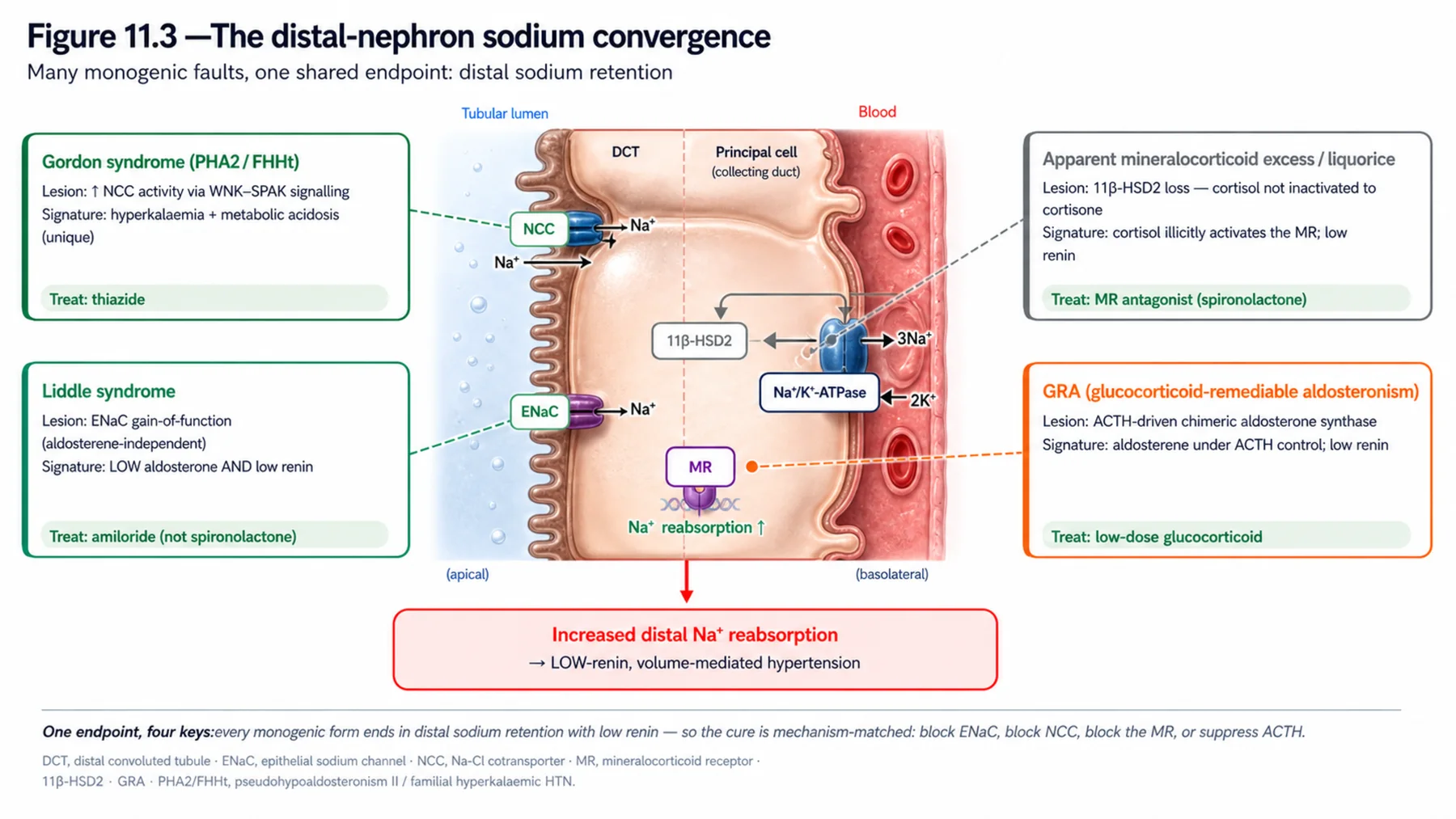
The monogenic hypertensions are rare single-gene defects that converge on increased distal sodium reabsorption, producing a low-renin, volume-mediated hypertension — confirming the kidney's central role.
Liddle syndrome is a gain-of-function of the epithelial sodium channel, with low renin and low aldosterone, treated with an epithelial-sodium-channel blocker (amiloride) rather than spironolactone.
Glucocorticoid-remediable aldosteronism produces ACTH-driven aldosterone and is treated with low-dose glucocorticoid.
Apparent mineralocorticoid excess is an inherited deficiency of that protective enzyme, treated with a mineralocorticoid antagonist and salt restriction.
Gordon syndrome increases sodium-chloride cotransporter activity, causing hypertension with hyperkalaemia and acidosis, and is treated with a thiazide.
Each of these causes is treated specifically, and the monogenic syndromes in particular reward recognition with a targeted, often dramatic response.
Together with the renovascular and endocrine causes, they complete the differential of secondary hypertension.
| 03 | PHASE A · LEVEL 3 · ORIENTATION & KNOWLEDGE Main Narrative |
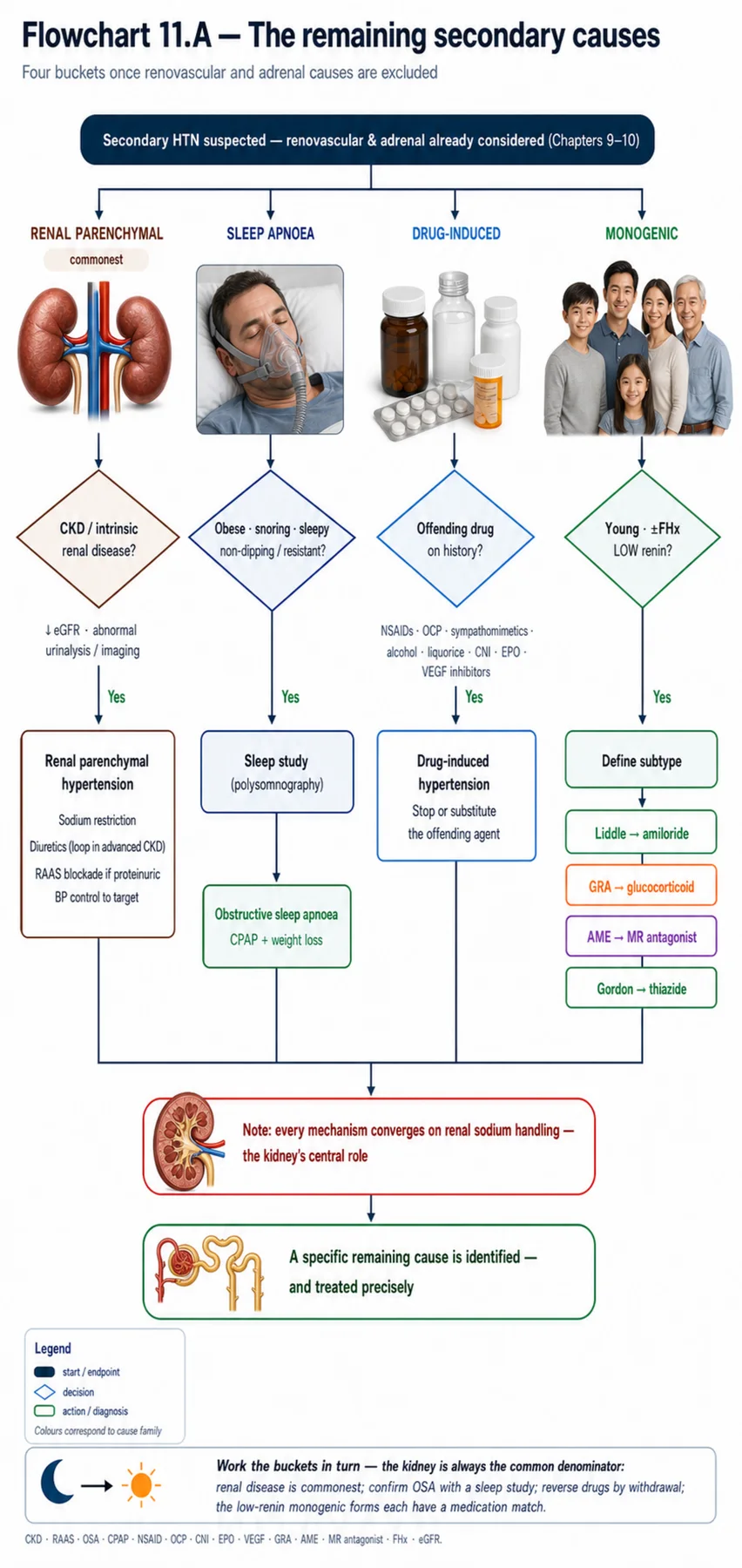
This chapter completes the secondary causes: the renal parenchymal disease that is the commonest of them all, the obstructive sleep apnoea that is common and missed, the drugs and substances that are reversible and overlooked, and the rare monogenic syndromes that, for all their rarity, teach the deepest lesson — that hypertension comes back, again and again, to the kidney's handling of sodium. Each is treated specifically, and recognising them rewards the patient with a targeted, sometimes curative, treatment.
— Renal parenchymal hypertension
Renal parenchymal disease — CKD of any cause — is the commonest secondary cause of hypertension, and its mechanisms are those the opening chapters described. The diseased kidney cannot excrete sodium normally (a rightward-shifted pressure-natriuresis), activates the RAAS and the sympathetic system, and produces less nitric oxide, all raising the blood pressure; and the elevated pressure in turn damages the kidney, setting up the bidirectional vicious cycle in which hypertension and kidney disease drive each other. Specific renal diseases add their own mechanisms — polycystic kidney disease, for instance, causes early hypertension as expanding cysts compress and locally ischaemia the parenchyma, activating the RAAS. The treatment follows the mechanisms: dietary sodium restriction, diuretics (with loop diuretics needed as the GFR falls and thiazides lose efficacy), RAAS blockade (which is renoprotective when there is proteinuria, with the monitoring caveats of the pharmacotherapy chapter), and blood-pressure control to the targets developed in the CKD-specific chapter and volume. Renal parenchymal hypertension is, in a sense, the purest expression of the kidney's central role in blood pressure.
— Obstructive sleep apnoea
Obstructive sleep apnoea is common, frequently under-diagnosed, and an important and treatable contributor to hypertension. During sleep the upper airway repeatedly collapses, causing intermittent hypoxia and arousals that trigger surges of sympathetic activity, activate the RAAS, and cause endothelial dysfunction — producing a sustained hypertension that characteristically is non-dipping (the nocturnal pressure fails to fall), is often resistant, and may be worst in the morning. The clues are obesity, loud snoring, witnessed apnoeas, daytime sleepiness, and a non-dipping nocturnal pattern on ambulatory monitoring, and the diagnosis is confirmed by a sleep study (full polysomnography or a home sleep test). Treatment is continuous positive airway pressure (CPAP), which produces a modest blood-pressure reduction — greater in patients who are resistant or symptomatic — alongside weight loss, which addresses both the apnoea and the associated obesity hypertension. Sleep apnoea should be actively sought in obese, snoring, non-dipping, and resistant hypertensives, because it is a treatable cause that is easily missed.
— Drug- and substance-induced hypertension
A wide range of drugs and substances raise blood pressure, and — because the cause is reversible — recognising them is high-yield. The mechanisms vary: NSAIDs cause sodium retention and reduce vasodilatory renal prostaglandins (and blunt antihypertensives); combined oral contraceptives raise blood pressure through oestrogen-driven angiotensinogen; glucocorticoids and mineralocorticoids act on their receptors; sympathomimetic decongestants and stimulants (and recreational drugs such as cocaine and amphetamines) raise sympathetic tone; alcohol raises it dose-dependently; calcineurin inhibitors (ciclosporin more than tacrolimus) cause vasoconstriction and sodium retention; erythropoietin and the anti-angiogenic VEGF inhibitors raise it by their own mechanisms. One deserves special mention for its elegance: liquorice contains glycyrrhetinic acid, which inhibits the enzyme (11-beta-hydroxysteroid dehydrogenase type 2) that normally inactivates cortisol in the kidney and protects the mineralocorticoid receptor; with the enzyme inhibited, cortisol floods the mineralocorticoid receptor and acts like aldosterone — producing hypertension with hypokalaemia and a low renin and aldosterone. The treatment of all drug-induced hypertension is to stop or substitute the offending agent, which often resolves it; the key is to look, through a careful drug and substance history.
— Monogenic hypertension: the distal-sodium convergence
The monogenic hypertensions are rare single-gene disorders, but they are worth knowing because they are individually treatable and because, collectively, they teach a profound lesson: they all converge on increased distal sodium reabsorption, producing a low-renin, volume-mediated hypertension — confirming, in the clearest possible way, that the kidney's handling of sodium is the final common pathway of hypertension (the principle of the opening chapters). Four are illustrative. Liddle syndrome is a gain-of-function mutation of the epithelial sodium channel, which reabsorbs sodium constitutively, causing hypertension with hypokalaemia, alkalosis, and — importantly — both a low renin and a low aldosterone (because the channel is active independent of aldosterone); it is treated with an epithelial-sodium-channel blocker (amiloride or triamterene), not spironolactone, because there is no aldosterone to antagonise. Glucocorticoid-remediable aldosteronism is a chimeric gene that puts aldosterone synthesis under the control of ACTH, treated with low-dose glucocorticoid that suppresses the ACTH. Apparent mineralocorticoid excess is an inherited deficiency of the same protective enzyme that liquorice inhibits, letting cortisol act on the mineralocorticoid receptor (the inherited version of the liquorice mechanism), treated with a mineralocorticoid antagonist and salt restriction. And Gordon syndrome (familial hyperkalaemic hypertension) increases the activity of the sodium-chloride cotransporter, causing sodium retention and hypertension with the unusual combination of hyperkalaemia and metabolic acidosis (the mirror image of Gitelman syndrome), treated with a thiazide that blocks that cotransporter.
— Reading the monogenic syndromes
Although rare, the monogenic syndromes are diagnostically and therapeutically distinctive, and a few patterns make them recognisable. They present young, often with a family history, with low-renin hypertension and a biochemical signature that points to the specific channel or enzyme involved — hypokalaemia in Liddle, apparent mineralocorticoid excess, and glucocorticoid-remediable aldosteronism (which mimic aldosteronism but with the renin and aldosterone discordant from true aldosteronism), and the distinctive hyperkalaemia with acidosis in Gordon syndrome. The therapeutic payoff is large and specific: amiloride (not spironolactone) for Liddle, low-dose glucocorticoid for glucocorticoid-remediable aldosteronism, a mineralocorticoid antagonist for apparent mineralocorticoid excess, and a thiazide for Gordon syndrome — each targeting the precise defect, often with a dramatic response. The most important practical distinction is Liddle from aldosteronism: both give low-renin hypertension with hypokalaemia, but Liddle has a low aldosterone (and responds to amiloride, not spironolactone), whereas aldosteronism has a high aldosterone (and responds to spironolactone). Getting this wrong — giving spironolactone for Liddle — fails, because there is no aldosterone to block.
— Completing the secondary differential
With this chapter, the secondary causes are complete. The approach chapter set out when to screen and the targeted method; the renovascular chapter detailed renal artery disease and its revascularisation debate; the endocrine chapter covered aldosteronism, phaeochromocytoma, and Cushing's; and this chapter has covered the commonest cause (renal parenchymal disease), a common and missed one (obstructive sleep apnoea), the reversible drug and substance causes, and the rare but instructive monogenic syndromes. The unifying observation across all of them — and a fitting close to the secondary-hypertension part — is how often the mechanism returns to the kidney and to sodium: the parenchymal disease impairing sodium excretion, the monogenic syndromes increasing distal sodium reabsorption, the liquorice and apparent-mineralocorticoid-excess mechanisms acting through the mineralocorticoid receptor on sodium transport. Even the causes that begin elsewhere — sleep apnoea's sympathetic surges, the drugs' varied actions — raise the pressure in part through renal sodium handling. The secondary causes, taken together, confirm the lesson of the opening chapters: the kidney is at the centre of hypertension, and finding the specific cause — whether a stenosed artery, an aldosterone-producing adenoma, a sleep disorder, a drug, or a single-gene channel defect — offers the chance to treat it precisely.
| 04 | PHASE A · LEVEL 4 · ORIENTATION & KNOWLEDGE Reference Tables |
Table 11.1 — Renal parenchymal hypertension
| Aspect | Detail |
| Frequency | Commonest secondary cause overall (CKD of any type) |
| Mechanisms | Impaired sodium excretion, RAAS + sympathetic activation, reduced nitric oxide |
| Vicious cycle | Hypertension and kidney damage drive each other (bidirectional) |
| Treatment | Sodium restriction, diuretics (loop in advanced CKD), RAAS blockade (if proteinuric), BP control |
Table 11.2 — Obstructive sleep apnoea
| Aspect | Detail |
| Mechanism | Intermittent hypoxia → sympathetic surges, RAAS, endothelial dysfunction |
| Pattern | Non-dipping, often resistant, worst in the morning |
| Clues | Obesity, snoring, witnessed apnoeas, daytime sleepiness, non-dipping |
| Diagnosis / treatment | Sleep study; CPAP (modest BP fall, more in resistant/symptomatic) + weight loss |
Table 11.3 — Drug- and substance-induced hypertension
| Agent | Mechanism |
| NSAIDs | Sodium retention, reduced renal prostaglandins; blunt antihypertensives |
| Oral contraceptives | Oestrogen → angiotensinogen |
| Sympathomimetics / stimulants / alcohol | Raised sympathetic tone / dose-dependent |
| Liquorice | Inhibits 11β-HSD2 → cortisol acts on the mineralocorticoid receptor |
| Calcineurin inhibitors / EPO / VEGF inhibitors | Vasoconstriction / drug-specific mechanisms |
Table 11.4 — The monogenic syndromes
| Syndrome | Defect / biochemistry | Treatment |
| Liddle | ENaC gain-of-function; low renin AND low aldosterone | Amiloride (NOT spironolactone) |
| Glucocorticoid-remediable aldosteronism | Chimeric gene; ACTH-driven aldosterone | Low-dose glucocorticoid |
| Apparent mineralocorticoid excess | 11β-HSD2 deficiency; cortisol on MR | MRA + salt restriction |
| Gordon (familial hyperkalaemic HTN) | ↑ NCC; HYPERkalaemia + acidosis | Thiazide |
Table 11.5 — The distal-sodium convergence
| Point | Detail |
| Common pathway | Monogenic syndromes increase distal sodium reabsorption |
| Phenotype | Low-renin, volume-mediated hypertension |
| Recognition | Young, family history, low renin, a distinctive biochemical signature |
| Lesson | Confirms the kidney's sodium handling as the final common pathway |
Table 11.6 — Liddle versus aldosteronism
| Feature | Liddle | Primary aldosteronism |
| Renin | Low | Low (suppressed) |
| Aldosterone | LOW | HIGH |
| Treatment | Amiloride (ENaC blocker) | Spironolactone / adrenalectomy |
| 05 | PHASE B · LEVEL 5 · VISUALISE & MAP Imaging & Flowchart Specifications |
| 06 | PHASE B · LEVEL 6 · VISUALISE & MAP Concept Maps |
Each chain runs from mechanism to a named bedside action; read the arrows as “leads to.”
Renal parenchymal. CKD → impaired sodium excretion + RAAS/sympathetic activation → hypertension → renal damage (vicious cycle) → ACTION: sodium restriction, diuretics (loop in advanced CKD), RAAS blockade if proteinuric, BP control.
Sleep apnoea. Airway collapse → intermittent hypoxia → sympathetic surges + RAAS → non-dipping/resistant hypertension → ACTION: sleep study, then CPAP and weight loss.
Drug-induced. NSAIDs/contraceptives/sympathomimetics/liquorice/calcineurin inhibitors/VEGF inhibitors → raised BP by varied mechanisms → ACTION: take a careful history and stop or substitute the agent.
Monogenic convergence. Liddle (ENaC), Gordon (NCC), AME/liquorice (cortisol on MR), GRA (ACTH-driven aldosterone) → increased distal sodium reabsorption → low-renin hypertension → ACTION: recognise the low-renin, young, familial pattern and treat the specific defect.
Liddle vs aldosteronism. Both low-renin with hypokalaemia, but Liddle has LOW aldosterone (ENaC-driven) → ACTION: treat Liddle with amiloride, aldosteronism with spironolactone — don't confuse them.
| 07 | PHASE B · LEVEL 7 · VISUALISE & MAP Decision Pathways |
| R1 | IF a patient has CKD, THEN expect renal parenchymal hypertension (the commonest secondary cause) and treat with sodium restriction, diuretics, RAAS blockade if proteinuric, and BP control. |
| R2 | IF the GFR is low, THEN use a loop diuretic — thiazides lose efficacy in advanced CKD. |
| R3 | IF a hypertensive patient is obese, snores, is sleepy, or has a non-dipping/resistant pattern, THEN investigate for obstructive sleep apnoea with a sleep study and treat with CPAP and weight loss. |
| R4 | IF hypertension is new or resistant, THEN take a careful drug and substance history and stop or substitute any culprit (NSAIDs, contraceptives, sympathomimetics, liquorice, calcineurin inhibitors). |
| R5 | IF hypertension with hypokalaemia and low renin has a LOW aldosterone, THEN consider Liddle syndrome and treat with amiloride — not spironolactone. |
| R6 | IF there is low-renin hypertension with hypokalaemia and a liquorice or apparent-mineralocorticoid-excess picture, THEN treat with a mineralocorticoid antagonist and salt restriction (and stop liquorice). |
| R7 | IF there is hypertension with hyperkalaemia and metabolic acidosis, THEN consider Gordon syndrome and treat with a thiazide. |
| R8 | IF a young patient has low-renin hypertension with a family history, THEN consider a monogenic syndrome and treat the specific defect. |
| 08 | PHASE C · LEVEL 8 · CLINICAL REASONING Clinical Cases |
| CASE 1 | THE COMMONEST CAUSE Sodium, diuretics, RAAS blockade Renal parenchymal hypertension |
Presentation
A patient with advanced CKD and proteinuria has difficult hypertension, and a thiazide has produced little effect. The team is unsure how to escalate.
❖ Pause and reflect Why is the thiazide ineffective, and what should this patient receive? |
Analysis
This is renal parenchymal hypertension — the commonest secondary cause — and the thiazide is ineffective because thiazides lose efficacy as the GFR falls in advanced CKD, where a loop diuretic is needed to achieve natriuresis. The hypertension is driven by impaired sodium excretion, RAAS and sympathetic activation, and reduced nitric oxide, in a vicious cycle with the kidney damage. The management is sodium restriction, a loop diuretic (for the volume component), RAAS blockade (which is renoprotective given the proteinuria, with the usual monitoring), and blood-pressure control to the CKD target. The thiazide's failure is a clue to the advanced CKD, not a reason to abandon diuresis.
Plan
Restrict sodium, switch to a loop diuretic (effective at low GFR), add RAAS blockade for the proteinuria (monitored), and control the blood pressure to the CKD target; break the vicious cycle. Use a loop diuretic and RAAS blockade in parenchymal hypertension with advanced CKD.
Teaching point
Renal parenchymal disease is the commonest secondary cause — treat with sodium restriction, a loop diuretic (in advanced CKD), and RAAS blockade if proteinuric.
Cross-reference
Exercises rules R1 and R2; the renal-parenchymal concept map; Figure 11.1; Tables 11.1; CKD hypertension in Chapter 14 and Volume 6.
| CASE 2 | RESISTANT AND SNORING Look for sleep apnoea Obstructive sleep apnoea |
Presentation
An obese patient with resistant hypertension snores loudly, has daytime sleepiness, and shows a non-dipping nocturnal pattern on ambulatory monitoring. No sleep assessment has been done.
❖ Pause and reflect What treatable cause should be sought here? |
Analysis
Obstructive sleep apnoea. The combination of obesity, loud snoring, daytime sleepiness, a non-dipping nocturnal pattern, and resistant hypertension is the classic profile. The repetitive airway collapse during sleep causes intermittent hypoxia that drives sympathetic surges, RAAS activation, and endothelial dysfunction, producing the non-dipping, resistant hypertension seen here. Sleep apnoea is common and frequently missed, and it is treatable. The diagnosis is confirmed by a sleep study, and treatment with CPAP (with a modest blood-pressure benefit, greater in resistant and symptomatic patients like this one) plus weight loss addresses both the apnoea and the obesity contribution.
Plan
Arrange a sleep study and, if obstructive sleep apnoea is confirmed, treat with CPAP and weight loss alongside the antihypertensives; this addresses a treatable contributor to the resistant hypertension. Seek and treat sleep apnoea in the obese, snoring, non-dipping, resistant hypertensive.
Teaching point
Obstructive sleep apnoea causes non-dipping, resistant hypertension — seek it in obese, snoring, sleepy patients and treat with CPAP and weight loss.
Cross-reference
Exercises rule R3; the sleep-apnoea concept map; Figure 11.2; Table 11.2; non-dipping in Chapter 2; resistant hypertension in Chapter 17.
| CASE 3 | THE SWEET TOOTH A reversible cause Liquorice-induced hypertension |
Presentation
A patient with new hypertension, hypokalaemia, and a low renin and aldosterone is found, on questioning, to consume large amounts of liquorice. A clinician is preparing an extensive endocrine work-up.
❖ Pause and reflect What explains the hypertension, hypokalaemia, and low renin and aldosterone here? |
Analysis
Liquorice. Its active component, glycyrrhetinic acid, inhibits the enzyme (11-beta-hydroxysteroid dehydrogenase type 2) that normally inactivates cortisol in the kidney and protects the mineralocorticoid receptor; with the enzyme inhibited, cortisol floods and activates the mineralocorticoid receptor, acting like aldosterone — producing hypertension with hypokalaemia and a suppressed renin and (importantly) a low aldosterone (the mineralocorticoid effect is from cortisol, not aldosterone). This is the acquired form of apparent mineralocorticoid excess. Recognising the liquorice history spares an extensive (and falsely reassuring) endocrine work-up: stopping the liquorice resolves the picture.
Plan
Stop the liquorice (and treat with a mineralocorticoid antagonist and salt restriction if needed in the interim), which resolves the apparent mineralocorticoid excess, rather than pursuing an extensive endocrine work-up. Take the substance history — liquorice is a reversible cause.
Teaching point
Liquorice inhibits 11β-HSD2, letting cortisol act on the mineralocorticoid receptor — hypertension with hypokalaemia and LOW aldosterone; stopping it resolves the picture.
Cross-reference
Exercises rules R4 and R6; the drug-induced concept map; Tables 11.3, 11.4; apparent mineralocorticoid excess (inherited form) below.
| CASE 4 | AMILORIDE, NOT SPIRONOLACTONE Liddle versus aldosteronism Monogenic hypertension |
Presentation
A young patient with a family history of hypertension has low-renin hypertension with hypokalaemia but a LOW aldosterone. Spironolactone has been tried with little effect.
❖ Pause and reflect Why did spironolactone fail, and what is the diagnosis? |
Analysis
This is Liddle syndrome, and spironolactone failed because there is no aldosterone to block. Liddle is a gain-of-function mutation of the epithelial sodium channel, which reabsorbs sodium constitutively — independent of aldosterone — causing low-renin hypertension with hypokalaemia and, crucially, a LOW aldosterone (distinguishing it from primary aldosteronism, which has a HIGH aldosterone). Spironolactone, a mineralocorticoid antagonist, is ineffective because the channel is active without aldosterone; the correct treatment is an epithelial-sodium-channel blocker (amiloride or triamterene), which directly closes the overactive channel. The young age, family history, low renin, and low aldosterone are the clues, and the amiloride-not-spironolactone distinction is the key teaching point.
Plan
Treat with amiloride (an epithelial-sodium-channel blocker), not spironolactone, given the diagnosis of Liddle syndrome (low-renin hypertension with hypokalaemia and a low aldosterone). Distinguish Liddle from aldosteronism by the aldosterone and treat accordingly.
Teaching point
Liddle syndrome (low renin, low aldosterone, ENaC gain-of-function) is treated with amiloride, NOT spironolactone — there is no aldosterone to block.
Cross-reference
Exercises rules R5 and R8; the monogenic-convergence and Liddle-vs-aldosteronism concept maps; Figure 11.3; Tables 11.4, 11.6; aldosteronism in Chapter 10.
| 09 | PHASE C · LEVEL 9 · CLINICAL REASONING Clinical Implications |
One triad per mechanism the narrative exposed: the physiology, why it matters, and the bedside move.
MECHANISM Renal parenchymal disease impairs sodium excretion and activates the RAAS in a vicious cycle. |
WHY IT MATTERS It is the commonest secondary cause and worsens with the kidney damage it causes. |
ACTION Treat with sodium restriction, a loop diuretic in advanced CKD, and RAAS blockade if proteinuric. |
MECHANISM Sleep apnoea's intermittent hypoxia drives sympathetic surges and RAAS activation. |
WHY IT MATTERS It produces non-dipping, resistant hypertension and is commonly missed. |
ACTION Seek it with a sleep study and treat with CPAP and weight loss. |
MECHANISM Many drugs and substances raise blood pressure by their own mechanisms. |
WHY IT MATTERS The cause is reversible and easily overlooked. |
ACTION Take a careful drug and substance history and stop or substitute the culprit. |
MECHANISM The monogenic syndromes increase distal sodium reabsorption by various single-gene defects. |
WHY IT MATTERS They cause low-renin, volume-mediated hypertension and reward specific treatment. |
ACTION Recognise the young, familial, low-renin pattern and treat the precise defect. |
MECHANISM Liddle syndrome activates the epithelial sodium channel independent of aldosterone. |
WHY IT MATTERS It gives a low aldosterone, so a mineralocorticoid antagonist does not work. |
ACTION Treat Liddle with amiloride, not spironolactone. |
| 10 | PHASE C · LEVEL 10 · CLINICAL REASONING Clinical Pearls |
| Renal parenchymal disease (CKD) = commonest secondary cause overall. | Mechanisms: impaired sodium excretion, RAAS/sympathetic activation, reduced NO. |
| Bidirectional vicious cycle (HTN ↔︎ kidney damage). | Treat: sodium restriction, diuretics, RAAS blockade (if proteinuric), BP control. |
| Use a LOOP diuretic in advanced CKD (thiazides lose efficacy). | OSA: intermittent hypoxia → sympathetic/RAAS → non-dipping, resistant HTN. |
| OSA clues: obesity, snoring, sleepiness, non-dipping; diagnose with a sleep study. | OSA treatment: CPAP (modest BP fall, more if resistant/symptomatic) + weight loss. |
| Drug-induced: NSAIDs, OCP, sympathomimetics, alcohol, liquorice, calcineurin inhibitors, EPO, VEGF inhibitors. | Liquorice inhibits 11β-HSD2 → cortisol on MR (low renin AND aldosterone). |
| Monogenic syndromes converge on distal sodium reabsorption — low-renin HTN. | Liddle: ENaC gain-of-function; low renin, LOW aldosterone → amiloride (NOT spironolactone). |
| GRA: ACTH-driven aldosterone → low-dose glucocorticoid. | Apparent mineralocorticoid excess: 11β-HSD2 deficiency → MRA + salt restriction. |
| Gordon syndrome: ↑NCC; HYPERkalaemia + acidosis → thiazide. | Liddle vs aldosteronism: aldosterone LOW (Liddle) vs HIGH (aldosteronism). |
| 11 | PHASE D · LEVEL 11 · SAFETY & EVIDENCE Red Flags & Never-Do |
Panel A — Red flags
| ▲ | Hypertension in CKD with an ineffective thiazide — use a loop diuretic in advanced CKD. |
| ▲ | An obese, snoring, sleepy, non-dipping resistant hypertensive — investigate for obstructive sleep apnoea. |
| ▲ | New or resistant hypertension — take a drug and substance history (NSAIDs, liquorice, calcineurin inhibitors). |
| ▲ | Low-renin hypertension with hypokalaemia and a LOW aldosterone — consider Liddle (treat with amiloride). |
| ▲ | Hypertension with hyperkalaemia and metabolic acidosis — consider Gordon syndrome (treat with a thiazide). |
Panel B — Never do
| ✖ NEVER — rely on a thiazide alone for hypertension in advanced CKD. |
| ✖ NEVER — overlook obstructive sleep apnoea in the obese, snoring, resistant hypertensive. |
| ✖ NEVER — treat Liddle syndrome with spironolactone — there is no aldosterone to block. |
| ✖ NEVER — pursue an endocrine work-up before excluding liquorice and other substances. |
| 12 | PHASE D · LEVEL 12 · SAFETY & EVIDENCE Common Pitfalls |
Pitfall 1 — Thiazide in advanced CKD
| ✖ | WRONG Persisting with a thiazide for hypertension in advanced CKD. |
| ✓ | RIGHT Switching to a loop diuretic. |
| ✉ | WHY Thiazides lose efficacy as the GFR falls. |
Pitfall 2 — Missing sleep apnoea
| ✖ | WRONG Escalating drugs in a resistant hypertensive without considering sleep apnoea. |
| ✓ | RIGHT Investigating with a sleep study and treating with CPAP. |
| ✉ | WHY Sleep apnoea is a common, treatable, missed cause. |
Pitfall 3 — Ignoring liquorice/substances
| ✖ | WRONG Working up apparent mineralocorticoid excess without a substance history. |
| ✓ | RIGHT Asking about liquorice and other substances first. |
| ✉ | WHY Liquorice mimics mineralocorticoid excess and is reversible. |
Pitfall 4 — Spironolactone for Liddle
| ✖ | WRONG Treating Liddle syndrome with spironolactone. |
| ✓ | RIGHT Treating it with amiloride (an ENaC blocker). |
| ✉ | WHY Liddle has a low aldosterone — there is nothing for spironolactone to block. |
Pitfall 5 — Missing Gordon syndrome
| ✖ | WRONG Overlooking hypertension with hyperkalaemia and acidosis. |
| ✓ | RIGHT Recognising Gordon syndrome and treating with a thiazide. |
| ✉ | WHY Increased NCC activity causes this distinctive picture. |
| 13 | PHASE D · LEVEL 13 · SAFETY & EVIDENCE Evidence Grading |
GRADE A HIGH CONFIDENCE The effect is real and the estimate is stable. RCTs at low risk of bias; multiple concordant prospective cohorts; meta-analyses. |
GRADE B MODERATE CONFIDENCE The effect is likely real but may shift with new data. Observational studies, registries, mechanistic human studies. |
GRADE C LOW CONFIDENCE Rests on physiology, reasoning, or consensus rather than outcomes. Pathophysiological reasoning; extrapolation; consensus without outcomes. |
Graded statements (by evidence type)
| Statement | Grade | Basis (evidence type) |
| Renal parenchymal disease is the commonest secondary cause of hypertension. | A | Epidemiological data |
| Loop diuretics are needed in advanced CKD as thiazides lose efficacy. | A | Pharmacology and clinical data |
| Obstructive sleep apnoea causes non-dipping, resistant hypertension. | A | Clinical and physiological data |
| CPAP produces a modest blood-pressure reduction. | B | RCTs and meta-analyses |
| Liquorice and apparent mineralocorticoid excess act through 11β-HSD2. | A | Established physiology |
| Liddle syndrome is treated with amiloride, not spironolactone. | A | Established physiology |
| The monogenic syndromes converge on distal sodium handling. | A | Established physiology |
| 14 | PHASE E · LEVEL 14 · PATIENT DECISIONS Absolute Risk in Natural Frequency |
Natural-frequency estimates for orientation, from these causes; they vary with the population. They convey the size of the decisions, expressed per 100 comparable patients.
| Per 100 patients… | Outcome | Roughly how many | See |
| Resistant hypertensives | Have obstructive sleep apnoea | A substantial share — hence seek it | L13 row 3 |
| With sleep apnoea treated with CPAP | Gain a modest blood-pressure reduction | Many, more if resistant/symptomatic | L13 row 4 |
| Drug-induced hypertension with the agent stopped | Improve or resolve | Many — hence take the history | L13 row 1 |
| Liddle syndrome treated with amiloride vs spironolactone | Respond | Far more with amiloride | L13 row 6 |
★ How to read these Read these as orientation, not promises; outcomes vary with the population. The stable signals: sleep apnoea is common in resistant hypertension, CPAP gives a modest benefit, stopping a culprit drug helps, and Liddle responds to amiloride not spironolactone. Communicate them as people out of 100, not as a hazard ratio. |
| 17 | PHASE F · LEVEL 17 · APPLY & TEST Documentation Templates |
Paste-ready notes. Tick the boxes that apply and delete the rest; make the cause and its specific treatment explicit.
Template 1 — Renal parenchymal / sleep apnoea / drug-induced
Template 2 — Monogenic hypertension
| 18 | PHASE F · LEVEL 18 · APPLY & TEST Cheat Sheet |
| Renal parenchymal (CKD) = commonest secondary cause. | Mechanisms: impaired Na excretion, RAAS/sympathetic, reduced NO; vicious cycle. |
| Treat: Na restriction, diuretics, RAAS blockade (proteinuric), BP control. | LOOP diuretic in advanced CKD. |
| OSA: intermittent hypoxia → sympathetic/RAAS → non-dipping/resistant HTN. | OSA clues: obese, snoring, sleepy, non-dipping; diagnose by sleep study. |
| OSA: CPAP + weight loss. | Drug-induced: NSAIDs, OCP, sympathomimetics, alcohol, liquorice, CNIs, EPO, VEGF inhibitors. |
| Liquorice: inhibits 11β-HSD2 → cortisol on MR (low renin AND aldosterone). | Monogenic: converge on distal sodium reabsorption — low-renin HTN. |
| Liddle: ENaC gain-of-function; LOW aldosterone → amiloride (NOT spironolactone). | GRA: ACTH-driven aldosterone → low-dose glucocorticoid. |
| AME: 11β-HSD2 deficiency → MRA + salt restriction. | Gordon: ↑NCC; HYPERkalaemia + acidosis → thiazide. |
| Liddle vs aldosteronism: aldosterone LOW vs HIGH. | The kidney's sodium handling is the recurring theme. |
| 19 | PHASE F · LEVEL 19 · APPLY & TEST Flashcards |
| CARD 1 | Q. How does renal parenchymal disease cause hypertension, and how is it treated? A. Through impaired sodium excretion, RAAS and sympathetic activation, and reduced nitric oxide, in a bidirectional vicious cycle with the kidney damage; treated with sodium restriction, diuretics (a loop diuretic in advanced CKD), RAAS blockade if proteinuric, and blood-pressure control. DETAILED. It is the commonest secondary cause. CLINICAL. Break the cycle with sodium control, diuretics, and RAAS blockade. |
| CARD 2 | Q. How does obstructive sleep apnoea raise blood pressure? A. Repetitive airway collapse causes intermittent hypoxia and arousals that trigger sympathetic surges, RAAS activation, and endothelial dysfunction, producing hypertension that is often non-dipping, resistant, and worst in the morning. DETAILED. It is common and frequently missed. CLINICAL. Seek it with a sleep study and treat with CPAP and weight loss. |
| CARD 3 | Q. What is the liquorice mechanism of hypertension? A. Glycyrrhetinic acid inhibits 11-beta-hydroxysteroid dehydrogenase type 2, the enzyme that protects the mineralocorticoid receptor from cortisol; with it inhibited, cortisol activates the receptor, producing hypertension with hypokalaemia and a low renin and aldosterone — acquired apparent mineralocorticoid excess. DETAILED. Stopping the liquorice resolves it. CLINICAL. Take the substance history and stop the liquorice. |
| CARD 4 | Q. Why do the monogenic hypertensions matter despite being rare? A. Because they are individually treatable and, collectively, they converge on increased distal sodium reabsorption — producing low-renin, volume-mediated hypertension — which confirms that the kidney's sodium handling is the final common pathway of hypertension. DETAILED. They present young, familial, and low-renin. CLINICAL. Recognise the pattern and treat the specific defect. |
| CARD 5 | Q. What is Liddle syndrome, and how is it treated? A. A gain-of-function mutation of the epithelial sodium channel causing constitutive sodium reabsorption — low-renin hypertension with hypokalaemia and a LOW aldosterone — treated with an epithelial-sodium-channel blocker (amiloride or triamterene), not spironolactone. DETAILED. There is no aldosterone for spironolactone to block. CLINICAL. Treat Liddle with amiloride, not spironolactone. |
| CARD 6 | Q. How does Liddle syndrome differ from primary aldosteronism? A. Both give low-renin hypertension with hypokalaemia, but Liddle has a LOW aldosterone (the channel is active independent of aldosterone) and responds to amiloride, whereas primary aldosteronism has a HIGH aldosterone and responds to spironolactone or adrenalectomy. DETAILED. The aldosterone level distinguishes them. CLINICAL. Check the aldosterone and treat accordingly. |
| CARD 7 | Q. What is Gordon syndrome? A. Familial hyperkalaemic hypertension — mutations increasing the activity of the sodium-chloride cotransporter, causing sodium retention and hypertension with the unusual combination of hyperkalaemia and metabolic acidosis (the mirror of Gitelman) — treated with a thiazide that blocks the cotransporter. DETAILED. Hyperkalaemia with hypertension is the clue. CLINICAL. Treat Gordon syndrome with a thiazide. |
| CARD 8 | Q. What unifies the secondary causes of hypertension? A. How often the mechanism returns to the kidney and to sodium — parenchymal disease impairing excretion, monogenic syndromes increasing distal reabsorption, the liquorice and apparent-mineralocorticoid-excess mechanisms acting on sodium transport — confirming the kidney's central role. DETAILED. Even causes beginning elsewhere raise pressure partly through renal sodium handling. CLINICAL. Find the specific cause and treat it precisely. |
| 20 | PHASE F · LEVEL 20 · APPLY & TEST One-Minute Preceptor |
| SCENE 1 | The intern stuck on the thiazide |
GET A COMMITMENT. “This advanced-CKD patient's hypertension isn't responding to the thiazide — what's wrong?”
PROBE FOR EVIDENCE. “The thiazide should work” — ask: “What happens to thiazide efficacy as the GFR falls?”
TEACH A GENERAL RULE. Thiazides lose efficacy in advanced CKD; a loop diuretic is needed for natriuresis, alongside sodium restriction and RAAS blockade if proteinuric.
REINFORCE WHAT WAS RIGHT. Recognising the volume component was correct.
CORRECT A MISTAKE. Switch to a loop diuretic in advanced CKD.
| SCENE 2 | The resident giving spironolactone for Liddle |
GET A COMMITMENT. “You've prescribed spironolactone for this young patient's low-renin, low-aldosterone hypertension — why?”
PROBE FOR EVIDENCE. “It's mineralocorticoid hypertension” — ask: “If the aldosterone is low, what is spironolactone meant to block?”
TEACH A GENERAL RULE. Liddle syndrome activates the sodium channel independent of aldosterone, so the aldosterone is low and spironolactone fails — amiloride, an ENaC blocker, is the treatment.
REINFORCE WHAT WAS RIGHT. Recognising a mineralocorticoid-like picture was reasonable.
CORRECT A MISTAKE. Treat Liddle with amiloride, not spironolactone.
| 22 | PHASE F · LEVEL 22 · APPLY & TEST Board-Style Questions |
| Q 01 | The commonest secondary cause of hypertension is: |
| A | Obstructive sleep apnoea |
| B | Renal parenchymal disease (CKD) |
| C | Liddle syndrome |
| D | Liquorice ingestion |
Rationale Renal parenchymal disease is the commonest secondary cause overall (case 1, Table 11.1). A is common but less so; C and D are uncommon. |
| Q 02 | Why is a loop diuretic preferred over a thiazide for hypertension in advanced CKD? |
| A | Loop diuretics are weaker |
| B | Thiazides lose efficacy as the GFR falls |
| C | Loop diuretics raise potassium |
| D | Thiazides are nephrotoxic |
Rationale Thiazides lose natriuretic efficacy at low GFR, so a loop diuretic is needed (case 1, rule R2). A, C, and D are incorrect. |
| Q 03 | Obstructive sleep apnoea characteristically causes hypertension that is: |
| A | Dipping and easily controlled |
| B | Non-dipping and often resistant |
| C | Only daytime |
| D | Curable by a single drug |
Rationale Intermittent hypoxia drives non-dipping, often resistant hypertension (case 2, Figure 11.2, Table 11.2). A, C, and D are wrong. |
| Q 04 | Liquorice causes hypertension by: |
| A | Stimulating renin |
| B | Inhibiting 11β-HSD2 so cortisol acts on the mineralocorticoid receptor |
| C | Blocking aldosterone |
| D | Raising potassium |
Rationale Glycyrrhetinic acid inhibits the protective enzyme, letting cortisol activate the mineralocorticoid receptor (case 3, Table 11.3). A, C, and D are incorrect. |
| Q 05 | Liddle syndrome is treated with: |
| A | Spironolactone |
| B | Amiloride (an epithelial-sodium-channel blocker) |
| C | A glucocorticoid |
| D | A thiazide |
Rationale Liddle has a low aldosterone (ENaC active independent of aldosterone), so amiloride works and spironolactone does not (case 4, Table 11.6, rule R5). A fails; C is for GRA; D is for Gordon. |
| Q 06 | How does Liddle syndrome differ biochemically from primary aldosteronism? |
| A | Both have high aldosterone |
| B | Liddle has a LOW aldosterone; aldosteronism has a HIGH aldosterone |
| C | Liddle has high renin |
| D | They are identical |
Rationale Both are low-renin with hypokalaemia, but the aldosterone is low in Liddle and high in aldosteronism (Table 11.6). A, C, and D are wrong. |
| Q 07 | Hypertension with hyperkalaemia and metabolic acidosis suggests: |
| A | Liddle syndrome |
| B | Gordon syndrome (familial hyperkalaemic hypertension) |
| C | Primary aldosteronism |
| D | Apparent mineralocorticoid excess |
Rationale Increased NCC activity in Gordon syndrome causes hypertension with hyperkalaemia and acidosis, treated with a thiazide (Table 11.4, rule R7). A, C, and D cause hypokalaemia. |
| Q 08 | What do the monogenic hypertension syndromes have in common? |
| A | High renin |
| B | Convergence on increased distal sodium reabsorption (low-renin hypertension) |
| C | Adrenal tumours |
| D | Renal artery stenosis |
Rationale They converge on distal sodium handling, producing low-renin, volume-mediated hypertension (Figure 11.3, Table 11.5, rule R8). A, C, and D are incorrect. |