Chapter Preamble
Signals declared
Sig-D — Diagnostic (primary). Identify which lifestyle levers will most help a given patient — the salt-sensitive, the obese, the high-intake.
Sig-T — Therapeutic (strong). Prescribe lifestyle change deliberately — sodium restriction, the DASH diet, weight loss, exercise, alcohol moderation, potassium — as the foundation for all and an adjunct to drugs.
Sig-V — Evidence-dense (strong). The trial evidence and the magnitude of effect for each intervention, and how they combine — graded and reflected on.
Levels populated and omitted
Populated (18): L1–L5, L7, L8, L10–L14, L17–L22. The evidence and therapeutic signals fire the absolute-risk table (L14), the templates (L17), and the reflective prompts (L21); the diagnostic signal drives the tables, rules, cases, pitfalls, and board items.
L6 / L9 mechanism levels — omitted. No Sig-M; the mechanisms were built in Chapters 1 and 4, and this is a treatment and evidence chapter.
L15 / L16 preference-sensitive map and SDM scripts — omitted. No Sig-E; lifestyle change is recommended for all — effective care, not a values-driven choice.
| 01 | PHASE A · LEVEL 1 · ORIENTATION & KNOWLEDGE Learning Objectives |
By the end of this chapter you should be able to:
Explain the role of sodium restriction and its expected magnitude of effect.
Describe the DASH and Mediterranean dietary patterns and their evidence.
Explain the blood-pressure benefit of weight loss and physical activity.
Describe alcohol moderation and increased potassium intake, with their cautions.
State the approximate blood-pressure reduction achievable with each intervention.
Explain that the effects are additive and combined lifestyle change can equal a drug.
Prescribe lifestyle change as the foundation for all patients and an adjunct to drugs.
Identify which lifestyle levers most help a given patient.
| 02 | PHASE A · LEVEL 2 · ORIENTATION & KNOWLEDGE Executive Summary |
Lifestyle and dietary change is the foundation of hypertension management — recommended for every patient and an adjunct to drug therapy throughout.
Sodium restriction (to below about 2 grams of sodium, roughly 5 grams of salt, a day) lowers blood pressure, with a larger effect in salt-sensitive patients — the older, the black, those with CKD or diabetes.
The DASH diet — rich in fruit, vegetables, low-fat dairy, and whole grains, low in saturated fat — produces one of the largest dietary blood-pressure reductions, and the Mediterranean diet is similar.
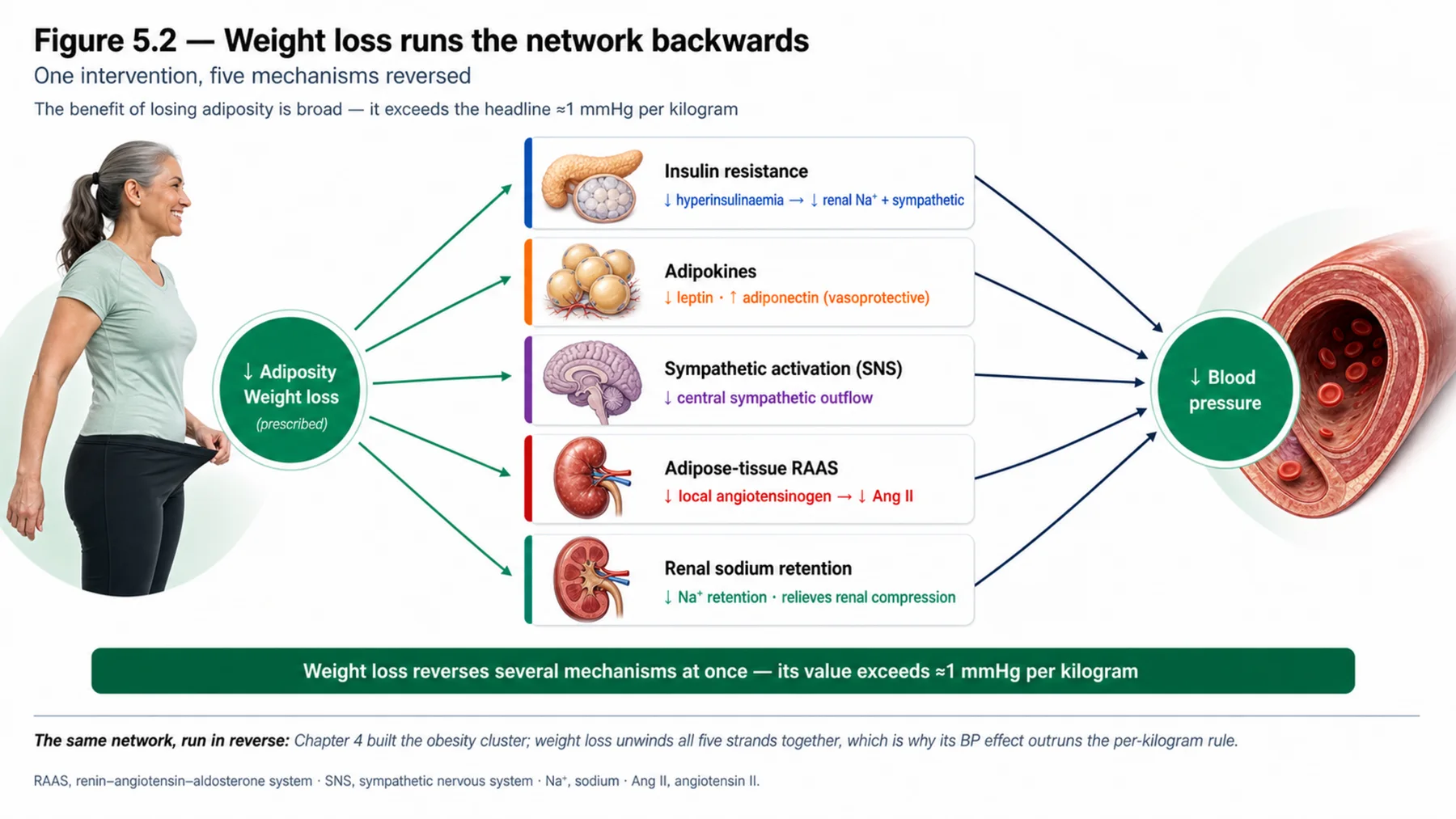
Weight loss lowers blood pressure by roughly 1 mmHg per kilogram lost and is the most effective intervention in the obese, reversing several mechanisms at once.
Regular physical activity — aerobic and dynamic resistance — lowers blood pressure modestly.
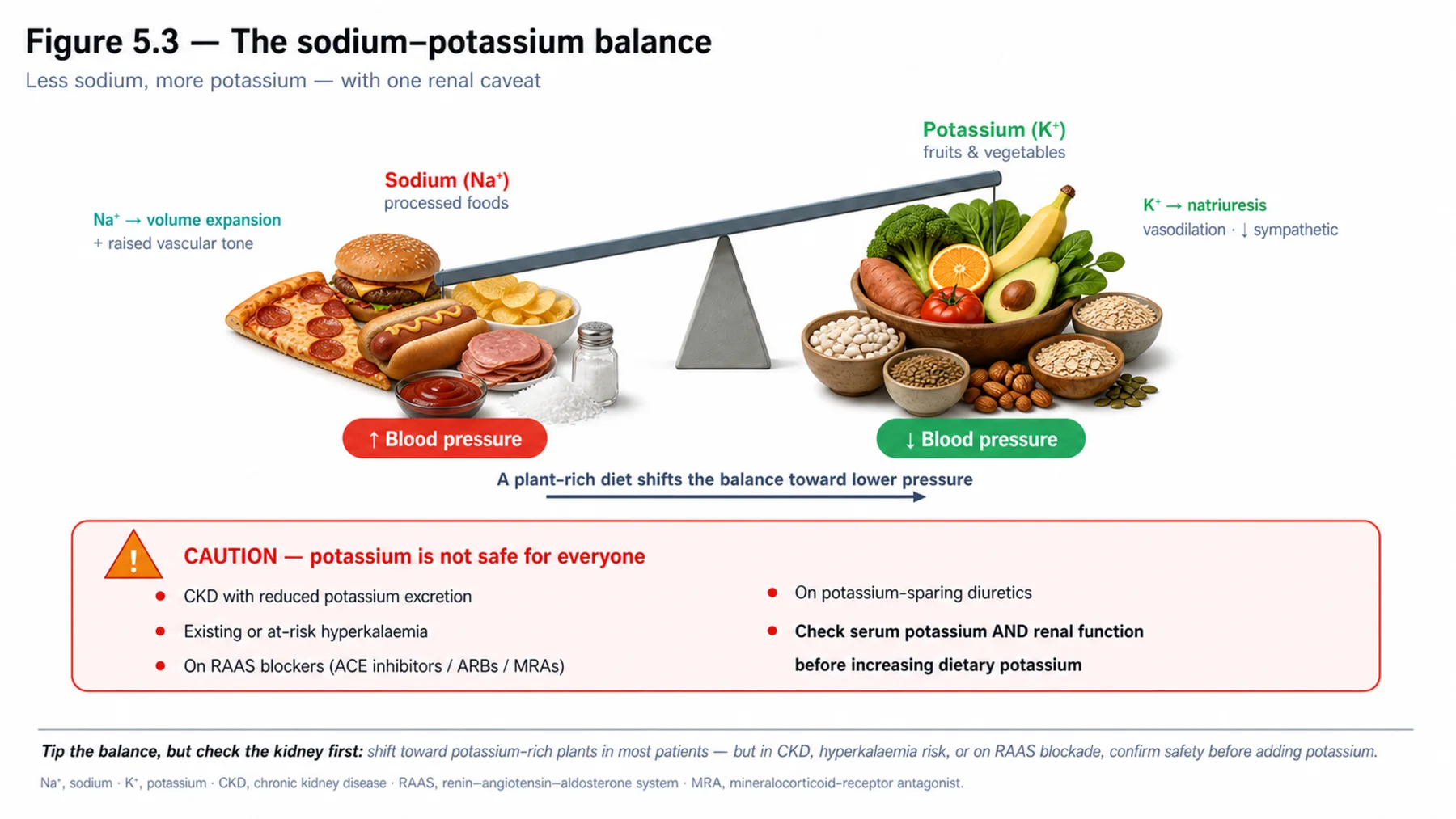
Moderating excess alcohol lowers blood pressure in a dose-dependent way, and increasing dietary potassium (mainly through fruit and vegetables) lowers it while countering sodium.
Increased potassium intake must be used cautiously in CKD, hyperkalaemia, and on RAAS blockers or potassium-sparing diuretics.
Each intervention is supported by trial evidence, and the effects are largely additive, so combined lifestyle change can achieve a reduction comparable to a single antihypertensive drug.
Lifestyle change may suffice for mild, low-risk hypertension and reduces the drug burden in everyone else.
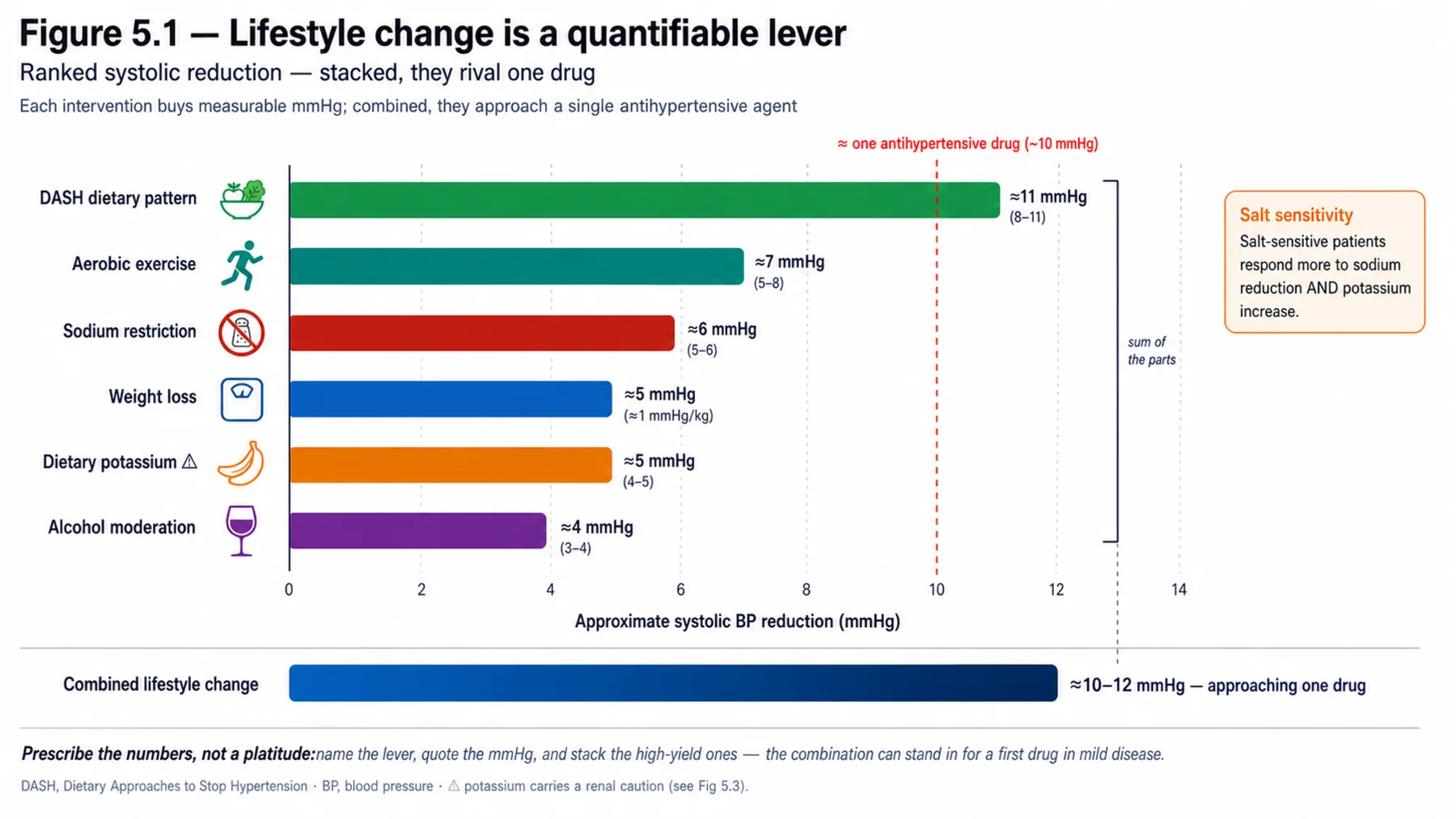
The magnitudes are meaningful: the DASH diet and weight loss can each lower systolic pressure by around 5 to 11 mmHg, sodium restriction and exercise by several mmHg each.
The main limitation is adherence, which requires sustained support rather than a single instruction.
Smoking cessation reduces cardiovascular risk (though its direct blood-pressure effect is small), and sleep apnoea should be treated.
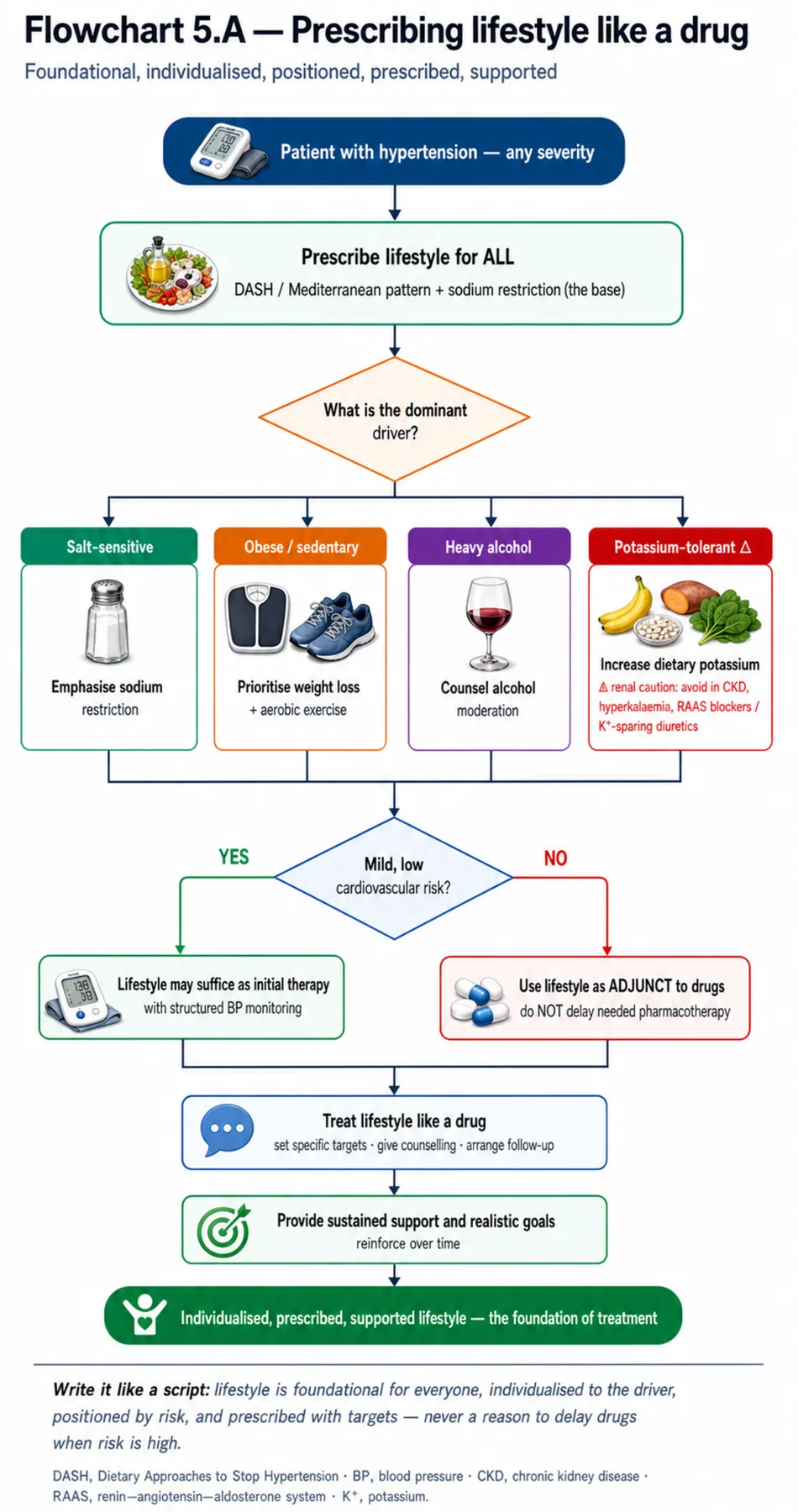
Lifestyle change should be prescribed as deliberately as a drug, with specific targets and follow-up.
It is the base on which all hypertension treatment is built.
| 03 | PHASE A · LEVEL 3 · ORIENTATION & KNOWLEDGE Main Narrative |
Before, alongside, and beneath every antihypertensive drug lies lifestyle change. It is recommended for every hypertensive patient, can by itself control mild hypertension, reduces the drug burden in everyone else, and — combined — can lower blood pressure as much as a single drug. This chapter sets out the evidence-based non-pharmacological interventions, their magnitudes, and how to prescribe them as deliberately as medication. The mechanisms behind them were built in the preceding chapters; here the focus is what works, how much, and for whom.
— Sodium restriction
Sodium restriction is the single most important dietary lever, following directly from the renal sodium physiology of the earlier chapters. Reducing sodium intake to below about 2 grams a day (roughly 5 grams of salt) lowers blood pressure, with the effect varying by salt sensitivity: it is modest in the salt-resistant but substantial in the salt-sensitive — the older patient, the black patient, and those with CKD or diabetes — in whom impaired renal sodium handling makes the pressure rise and fall with salt. The DASH-sodium trial demonstrated a clear dose-response, with lower sodium producing lower pressure, and the benefit is greatest when combined with the DASH dietary pattern. Because most dietary sodium comes from processed and restaurant foods rather than the salt shaker, effective restriction means changing what is bought and eaten, not just removing added salt — which is why it requires real dietary counselling. Sodium restriction is the lever that most directly addresses the central mechanism of hypertension.
— The DASH and Mediterranean dietary patterns
Diet as a whole, not just its sodium, matters — and the DASH diet (Dietary Approaches to Stop Hypertension) is the best-evidenced pattern. Rich in fruit, vegetables, low-fat dairy, whole grains, and nuts, and low in saturated and total fat, red meat, and sweets, it lowers systolic pressure by around 8 to 11 mmHg in the original trial — one of the largest non-pharmacological effects, comparable to a drug — and even more when combined with sodium restriction. Its benefit comes from the whole pattern (the potassium, magnesium, calcium, and fibre of a plant-rich diet), not a single nutrient, which is why it works better than supplementing any one component. The Mediterranean diet, similar in emphasising plants, fish, and unsaturated fats, produces comparable benefits. The practical message is to prescribe a dietary pattern, not just 'eat less salt' — the DASH or Mediterranean pattern is itself a powerful antihypertensive.
— Weight loss and physical activity
For the large proportion of hypertensives who are overweight or obese, weight loss is the most effective intervention, lowering blood pressure by roughly 1 mmHg for each kilogram lost and reversing several of the obesity-driven mechanisms (insulin resistance, sympathetic activation, the adipose RAAS, sodium retention) at once — which is why it punches above its weight. Even modest, sustained weight loss helps, and larger losses help more. Physical activity is a second pillar: regular aerobic exercise (around 150 minutes a week of moderate activity) and dynamic resistance training lower systolic pressure by several mmHg independently of weight loss, through improved vascular and autonomic function. Together, weight loss and exercise address the metabolic and vascular contributors to hypertension and confer broad cardiovascular benefit beyond the blood pressure itself. For the obese, sedentary hypertensive, these two interventions are often the highest-yield non-pharmacological measures.
— Alcohol, potassium, and the rest
Several further measures complete the lifestyle prescription. Excess alcohol raises blood pressure in a dose-dependent way, so moderating intake (to within recommended limits) lowers it by a few mmHg in heavy drinkers. Increasing dietary potassium — mainly through fruit and vegetables, or a potassium-based salt substitute — lowers blood pressure by counteracting sodium's effects, but it carries an important caution: it must be used carefully in CKD, in hyperkalaemia, and in patients on RAAS blockers or potassium-sparing diuretics, where a potassium load can be dangerous (the hyperkalaemia chapter of the electrolyte volume). Smoking cessation has only a small direct effect on blood pressure but is essential for cardiovascular risk reduction. Caffeine has a modest, transient effect. Stress-reduction techniques have small benefits, and obstructive sleep apnoea — a treatable, often-overlooked contributor — should be sought and treated. None of these alone is dramatic, but each adds to the total.
— The evidence: additive effects and the drug comparison
The key evidential point is that the lifestyle interventions are each supported by trials and their effects are largely additive, so that combined lifestyle change can lower blood pressure by an amount comparable to a single antihypertensive drug. The DASH diet and weight loss can each contribute around 5 to 11 mmHg of systolic reduction, sodium restriction and exercise several mmHg each, and alcohol moderation and increased potassium a few mmHg — and a patient who adopts several at once can achieve a sum that controls mild hypertension without medication or substantially reduces the dose needed in more severe cases. This is why guidelines recommend lifestyle change for every patient: not as a token gesture but as a genuinely effective treatment, the foundation on which any drug therapy is added. The evidence is strong for the individual interventions, though the precise magnitudes vary with the population, the baseline, and the degree of salt sensitivity, and the central practical challenge is sustaining the change.
— Prescribing lifestyle, and adherence
Because lifestyle change is genuinely effective, it should be prescribed as deliberately as a drug — with a specific recommendation, a target, and follow-up — rather than offered as a vague exhortation to 'eat better and exercise.' The prescription is individualised to the patient's predominant contributors: sodium restriction and the DASH pattern for the salt-sensitive, weight loss and exercise for the obese and sedentary, alcohol moderation for the heavy drinker, increased potassium (with the renal caution) for those who can tolerate it. And it is positioned correctly: as the foundation for all patients, as potentially sufficient for mild, low-risk hypertension, and as an adjunct that reduces the drug burden in everyone else — never as an alternative to needed drug therapy in high-risk patients, where delaying drugs to 'try lifestyle first' can leave significant risk untreated. The dominant limitation is adherence: lifestyle effects are real but require sustained behaviour change, which needs ongoing support, realistic goals, and reinforcement rather than a single instruction. Prescribed and supported properly, lifestyle change is the most cost-effective and broadly beneficial treatment in hypertension — the base on which the pharmacotherapy of the next chapters builds.
| 04 | PHASE A · LEVEL 4 · ORIENTATION & KNOWLEDGE Reference Tables |
Table 5.1 — The lifestyle interventions and their magnitude
| Intervention | Target | Approx. SBP reduction |
| Sodium restriction | < ~2 g sodium (~5 g salt)/day | ~2–8 mmHg (more if salt-sensitive) |
| DASH / Mediterranean diet | Plant-rich pattern | ~8–11 mmHg |
| Weight loss | Toward healthy weight | ~1 mmHg per kg |
| Physical activity | ~150 min/week moderate | ~4–8 mmHg |
| Alcohol moderation / potassium | Limit alcohol; ↑ dietary potassium | ~2–4 mmHg each |
Table 5.2 — Sodium restriction
| Aspect | Detail |
| Target | < ~2 g sodium (~5 g salt) per day |
| Salt-sensitive (larger effect) | Older, black, CKD, diabetes |
| Evidence | DASH-sodium — dose-response; best combined with DASH pattern |
| Practical | Most sodium is in processed/restaurant food — change what is bought |
Table 5.3 — Dietary patterns
| Pattern | Detail |
| DASH | Fruit, vegetables, low-fat dairy, whole grains, nuts; low saturated fat/red meat/sweets |
| Effect | ~8–11 mmHg SBP (more with sodium restriction) |
| Mediterranean | Plants, fish, unsaturated fats — comparable benefit |
| Principle | The whole pattern works — not a single supplemented nutrient |
Table 5.4 — Weight loss and physical activity
| Intervention | Detail |
| Weight loss | ~1 mmHg/kg; most effective in the obese; reverses several mechanisms |
| Aerobic exercise | ~150 min/week moderate — several mmHg, independent of weight |
| Resistance training | Dynamic (and isometric) — additional benefit |
| Bonus | Broad cardiovascular benefit beyond the blood pressure |
Table 5.5 — Alcohol, potassium, and other measures
| Measure | Detail |
| Alcohol moderation | Dose-dependent BP rise — reduce excess (few mmHg in heavy drinkers) |
| Increased potassium | Fruit/vegetables or K-salt substitute — counters sodium |
| Potassium CAUTION | CKD, hyperkalaemia, RAAS blockers, K-sparing diuretics |
| Other | Smoking cessation (CV risk), treat OSA, stress reduction, modest caffeine effect |
Table 5.6 — The evidence and combined effect
| Point | Detail |
| Trial-supported | DASH, DASH-sodium, weight-loss and exercise trials, meta-analyses |
| Additive | Effects largely add — combined change ≈ a single drug |
| Sufficient / adjunct | May control mild low-risk HTN; reduces drug burden in all |
| Limitation | Adherence — needs sustained support, not one instruction |
| 05 | PHASE B · LEVEL 5 · VISUALISE & MAP Imaging & Flowchart Specifications |
| 08 | PHASE C · LEVEL 8 · CLINICAL REASONING Clinical Cases |
| CASE 1 | THE SALT RESPONDER Sodium restriction Salt-sensitive hypertension |
Presentation
An older patient with CKD and hypertension has a high dietary sodium intake. The team is sceptical that sodium restriction will make much difference.
❖ Pause and reflect How much will sodium restriction help this particular patient? |
Analysis
Substantially — because this patient is salt-sensitive. Older age and CKD both impair renal sodium handling, so the blood pressure rises and falls more with salt than in a salt-resistant person, and sodium restriction will produce a larger-than-average reduction. The DASH-sodium evidence shows a dose-response, and combining sodium restriction with the DASH dietary pattern amplifies the effect. Because most of this patient's sodium comes from processed foods, effective restriction means changing what is bought and eaten, with real dietary counselling — not just removing the salt shaker. Sodium restriction is the highest-yield lifestyle lever here.
Plan
Prescribe sodium restriction to below about 2 grams a day with proper dietary counselling, combined with the DASH pattern, expecting a substantial reduction given the salt sensitivity; monitor the response. Target sodium as the highest-yield lever in the salt-sensitive.
Teaching point
Sodium restriction helps most in salt-sensitive patients (older, black, CKD, diabetes) — expect a large reduction and counsel on processed-food sodium.
Cross-reference
Exercises the sodium content; Figure 5.1; Tables 5.1, 5.2; salt sensitivity in Chapter 4.
| CASE 2 | LIFESTYLE AS A DRUG Combined change Combined lifestyle effect |
Presentation
A patient with mild, low-risk hypertension and obesity is keen to avoid medication. The team wonders whether lifestyle change alone could control the blood pressure.
❖ Pause and reflect Can combined lifestyle change control this mild hypertension? |
Analysis
Quite possibly, because the lifestyle effects are largely additive and, combined, can equal a single antihypertensive drug. This patient could adopt the DASH diet (around 8 to 11 mmHg), lose weight (around 1 mmHg per kilogram, reversing several obesity mechanisms), restrict sodium, exercise, and moderate alcohol — a sum that can readily control mild hypertension without medication. For mild, low-risk hypertension, a trial of intensive, well-supported lifestyle change with monitoring is appropriate before committing to drugs. The key is to prescribe the change deliberately, with targets and follow-up, and to support adherence — not to offer a vague suggestion.
Plan
Prescribe a deliberate, combined lifestyle programme (DASH, weight loss, sodium restriction, exercise, alcohol moderation) with specific targets, support, and monitoring; this may control the mild hypertension without drugs. Use combined lifestyle change as a genuine treatment in mild low-risk disease.
Teaching point
Lifestyle effects are additive — combined change can equal a drug and may control mild low-risk hypertension without medication.
Cross-reference
Exercises the combined-effect content; Figure 5.1; Tables 5.1, 5.6.
| CASE 3 | MORE POTASSIUM — BUT CAREFULLY The renal caution Potassium intake in CKD |
Presentation
A patient with advanced CKD on an ACE inhibitor is advised by a well-meaning clinician to increase dietary potassium and use a potassium-based salt substitute to lower the blood pressure.
❖ Pause and reflect Is increasing potassium safe in this patient? |
Analysis
No — not without caution. Increasing dietary potassium does lower blood pressure by countering sodium, and is beneficial in patients who can handle a potassium load. But this patient has advanced CKD and is on an ACE inhibitor, both of which impair potassium excretion and predispose to hyperkalaemia; adding a potassium load (especially a potassium-based salt substitute, which is potassium chloride) could cause dangerous hyperkalaemia. The potassium recommendation, helpful in the general hypertensive, is hazardous here. The other lifestyle levers (sodium restriction, weight loss, the DASH pattern adapted for potassium) should be used instead.
Plan
Avoid increasing potassium and the potassium-based salt substitute given the advanced CKD and ACE inhibitor; use sodium restriction, weight loss, and a potassium-mindful diet instead, monitoring the potassium. Apply the renal caution to the potassium recommendation.
Teaching point
Increasing potassium lowers blood pressure but is hazardous in CKD, hyperkalaemia, and on RAAS blockers/potassium-sparing diuretics — apply the caution.
Cross-reference
Exercises the potassium caution; Figure 5.3; Table 5.5; hyperkalaemia in the electrolyte volume.
| CASE 4 | NOT INSTEAD OF DRUGS Foundation and adjunct Positioning lifestyle correctly |
Presentation
A high-risk patient with stage 2 hypertension, diabetes, and established cardiovascular disease asks to 'try lifestyle first' and defer medication. A trainee is inclined to agree.
❖ Pause and reflect Should drug therapy be deferred to try lifestyle alone in this patient? |
Analysis
No — lifestyle change is the foundation and an adjunct, not a substitute that should delay needed drugs in a high-risk patient. This patient has stage 2 hypertension with diabetes and established cardiovascular disease — high total cardiovascular risk — so the absolute benefit of prompt blood-pressure lowering is large, and deferring drugs to try lifestyle alone would leave significant risk untreated. Lifestyle change should be prescribed enthusiastically and from the start (it will reduce the eventual drug burden), but alongside drug therapy, not instead of it. The 'try lifestyle first' approach is appropriate for mild, low-risk hypertension, not for the high-risk patient.
Plan
Start drug therapy promptly given the high risk, and prescribe lifestyle change alongside it as the foundation (which will reduce the drug burden); do not defer needed drugs to try lifestyle alone. Position lifestyle as foundation and adjunct, not a substitute in high-risk patients.
Teaching point
Lifestyle change is the foundation and adjunct — not a substitute that delays needed drug therapy in high-risk patients.
Cross-reference
Exercises the positioning principle; Table 5.6; risk stratification in Chapter 3; pharmacotherapy in Chapters 6–7.
| 10 | PHASE C · LEVEL 10 · CLINICAL REASONING Clinical Pearls |
| Lifestyle change is the foundation — for all, and an adjunct to drugs. | Sodium restriction (<~2 g sodium/~5 g salt/day) — the key dietary lever. |
| Salt sensitivity (older, black, CKD, diabetes) → larger sodium effect. | Most dietary sodium is in processed/restaurant food. |
| DASH diet: plant-rich — ~8–11 mmHg SBP (more with sodium restriction). | Mediterranean diet — comparable benefit; the whole pattern works. |
| Weight loss: ~1 mmHg/kg; most effective in the obese; reverses several mechanisms. | Aerobic exercise (~150 min/week) + resistance — several mmHg. |
| Alcohol moderation — dose-dependent; reduces BP in heavy drinkers. | Increased potassium (fruit/veg) lowers BP — counters sodium. |
| Potassium CAUTION: CKD, hyperkalaemia, RAAS blockers, K-sparing diuretics. | Smoking cessation: CV risk (small BP effect); treat OSA. |
| Effects are ADDITIVE — combined lifestyle ≈ a single drug. | May control mild low-risk HTN; reduces drug burden in all. |
| Prescribe lifestyle deliberately — targets, counselling, follow-up. | Adherence is the main limitation — needs sustained support. |
| 11 | PHASE D · LEVEL 11 · SAFETY & EVIDENCE Red Flags & Never-Do |
Panel A — Red flags
| ▲ | A high dietary sodium intake in a salt-sensitive patient — the highest-yield lever; restrict and counsel. |
| ▲ | A patient wanting to avoid drugs with mild low-risk hypertension — combined lifestyle may suffice; prescribe it deliberately. |
| ▲ | A potassium recommendation in CKD or on an ACE inhibitor — hyperkalaemia risk; apply the caution. |
| ▲ | 'Try lifestyle first' in a high-risk patient — don't defer needed drugs; lifestyle is an adjunct. |
| ▲ | An obese, sleep-apnoeic hypertensive — prioritise weight loss and treat the sleep apnoea. |
Panel B — Never do
| ✖ NEVER — offer lifestyle change as a vague exhortation rather than a deliberate prescription. |
| ✖ NEVER — recommend increased potassium without considering CKD and RAAS blockade. |
| ✖ NEVER — delay needed drug therapy in a high-risk patient to try lifestyle alone. |
| ✖ NEVER — expect adherence from a single instruction without ongoing support. |
| 12 | PHASE D · LEVEL 12 · SAFETY & EVIDENCE Common Pitfalls |
Pitfall 1 — Vague advice
| ✖ | WRONG Telling the patient to 'eat better and exercise.' |
| ✓ | RIGHT Prescribing specific interventions with targets and follow-up. |
| ✉ | WHY Lifestyle change is effective only when prescribed deliberately and supported. |
Pitfall 2 — Underrating sodium
| ✖ | WRONG Dismissing sodium restriction as ineffective. |
| ✓ | RIGHT Targeting it, especially in the salt-sensitive. |
| ✉ | WHY It is the highest-yield dietary lever, with a dose-response. |
Pitfall 3 — Reckless potassium
| ✖ | WRONG Recommending increased potassium to a CKD patient on an ACE inhibitor. |
| ✓ | RIGHT Applying the renal caution and using other levers. |
| ✉ | WHY A potassium load can cause dangerous hyperkalaemia. |
Pitfall 4 — Lifestyle instead of drugs
| ✖ | WRONG Deferring drugs in a high-risk patient to try lifestyle alone. |
| ✓ | RIGHT Starting drugs promptly with lifestyle as the adjunct. |
| ✉ | WHY High-risk patients need timely treatment; lifestyle is the foundation, not a substitute. |
Pitfall 5 — Ignoring adherence
| ✖ | WRONG Assuming a single instruction produces lasting change. |
| ✓ | RIGHT Providing sustained support, realistic goals, and reinforcement. |
| ✉ | WHY Adherence is the dominant limitation on lifestyle benefit. |
| 13 | PHASE D · LEVEL 13 · SAFETY & EVIDENCE Evidence Grading |
GRADE A HIGH CONFIDENCE The effect is real and the estimate is stable. RCTs at low risk of bias; multiple concordant prospective cohorts; meta-analyses. |
GRADE B MODERATE CONFIDENCE The effect is likely real but may shift with new data. Observational studies, registries, mechanistic human studies. |
GRADE C LOW CONFIDENCE Rests on physiology, reasoning, or consensus rather than outcomes. Pathophysiological reasoning; extrapolation; consensus without outcomes. |
Graded statements (by evidence type)
| Statement | Grade | Basis (evidence type) |
| Sodium restriction lowers blood pressure, more in salt-sensitive patients. | A | RCTs (DASH-sodium) and meta-analyses |
| The DASH dietary pattern substantially lowers blood pressure. | A | RCT (DASH) |
| Weight loss lowers blood pressure roughly 1 mmHg per kilogram. | A | RCTs and meta-analyses |
| Regular physical activity lowers blood pressure. | A | RCTs and meta-analyses |
| Increased potassium lowers blood pressure but is hazardous in CKD. | A | RCTs and physiology |
| Lifestyle effects are additive and can equal a single drug. | B | Combined-intervention trials |
| Adherence is the main limitation on lifestyle benefit. | A | Behavioural and clinical data |
| 14 | PHASE E · LEVEL 14 · PATIENT DECISIONS Absolute Risk in Natural Frequency |
Natural-frequency estimates for orientation, from the lifestyle trials; effects vary with the patient and baseline. They convey the size of the decisions, expressed in mmHg or per 100 patients.
| Intervention / group | Typical effect | Roughly | See |
| DASH diet | Systolic reduction | ~8–11 mmHg | L13 row 2 |
| Weight loss | Systolic reduction | ~1 mmHg per kg lost | L13 row 3 |
| Sodium restriction (salt-sensitive) | Systolic reduction | Larger than in salt-resistant | L13 row 1 |
| Combined lifestyle change | Systolic reduction | Comparable to a single drug | L13 row 6 |
★ How to read these Read these as orientation, not promises; effects vary with the patient, the baseline, and salt sensitivity. The stable signals: the DASH diet and weight loss are large levers, sodium restriction helps most in the salt-sensitive, and combined change rivals a drug. Communicate them as expected mmHg reductions, not guarantees. |
| 17 | PHASE F · LEVEL 17 · APPLY & TEST Documentation Templates |
Paste-ready notes. Tick the boxes that apply and delete the rest; make the individualised prescription and the targets explicit.
Template 1 — Lifestyle prescription
Template 2 — Diet and sodium counselling
| 18 | PHASE F · LEVEL 18 · APPLY & TEST Cheat Sheet |
| Lifestyle = foundation for all + adjunct to drugs. | Sodium < ~2 g/day (~5 g salt) — key lever. |
| Salt-sensitive (older/black/CKD/diabetes) → bigger sodium effect. | Most sodium is in processed food. |
| DASH: plant-rich — ~8–11 mmHg SBP. | Mediterranean — comparable; whole pattern works. |
| Weight loss ~1 mmHg/kg; best in obese; reverses several mechanisms. | Exercise ~150 min/week + resistance — several mmHg. |
| Alcohol moderation — dose-dependent. | More potassium lowers BP (counters sodium). |
| Potassium CAUTION: CKD/hyperkalaemia/RAAS blocker/K-sparing. | Smoking cessation (CV risk); treat OSA. |
| Effects ADDITIVE — combined ≈ a drug. | May control mild low-risk HTN; reduces drug burden. |
| Prescribe deliberately (targets, counselling, follow-up). | Adherence is the main limitation. |
| 19 | PHASE F · LEVEL 19 · APPLY & TEST Flashcards |
| CARD 1 | Q. What is the role of lifestyle change in hypertension? A. It is the foundation of management — recommended for every patient, potentially sufficient for mild low-risk hypertension, and an adjunct that reduces the drug burden in everyone else — not a substitute that should delay needed drugs in high-risk patients. DETAILED. Combined, it can equal a single drug. CLINICAL. Prescribe it for all, deliberately, and position it correctly. |
| CARD 2 | Q. What is the target and effect of sodium restriction? A. Reducing sodium to below about 2 grams a day (roughly 5 grams of salt) lowers blood pressure, with a larger effect in salt-sensitive patients (older, black, CKD, diabetes); the DASH-sodium trial showed a dose-response. DETAILED. Most dietary sodium is in processed and restaurant food. CLINICAL. Restrict sodium and counsel on processed-food sources. |
| CARD 3 | Q. What is the DASH diet and its effect? A. A plant-rich pattern — fruit, vegetables, low-fat dairy, whole grains, nuts, low in saturated fat and red meat — that lowers systolic pressure by around 8 to 11 mmHg, more when combined with sodium restriction. DETAILED. The whole pattern works, not a single nutrient. CLINICAL. Prescribe a dietary pattern (DASH or Mediterranean), not just 'less salt.' |
| CARD 4 | Q. Why is weight loss so valuable in the obese hypertensive? A. It lowers blood pressure by roughly 1 mmHg per kilogram and reverses several obesity-driven mechanisms at once — insulin resistance, sympathetic activation, the adipose RAAS, sodium retention — with broad cardiovascular benefit. DETAILED. Its value exceeds the per-kilogram number. CLINICAL. Prioritise weight loss in the obese. |
| CARD 5 | Q. What is the caution with increasing dietary potassium? A. Increased potassium lowers blood pressure by countering sodium, but it can cause dangerous hyperkalaemia in CKD, in hyperkalaemia, and in patients on RAAS blockers or potassium-sparing diuretics. DETAILED. A potassium-based salt substitute is potassium chloride. CLINICAL. Apply the renal caution before recommending potassium. |
| CARD 6 | Q. How do the lifestyle effects combine? A. They are largely additive — the DASH diet and weight loss each around 5 to 11 mmHg, sodium restriction and exercise several mmHg each — so combined change can lower blood pressure by an amount comparable to a single antihypertensive drug. DETAILED. This is why lifestyle is a genuine treatment. CLINICAL. Combine interventions to maximise the effect. |
| CARD 7 | Q. How should lifestyle change be prescribed? A. Deliberately, like a drug — with a specific recommendation, a target, and follow-up — individualised to the patient's predominant contributors, rather than offered as a vague exhortation. DETAILED. Adherence requires sustained support, not one instruction. CLINICAL. Prescribe specific interventions with targets and support. |
| CARD 8 | Q. When is lifestyle change sufficient on its own? A. For mild, low-risk hypertension, a trial of intensive, supported lifestyle change with monitoring is appropriate before drugs; in higher-risk patients it is an adjunct that should not delay needed drug therapy. DETAILED. It is the foundation, not always a substitute. CLINICAL. Position lifestyle by the patient's risk. |
| 20 | PHASE F · LEVEL 20 · APPLY & TEST One-Minute Preceptor |
| SCENE 1 | The intern giving vague advice |
GET A COMMITMENT. “You told this patient to 'eat better and exercise' — is that an effective prescription?”
PROBE FOR EVIDENCE. “It's good advice” — ask: “What specific interventions, targets, and follow-up would make it work?”
TEACH A GENERAL RULE. Lifestyle change is genuinely effective — combined, it can equal a drug — but only when prescribed deliberately with specific targets and sustained support, not as a vague exhortation.
REINFORCE WHAT WAS RIGHT. Recommending lifestyle change was correct.
CORRECT A MISTAKE. Prescribe specific interventions (DASH, sodium target, weight, activity) with follow-up.
| SCENE 2 | The resident recommending potassium in CKD |
GET A COMMITMENT. “You've advised more potassium and a salt substitute for this CKD patient on an ACE inhibitor — any concern?”
PROBE FOR EVIDENCE. “Potassium lowers blood pressure” — ask: “What does a potassium load do in CKD on RAAS blockade?”
TEACH A GENERAL RULE. Increased potassium lowers blood pressure but is hazardous in CKD and on RAAS blockers — a potassium load can cause dangerous hyperkalaemia, so the caution applies.
REINFORCE WHAT WAS RIGHT. Knowing potassium lowers blood pressure was correct.
CORRECT A MISTAKE. Avoid the potassium load here; use other lifestyle levers.
| 21 | PHASE F · LEVEL 21 · APPLY & TEST Reflective Prompts |
Genuine tensions this evidence leaves open; sit with them rather than resolving them too quickly.
Combined lifestyle change can equal a drug, yet adherence is poor and support is scarce. How should a system that pays readily for pills but rarely for dietitians be judged?
Most dietary sodium is added by industry, not the individual. How much of hypertension prevention is really a matter of food policy rather than personal choice?
Lifestyle advice can shade into blame when patients cannot afford fresh food or time to exercise. How do you prescribe it without moralising about circumstances?
The potassium-rich diet that helps most hypertensives is dangerous in the CKD patient who most needs blood-pressure control. How do you navigate a treatment that helps and harms the same population differently?
‘Try lifestyle first’ is right for the low-risk and wrong for the high-risk. How do you keep that distinction sharp when patients of every risk prefer to avoid pills?
| 22 | PHASE F · LEVEL 22 · APPLY & TEST Board-Style Questions |
| Q 01 | Which patients show the largest blood-pressure response to sodium restriction? |
| A | Young, salt-resistant patients |
| B | Salt-sensitive patients — older, black, with CKD or diabetes |
| C | Patients with low sodium intake |
| D | Patients on no medication |
Rationale Salt-sensitive patients respond most because their renal sodium handling is impaired (case 1, Table 5.2). A, C, and D respond less or are not the answer. |
| Q 02 | The DASH diet lowers systolic blood pressure by approximately: |
| A | 1–2 mmHg |
| B | 8–11 mmHg |
| C | No measurable amount |
| D | 30 mmHg |
Rationale The DASH pattern lowers systolic pressure by around 8 to 11 mmHg, comparable to a drug (Table 5.3). A understates; C and D are wrong. |
| Q 03 | Weight loss lowers blood pressure by approximately: |
| A | No effect |
| B | About 1 mmHg per kilogram lost |
| C | Only if over 50 kg is lost |
| D | Only in non-obese patients |
Rationale Weight loss lowers blood pressure by roughly 1 mmHg per kilogram and is most effective in the obese (Table 5.4). A, C, and D are incorrect. |
| Q 04 | Increasing dietary potassium to lower blood pressure is hazardous in: |
| A | Healthy young adults |
| B | CKD, hyperkalaemia, and patients on RAAS blockers or potassium-sparing diuretics |
| C | Patients on calcium-channel blockers |
| D | Patients with low sodium intake |
Rationale A potassium load can cause dangerous hyperkalaemia in these settings (case 3, Figure 5.3, Table 5.5). A, C, and D are not the high-risk groups. |
| Q 05 | Combined lifestyle change can lower blood pressure by an amount comparable to: |
| A | Nothing measurable |
| B | A single antihypertensive drug |
| C | Three drugs combined |
| D | Surgery |
Rationale The additive effects of combined lifestyle change can equal a single drug (case 2, Table 5.6). A, C, and D over- or under-state it. |
| Q 06 | In a high-risk patient with stage 2 hypertension and established CVD, lifestyle change should be: |
| A | Tried alone before any drug |
| B | Prescribed alongside prompt drug therapy as the foundation/adjunct |
| C | Deferred entirely |
| D | Used instead of drugs |
Rationale Lifestyle is the foundation and adjunct, not a substitute that delays needed drugs in high-risk patients (case 4, Table 5.6). A, C, and D mis-position it. |
| Q 07 | Most dietary sodium comes from: |
| A | The salt shaker |
| B | Processed and restaurant foods |
| C | Fresh fruit |
| D | Tap water |
Rationale Most sodium is in processed and restaurant food, so effective restriction means changing what is bought (Table 5.2, case 1). A, C, and D contribute little. |
| Q 08 | The dominant limitation on the benefit of lifestyle change is: |
| A | Lack of evidence |
| B | Adherence — it requires sustained behaviour change |
| C | It has no effect |
| D | It is unsafe |
Rationale The interventions are effective but require sustained adherence, the main practical limitation (Table 5.6, rule on support). A, C, and D are false. |