Chapter Preamble
Signals declared
Sig-D — Diagnostic (primary). Understand the determinants and regulators of blood pressure well enough to read a hypertensive patient and to see where each disorder and drug acts.
Sig-M — Mechanistic (strong). The short-term baroreceptor reflex, the RAAS, and the kidney's pressure-natriuresis — and why the kidney is the long-term arbiter of blood pressure.
Levels populated and omitted
Populated (17): L1–L13, L18–L20, L22. The mechanistic signal fires the concept maps (L6) and triads (L9); the diagnostic signal drives the tables, rules, cases, pitfalls, and board items.
L14 absolute-risk — omitted. No Sig-T/E/V; this is a foundational physiology chapter, and the treatment outcomes are quantified later in the volume.
L15 / L16 preference-sensitive map and SDM scripts — omitted. No Sig-E; understanding blood-pressure regulation is foundational knowledge, not a values-driven choice.
L17 documentation templates — omitted. No Sig-P/T; the management templates belong with the treatment chapters.
| 01 | PHASE A · LEVEL 1 · ORIENTATION & KNOWLEDGE Learning Objectives |
By the end of this chapter you should be able to:
State the determinants of blood pressure and how they are regulated over different timescales.
Describe the short-term baroreceptor reflex.
Explain the renin-angiotensin-aldosterone system and its triggers and actions.
Explain pressure-natriuresis and why the kidney is the long-term arbiter of blood pressure.
Explain why sustained hypertension requires a shift in the pressure-natriuresis relationship.
Describe salt sensitivity and impaired renal sodium handling.
Explain why the kidney is both a cause and a victim of hypertension.
Map the major antihypertensive drug classes onto the regulatory systems they target.
| 02 | PHASE A · LEVEL 2 · ORIENTATION & KNOWLEDGE Executive Summary |
Blood pressure is the product of cardiac output and systemic vascular resistance, regulated over timescales from seconds to days.
Short-term regulation is the arterial baroreceptor reflex, adjusting heart rate, contractility, and vascular tone within seconds.
The renin-angiotensin-aldosterone system is the central medium-term regulator: renin, released for reduced renal perfusion, reduced distal sodium delivery, or sympathetic stimulation, generates angiotensin II, which raises blood pressure and drives sodium retention.
The kidney is the dominant long-term controller of blood pressure, through pressure-natriuresis: a rise in pressure increases sodium and water excretion, reducing volume and returning pressure toward a set point.
Because this feedback has very high gain, the kidney effectively sets the long-term blood pressure by its handling of sodium.
Sustained hypertension therefore requires a rightward shift of the pressure-natriuresis relationship — the kidney needs a higher pressure to excrete a given sodium load.
Salt sensitivity reflects impaired renal sodium excretion, so blood pressure must rise to maintain sodium balance.
The sympathetic nervous system, natriuretic peptides, and endothelial factors (nitric oxide, endothelin) modulate the system, and chronic hypertension remodels the vasculature.
The kidney is both a cause of hypertension (through impaired sodium handling, RAAS activation, and renal disease) and a victim of it (nephrosclerosis), creating a vicious cycle in CKD.
Essentially all hypertension involves the kidney's sodium handling at some level.
This is why sodium, the RAAS, and the kidney are the central therapeutic targets.
The major antihypertensive classes map onto the regulatory systems: diuretics on sodium and volume, RAAS blockers on angiotensin and aldosterone, calcium-channel blockers on vascular tone, and sympatholytics on the nervous system.
Understanding this regulation makes the rest of the volume — the causes, the consequences, and the treatments of hypertension — intelligible.
| 03 | PHASE A · LEVEL 3 · ORIENTATION & KNOWLEDGE Main Narrative |
Hypertension is, at its core, a disorder of the systems that regulate blood pressure — and of those systems, the kidney is the most important. This opening chapter builds the regulatory physiology that the rest of the volume depends on: how blood pressure is set, how it is defended over seconds and over days, and why the kidney, through its handling of sodium, is the long-term arbiter of blood pressure and the organ at the centre of almost all hypertension.
— What sets blood pressure
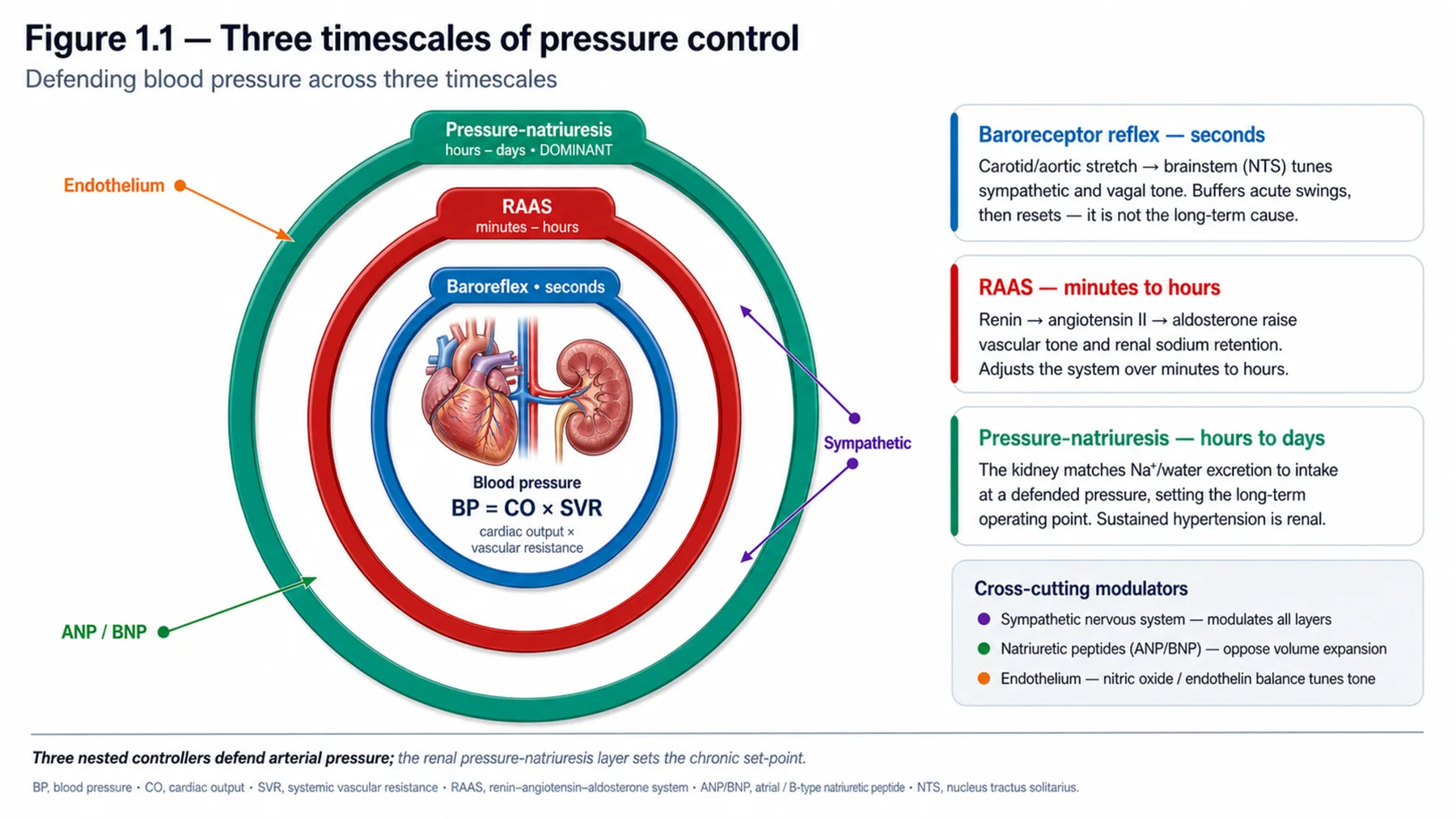
Blood pressure is the product of two quantities: the cardiac output (how much blood the heart pumps) and the systemic vascular resistance (how much the vessels oppose its flow). Anything that raises either raises blood pressure — a faster or stronger heart, an expanded blood volume (raising output), or constricted, stiffened vessels (raising resistance). The body regulates blood pressure by adjusting these, through a hierarchy of systems operating over different timescales: the baroreceptor reflex acts within seconds, the renin-angiotensin-aldosterone system over minutes to hours, and the kidney's control of sodium and volume over hours to days. Each timescale has its dominant controller, and the slowest — the renal control of volume — is, as we will see, the one that ultimately sets the long-term level. Holding the cardiac-output-times-resistance framework and the timescale hierarchy in mind makes every regulator, disorder, and drug in this volume locatable.
— The short-term reflex: baroreceptors
The fastest regulator is the arterial baroreceptor reflex. Stretch receptors in the carotid sinus and aortic arch sense the arterial pressure and signal the brainstem; when pressure falls, the reflex increases sympathetic outflow and decreases parasympathetic tone, raising the heart rate, contractility, and vascular tone to restore pressure within seconds, and the reverse when pressure rises. This reflex is what buffers the moment-to-moment swings of pressure — on standing, during exercise — but it is a short-term system that resets to the prevailing pressure over time, so it cannot set the long-term level. It is the reason an acute drop in pressure produces a reflex tachycardia, and the reason baroreceptor resetting allows chronic hypertension to persist without the reflex constantly opposing it. The baroreceptor reflex is the rapid stabiliser, not the long-term governor.
— The RAAS: the central hormonal regulator
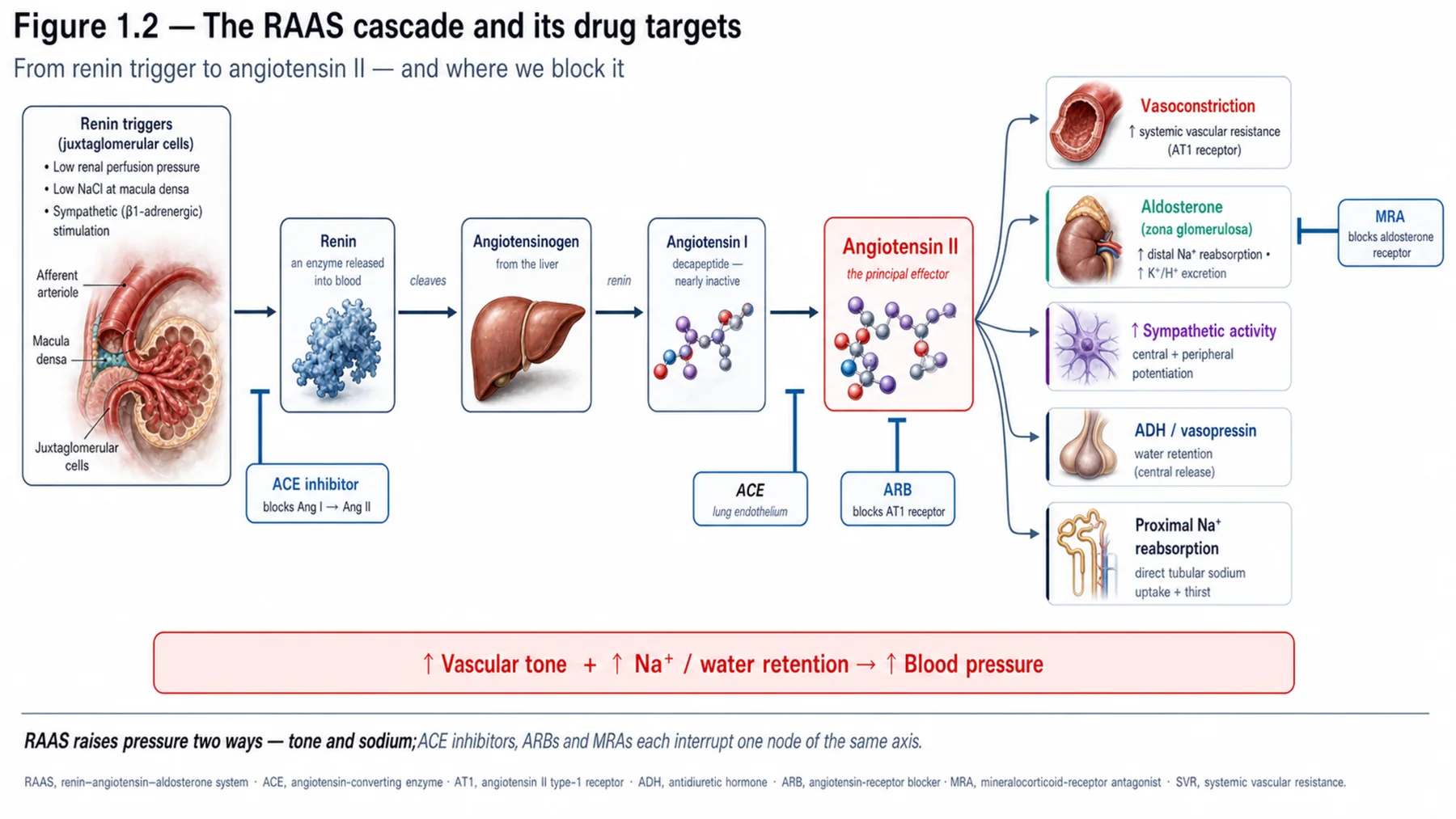
The renin-angiotensin-aldosterone system is the central medium-term regulator and the one most entangled with the kidney and with antihypertensive therapy. Its trigger is the kidney: the juxtaglomerular apparatus releases renin in response to reduced renal perfusion pressure, reduced sodium chloride delivery to the macula densa, or sympathetic (beta-1) stimulation. Renin cleaves angiotensinogen to angiotensin I, which angiotensin-converting enzyme converts to angiotensin II — the effector. Angiotensin II raises blood pressure by several routes at once: direct vasoconstriction (raising resistance), stimulation of aldosterone (driving distal sodium reabsorption), facilitation of sympathetic activity, release of ADH, stimulation of thirst, and enhancement of proximal sodium reabsorption. Aldosterone, in turn, reabsorbs sodium and excretes potassium in the distal nephron. The net effect is to raise both vascular tone and sodium retention — the two levers of blood pressure. Because the system is triggered by renal perfusion and acts so powerfully on sodium and tone, it is both a key mechanism of hypertension (when inappropriately activated) and the target of the most important antihypertensive drugs.
— Pressure-natriuresis: the kidney as long-term arbiter
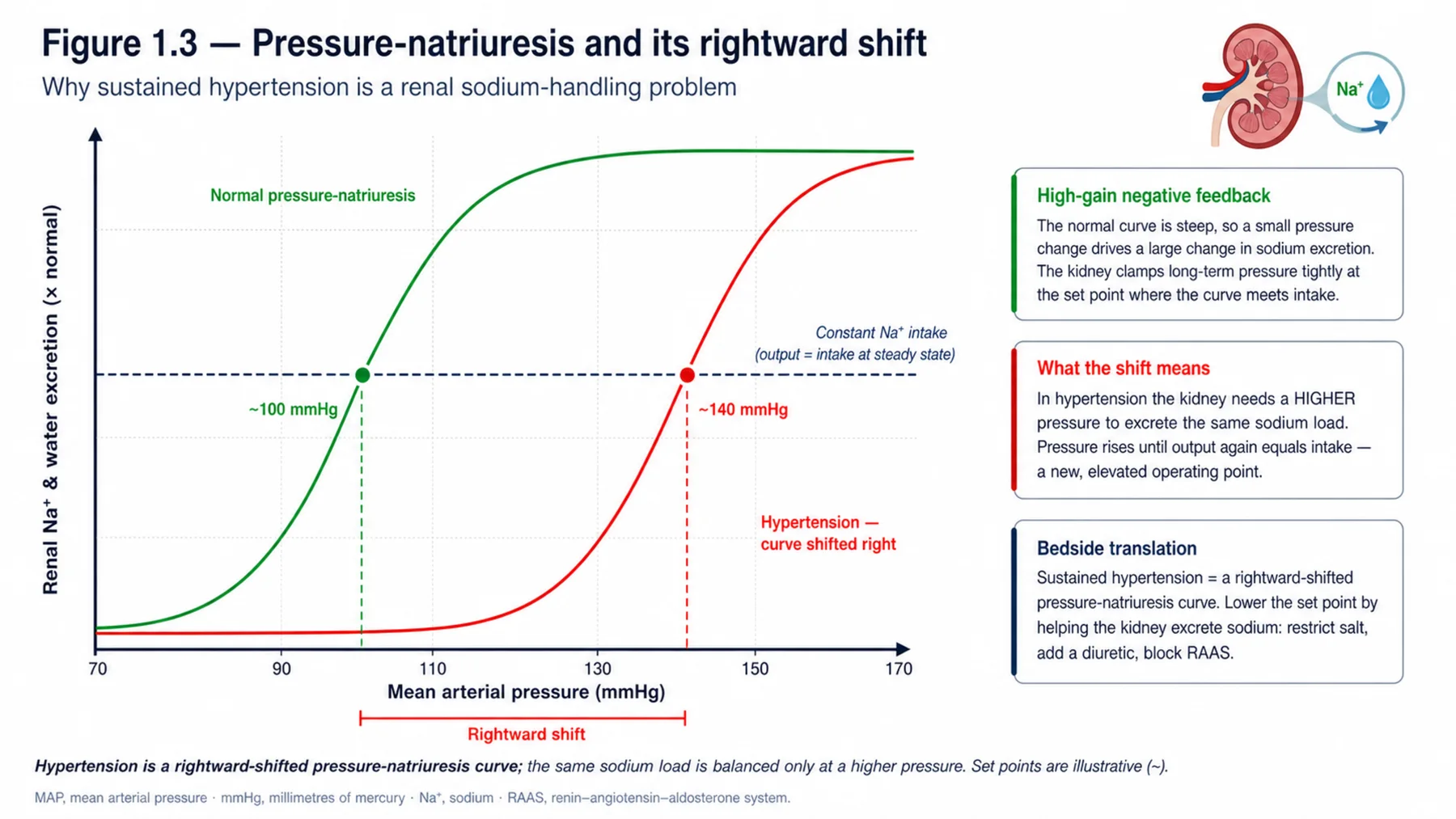
The deepest principle in blood-pressure regulation — and the conceptual heart of this chapter — is pressure-natriuresis, the idea (developed by Guyton) that the kidney is the dominant long-term controller of blood pressure through its handling of sodium and volume. The relationship is this: at any given arterial pressure, the kidney excretes a certain amount of sodium and water; raise the pressure, and the kidney excretes more (pressure-natriuresis); lower it, and the kidney excretes less. This creates a powerful negative feedback loop — if blood pressure rises above the kidney's set point, the increased sodium and water excretion reduces the blood volume and returns the pressure toward that set point, and vice versa. Crucially, this feedback has very high (effectively infinite) gain over the long term, which means the kidney, by its pressure-natriuresis relationship, sets the long-term blood pressure: whatever the short-term and hormonal systems do, the long-term pressure settles at the level where the kidney's sodium output matches the sodium intake. No other system can override the kidney over days, because only the kidney can permanently change the body's sodium and volume. This is why the kidney is called the long-term arbiter of blood pressure.
— Why sustained hypertension needs a renal shift
The pressure-natriuresis principle has a profound corollary: sustained hypertension cannot occur unless the kidney's pressure-natriuresis relationship is shifted. If the normal kidney returned blood pressure to its set point by excreting sodium whenever pressure rose, a chronically elevated pressure would be impossible — the kidney would simply natriurese it away. So for hypertension to persist, the relationship must be reset: the kidney must require a higher pressure to excrete the same sodium load (a rightward shift of the pressure-natriuresis curve). Every cause of hypertension, at some level, produces such a shift — whether through RAAS activation, sympathetic overactivity, intrinsic renal disease, salt sensitivity, or genetic defects in tubular sodium transport. This is the unifying insight: the kidney is involved in essentially all sustained hypertension, because sustained hypertension requires a renal sodium-handling shift. It reframes hypertension not as a disorder of blood vessels alone but as a disorder, ultimately, of renal sodium handling — which is why the kidney is at the centre of this entire volume.
— Salt sensitivity, the modulators, and the vicious cycle
Several further threads complete the picture. Salt sensitivity — the rise in blood pressure with sodium intake seen in many hypertensives — is the pressure-natriuresis principle in action: a kidney with impaired sodium excretion must run at a higher pressure to clear a sodium load, so blood pressure rises with salt. The system is modulated by the sympathetic nervous system (raising tone and renin), the natriuretic peptides (ANP and BNP, which promote natriuresis and oppose the RAAS), and the endothelium (nitric oxide vasodilating, endothelin vasoconstricting), with chronic hypertension remodelling and stiffening the vasculature over time. And the kidney's centrality cuts both ways: it is a cause of hypertension (impaired sodium handling, RAAS activation, renal parenchymal and renovascular disease) and a victim of it (the nephrosclerosis of later chapters), so that in CKD a vicious cycle develops — kidney disease raises blood pressure, which damages the kidney, which raises blood pressure further. This dual role, cause and victim, is a theme that will recur throughout the volume.
— Why this matters: the therapeutic map
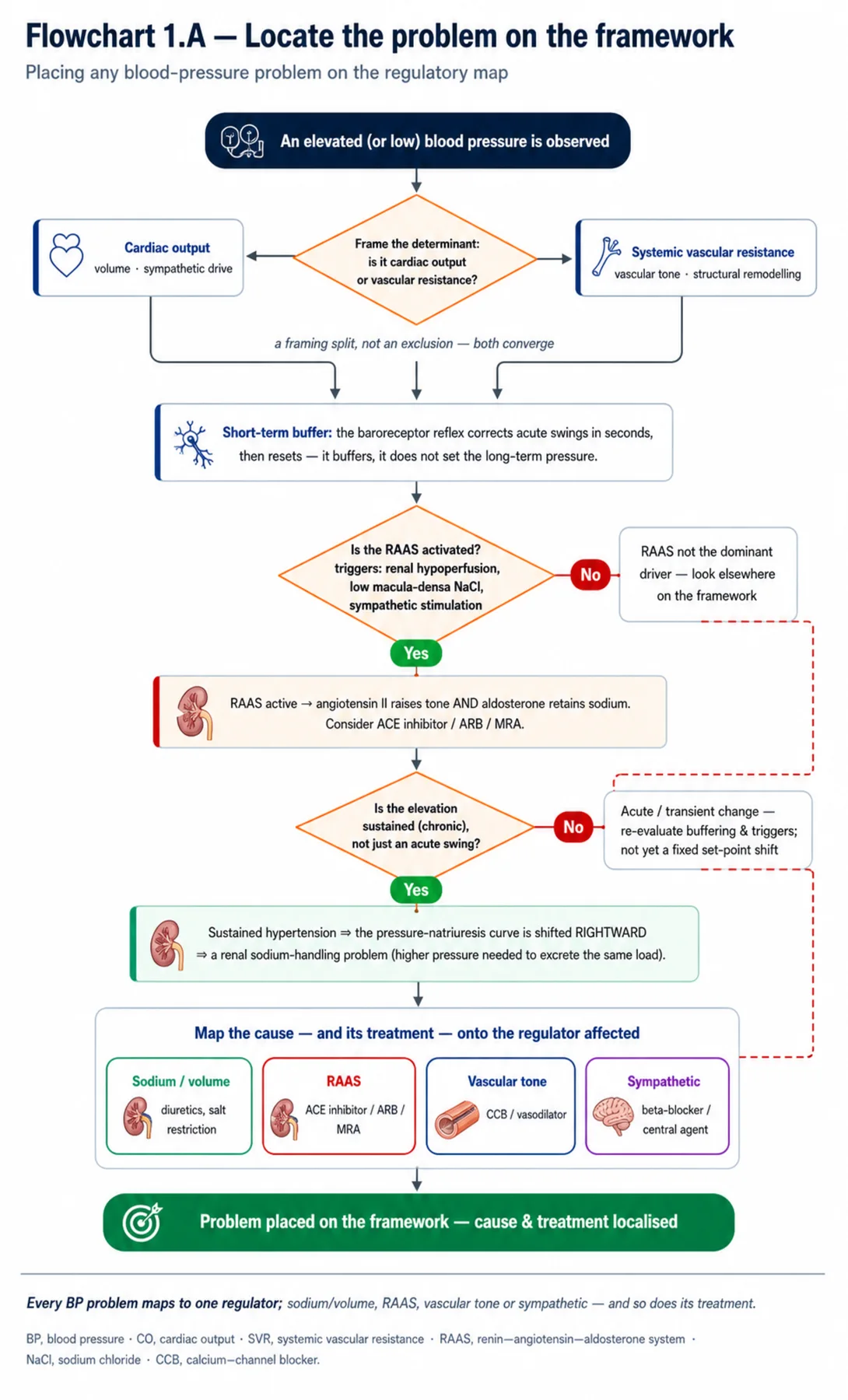
The payoff of this physiology is that it maps directly onto treatment. Because blood pressure is set by sodium-volume and vascular tone, and because the kidney and the RAAS are central, the major antihypertensive classes each target a node in the system: diuretics act on the kidney's sodium and volume handling (shifting the pressure-natriuresis relationship favourably); RAAS blockers (ACE inhibitors, angiotensin-receptor blockers, and mineralocorticoid antagonists) interrupt the angiotensin-aldosterone axis; calcium-channel blockers reduce vascular tone and resistance; and sympatholytics (beta-blockers, central agents) reduce sympathetic drive and renin. Seen this way, antihypertensive therapy is not an arbitrary list of drugs but a set of interventions each aimed at a specific regulator of blood pressure, with the kidney and the RAAS as the dominant targets. The chapters that follow — the causes of hypertension, its consequences, and its treatment — all build on this single framework: blood pressure is regulated by cardiac output and resistance, defended over seconds by baroreceptors and over hours by the RAAS, and set over the long term by the kidney's pressure-natriuresis, which is why the kidney is the centre of hypertension.
| 04 | PHASE A · LEVEL 4 · ORIENTATION & KNOWLEDGE Reference Tables |
Table 1.1 — Determinants of blood pressure
| Determinant | Detail |
| Blood pressure | = cardiac output × systemic vascular resistance |
| Cardiac output | Heart rate × stroke volume; raised by volume expansion, sympathetic drive |
| Systemic vascular resistance | Vascular tone and structure; raised by vasoconstriction, remodelling |
| Volume | Sodium and water content — the kidney's domain |
Table 1.2 — The regulators by timescale
| System | Timescale | Role |
| Baroreceptor reflex | Seconds | Buffers moment-to-moment swings; resets — not long-term |
| RAAS | Minutes–hours | Vasoconstriction + sodium retention; renal-triggered |
| Pressure-natriuresis | Hours–days | The dominant long-term controller (the kidney) |
| Modulators | Varies | Sympathetic, natriuretic peptides, endothelium |
Table 1.3 — The renin-angiotensin-aldosterone system
| Component | Detail |
| Renin trigger | Reduced renal perfusion, reduced macula densa NaCl, sympathetic (β-1) |
| Angiotensin II | Vasoconstriction, aldosterone, sympathetic, ADH, thirst, proximal Na reabsorption |
| Aldosterone | Distal sodium reabsorption, potassium excretion |
| Net effect | Raises both vascular tone and sodium retention |
Table 1.4 — Pressure-natriuresis
| Aspect | Detail |
| The relationship | Higher pressure → more sodium/water excretion; lower → less |
| The feedback | High-gain loop returning pressure toward the kidney's set point |
| The consequence | The kidney sets the long-term blood pressure |
| Sustained hypertension | Requires a rightward shift — higher pressure to excrete the same sodium |
Table 1.5 — The kidney: cause and victim
| Role | Detail |
| Cause | Impaired sodium handling, RAAS activation, renal/renovascular disease |
| Victim | Hypertensive nephrosclerosis |
| Vicious cycle | CKD raises BP → BP damages the kidney → BP rises further |
| Unifying point | Essentially all sustained hypertension involves renal sodium handling |
Table 1.6 — Antihypertensives mapped to the regulators
| Drug class | Target node |
| Diuretics | Renal sodium/volume — shift pressure-natriuresis |
| RAAS blockers (ACEi/ARB/MRA) | Angiotensin-aldosterone axis |
| Calcium-channel blockers | Vascular tone / resistance |
| Sympatholytics (beta-blockers, central agents) | Sympathetic drive and renin |
| 05 | PHASE B · LEVEL 5 · VISUALISE & MAP Imaging & Flowchart Specifications |
| 06 | PHASE B · LEVEL 6 · VISUALISE & MAP Concept Maps |
Each chain runs from physiology to a named clinical insight; read the arrows as “leads to.”
BP determinants. Blood pressure = cardiac output × systemic vascular resistance → raised by volume/sympathetic (output) or vasoconstriction/remodelling (resistance) → ACTION: locate any blood-pressure problem on output versus resistance.
Baroreceptor reflex. Carotid/aortic stretch receptors → brainstem → autonomic adjustment of rate, contractility, tone (seconds) → resets over time → ACTION: read it as the rapid buffer, not the long-term cause.
RAAS. Renal hypoperfusion/low macula densa NaCl/sympathetic → renin → angiotensin II → vasoconstriction + aldosterone + sodium retention → ACTION: recognise RAAS activation and target it (ACEi/ARB/MRA).
Pressure-natriuresis. Higher pressure → more sodium excretion (high-gain feedback) → the kidney sets the long-term pressure → ACTION: recognise the kidney as the long-term arbiter; diuretics shift the curve favourably.
The renal shift. Sustained hypertension requires a rightward-shifted pressure-natriuresis → the kidney needs a higher pressure to excrete the same sodium → ACTION: see essentially all sustained hypertension as a renal sodium-handling problem.
| 07 | PHASE B · LEVEL 7 · VISUALISE & MAP Decision Pathways |
| R1 | IF analysing a blood pressure, THEN locate it on cardiac output (volume, sympathetic) versus systemic vascular resistance (tone, structure). |
| R2 | IF an acute pressure change occurs, THEN expect the baroreceptor reflex to buffer it within seconds — but it resets and does not set the long-term level. |
| R3 | IF the RAAS is activated (renal hypoperfusion, low sodium delivery, sympathetic drive), THEN expect vasoconstriction and sodium retention raising blood pressure. |
| R4 | IF considering long-term blood pressure, THEN recognise the kidney as the arbiter through pressure-natriuresis — it sets the level by its sodium handling. |
| R5 | IF hypertension is sustained, THEN infer a rightward-shifted pressure-natriuresis — a renal sodium-handling problem underlies it. |
| R6 | IF blood pressure rises with salt intake, THEN recognise salt sensitivity — impaired renal sodium excretion requiring a higher pressure. |
| R7 | IF a patient has CKD, THEN expect the cause-and-victim vicious cycle — kidney disease raises blood pressure, which damages the kidney further. |
| R8 | IF choosing an antihypertensive, THEN map it to the regulator it targets — sodium/volume, RAAS, vascular tone, or sympathetic drive. |
| 08 | PHASE C · LEVEL 8 · CLINICAL REASONING Clinical Cases |
| CASE 1 | WHY IT STAYS HIGH The kidney sets the level Pressure-natriuresis |
Presentation
A student asks why, if a high blood pressure should make the kidney excrete more sodium and bring the pressure back down, a hypertensive patient's pressure stays elevated rather than self-correcting.
❖ Pause and reflect Why doesn't pressure-natriuresis simply correct sustained hypertension? |
Analysis
The question gets to the heart of pressure-natriuresis. In a normal person, a rise in pressure does increase sodium excretion, which lowers volume and returns the pressure to the kidney's set point — so a normal kidney would indeed natriurese away a high pressure. For hypertension to persist, the kidney's pressure-natriuresis relationship must be shifted rightward: the kidney now requires a higher pressure to excrete the same sodium load, so the pressure settles at a new, higher set point where sodium output again matches intake. The pressure stays high precisely because the kidney's relationship has reset — it is no longer 'trying' to bring the pressure down to the old level.
Plan
Understand sustained hypertension as a rightward-shifted pressure-natriuresis relationship — a renal sodium-handling problem — which is why interventions that shift the curve favourably (diuretics, sodium restriction, RAAS blockade) lower blood pressure. Treat the kidney's sodium handling, not just the vessels.
Teaching point
Sustained hypertension requires a rightward-shifted pressure-natriuresis — the kidney sets the long-term pressure and has reset to a higher level.
Cross-reference
Exercises rules R4 and R5; the pressure-natriuresis and renal-shift concept maps; Figure 1.3; Tables 1.4, 1.5.
| CASE 2 | THE KIDNEY CRIES FOR PRESSURE RAAS activation Renal hypoperfusion |
Presentation
A patient with a narrowed renal artery develops hypertension. The team wants to understand the mechanistic link between the reduced renal perfusion and the high systemic blood pressure.
❖ Pause and reflect How does reduced perfusion to one kidney raise the whole body's blood pressure? |
Analysis
Through the RAAS. The narrowed artery reduces perfusion pressure to that kidney, which the juxtaglomerular apparatus reads as a signal to release renin. Renin generates angiotensin II, which raises systemic blood pressure by vasoconstriction and by driving aldosterone and sodium retention — the kidney, sensing it is under-perfused, 'cries for pressure' by activating the system that raises pressure everywhere. The result is systemic hypertension driven by the RAAS, which is exactly why renovascular hypertension responds to RAAS blockade (and why the full renovascular story, including its hazards, comes later in the volume).
Plan
Recognise the renal hypoperfusion as the trigger for RAAS activation and the systemic hypertension as angiotensin-II-driven; this foreshadows the renovascular hypertension chapter. Understand RAAS activation as the link between renal perfusion and systemic pressure.
Teaching point
Reduced renal perfusion activates the RAAS — the kidney raises systemic pressure to defend its own perfusion.
Cross-reference
Exercises rule R3; the RAAS concept map; Figure 1.2; Table 1.3; renovascular hypertension in Chapter 9.
| CASE 3 | CAUSE AND VICTIM The vicious cycle Hypertension and CKD |
Presentation
A patient with CKD has worsening hypertension, and as the blood pressure rises the kidney function declines further, which in turn makes the blood pressure harder to control.
❖ Pause and reflect Why do hypertension and CKD worsen each other? |
Analysis
Because the kidney is both a cause and a victim of hypertension. The CKD impairs sodium handling and activates the RAAS, raising blood pressure (the kidney as cause); the elevated pressure damages the renal vasculature and glomeruli (nephrosclerosis — the kidney as victim), further impairing sodium handling and raising pressure still more. This sets up a vicious cycle in which kidney disease and hypertension drive each other, which is why blood-pressure control is central to slowing CKD progression and why the two are managed together throughout this volume and the CKD volume.
Plan
Recognise and interrupt the vicious cycle by controlling the blood pressure (to protect the kidney) and treating the kidney disease (to control the pressure), using the renally-active agents that target both. Manage hypertension and CKD together.
Teaching point
The kidney is both cause and victim of hypertension — in CKD the two drive each other in a vicious cycle that blood-pressure control interrupts.
Cross-reference
Exercises rule R7; the renal-shift concept map; Table 1.5; nephrosclerosis in Chapter 12 and CKD in Volume 6.
| CASE 4 | WHY THESE DRUGS Mapping treatment to physiology The therapeutic targets |
Presentation
A trainee is confused by the array of antihypertensive classes — diuretics, ACE inhibitors, calcium-channel blockers, beta-blockers — and asks whether there is a logic to which does what.
❖ Pause and reflect Is there a unifying logic to the antihypertensive drug classes? |
Analysis
Yes — each class targets a node in the regulatory system. Diuretics act on the kidney's sodium and volume handling, shifting the pressure-natriuresis relationship favourably. RAAS blockers (ACE inhibitors, angiotensin-receptor blockers, mineralocorticoid antagonists) interrupt the angiotensin-aldosterone axis. Calcium-channel blockers reduce vascular tone and systemic resistance. Sympatholytics (beta-blockers, central agents) reduce sympathetic drive and renin. Far from an arbitrary list, the classes map cleanly onto the determinants of blood pressure (output and resistance) and its regulators (sodium/volume, RAAS, tone, sympathetic), with the kidney and the RAAS as the dominant targets.
Plan
Learn the antihypertensive classes by the regulator each targets — sodium/volume, RAAS, vascular tone, or sympathetic drive — which makes their selection and combination logical (developed in the pharmacotherapy chapters). Map each drug to its physiological node.
Teaching point
The antihypertensive classes each target a regulator of blood pressure — sodium/volume, RAAS, vascular tone, or sympathetic drive — with the kidney and RAAS central.
Cross-reference
Exercises rule R8; the BP-determinants concept map; Table 1.6; pharmacotherapy in Chapters 6–7.
| 09 | PHASE C · LEVEL 9 · CLINICAL REASONING Clinical Implications |
One triad per mechanism the narrative exposed: the physiology, why it matters, and the clinical move.
MECHANISM Blood pressure is the product of cardiac output and systemic vascular resistance. |
WHY IT MATTERS Every cause and treatment of hypertension acts on one of these or their regulators. |
ACTION Locate any blood-pressure problem on output versus resistance. |
MECHANISM The baroreceptor reflex buffers pressure within seconds but resets over time. |
WHY IT MATTERS It cannot set the long-term level, so chronic hypertension persists despite it. |
ACTION Read the baroreceptor reflex as the rapid stabiliser, not the long-term cause. |
MECHANISM The RAAS is triggered by the kidney and raises both vascular tone and sodium retention. |
WHY IT MATTERS Inappropriate activation drives hypertension, and the system is the key drug target. |
ACTION Recognise RAAS activation and target it with ACE inhibitors, ARBs, or MRAs. |
MECHANISM Pressure-natriuresis is a high-gain feedback by which the kidney sets the long-term pressure. |
WHY IT MATTERS No other system can override the kidney's control of sodium and volume over days. |
ACTION Recognise the kidney as the long-term arbiter and treat its sodium handling. |
MECHANISM Sustained hypertension requires a rightward-shifted pressure-natriuresis relationship. |
WHY IT MATTERS This means essentially all sustained hypertension involves renal sodium handling. |
ACTION See hypertension as, ultimately, a renal sodium-handling problem. |
| 10 | PHASE C · LEVEL 10 · CLINICAL REASONING Clinical Pearls |
| Blood pressure = cardiac output × systemic vascular resistance. | Regulated over timescales: baroreceptors (seconds), RAAS (hours), kidney (days). |
| Baroreceptor reflex buffers acute swings — resets, not the long-term setter. | RAAS trigger: low renal perfusion, low macula densa NaCl, sympathetic. |
| Angiotensin II: vasoconstriction + aldosterone + sympathetic + ADH + thirst + Na reabsorption. | Aldosterone: distal sodium reabsorption, potassium excretion. |
| Pressure-natriuresis: higher pressure → more sodium excretion (high-gain feedback). | The kidney sets the long-term blood pressure. |
| Sustained hypertension = a rightward-shifted pressure-natriuresis curve. | Essentially all sustained hypertension involves renal sodium handling. |
| Salt sensitivity = impaired renal sodium excretion (BP rises with salt). | Modulators: sympathetic, natriuretic peptides, endothelium (NO/endothelin). |
| The kidney is both CAUSE and VICTIM of hypertension. | CKD + hypertension = a vicious cycle (control BP to protect the kidney). |
| Antihypertensives map to the regulators they target. | Diuretics (Na/volume), RAAS blockers, CCBs (tone), sympatholytics. |
| 11 | PHASE D · LEVEL 11 · SAFETY & EVIDENCE Red Flags & Never-Do |
Panel A — Red flags
| ▲ | Hypertension with hypokalaemia and alkalosis — think RAAS/aldosterone excess (the secondary-cause chapters). |
| ▲ | Hypertension that worsens as renal function declines — the cause-and-victim vicious cycle of CKD. |
| ▲ | Blood pressure that rises markedly with salt — salt sensitivity from impaired renal sodium excretion. |
| ▲ | Hypertension in a young patient or with renal asymmetry — consider renovascular or monogenic causes (later chapters). |
| ▲ | Reflex tachycardia with a falling pressure — the baroreceptor reflex responding to an acute drop. |
Panel B — Never do
| ✖ NEVER — think of hypertension as a disorder of blood vessels alone — the kidney's sodium handling is central. |
| ✖ NEVER — expect the baroreceptor reflex to control long-term blood pressure. |
| ✖ NEVER — overlook the kidney as both a cause and a victim of hypertension. |
| ✖ NEVER — choose an antihypertensive without knowing which regulator it targets. |
| 12 | PHASE D · LEVEL 12 · SAFETY & EVIDENCE Common Pitfalls |
Pitfall 1 — Vessels alone
| ✖ | WRONG Treating hypertension as a problem of the blood vessels only. |
| ✓ | RIGHT Recognising the kidney's sodium handling as central. |
| ✉ | WHY Sustained hypertension requires a renal pressure-natriuresis shift. |
Pitfall 2 — Relying on the reflex
| ✖ | WRONG Expecting the baroreceptor reflex to govern chronic pressure. |
| ✓ | RIGHT Recognising it as a short-term buffer that resets. |
| ✉ | WHY Only the kidney sets the long-term level. |
Pitfall 3 — Missing RAAS activation
| ✖ | WRONG Overlooking renal hypoperfusion as a driver of systemic hypertension. |
| ✓ | RIGHT Recognising RAAS activation and targeting it. |
| ✉ | WHY Angiotensin II links renal perfusion to systemic pressure. |
Pitfall 4 — Ignoring the cycle
| ✖ | WRONG Managing CKD and hypertension as separate problems. |
| ✓ | RIGHT Interrupting the vicious cycle by controlling both together. |
| ✉ | WHY The kidney is cause and victim, so they drive each other. |
Pitfall 5 — Arbitrary drug choice
| ✖ | WRONG Treating the antihypertensive classes as an arbitrary list. |
| ✓ | RIGHT Mapping each to the regulator it targets. |
| ✉ | WHY The classes target specific nodes — sodium/volume, RAAS, tone, sympathetic. |
| 13 | PHASE D · LEVEL 13 · SAFETY & EVIDENCE Evidence Grading |
GRADE A HIGH CONFIDENCE The effect is real and the estimate is stable. RCTs at low risk of bias; multiple concordant prospective cohorts; meta-analyses. |
GRADE B MODERATE CONFIDENCE The effect is likely real but may shift with new data. Observational studies, registries, mechanistic human studies. |
GRADE C LOW CONFIDENCE Rests on physiology, reasoning, or consensus rather than outcomes. Pathophysiological reasoning; extrapolation; consensus without outcomes. |
Graded statements (by evidence type)
| Statement | Grade | Basis (evidence type) |
| Blood pressure is the product of cardiac output and systemic vascular resistance. | A | Established physiology |
| The baroreceptor reflex provides short-term, not long-term, regulation. | A | Established physiology |
| The RAAS raises blood pressure via vasoconstriction and sodium retention. | A | Established physiology |
| The kidney sets long-term blood pressure through pressure-natriuresis. | A | Established physiology (Guyton) |
| Sustained hypertension requires a rightward-shifted pressure-natriuresis. | A | Established physiology |
| Salt sensitivity reflects impaired renal sodium excretion. | A | Established physiology and clinical data |
| Hypertension and CKD form a bidirectional vicious cycle. | A | Established physiology and clinical data |
| 18 | PHASE F · LEVEL 18 · APPLY & TEST Cheat Sheet |
| BP = cardiac output × systemic vascular resistance. | Regulators: baroreceptors (sec), RAAS (hrs), kidney (days). |
| Baroreceptor reflex = rapid buffer; resets; not long-term. | RAAS trigger: low renal perfusion / low macula densa NaCl / sympathetic. |
| Angiotensin II: vasoconstriction + aldosterone + Na retention + more. | Pressure-natriuresis: higher pressure → more Na excretion. |
| The kidney sets the long-term BP (high-gain feedback). | Sustained HTN = rightward-shifted pressure-natriuresis. |
| Essentially all sustained HTN involves renal sodium handling. | Salt sensitivity = impaired renal Na excretion. |
| Modulators: sympathetic, natriuretic peptides, endothelium. | Kidney = CAUSE and VICTIM of HTN. |
| CKD + HTN = vicious cycle. | Diuretics → Na/volume; RAAS blockers → angiotensin-aldosterone. |
| CCBs → vascular tone; sympatholytics → sympathetic/renin. | Map every cause and drug to its regulator. |
| 19 | PHASE F · LEVEL 19 · APPLY & TEST Flashcards |
| CARD 1 | Q. What determines blood pressure, and how is it regulated over time? A. Blood pressure is the product of cardiac output and systemic vascular resistance, regulated by the baroreceptor reflex (seconds), the RAAS (minutes to hours), and the kidney's pressure-natriuresis (hours to days). DETAILED. The slowest layer — renal volume control — sets the long-term level. CLINICAL. Locate any problem on output versus resistance and its regulator. |
| CARD 2 | Q. What is the role of the baroreceptor reflex? A. Arterial stretch receptors in the carotid sinus and aortic arch signal the brainstem to adjust heart rate, contractility, and vascular tone within seconds, buffering acute swings — but the reflex resets and cannot set the long-term pressure. DETAILED. It is the rapid stabiliser, not the long-term governor. CLINICAL. Read it as a short-term buffer. |
| CARD 3 | Q. How does the RAAS raise blood pressure? A. Renin (released for reduced renal perfusion, reduced macula densa sodium, or sympathetic drive) generates angiotensin II, which vasoconstricts and stimulates aldosterone, sympathetic activity, ADH, thirst, and sodium reabsorption — raising both tone and sodium retention. DETAILED. It is triggered by the kidney and is the key drug target. CLINICAL. Recognise and target RAAS activation. |
| CARD 4 | Q. What is pressure-natriuresis, and why does it matter? A. The relationship by which a higher arterial pressure increases renal sodium and water excretion; through this high-gain feedback the kidney returns pressure to its set point and thereby sets the long-term blood pressure. DETAILED. No other system can override the kidney's volume control over days. CLINICAL. Recognise the kidney as the long-term arbiter of blood pressure. |
| CARD 5 | Q. Why must sustained hypertension involve the kidney? A. Because a normal kidney would natriurese away a high pressure; for hypertension to persist, the pressure-natriuresis relationship must be shifted rightward, so the kidney requires a higher pressure to excrete the same sodium. DETAILED. Essentially all sustained hypertension involves renal sodium handling. CLINICAL. See hypertension as, ultimately, a renal sodium-handling problem. |
| CARD 6 | Q. What is salt sensitivity? A. The rise in blood pressure with sodium intake seen in many hypertensives — the consequence of impaired renal sodium excretion, so the kidney must run at a higher pressure to clear a sodium load. DETAILED. It is pressure-natriuresis seen clinically. CLINICAL. Restrict sodium and treat the renal sodium handling. |
| CARD 7 | Q. Why is the kidney both a cause and a victim of hypertension? A. It is a cause through impaired sodium handling, RAAS activation, and renal disease, and a victim through hypertensive nephrosclerosis — so in CKD a vicious cycle develops where each worsens the other. DETAILED. Blood-pressure control interrupts the cycle. CLINICAL. Manage hypertension and CKD together. |
| CARD 8 | Q. How do the antihypertensive classes map onto the physiology? A. Diuretics target renal sodium and volume; RAAS blockers (ACE inhibitors, ARBs, MRAs) the angiotensin-aldosterone axis; calcium-channel blockers vascular tone; and sympatholytics the sympathetic drive and renin. DETAILED. Each targets a regulator of blood pressure, with the kidney and RAAS central. CLINICAL. Choose drugs by the regulator they target. |
| 20 | PHASE F · LEVEL 20 · APPLY & TEST One-Minute Preceptor |
| SCENE 1 | The student puzzled by persistent hypertension |
GET A COMMITMENT. “Why doesn't the kidney just excrete sodium and bring this high pressure back to normal?”
PROBE FOR EVIDENCE. “It should natriurese” — ask: “What must have happened to the pressure-natriuresis relationship for the pressure to stay high?”
TEACH A GENERAL RULE. Sustained hypertension requires a rightward-shifted pressure-natriuresis — the kidney has reset to need a higher pressure to excrete the same sodium, so the pressure settles high.
REINFORCE WHAT WAS RIGHT. Recognising that a normal kidney would natriurese was the right instinct.
CORRECT A MISTAKE. See sustained hypertension as a renal sodium-handling shift.
| SCENE 2 | The trainee lost among the drug classes |
GET A COMMITMENT. “You find the antihypertensive classes confusing — is there a logic to them?”
PROBE FOR EVIDENCE. “They all just lower pressure” — ask: “Which regulator does each one target?”
TEACH A GENERAL RULE. Each class targets a node — diuretics the kidney's sodium/volume, RAAS blockers the angiotensin-aldosterone axis, calcium-channel blockers vascular tone, sympatholytics the sympathetic drive.
REINFORCE WHAT WAS RIGHT. Knowing they all lower pressure was a start.
CORRECT A MISTAKE. Learn each drug by the regulator it targets.
| 22 | PHASE F · LEVEL 22 · APPLY & TEST Board-Style Questions |
| Q 01 | Blood pressure is the product of: |
| A | Heart rate and stroke volume only |
| B | Cardiac output and systemic vascular resistance |
| C | Renin and aldosterone |
| D | Sodium and water |
Rationale Blood pressure equals cardiac output times systemic vascular resistance (Table 1.1, rule R1). A defines only cardiac output; C and D are regulators/components, not the equation. |
| Q 02 | The arterial baroreceptor reflex: |
| A | Sets the long-term blood pressure |
| B | Buffers acute pressure changes within seconds but resets over time |
| C | Releases renin |
| D | Excretes sodium |
Rationale The baroreceptor reflex is the rapid short-term buffer that resets and cannot set the long-term level (Table 1.2, rule R2). A, C, and D misattribute its role. |
| Q 03 | What triggers renin release? |
| A | High renal perfusion |
| B | Reduced renal perfusion, reduced macula densa sodium, or sympathetic stimulation |
| C | High potassium |
| D | Volume overload |
Rationale Renin is released for reduced perfusion, reduced distal sodium delivery, or sympathetic drive (Figure 1.2, Table 1.3, rule R3). A is the opposite; C and D do not trigger renin this way. |
| Q 04 | Through what mechanism does the kidney set the long-term blood pressure? |
| A | The baroreceptor reflex |
| B | Pressure-natriuresis — higher pressure increases sodium excretion |
| C | Aldosterone alone |
| D | Vascular remodelling |
Rationale Pressure-natriuresis is the high-gain feedback by which the kidney sets the long-term pressure (Figure 1.3, Table 1.4, rule R4). A is short-term; C and D are partial. |
| Q 05 | Why must sustained hypertension involve the kidney? |
| A | It does not |
| B | A normal kidney would natriurese away a high pressure, so persistence requires a rightward-shifted pressure-natriuresis |
| C | Only the heart matters |
| D | The baroreceptors fail |
Rationale Sustained hypertension requires the kidney's pressure-natriuresis to shift rightward (case 1, rule R5). A, C, and D are incorrect. |
| Q 06 | How does a narrowed renal artery cause systemic hypertension? |
| A | By direct vasoconstriction only |
| B | Reduced perfusion activates renin, generating angiotensin II that raises systemic pressure |
| C | By raising potassium |
| D | It does not |
Rationale Renal hypoperfusion activates the RAAS, and angiotensin II raises systemic pressure (case 2, Figure 1.2). A, C, and D are incorrect. |
| Q 07 | Why do hypertension and CKD worsen each other? |
| A | They are unrelated |
| B | The kidney is both a cause and a victim of hypertension, creating a vicious cycle |
| C | Only CKD causes hypertension |
| D | Only hypertension causes CKD |
Rationale The kidney causes hypertension (sodium handling, RAAS) and is damaged by it (nephrosclerosis), driving a vicious cycle (case 3, Table 1.5, rule R7). A, C, and D are incomplete. |
| Q 08 | Which antihypertensive class acts on the kidney's sodium and volume handling? |
| A | Calcium-channel blockers |
| B | Diuretics |
| C | Beta-blockers |
| D | Direct vasodilators |
Rationale Diuretics target renal sodium and volume, shifting pressure-natriuresis favourably (case 4, Table 1.6, rule R8). A targets tone; C targets the sympathetic system; D targets vessels. |