Chapter Preamble
Signals declared
Sig-D — Diagnostic (primary). Recognise that each special population has a different physiological baseline, so 'normal' values and the disturbances differ.
Sig-T — Therapeutic (strong). Adjust the targets and the treatment to the population — isotonic paediatric fluids, cautious correction in the elderly, the pregnancy-specific hazards.
Levels populated and omitted
Populated (17): L1–L5, L7, L8, L10–L14, L17–L20, L22. The therapeutic signal fires the absolute-risk table (L14) and templates (L17); the diagnostic signal drives the tables, rules, cases, pitfalls, and board items.
L6 / L9 mechanism levels — omitted. No Sig-M; the underlying mechanisms were built in the disorder chapters, and this chapter applies them to populations.
L15 / L16 preference-sensitive map and SDM scripts — omitted. No Sig-E; adapting management to a population is effective care.
| 01 | PHASE A · LEVEL 1 · ORIENTATION & KNOWLEDGE Learning Objectives |
By the end of this chapter you should be able to:
Explain why each special population has a different physiological baseline.
Describe the normal acid-base and sodium changes of pregnancy and their disorders.
Recognise why the elderly are prone to both hypo- and hypernatraemia and to hyperkalaemia.
Describe the paediatric fluid baseline and the major paediatric disturbances.
Use isotonic maintenance fluids in children and explain why.
Correct dysnatraemias cautiously in the elderly and in hypernatraemic children.
Adjust the targets and treatment to the population's baseline.
Account for each population's specific vulnerabilities.
| 02 | PHASE A · LEVEL 2 · ORIENTATION & KNOWLEDGE Executive Summary |
Each special population — pregnant, elderly, paediatric — has a different physiological baseline, so the 'normal' values and the characteristic disturbances differ, and management is adjusted accordingly.
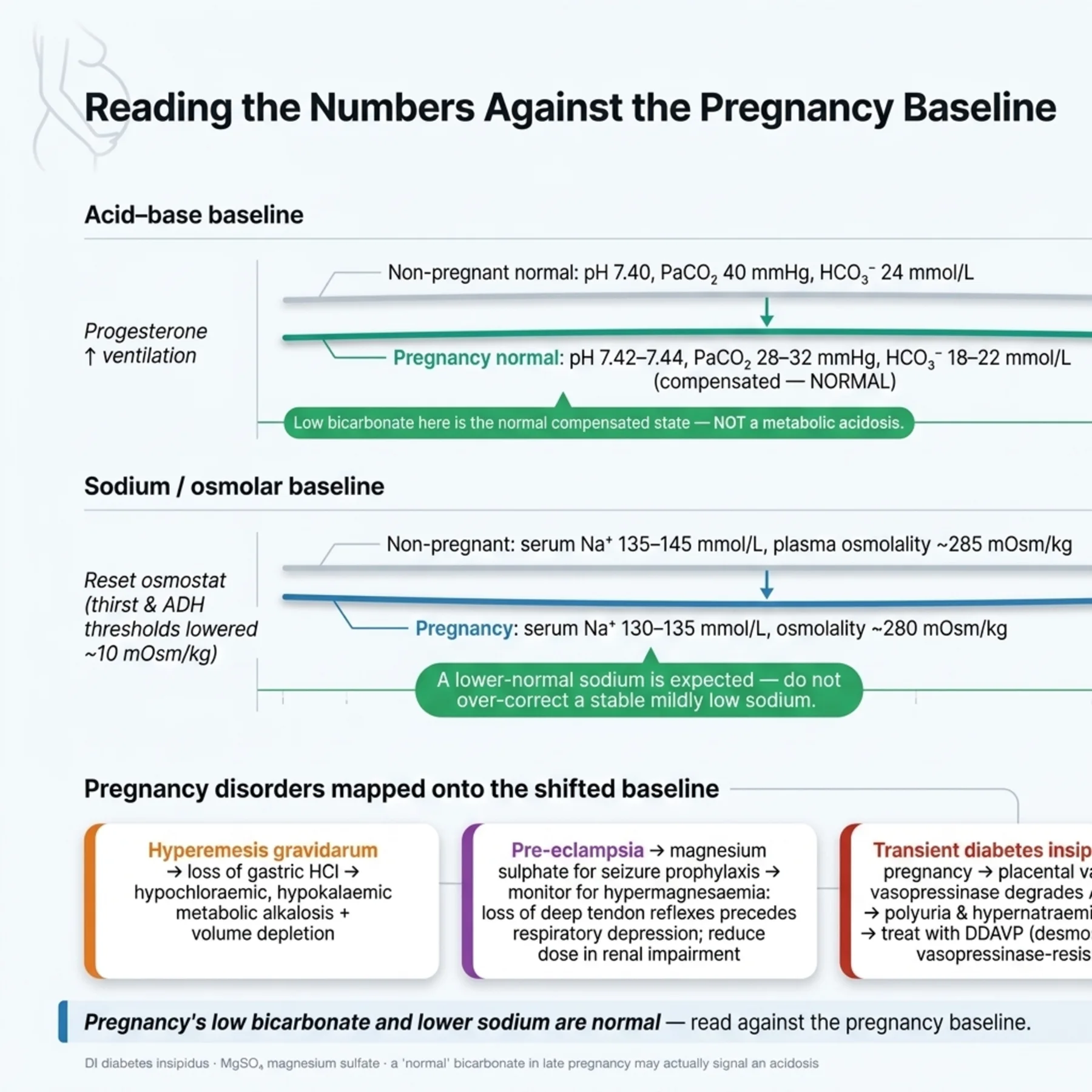
Pregnancy produces a chronic respiratory alkalosis (progesterone-driven hyperventilation) with a compensatory low bicarbonate — a normal finding — and a reset osmostat that lowers the normal sodium by a few mmol.
Pregnancy disorders include hyperemesis (a metabolic alkalosis with hypokalaemia and ketosis), the magnesium therapy of pre-eclampsia (with its hypermagnesaemia risk), cautious fluid management, and a transient diabetes insipidus from placental vasopressinase.
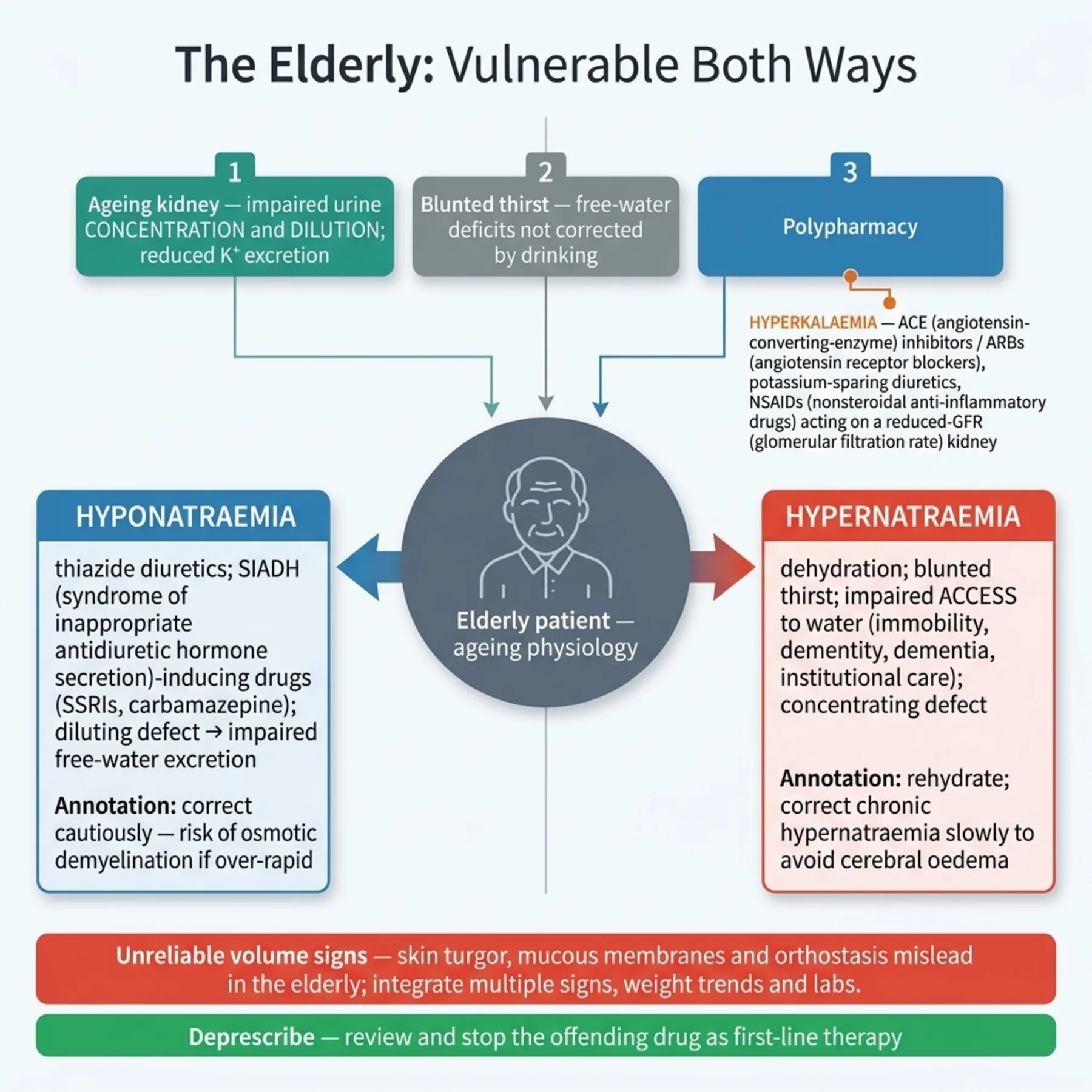
The elderly have a reduced GFR, impaired urinary concentration and dilution, blunted thirst, reduced total body water, and reduced renin and aldosterone.
They are therefore prone to both hyponatraemia (thiazides, SIADH, impaired water excretion) and hypernatraemia (dehydration, blunted thirst, impaired access), and to hyperkalaemia.
Clinical volume signs are unreliable in the elderly, and polypharmacy is a major contributor, so deprescribing and cautious correction matter.
Children have a higher total body water, a higher turnover, and an immature neonatal kidney, with weight-based dosing.
Dehydration from gastroenteritis is the major paediatric fluid problem.
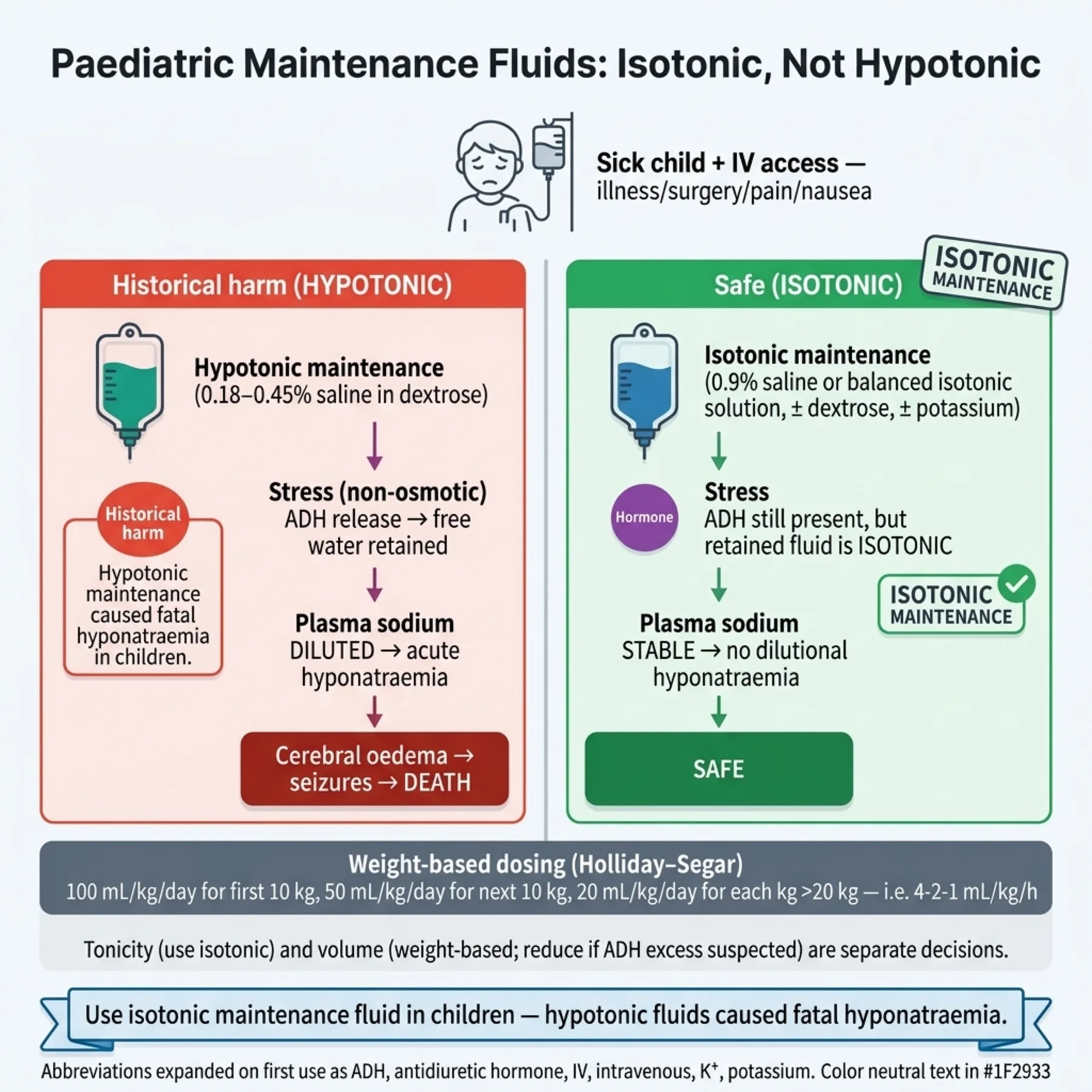
Isotonic maintenance fluids are used in children, because hypotonic fluids caused fatal hyponatraemia.
Hypernatraemic dehydration in children is corrected slowly to avoid cerebral oedema, and pyloric stenosis produces a hypochloraemic, hypokalaemic metabolic alkalosis.
The unifying principle is to recognise the population's baseline, adjust the targets and treatment, and account for the specific vulnerabilities.
A value that is abnormal in one population may be normal in another — the low bicarbonate of pregnancy, the lower sodium of the reset osmostat.
Failing to adjust for the baseline leads to mistreating normal physiology or missing a real disturbance.
| 03 | PHASE A · LEVEL 3 · ORIENTATION & KNOWLEDGE Main Narrative |
The reference ranges of this volume assume a typical adult. Pregnancy, old age, and childhood each shift the physiological baseline, so a value that is abnormal in one is normal in another, and the management that suits one would harm another. The low bicarbonate of pregnancy is normal; the elderly patient's blunted thirst makes hypernatraemia easy; the child needs isotonic maintenance fluid where an adult might tolerate hypotonic. This chapter adjusts the volume's principles to three populations whose baselines differ.
— Pregnancy: a normal respiratory alkalosis and a reset osmostat
Pregnancy changes the acid-base and sodium baselines in ways that look abnormal but are physiological. Progesterone stimulates ventilation, producing a chronic respiratory alkalosis with a low PCO2 and a compensatory low bicarbonate — so a 'low bicarbonate' that would signal a metabolic acidosis in a non-pregnant adult is the expected compensation in pregnancy. The osmostat is reset downward, lowering the normal sodium by a few mmol (around 5), so a mildly low sodium can be normal for pregnancy. Plasma volume expands (a dilutional effect), and the GFR rises (lowering the normal creatinine and urea). On this altered baseline sit the pregnancy-specific disorders: hyperemesis gravidarum (severe vomiting causing a metabolic alkalosis with hypokalaemia and ketosis), the magnesium sulfate used for pre-eclampsia and eclampsia (requiring monitoring for hypermagnesaemia), the need for cautious fluid management (the pre-eclamptic patient is prone to pulmonary oedema), and a transient diabetes insipidus from placental vasopressinase degrading ADH. The key is to read the pregnant patient against the pregnancy baseline, not the standard adult one.
— The elderly: impaired handling and blunted thirst
Ageing degrades several of the regulatory functions this volume describes, making the elderly vulnerable to disturbance in both directions. The GFR falls, the ability to concentrate and dilute the urine declines, thirst is blunted, total body water is reduced, and the renin-aldosterone axis is less responsive. The consequences are a striking susceptibility to both hyponatraemia and hypernatraemia: hyponatraemia from thiazides, SIADH, and impaired water excretion; hypernatraemia from dehydration, the blunted thirst, and impaired access to water (the populations of the hypernatraemia chapter). The elderly are also prone to hyperkalaemia (reduced excretion compounded by RAAS blockers and potassium-sparing diuretics) and to both volume depletion and overload. Two practical points dominate their care: the clinical signs of volume status are especially unreliable in the elderly (skin turgor, as the opening chapter warned, is nearly useless), so assessment must integrate multiple signs and adjuncts; and polypharmacy is a leading cause, making medication review and deprescribing central. Correction is cautious, because the ageing brain is vulnerable and the disturbances are often chronic and adapted.
— Children: high water, immature kidney, and the maintenance-fluid lesson
Children differ from adults in body composition and renal maturity, and one historical lesson dominates their fluid management. The total body water fraction is higher (around 70 to 75% in the neonate), turnover is faster, and the neonatal kidney is immature with limited concentrating ability — and everything is dosed by weight. Dehydration, usually from gastroenteritis, is the major paediatric fluid problem, managed with careful weight-based rehydration (oral where possible). The dominant lesson concerns maintenance fluids: the historical use of hypotonic maintenance fluids in children caused fatal hyponatraemia (stress-driven ADH retaining the free water), and the now-standard recommendation is isotonic maintenance fluid — the clearest legacy of that harm, met first in the fluids chapter. Two further paediatric specifics: hypernatraemic dehydration must be corrected slowly to avoid cerebral oedema (the same chronic-correction caution as in adults, sharpened by the vulnerable child's brain), and pyloric stenosis produces the classic hypochloraemic, hypokalaemic metabolic alkalosis from the projectile vomiting of gastric acid. Weight-based, isotonic, and cautious is the paediatric refrain.
— The unifying principle: adjust for the baseline
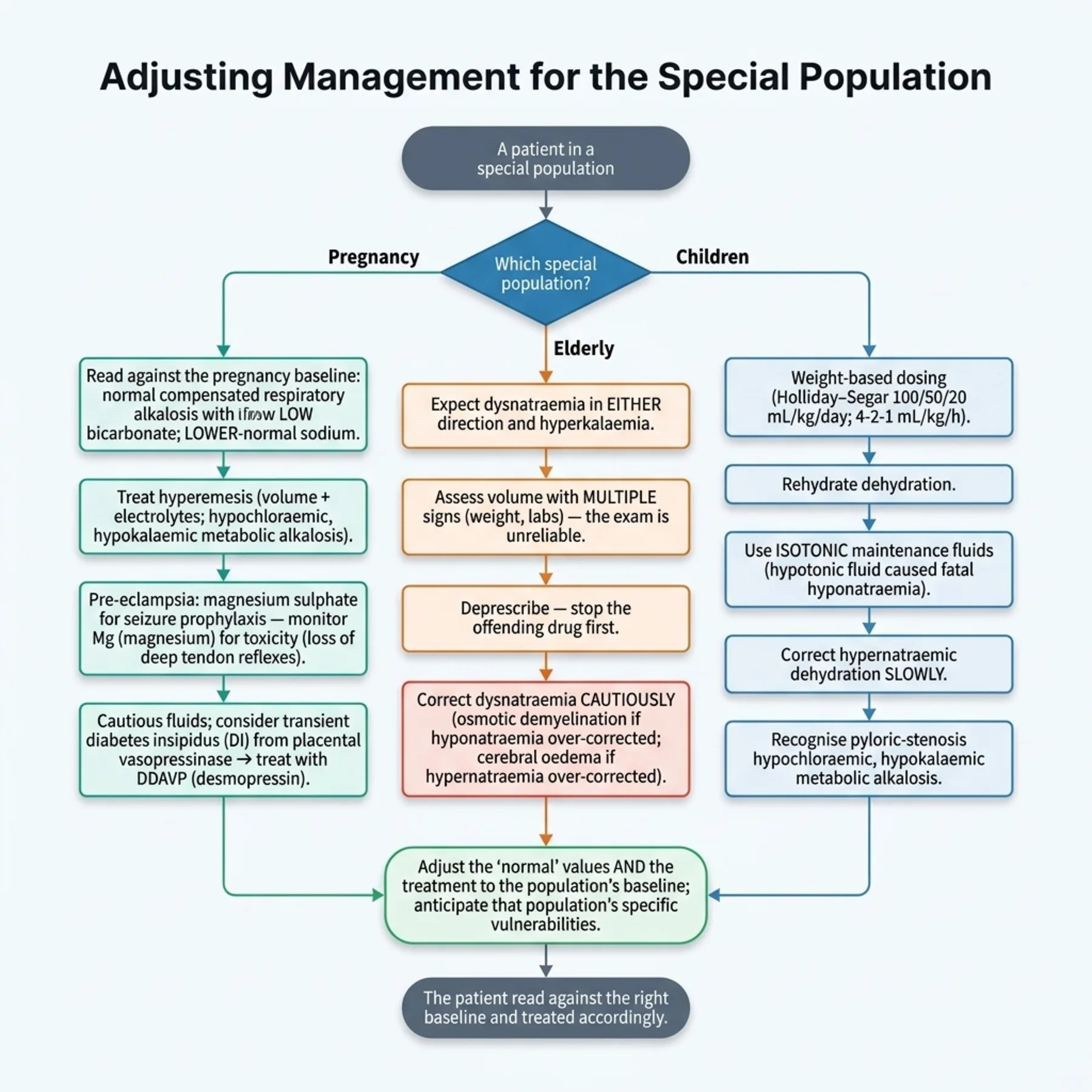
Across all three populations, the method is the same: recognise the population's physiological baseline, adjust the 'normal' values and the treatment targets, and account for the specific vulnerabilities. The failure mode is to apply the standard adult reference range and either mistreat normal physiology (giving bicarbonate for the 'low bicarbonate' of pregnancy, or worrying about the reset-osmostat sodium) or miss a real disturbance (failing to recognise that the elderly patient's 'mild' hyponatraemia from a thiazide is both real and consequential). Adjusting for the baseline also means anticipating the population's characteristic risks — the elderly patient's blunted thirst and polypharmacy, the child's vulnerability to hypotonic fluids, the pregnant patient's pre-eclampsia and magnesium therapy. The principle generalises: there is no single 'normal,' and good management reads each patient against the right baseline.
— Treating across the populations
Treatment adapts the volume's principles to each population's baseline and vulnerabilities. In pregnancy, the disorders are treated with the pregnancy baseline in mind — not 'correcting' the normal respiratory alkalosis or reset-osmostat sodium, treating hyperemesis with fluids and electrolytes, monitoring magnesium in pre-eclampsia, and managing fluids cautiously. In the elderly, treatment is cautious and integrated: correct dysnatraemias slowly (the adapted brain), review and deprescribe the contributing drugs, assess volume with multiple signs given the unreliable exam, and watch for hyperkalaemia. In children, treatment is weight-based and isotonic: rehydrate dehydration by weight, use isotonic maintenance fluids, correct hypernatraemic dehydration slowly, and recognise the pyloric-stenosis alkalosis. The common thread — fitting the standard principles to the population — is what distinguishes safe management in these groups from the error of treating everyone as a standard adult. As the volume nears its synthesis, this chapter is a reminder that physiology, and therefore management, is not one-size-fits-all.
| 04 | PHASE A · LEVEL 4 · ORIENTATION & KNOWLEDGE Reference Tables |
Table 17.1 — Pregnancy: baseline and disorders
| Aspect | Detail |
| Acid-base baseline | Chronic respiratory alkalosis (progesterone) + compensatory low bicarbonate — NORMAL |
| Sodium baseline | Reset osmostat — normal sodium lower by ~5 mmol; plasma volume expanded |
| GFR | Increased — lower normal creatinine/urea |
| Disorders | Hyperemesis (alkalosis + hypokalaemia + ketosis); pre-eclampsia (Mg therapy); transient DI (vasopressinase) |
| Fluids | Cautious — pulmonary-oedema risk in pre-eclampsia |
Table 17.2 — The elderly: physiology and vulnerabilities
| Aspect | Detail |
| Physiology | Reduced GFR, impaired concentration/dilution, blunted thirst, reduced TBW, reduced renin/aldosterone |
| Hyponatraemia | Thiazides, SIADH, impaired water excretion |
| Hypernatraemia | Dehydration, blunted thirst, impaired access |
| Hyperkalaemia | Reduced excretion + RAAS/K-sparing drugs |
| Practical | Unreliable volume signs; polypharmacy; cautious correction, deprescribing |
Table 17.3 — Children: physiology and disorders
| Aspect | Detail |
| Body composition | Higher total body water (neonate ~70–75%); faster turnover |
| Kidney | Immature neonatal kidney — limited concentrating; weight-based dosing |
| Major problem | Dehydration (gastroenteritis) — weight-based rehydration |
| Maintenance fluids | ISOTONIC (hypotonic caused fatal hyponatraemia) |
| Specifics | Hypernatraemic dehydration (correct slowly); pyloric stenosis (hypochloraemic hypokalaemic alkalosis) |
Table 17.4 — The baselines compared
| Population | Key baseline shift |
| Pregnancy | Respiratory alkalosis + low bicarbonate (normal); lower sodium (reset osmostat) |
| Elderly | Impaired water handling + blunted thirst — dysnatraemia either way |
| Children | Higher total body water; immature kidney; weight-based |
| Principle | A value normal in one may be abnormal in another |
Table 17.5 — Management adjustments
| Population | Adjustment |
| Pregnancy | Read against the pregnancy baseline; treat hyperemesis; monitor Mg; cautious fluids |
| Elderly | Cautious correction; deprescribe; assess volume with multiple signs |
| Children | Weight-based; ISOTONIC maintenance; correct hypernatraemic dehydration slowly |
| All | Adjust targets and treatment to the baseline; anticipate the vulnerabilities |
Table 17.6 — Population-specific vulnerabilities
| Population | Watch for |
| Pregnancy | Mistreating normal alkalosis/sodium; hypermagnesaemia (pre-eclampsia); pulmonary oedema |
| Elderly | Both dysnatraemias; hyperkalaemia; unreliable exam; polypharmacy |
| Children | Hypotonic-fluid hyponatraemia; hypernatraemic-dehydration cerebral oedema |
| All | Applying the standard adult range inappropriately |
| 05 | PHASE B · LEVEL 5 · VISUALISE & MAP Imaging & Flowchart Specifications |
| 08 | PHASE C · LEVEL 8 · CLINICAL REASONING Clinical Cases |
| CASE 1 | NORMAL FOR PREGNANCY Read the right baseline The pregnancy baseline |
Presentation
A pregnant patient has a low bicarbonate and a sodium a few mmol below the standard range. A trainee, applying the standard adult reference range, plans to investigate and treat a metabolic acidosis and hyponatraemia.
❖ Pause and reflect Are these values abnormal in pregnancy? |
Analysis
No — both are the normal pregnancy baseline. Progesterone drives a chronic respiratory alkalosis, and the compensatory response lowers the bicarbonate; so the 'low bicarbonate' is the expected compensation, not a metabolic acidosis. The osmostat is reset downward, so a sodium a few mmol below the standard range is normal for pregnancy. Treating these as pathology would be mistreating normal physiology. The values must be read against the pregnancy baseline, not the standard adult one.
Plan
Recognise the low bicarbonate as the normal compensation for the physiological respiratory alkalosis and the slightly low sodium as the reset osmostat; do not investigate or treat them as disease. Read pregnant patients against the pregnancy baseline.
Teaching point
Pregnancy's respiratory alkalosis with a low bicarbonate, and its lower sodium, are normal — read against the pregnancy baseline, don't treat them.
Cross-reference
Exercises the adjust-for-baseline principle; Figure 17.1; Tables 17.1, 17.4.
| CASE 2 | BOTH WAYS Vulnerable in either direction Dysnatraemia in the elderly |
Presentation
An elderly patient on a thiazide presents with hyponatraemia; on another admission, after a febrile illness with poor intake, the same patient presents hypernatraemic. The team is puzzled by the opposite disturbances.
❖ Pause and reflect How can the same patient develop opposite dysnatraemias? |
Analysis
Because ageing impairs water handling in both directions and blunts thirst. The thiazide impaired free-water excretion, causing hyponatraemia; the febrile illness with poor intake, combined with blunted thirst and impaired concentrating ability, caused hypernatraemia. The elderly are vulnerable to dysnatraemia either way — a single patient can swing between them depending on the precipitant. The drug (thiazide) and the access/thirst issues are the leverage points, and the clinical volume signs are unreliable, so assessment integrates multiple signs.
Plan
For the hyponatraemia, review and stop the thiazide and manage the sodium; for the hypernatraemia, restore water and address access and thirst — correcting both cautiously given the adapted brain. Recognise the bidirectional vulnerability and review the medications.
Teaching point
The elderly are prone to BOTH hyponatraemia (thiazides, impaired excretion) and hypernatraemia (dehydration, blunted thirst) — review drugs and correct cautiously.
Cross-reference
Exercises the elderly adjustments; Figure 17.2; Tables 17.2, 17.6; hyponatraemia (Chapter 4) and hypernatraemia (Chapter 6).
| CASE 3 | ISOTONIC, NOT HYPOTONIC The maintenance-fluid lesson Paediatric fluids |
Presentation
A child admitted with gastroenteritis is placed on hypotonic maintenance fluid, and over a day the sodium falls and the child becomes drowsy.
❖ Pause and reflect Why did the sodium fall on maintenance fluid, and what should have been used? |
Analysis
The hypotonic maintenance fluid caused the hyponatraemia. The child's illness drives ADH secretion, which retains the free water delivered by hypotonic fluid, dropping the sodium — the well-described, occasionally fatal harm that led to the now-standard recommendation for isotonic maintenance fluids in children. The error was using hypotonic fluid; isotonic maintenance, dosed by weight, would have avoided it. This is the paediatric form of the maintenance-fluid lesson from the fluids chapter, where the harm was first established.
Plan
Stop the hypotonic fluid, switch to isotonic maintenance dosed by weight, and manage the hyponatraemia; rehydrate the gastroenteritis appropriately. Use isotonic maintenance fluids in children by default.
Teaching point
Use isotonic maintenance fluid in children — hypotonic fluids cause fatal hyponatraemia (stress ADH retains the free water).
Cross-reference
Exercises the paediatric adjustments; Figure 17.3; Tables 17.3, 17.6; maintenance fluids in Chapter 2.
| CASE 4 | GO SLOW IN THE CHILD The vulnerable brain Hypernatraemic dehydration |
Presentation
A young child with prolonged diarrhoea presents with hypernatraemic dehydration. The team plans rapid free-water replacement to normalise the sodium quickly.
❖ Pause and reflect Should the sodium be corrected rapidly in this child? |
Analysis
No — hypernatraemic dehydration that has developed over time must be corrected slowly, because the brain has adapted (generating osmolytes), and rapid free-water replacement risks cerebral oedema — the same chronic-correction caution as in adults, sharpened by the child's vulnerable brain. The dehydration must be addressed (with attention to volume first if the circulation is threatened), but the sodium is lowered gradually, not rushed to normal. Rapid correction is the error.
Plan
Restore volume if the circulation is compromised, then replace the free-water deficit slowly, lowering the sodium gradually to avoid cerebral oedema, with weight-based fluids and frequent monitoring. Correct hypernatraemic dehydration slowly in children.
Teaching point
Correct hypernatraemic dehydration slowly in children — the adapted, vulnerable brain swells if the sodium is lowered too fast.
Cross-reference
Exercises the paediatric adjustments; Tables 17.3, 17.6; chronic hypernatraemia correction in Chapter 6.
| 10 | PHASE C · LEVEL 10 · CLINICAL REASONING Clinical Pearls |
| Each special population has a different physiological baseline. | A value normal in one population may be abnormal in another. |
| Pregnancy: chronic respiratory alkalosis + low bicarbonate — NORMAL. | Pregnancy: reset osmostat — normal sodium lower by ~5 mmol. |
| Pregnancy: increased GFR (lower normal creatinine/urea). | Hyperemesis: metabolic alkalosis + hypokalaemia + ketosis. |
| Pre-eclampsia: Mg therapy — monitor for hypermagnesaemia. | Transient DI of pregnancy (placental vasopressinase). |
| Elderly: impaired concentration/dilution, blunted thirst, reduced GFR. | Elderly: prone to BOTH hyponatraemia and hypernatraemia. |
| Elderly: hyperkalaemia (reduced excretion + drugs); unreliable volume signs. | Elderly: polypharmacy — deprescribe; correct cautiously. |
| Children: higher total body water; immature kidney; weight-based. | Children: ISOTONIC maintenance (hypotonic caused fatal hyponatraemia). |
| Children: correct hypernatraemic dehydration slowly (cerebral oedema). | Adjust the 'normal' values and treatment to the population's baseline. |
| 11 | PHASE D · LEVEL 11 · SAFETY & EVIDENCE Red Flags & Never-Do |
Panel A — Red flags
| ▲ | Investigating a 'low bicarbonate' in pregnancy — it is the normal compensation for the physiological respiratory alkalosis. |
| ▲ | An elderly patient on a thiazide with hyponatraemia — review the drug; the elderly are prone to dysnatraemia. |
| ▲ | Hypotonic maintenance fluid prescribed for a child — risk of fatal hyponatraemia; use isotonic. |
| ▲ | Rapid correction of hypernatraemic dehydration in a child — cerebral oedema risk; correct slowly. |
| ▲ | A pre-eclamptic patient on magnesium becoming hyporeflexic — hypermagnesaemia; monitor and treat. |
Panel B — Never do
| ✖ NEVER — treat the normal respiratory alkalosis or reset-osmostat sodium of pregnancy as disease. |
| ✖ NEVER — give hypotonic maintenance fluid to a child. |
| ✖ NEVER — correct a child's hypernatraemic dehydration rapidly. |
| ✖ NEVER — rely on skin turgor to assess volume in the elderly. |
| 12 | PHASE D · LEVEL 12 · SAFETY & EVIDENCE Common Pitfalls |
Pitfall 1 — Standard range in pregnancy
| ✖ | WRONG Treating the low bicarbonate and slightly low sodium of pregnancy as disease. |
| ✓ | RIGHT Reading them against the pregnancy baseline as normal. |
| ✉ | WHY Pregnancy resets the acid-base and sodium baselines. |
Pitfall 2 — Missing the drug in the elderly
| ✖ | WRONG Treating an elderly patient's hyponatraemia without reviewing the thiazide. |
| ✓ | RIGHT Reviewing and stopping the contributing drug. |
| ✉ | WHY Polypharmacy is a leading cause of dysnatraemia in the elderly. |
Pitfall 3 — Hypotonic fluid in children
| ✖ | WRONG Prescribing hypotonic maintenance fluid for a child. |
| ✓ | RIGHT Using isotonic maintenance fluid dosed by weight. |
| ✉ | WHY Hypotonic fluid plus stress ADH causes fatal hyponatraemia. |
Pitfall 4 — Rushing the child's sodium
| ✖ | WRONG Rapidly correcting a child's hypernatraemic dehydration. |
| ✓ | RIGHT Correcting the sodium slowly. |
| ✉ | WHY The adapted, vulnerable brain swells with rapid correction. |
Pitfall 5 — Trusting the elderly exam
| ✖ | WRONG Assessing elderly volume status by skin turgor. |
| ✓ | RIGHT Integrating multiple signs and adjuncts. |
| ✉ | WHY Clinical volume signs are especially unreliable in the elderly. |
| 13 | PHASE D · LEVEL 13 · SAFETY & EVIDENCE Evidence Grading |
GRADE A HIGH CONFIDENCE The effect is real and the estimate is stable. RCTs at low risk of bias; multiple concordant prospective cohorts; meta-analyses. |
GRADE B MODERATE CONFIDENCE The effect is likely real but may shift with new data. Observational studies, registries, mechanistic human studies. |
GRADE C LOW CONFIDENCE Rests on physiology, reasoning, or consensus rather than outcomes. Pathophysiological reasoning; extrapolation; consensus without outcomes. |
Graded statements (by evidence type)
| Statement | Grade | Basis (evidence type) |
| Pregnancy causes a normal respiratory alkalosis with a low bicarbonate. | A | Established physiology |
| Pregnancy resets the osmostat, lowering the normal sodium. | A | Established physiology |
| The elderly are prone to both hyponatraemia and hypernatraemia. | A | Established physiology and epidemiology |
| Hypotonic maintenance fluids cause fatal hyponatraemia in children. | A | Clinical data and guidelines |
| Isotonic maintenance fluids are recommended in children. | A | Clinical guidelines |
| Hypernatraemic dehydration in children must be corrected slowly. | A | Established physiology |
| Clinical volume signs are unreliable in the elderly. | A | Diagnostic-accuracy data |
| 14 | PHASE E · LEVEL 14 · PATIENT DECISIONS Absolute Risk in Natural Frequency |
Natural-frequency estimates for orientation, from special-population care; they vary with circumstance. They convey the size of the decisions, expressed per 100 comparable patients.
| Per 100 patients… | Outcome | Roughly how many | See |
| Children given hypotonic vs isotonic maintenance | Develop hyponatraemia | More with hypotonic fluid | L13 rows 4–5 |
| Children with hypernatraemic dehydration corrected fast | Develop cerebral oedema | More than the slowly corrected | L13 row 6 |
| Elderly on thiazides | Develop hyponatraemia | More than those not on a thiazide | L13 row 3 |
| Pregnant patients whose normal alkalosis is 'treated' | Are harmed by unnecessary intervention | More than those read against the right baseline | L13 row 1 |
★ How to read these Read these as orientation, not promises; outcomes depend on circumstance. The stable signals: hypotonic fluids harm children, fast correction harms the hypernatraemic child, thiazides drop the elderly sodium, and mistreating normal pregnancy physiology causes avoidable harm. Communicate them as people out of 100, not as a hazard ratio. |
| 17 | PHASE F · LEVEL 17 · APPLY & TEST Documentation Templates |
Paste-ready notes. Tick the boxes that apply and delete the rest; make the baseline and the population-specific adjustments explicit.
Template 1 — Population baseline and adjustment
Template 2 — Specific management
| 18 | PHASE F · LEVEL 18 · APPLY & TEST Cheat Sheet |
| Each population has a different baseline — adjust 'normal' and treatment. | A value normal in one may be abnormal in another. |
| Pregnancy: respiratory alkalosis + low bicarbonate (NORMAL). | Pregnancy: reset osmostat — lower normal sodium (~5 mmol). |
| Pregnancy: increased GFR. | Hyperemesis: alkalosis + hypoK + ketosis. |
| Pre-eclampsia: Mg therapy — watch hypermagnesaemia. | Transient DI of pregnancy (vasopressinase). |
| Elderly: impaired water handling + blunted thirst + reduced GFR. | Elderly: prone to BOTH dysnatraemias + hyperkalaemia. |
| Elderly: unreliable volume signs; polypharmacy — deprescribe. | Children: higher TBW; immature kidney; weight-based. |
| Children: ISOTONIC maintenance (hypotonic = fatal hyponatraemia). | Children: correct hypernatraemic dehydration slowly. |
| Pyloric stenosis: hypochloraemic hypokalaemic alkalosis. | Read each patient against the right baseline. |
| 19 | PHASE F · LEVEL 19 · APPLY & TEST Flashcards |
| CARD 1 | Q. What is the normal acid-base baseline of pregnancy? A. A chronic respiratory alkalosis (progesterone-driven hyperventilation lowering PCO2) with a compensatory low bicarbonate — so a 'low bicarbonate' that would signal a metabolic acidosis in a non-pregnant adult is the normal compensation in pregnancy. DETAILED. The osmostat is also reset, lowering the normal sodium by a few mmol. CLINICAL. Read pregnant patients against the pregnancy baseline. |
| CARD 2 | Q. What are the pregnancy-specific disturbances? A. Hyperemesis gravidarum (a metabolic alkalosis with hypokalaemia and ketosis), the magnesium therapy of pre-eclampsia (with hypermagnesaemia risk), the need for cautious fluids, and a transient diabetes insipidus from placental vasopressinase. DETAILED. They sit on the altered pregnancy baseline. CLINICAL. Treat them with the pregnancy baseline in mind. |
| CARD 3 | Q. Why are the elderly prone to both hypo- and hypernatraemia? A. Ageing impairs both urinary concentration and dilution and blunts thirst, so they cannot excrete a water load (hyponatraemia, worsened by thiazides) nor conserve water (hypernatraemia, worsened by impaired access). DETAILED. Polypharmacy is a leading contributor. CLINICAL. Review the drugs and correct cautiously. |
| CARD 4 | Q. What is the major paediatric fluid problem and its maintenance-fluid lesson? A. Dehydration from gastroenteritis is the major problem; the lesson is that hypotonic maintenance fluids caused fatal hyponatraemia (stress ADH retaining free water), so isotonic maintenance fluids are now standard. DETAILED. Everything is dosed by weight. CLINICAL. Use isotonic maintenance fluids in children. |
| CARD 5 | Q. How is hypernatraemic dehydration corrected in children? A. Slowly — because the brain has adapted and rapid free-water replacement risks cerebral oedema, the same chronic-correction caution as in adults, sharpened by the child's vulnerable brain (with volume restored first if the circulation is compromised). DETAILED. Pyloric stenosis instead causes a hypochloraemic hypokalaemic alkalosis. CLINICAL. Correct the sodium gradually. |
| CARD 6 | Q. Why are clinical volume signs unreliable in the elderly? A. Skin turgor and other signs are degraded by ageing skin and physiology, so they poorly reflect volume status — assessment must integrate multiple signs and adjuncts rather than rely on the exam. DETAILED. It is the opening chapter's caution, sharpened by age. CLINICAL. Assess elderly volume with multiple signs, not turgor alone. |
| CARD 7 | Q. What is the unifying principle across special populations? A. Recognise the population's physiological baseline, adjust the 'normal' values and treatment targets, and account for the specific vulnerabilities — because there is no single 'normal.' DETAILED. The failure mode is applying the standard adult range inappropriately. CLINICAL. Read each patient against the right baseline. |
| CARD 8 | Q. Why does the GFR and creatinine change in pregnancy? A. Pregnancy increases the GFR, which lowers the normal creatinine and urea — so a creatinine that looks reassuringly normal by adult standards may actually be elevated for pregnancy. DETAILED. It is part of the altered pregnancy baseline. CLINICAL. Interpret renal function against the pregnancy baseline. |
| 20 | PHASE F · LEVEL 20 · APPLY & TEST One-Minute Preceptor |
| SCENE 1 | The intern treating normal pregnancy values |
GET A COMMITMENT. “You want to work up a metabolic acidosis in this pregnant patient — why?”
PROBE FOR EVIDENCE. “The bicarbonate is low” — ask: “What does progesterone do to ventilation, and what compensates for that?”
TEACH A GENERAL RULE. Pregnancy causes a normal respiratory alkalosis, and the low bicarbonate is its expected compensation — read pregnant patients against the pregnancy baseline, not the adult range.
REINFORCE WHAT WAS RIGHT. Noticing the low bicarbonate was observant.
CORRECT A MISTAKE. Recognise it as normal for pregnancy and don't treat it.
| SCENE 2 | The resident reaching for hypotonic fluid |
GET A COMMITMENT. “You've prescribed hypotonic maintenance fluid for this child — why?”
PROBE FOR EVIDENCE. “It's the usual maintenance fluid” — ask: “What happens to a child's sodium on hypotonic fluid with stress ADH?”
TEACH A GENERAL RULE. Hypotonic maintenance fluid causes fatal hyponatraemia in children, which is why isotonic maintenance is now standard.
REINFORCE WHAT WAS RIGHT. Providing maintenance fluid was appropriate.
CORRECT A MISTAKE. Switch to isotonic maintenance, dosed by weight.
| 22 | PHASE F · LEVEL 22 · APPLY & TEST Board-Style Questions |
| Q 01 | A pregnant patient has a low bicarbonate. This most likely represents: |
| A | A metabolic acidosis to treat |
| B | The normal compensation for the physiological respiratory alkalosis of pregnancy |
| C | Renal failure |
| D | Hyperemesis |
Rationale Progesterone causes a respiratory alkalosis, and the low bicarbonate is its normal compensation (case 1, Figure 17.1, Table 17.1). A, C, and D misread the baseline. |
| Q 02 | The osmostat in pregnancy is: |
| A | Unchanged |
| B | Reset downward, lowering the normal sodium by a few mmol |
| C | Reset upward |
| D | Abolished |
Rationale Pregnancy resets the osmostat down, so a slightly low sodium is normal (Table 17.1). A, C, and D are incorrect. |
| Q 03 | Why are the elderly prone to both hyponatraemia and hypernatraemia? |
| A | They have normal kidneys |
| B | Impaired water handling (both concentration and dilution) plus blunted thirst |
| C | Only because of drugs |
| D | They are not prone to either |
Rationale Ageing impairs both directions of water handling and blunts thirst (case 2, Figure 17.2, Table 17.2). A and D are false; C is partial. |
| Q 04 | What maintenance fluid should be used in children, and why? |
| A | Hypotonic — it matches their needs |
| B | Isotonic — hypotonic fluids caused fatal hyponatraemia |
| C | 5% dextrose alone |
| D | No maintenance fluid |
Rationale Hypotonic maintenance fluid plus stress ADH causes fatal hyponatraemia, so isotonic is standard (case 3, Figure 17.3, Table 17.3). A, C, and D are unsafe or wrong. |
| Q 05 | Hypernatraemic dehydration in a child should be corrected: |
| A | Rapidly |
| B | Slowly, to avoid cerebral oedema |
| C | Not at all |
| D | With hypertonic saline |
Rationale The adapted, vulnerable brain swells with rapid correction, so the sodium is lowered slowly (case 4, Table 17.3). A causes oedema; C and D are wrong. |
| Q 06 | Magnesium sulfate therapy for pre-eclampsia requires monitoring for: |
| A | Hypomagnesaemia |
| B | Hypermagnesaemia |
| C | Hyperkalaemia |
| D | Hypocalcaemia |
Rationale The magnesium load can cause hypermagnesaemia, requiring monitoring (Table 17.1, 17.6). A is the opposite; C and D are not the primary concern. |
| Q 07 | Why are clinical volume signs unreliable in the elderly? |
| A | They are reliable |
| B | Ageing degrades signs like skin turgor, which poorly reflect volume |
| C | Only in dehydration |
| D | Only in overload |
Rationale Skin turgor and similar signs are unreliable in the elderly, so multiple signs are integrated (Table 17.2, rule on assessment). A, C, and D are incorrect. |
| Q 08 | What is the unifying principle for managing special populations? |
| A | Apply the standard adult range to everyone |
| B | Recognise the population's baseline, adjust the targets and treatment, and anticipate the vulnerabilities |
| C | Treat only the numbers |
| D | Avoid treating them |
Rationale There is no single 'normal' — read each patient against the right baseline (Table 17.5, L3). A causes the errors; C and D are wrong. |