Chapter Preamble
Signals declared
Sig-D — Diagnostic (primary). Split metabolic alkalosis by the urine chloride, and identify the respiratory disorders and their acute-versus-chronic patterns.
Sig-T — Therapeutic (strong). Saline for the saline-responsive, cause-directed treatment for the resistant, and ventilation and controlled oxygen for the respiratory disorders.
Sig-M — Mechanistic (strong). The generation-and-maintenance model of metabolic alkalosis, why it persists, and the hypoventilation and hyperventilation behind the respiratory disorders.
Levels populated and omitted
Populated (19): L1–L14, L17–L20, L22. The mechanistic signal fires the concept maps (L6) and triads (L9); the therapeutic signal fires the absolute-risk table (L14) and templates (L17); the diagnostic signal drives the tables, rules, cases, pitfalls, and board items.
L15 / L16 preference-sensitive map and SDM scripts — omitted. No Sig-E; treating these disorders is effective care.
L21 reflective prompts — omitted. No Sig-E/V; the chapter's tensions (the saline split, the don't-assume-anxiety lesson) are worked through the cases and pitfalls.
| 01 | PHASE A · LEVEL 1 · ORIENTATION & KNOWLEDGE Learning Objectives |
By the end of this chapter you should be able to:
Explain metabolic alkalosis as a two-phase disorder of generation and maintenance.
State why the kidney normally cannot sustain an alkalosis, and what maintains it.
Use the urine chloride to split saline-responsive from saline-resistant alkalosis.
Treat saline-responsive alkalosis with saline and saline-resistant alkalosis by its cause.
Recognise respiratory acidosis, its causes, and the acute-versus-chronic patterns.
Manage respiratory acidosis with ventilation and controlled oxygen in chronic retainers.
Recognise respiratory alkalosis and its causes.
Avoid assuming anxiety in a respiratory alkalosis before excluding serious causes.
| 02 | PHASE A · LEVEL 2 · ORIENTATION & KNOWLEDGE Executive Summary |
Metabolic alkalosis is a high bicarbonate with alkalaemia, understood as two phases: generation and maintenance.
Generation is how the alkalosis arose — loss of acid (vomiting, nasogastric suction, diuretics, mineralocorticoid excess), gain of bicarbonate, or contraction around a fixed bicarbonate.
Maintenance is why the kidney does not simply excrete the excess bicarbonate, which it normally can — sustained by volume depletion, chloride depletion, hypokalaemia, and hyperaldosteronism.
The clinical split is by the urine chloride.
Saline-responsive (chloride-responsive) alkalosis has a low urine chloride and reflects volume and chloride depletion — vomiting, nasogastric suction, prior diuretics, contraction — and corrects with saline.
Saline-resistant (chloride-resistant) alkalosis has a high urine chloride and reflects mineralocorticoid excess or severe hypokalaemia — primary hyperaldosteronism, Cushing's, Liddle, Bartter, Gitelman, current diuretics — and does not correct with saline.
The urine chloride, not the urine sodium, is used, because bicarbonaturia raises the urine sodium even when the patient is volume-depleted.
Saline-resistant alkalosis is treated by addressing the cause, with potassium correction and potassium-sparing agents.
Respiratory acidosis is a high PCO2 from hypoventilation, with acute and chronic patterns distinguished by the degree of renal compensation.
Its causes span central nervous system depression, airway disease, neuromuscular weakness, and chest-wall disorders, and severe cases cause carbon dioxide narcosis.
It is treated by improving ventilation — reversing the cause, non-invasive or invasive ventilation — with controlled oxygen in chronic carbon dioxide retainers.
Respiratory alkalosis is a low PCO2 from hyperventilation, caused by hypoxia, central stimulation, pain, sepsis, salicylate, pregnancy, and over-ventilation.
Its treatment is to treat the cause, and the cardinal error is to assume anxiety before excluding serious causes such as pulmonary embolism, sepsis, and hypoxia.
| 03 | PHASE A · LEVEL 3 · ORIENTATION & KNOWLEDGE Main Narrative |
This chapter completes the acid-base quartet with the alkaloses and the respiratory disorders. Metabolic alkalosis is the one that puzzles, because the healthy kidney is so good at excreting excess bicarbonate that an alkalosis should not persist — which is why it must be understood in two phases, generation and maintenance, and split at the bedside by a single test, the urine chloride. The respiratory disorders are simpler in principle: too little or too much ventilation, treated by fixing the ventilation and the cause.
— Metabolic alkalosis: generation and maintenance
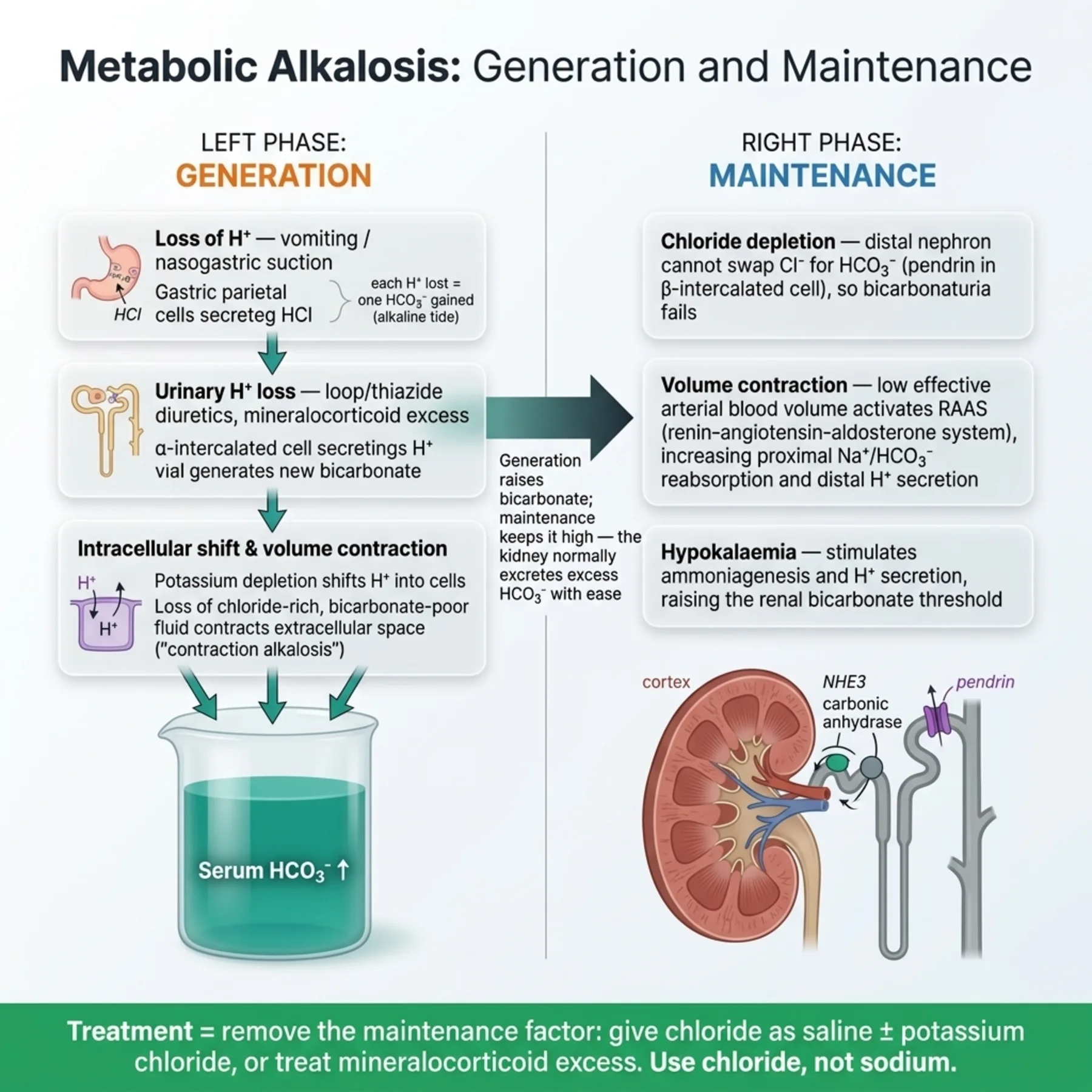
The puzzle of metabolic alkalosis is that the kidney can normally excrete a large bicarbonate load rapidly, so a sustained alkalosis requires two separate things to be true. Generation is how the alkalosis was created: by losing acid (vomiting and nasogastric suction lose hydrochloric acid; diuretics and mineralocorticoid excess drive renal hydrogen-ion loss), by gaining bicarbonate (exogenous bicarbonate, milk-alkali), or by contraction — losing a bicarbonate-poor fluid so the remaining bicarbonate is concentrated. But generation alone would be transient if the kidney then dumped the excess bicarbonate. Maintenance is why it does not: the kidney is prevented from excreting the bicarbonate by volume depletion (which drives avid sodium and bicarbonate reabsorption), chloride depletion, hypokalaemia, and hyperaldosteronism. So a persistent metabolic alkalosis always has a maintenance factor, and treatment is really about removing that factor — which is what the urine chloride identifies.
— The urine chloride split
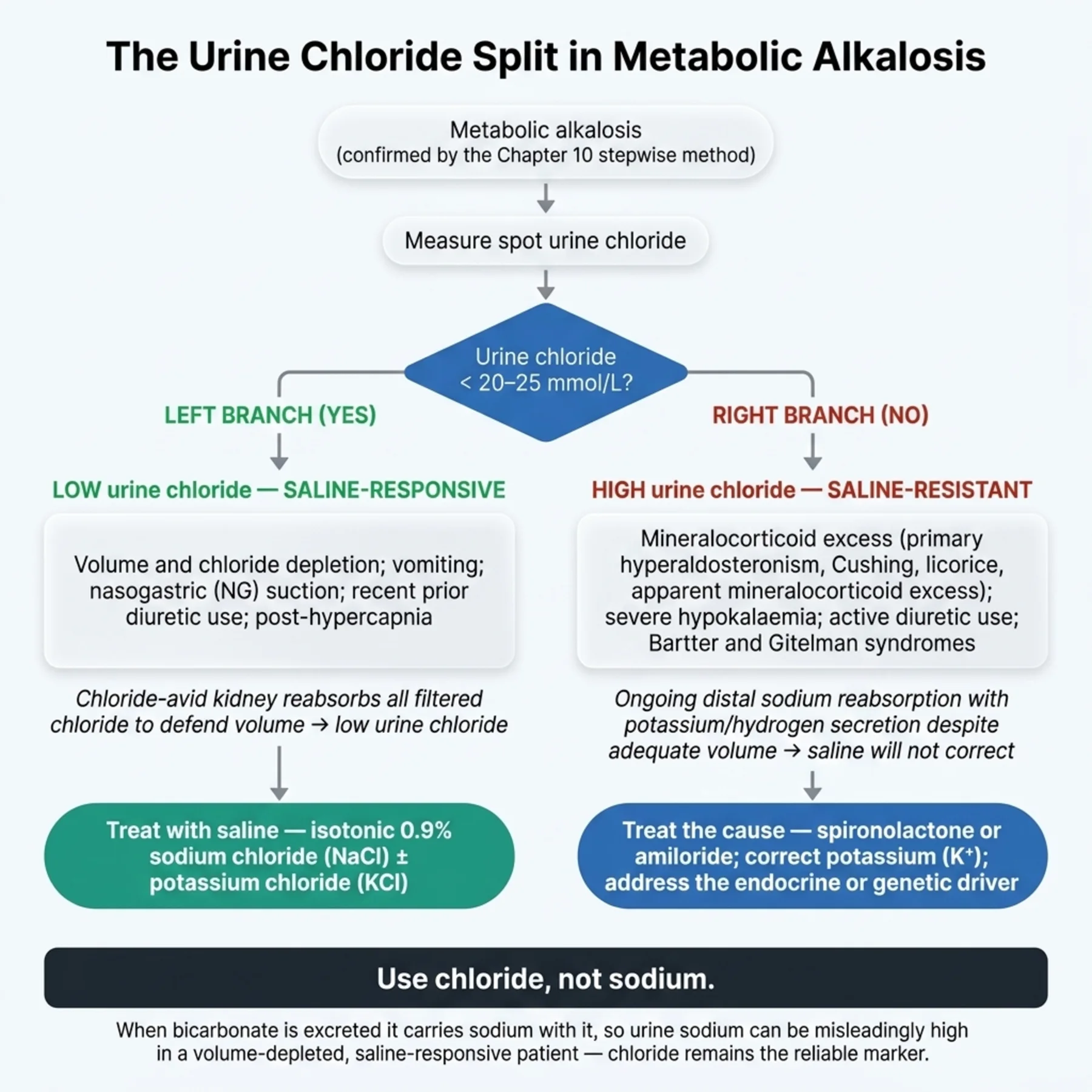
The single most useful test in metabolic alkalosis is the urine chloride, because it identifies the maintenance factor and therefore the treatment. A low urine chloride (under about 20 to 25) means the kidney is avidly retaining chloride because the patient is volume- and chloride-depleted — this is saline-responsive (chloride-responsive) alkalosis, from vomiting, nasogastric suction, prior diuretic use, or contraction, and it corrects when saline restores the volume and chloride and allows the kidney to excrete the bicarbonate. A high urine chloride (over 20 to 25) means the patient is not chloride-depleted, and the alkalosis is maintained instead by mineralocorticoid excess or severe hypokalaemia — this is saline-resistant (chloride-resistant) alkalosis, from primary hyperaldosteronism, Cushing's, Liddle, the Bartter and Gitelman tubulopathies, or current diuretic action, and saline will not correct it. A crucial technical point: the urine chloride, not the urine sodium, is used, because the bicarbonaturia of an alkalosis obligates sodium loss (sodium accompanies the excreted bicarbonate), so the urine sodium can be high even in a volume-depleted patient and would mislead — chloride is the reliable marker of volume status here.
— Treating the two alkaloses
Treatment follows directly from the split. Saline-responsive alkalosis is treated with saline (with potassium chloride if hypokalaemic): restoring volume and chloride removes the maintenance factor, and the kidney then excretes the excess bicarbonate and the alkalosis resolves — simple and effective. Saline-resistant alkalosis is the opposite: giving saline does not correct it (the patient is not chloride-depleted) and may worsen the volume overload of a hyperaldosterone state, so the treatment is to address the cause — a potassium-sparing agent (spironolactone or amiloride) to counter the mineralocorticoid effect, correction of the hypokalaemia, and specific treatment of the underlying disorder (the adrenal lesion, the tubulopathy). The clinical effects of metabolic alkalosis itself are largely through the associated hypokalaemia and hypocalcaemia (tetany, arrhythmia) and the compensatory hypoventilation, with severe alkalaemia carrying its own dangers. So the management is: split by urine chloride, give saline to the responsive, and treat the cause of the resistant.
— Respiratory acidosis
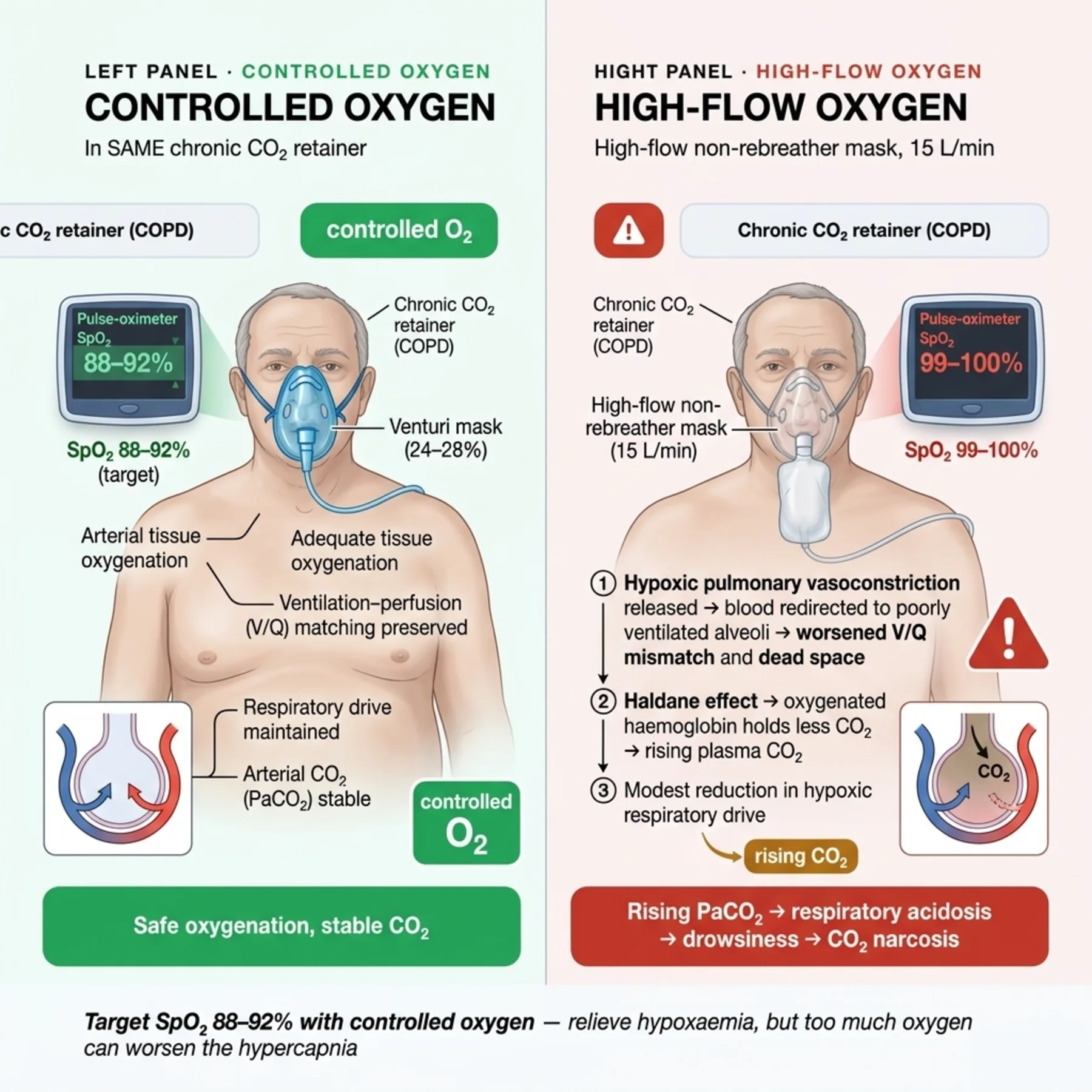
Respiratory acidosis is a high PCO2 from inadequate ventilation, and the kidney compensates by retaining bicarbonate — slowly, so the bicarbonate rises little acutely and substantially in chronic disease, the acute-versus-chronic distinction of the method chapter. The causes are anything that reduces effective ventilation: central nervous system depression (opioids and other sedatives, stroke), airway disease (COPD, asthma, obstruction), neuromuscular weakness (Guillain-Barré, myasthenia, fatigue), and chest-wall or restrictive disorders (obesity hypoventilation, kyphoscoliosis). Severe or acute hypercapnia causes carbon dioxide narcosis — drowsiness, confusion, asterixis. The treatment is to improve ventilation: reverse the cause (naloxone for opioids, bronchodilators for airway disease), and support ventilation with non-invasive or invasive ventilation when needed. A specific caution applies to chronic carbon dioxide retainers (notably COPD): oxygen must be given in a controlled fashion, targeting a lower oxygen saturation (around 88 to 92%), because high-flow oxygen can worsen hypercapnia (through altered ventilation-perfusion matching and reduced respiratory drive). And chronic respiratory acidosis with its compensatory high bicarbonate should not be over-corrected acutely.
— Respiratory alkalosis
Respiratory alkalosis is a low PCO2 from hyperventilation, with renal compensation lowering the bicarbonate (again, acute versus chronic). Its causes are a list worth knowing because several are serious: hypoxia (pulmonary embolism, pneumonia, asthma, high altitude), central stimulation (anxiety and pain, stroke, central nervous system infection, sepsis), drugs (salicylate — early, producing the mixed picture with a high-gap acidosis met in the last chapter; progesterone), pregnancy, liver failure, and iatrogenic over-ventilation. The treatment is to treat the cause, and the chapter's key warning is here: a respiratory alkalosis must not be dismissed as anxiety until the serious causes have been excluded. Attributing a tachypnoeic, hyperventilating patient's respiratory alkalosis to anxiety — and missing a pulmonary embolism, sepsis, or hypoxia behind it — is a classic and dangerous error. Reassurance and rebreathing are appropriate for genuine anxiety, but only after the dangerous causes are ruled out.
— Completing the quartet
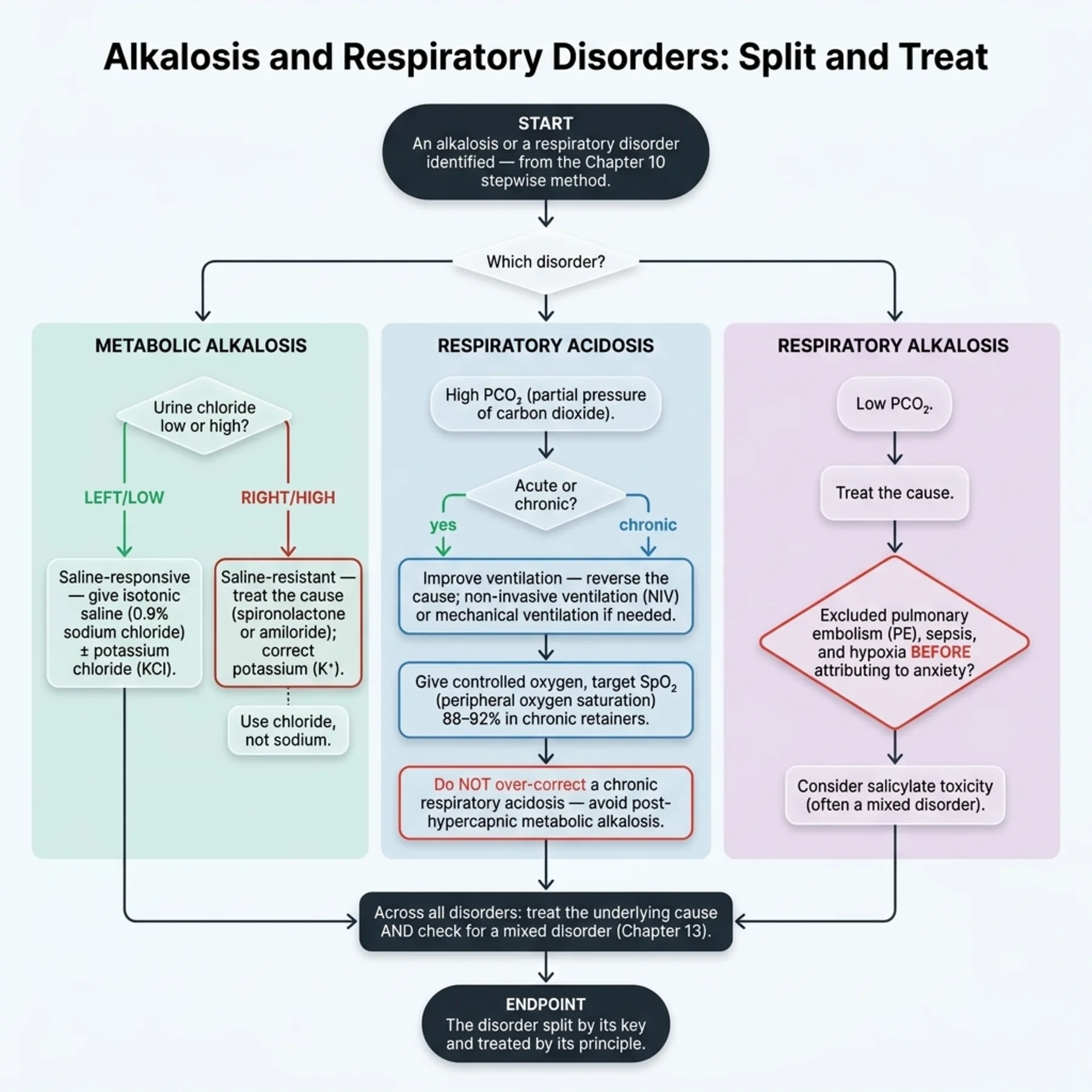
With these disorders, the four primary acid-base disturbances are complete: the metabolic acidosis of the last chapter, the metabolic alkalosis and the two respiratory disorders here. Each has its diagnostic key — the anion gap for metabolic acidosis, the urine chloride for metabolic alkalosis, the acute-versus-chronic pattern for the respiratory disorders — and each its treatment principle: treat the cause throughout, with the type-specific moves (bicarbonate-by-type, saline-by-urine-chloride, ventilation-and-controlled-oxygen). The two recurring bedside lessons of this chapter are to use the urine chloride (not sodium) to split metabolic alkalosis and to give saline only to the responsive, and never to dismiss a respiratory alkalosis as anxiety before excluding the dangerous causes. The next chapter brings all four together in the mixed and complex disorders, where two or three of these coexist and the systematic method of Chapter 10 earns its keep.
| 04 | PHASE A · LEVEL 4 · ORIENTATION & KNOWLEDGE Reference Tables |
Table 12.1 — Metabolic alkalosis: generation and maintenance
| Phase | Detail |
| Generation — acid loss | Vomiting, nasogastric suction (HCl); diuretics, mineralocorticoid excess (renal H+) |
| Generation — base gain / contraction | Exogenous bicarbonate, milk-alkali; loss of bicarbonate-poor fluid |
| Maintenance | Volume depletion, chloride depletion, hypokalaemia, hyperaldosteronism |
| Key point | A persistent alkalosis always has a maintenance factor |
Table 12.2 — The urine chloride split
| Saline-responsive | Saline-resistant | |
| Urine chloride | Low (< ~20–25) | High (> ~20–25) |
| Mechanism | Volume/chloride depletion | Mineralocorticoid excess / severe hypoK |
| Causes | Vomiting, NG suction, prior diuretics, contraction | Hyperaldosteronism, Cushing's, Liddle, Bartter/Gitelman, current diuretics |
| Treatment | Saline (± KCl) | Treat cause; spironolactone/amiloride; correct K |
Table 12.3 — Why urine chloride, not sodium
| Point | Detail |
| Bicarbonaturia | Excreted bicarbonate obligates sodium loss |
| So urine sodium | Can be high even in volume depletion — misleading |
| Urine chloride | Reliably reflects volume/chloride status in alkalosis |
| Rule | Use the urine chloride to split metabolic alkalosis |
Table 12.4 — Respiratory acidosis
| Aspect | Detail |
| Mechanism | High PCO2 from hypoventilation; renal compensation (acute vs chronic) |
| Causes | CNS depression, airway (COPD/asthma), neuromuscular, chest wall |
| Clinical | CO2 narcosis (drowsiness, confusion, asterixis) when severe/acute |
| Treatment | Improve ventilation (reverse cause, NIV/ventilation); controlled O2 in chronic retainers |
Table 12.5 — Respiratory alkalosis
| Aspect | Detail |
| Mechanism | Low PCO2 from hyperventilation; renal compensation (acute vs chronic) |
| Causes | Hypoxia (PE, pneumonia, asthma), CNS (anxiety/pain, stroke, sepsis), salicylate, pregnancy, liver failure, over-ventilation |
| Salicylate | Respiratory alkalosis + high-gap acidosis (mixed — Chapter 11) |
| Treatment | Treat the cause — do NOT assume anxiety before excluding PE/sepsis/hypoxia |
Table 12.6 — The four primary disorders (keys)
| Disorder | Diagnostic key / treatment principle |
| Metabolic acidosis | Anion gap; treat cause, bicarbonate by type (Chapter 11) |
| Metabolic alkalosis | Urine chloride; saline if responsive, treat cause if resistant |
| Respiratory acidosis | Acute vs chronic; improve ventilation, controlled O2 |
| Respiratory alkalosis | Acute vs chronic; treat the cause, exclude serious ones |
| 05 | PHASE B · LEVEL 5 · VISUALISE & MAP Imaging & Flowchart Specifications |
| 06 | PHASE B · LEVEL 6 · VISUALISE & MAP Concept Maps |
Each chain runs from physiology to a named bedside action; read the arrows as “leads to.”
Generation and maintenance. Acid loss/base gain/contraction generates a high bicarbonate → but the kidney would excrete it unless a maintenance factor (volume/chloride depletion, hypokalaemia, hyperaldosteronism) blocks it → ACTION: identify and remove the maintenance factor to correct the alkalosis.
The urine chloride split. Low urine chloride (volume/chloride depletion) → saline-responsive; high urine chloride (mineralocorticoid excess) → saline-resistant → ACTION: use the urine chloride (not sodium) to decide saline versus cause-directed treatment.
Why chloride not sodium. Excreted bicarbonate drags sodium with it → urine sodium can be high despite volume depletion → chloride reflects volume reliably → ACTION: read the urine chloride in metabolic alkalosis.
Respiratory acidosis. Hypoventilation → high PCO2 → renal compensation (slow; acute vs chronic) → CO2 narcosis if severe → ACTION: improve ventilation and give controlled oxygen in chronic retainers.
Respiratory alkalosis. Hyperventilation (hypoxia, sepsis, PE, pain, salicylate) → low PCO2 → ACTION: treat the cause and exclude the dangerous ones before assuming anxiety.
| 07 | PHASE B · LEVEL 7 · VISUALISE & MAP Decision Pathways |
| R1 | IF a metabolic alkalosis persists, THEN look for the maintenance factor — volume/chloride depletion, hypokalaemia, or hyperaldosteronism — because the kidney would otherwise excrete the bicarbonate. |
| R2 | IF classifying a metabolic alkalosis, THEN measure the URINE CHLORIDE, not the urine sodium — bicarbonaturia makes the urine sodium misleading. |
| R3 | IF the urine chloride is low, THEN the alkalosis is saline-responsive — treat with saline (and potassium chloride if hypokalaemic). |
| R4 | IF the urine chloride is high, THEN the alkalosis is saline-resistant — do not give saline; treat the cause with a potassium-sparing agent and potassium correction. |
| R5 | IF there is a respiratory acidosis, THEN improve ventilation (reverse the cause, non-invasive or invasive ventilation) and treat the underlying disorder. |
| R6 | IF the patient is a chronic carbon dioxide retainer, THEN give controlled oxygen (target ~88–92%) — high-flow oxygen can worsen the hypercapnia. |
| R7 | IF a respiratory disorder is chronic with a compensated bicarbonate, THEN do not over-correct it acutely. |
| R8 | IF there is a respiratory alkalosis, THEN treat the cause and exclude pulmonary embolism, sepsis, and hypoxia before attributing it to anxiety. |
| 08 | PHASE C · LEVEL 8 · CLINICAL REASONING Clinical Cases |
| CASE 1 | SALINE FIXES IT Low urine chloride Saline-responsive alkalosis |
Presentation
A patient with several days of vomiting has a metabolic alkalosis, is volume-depleted, and has a urine chloride of 8. The team is unsure whether saline will help.
❖ Pause and reflect What does the low urine chloride indicate, and will saline correct this? |
Analysis
The low urine chloride confirms a saline-responsive alkalosis. The vomiting generated the alkalosis by losing hydrochloric acid, and it is maintained by the volume and chloride depletion, which make the kidney avidly retain bicarbonate. Restoring volume and chloride with saline removes the maintenance factor, and the kidney then excretes the excess bicarbonate and the alkalosis corrects — with potassium chloride added if the patient is hypokalaemic. Saline is exactly the right treatment here.
Plan
Give intravenous saline to restore volume and chloride (with potassium chloride if hypokalaemic), and treat the vomiting; the alkalosis will correct as the maintenance factor is removed. Confirm the diagnosis with the low urine chloride.
Teaching point
A low urine chloride means saline-responsive alkalosis — saline restores volume and chloride and the kidney corrects the alkalosis.
Cross-reference
Exercises rules R2 and R3; the generation-and-maintenance and urine-chloride concept maps; Figures 12.1–12.2; Tables 12.1, 12.2.
| CASE 2 | SALINE WON'T WORK High urine chloride Saline-resistant alkalosis |
Presentation
A hypertensive patient has a metabolic alkalosis with hypokalaemia and a urine chloride of 45, on no diuretics. The team gives saline expecting correction, but the alkalosis persists.
❖ Pause and reflect Why didn't saline correct this alkalosis? |
Analysis
Because it is saline-resistant. The high urine chloride shows the patient is not chloride-depleted, so the alkalosis is maintained instead by mineralocorticoid excess (the hypertension and hypokalaemia suggest primary hyperaldosteronism), and saline cannot correct it — the maintenance factor is hormonal, not volume. Giving saline may even worsen the volume state. The treatment is to address the mineralocorticoid excess and correct the potassium, not to give more saline.
Plan
Stop expecting saline to work; investigate the mineralocorticoid excess (renin/aldosterone), treat the cause, use a potassium-sparing agent (spironolactone or amiloride), and correct the hypokalaemia. The high urine chloride was the clue that saline would fail.
Teaching point
A high urine chloride means saline-resistant alkalosis — saline won't correct it; treat the mineralocorticoid excess and correct potassium.
Cross-reference
Exercises rules R2 and R4; the urine-chloride concept map; Figure 12.2; Table 12.2; mineralocorticoid excess in Chapter 7.
| CASE 3 | EASY ON THE OXYGEN Controlled O2 Respiratory acidosis in the chronic retainer |
Presentation
A patient with a COPD exacerbation and chronic respiratory acidosis is given high-flow oxygen, and becomes progressively drowsy with a rising PCO2.
❖ Pause and reflect Why did the high-flow oxygen worsen this patient's condition? |
Analysis
This is the chronic-carbon-dioxide-retainer hazard. In a patient with chronic hypercapnia, high-flow oxygen can worsen the hypercapnia — through altered ventilation-perfusion matching and a reduced respiratory drive — precipitating carbon dioxide narcosis, hence the drowsiness and rising PCO2. Oxygen must be given in a controlled fashion, targeting a lower saturation (around 88 to 92%), which maintains safe oxygenation without worsening the hypercapnia, alongside treating the exacerbation and supporting ventilation.
Plan
Reduce to controlled oxygen targeting an oxygen saturation of about 88 to 92%, treat the COPD exacerbation (bronchodilators, steroids), and consider non-invasive ventilation for the respiratory acidosis. Avoid high-flow oxygen in chronic retainers.
Teaching point
In a chronic carbon dioxide retainer, give controlled oxygen (target ~88–92%) — high-flow oxygen can worsen the hypercapnia and cause narcosis.
Cross-reference
Exercises rules R5 and R6; the respiratory-acidosis concept map; Figure 12.3; Table 12.4.
| CASE 4 | NOT JUST ANXIETY Exclude the dangerous Respiratory alkalosis |
Presentation
A breathless, hyperventilating patient with a respiratory alkalosis is diagnosed with 'anxiety' and offered reassurance, without further investigation. They are in fact developing a pulmonary embolism.
❖ Pause and reflect Is it safe to attribute this respiratory alkalosis to anxiety? |
Analysis
No — this is the classic and dangerous error. A respiratory alkalosis from hyperventilation has many serious causes — pulmonary embolism, sepsis, hypoxia, pneumonia — and attributing it to anxiety without excluding them risks missing a life-threatening diagnosis, as here, where a pulmonary embolism is the true cause. Anxiety is a diagnosis of exclusion in this setting: reassurance and rebreathing are appropriate only after the dangerous causes have been ruled out.
Plan
Investigate for serious causes of the respiratory alkalosis — pulmonary embolism, sepsis, hypoxia — before attributing it to anxiety, and treat the cause found (here, the pulmonary embolism). Reserve reassurance for genuine, excluded anxiety.
Teaching point
Never assume a respiratory alkalosis is anxiety before excluding pulmonary embolism, sepsis, and hypoxia — anxiety is a diagnosis of exclusion.
Cross-reference
Exercises rule R8; the respiratory-alkalosis concept map; Table 12.5.
| 09 | PHASE C · LEVEL 9 · CLINICAL REASONING Clinical Implications |
One triad per mechanism the narrative exposed: the physiology, why it matters, and the bedside move.
MECHANISM The kidney can normally excrete excess bicarbonate, so an alkalosis needs both generation and a maintenance factor. |
WHY IT MATTERS A persistent metabolic alkalosis always has something preventing bicarbonate excretion. |
ACTION Identify and remove the maintenance factor to correct the alkalosis. |
MECHANISM The urine chloride reflects volume and chloride status, distinguishing the two maintenance mechanisms. |
WHY IT MATTERS It separates saline-responsive from saline-resistant alkalosis, which need opposite treatments. |
ACTION Measure the urine chloride and treat accordingly. |
MECHANISM Bicarbonaturia obligates sodium loss, so the urine sodium rises even in volume depletion. |
WHY IT MATTERS The urine sodium misleads in metabolic alkalosis, while chloride does not. |
ACTION Use the urine chloride, not the urine sodium, in metabolic alkalosis. |
MECHANISM High-flow oxygen in a chronic retainer worsens ventilation-perfusion matching and reduces drive. |
WHY IT MATTERS It can raise the PCO2 and precipitate carbon dioxide narcosis. |
ACTION Give controlled oxygen (target ~88–92%) in chronic carbon dioxide retainers. |
MECHANISM Hyperventilation has many serious causes, not just anxiety. |
WHY IT MATTERS Assuming anxiety can miss a pulmonary embolism, sepsis, or hypoxia. |
ACTION Exclude the dangerous causes of a respiratory alkalosis before attributing it to anxiety. |
| 10 | PHASE C · LEVEL 10 · CLINICAL REASONING Clinical Pearls |
| Metabolic alkalosis = high bicarbonate + alkalaemia; two phases. | Generation: acid loss (vomiting/NG/diuretics/mineralocorticoid), base gain, contraction. |
| Maintenance: volume/chloride depletion, hypokalaemia, hyperaldosteronism. | A persistent alkalosis always has a maintenance factor. |
| Split by URINE CHLORIDE (not sodium). | Low urine Cl (< ~20–25) = saline-responsive (vomiting, NG, diuretics, contraction). |
| High urine Cl (> ~20–25) = saline-resistant (mineralocorticoid excess, hypoK). | Why chloride: bicarbonaturia raises urine sodium even in depletion. |
| Saline-responsive → saline (± KCl). | Saline-resistant → treat cause, spironolactone/amiloride, correct K. |
| Respiratory acidosis = high PCO2 (hypoventilation); acute vs chronic. | Causes: CNS depression, airway, neuromuscular, chest wall. |
| Improve ventilation; controlled O2 (88–92%) in chronic retainers. | Respiratory alkalosis = low PCO2 (hyperventilation). |
| Causes: hypoxia/PE, sepsis, pain/anxiety, salicylate, pregnancy, over-ventilation. | Don't assume anxiety — exclude PE/sepsis/hypoxia first. |
| 11 | PHASE D · LEVEL 11 · SAFETY & EVIDENCE Red Flags & Never-Do |
Panel A — Red flags
| ▲ | A metabolic alkalosis classified by urine sodium — use the urine chloride; sodium misleads here. |
| ▲ | A metabolic alkalosis with a high urine chloride not responding to saline — saline-resistant; treat the cause. |
| ▲ | Rising drowsiness and PCO2 after high-flow oxygen in a COPD patient — controlled oxygen needed. |
| ▲ | A hyperventilating patient labelled 'anxiety' without investigation — exclude PE, sepsis, hypoxia first. |
| ▲ | A respiratory alkalosis with a high-anion-gap acidosis — think salicylate (mixed). |
Panel B — Never do
| ✖ NEVER — use the urine sodium to classify a metabolic alkalosis. |
| ✖ NEVER — give saline expecting to correct a saline-resistant alkalosis. |
| ✖ NEVER — give high-flow oxygen to a chronic carbon dioxide retainer. |
| ✖ NEVER — attribute a respiratory alkalosis to anxiety before excluding serious causes. |
| 12 | PHASE D · LEVEL 12 · SAFETY & EVIDENCE Common Pitfalls |
Pitfall 1 — Using urine sodium
| ✖ | WRONG Classifying a metabolic alkalosis by the urine sodium. |
| ✓ | RIGHT Using the urine chloride. |
| ✉ | WHY Bicarbonaturia raises the urine sodium even in volume depletion. |
Pitfall 2 — Saline for the resistant
| ✖ | WRONG Giving saline to a saline-resistant alkalosis. |
| ✓ | RIGHT Treating the mineralocorticoid excess and correcting potassium. |
| ✉ | WHY The patient is not chloride-depleted, so saline cannot correct it. |
Pitfall 3 — High-flow oxygen
| ✖ | WRONG Giving high-flow oxygen to a chronic carbon dioxide retainer. |
| ✓ | RIGHT Giving controlled oxygen (target ~88–92%). |
| ✉ | WHY High-flow oxygen can worsen the hypercapnia and cause narcosis. |
Pitfall 4 — Assuming anxiety
| ✖ | WRONG Labelling a respiratory alkalosis as anxiety and reassuring. |
| ✓ | RIGHT Excluding pulmonary embolism, sepsis, and hypoxia first. |
| ✉ | WHY Hyperventilation has serious causes that anxiety attribution misses. |
Pitfall 5 — Over-correcting chronic
| ✖ | WRONG Acutely correcting a chronic respiratory disorder's compensated bicarbonate. |
| ✓ | RIGHT Leaving the compensation in place and treating the disorder. |
| ✉ | WHY Acute over-correction unbalances the compensated pH. |
| 13 | PHASE D · LEVEL 13 · SAFETY & EVIDENCE Evidence Grading |
GRADE A HIGH CONFIDENCE The effect is real and the estimate is stable. RCTs at low risk of bias; multiple concordant prospective cohorts; meta-analyses. |
GRADE B MODERATE CONFIDENCE The effect is likely real but may shift with new data. Observational studies, registries, mechanistic human studies. |
GRADE C LOW CONFIDENCE Rests on physiology, reasoning, or consensus rather than outcomes. Pathophysiological reasoning; extrapolation; consensus without outcomes. |
Graded statements (by evidence type)
| Statement | Grade | Basis (evidence type) |
| Metabolic alkalosis requires both generation and a maintenance factor. | A | Established physiology |
| The urine chloride distinguishes saline-responsive from saline-resistant alkalosis. | A | Established physiology |
| The urine sodium misleads in metabolic alkalosis due to bicarbonaturia. | A | Established physiology |
| Saline corrects saline-responsive but not saline-resistant alkalosis. | A | Established physiology |
| High-flow oxygen can worsen hypercapnia in chronic retainers. | A | Physiology and clinical data |
| Controlled oxygen (target ~88–92%) is appropriate in chronic CO2 retainers. | B | Clinical trials and guidelines |
| A respiratory alkalosis should not be attributed to anxiety before excluding serious causes. | A | Clinical reasoning and safety data |
| 14 | PHASE E · LEVEL 14 · PATIENT DECISIONS Absolute Risk in Natural Frequency |
Natural-frequency estimates for orientation, from alkalosis and respiratory-disorder management; they vary with cause. They convey the size of the decisions, expressed per 100 comparable patients.
| Per 100 patients… | Outcome | Roughly how many | See |
| Saline-responsive alkalosis given saline | Correct the alkalosis | Most | L13 row 4 |
| Saline-resistant alkalosis given saline | Correct the alkalosis | Few — it doesn't respond | L13 row 4 |
| Chronic CO2 retainers given controlled vs high-flow oxygen | Avoid worsening hypercapnia | More with controlled oxygen | L13 rows 5–6 |
| Respiratory alkalosis attributed to anxiety unexamined | Have a missed serious cause | A dangerous share — hence exclude first | L13 row 7 |
★ How to read these Read these as orientation, not promises; outcomes depend on the cause. The stable signals: saline corrects only the responsive alkalosis, controlled oxygen protects the chronic retainer, and assuming anxiety risks a missed embolism or sepsis. Communicate them as people out of 100, not as a hazard ratio. |
| 17 | PHASE F · LEVEL 17 · APPLY & TEST Documentation Templates |
Paste-ready notes. Tick the boxes that apply and delete the rest; make the urine-chloride split and the controlled-oxygen/exclude-anxiety points explicit.
Template 1 — Metabolic alkalosis
Template 2 — Respiratory disorder
| 18 | PHASE F · LEVEL 18 · APPLY & TEST Cheat Sheet |
| Metabolic alkalosis = high HCO3 + alkalaemia. | Two phases: generation + maintenance. |
| Generation: acid loss / base gain / contraction. | Maintenance: volume/chloride depletion, hypoK, hyperaldosteronism. |
| Persistent alkalosis always has a maintenance factor. | Split by URINE CHLORIDE (not sodium). |
| Low Cl = saline-responsive (vomiting/NG/diuretics/contraction) → saline. | High Cl = saline-resistant (mineralocorticoid excess/hypoK) → treat cause. |
| Why chloride: bicarbonaturia raises urine sodium even in depletion. | Resp acidosis = high PCO2 (hypoventilation); acute vs chronic. |
| Causes: CNS depression, airway, neuromuscular, chest wall. | Improve ventilation; controlled O2 (88–92%) in chronic retainers. |
| Don't over-correct chronic compensation. | Resp alkalosis = low PCO2 (hyperventilation). |
| Causes: hypoxia/PE, sepsis, pain/anxiety, salicylate, pregnancy. | Don't assume anxiety — exclude PE/sepsis/hypoxia. |
| 19 | PHASE F · LEVEL 19 · APPLY & TEST Flashcards |
| CARD 1 | Q. Why is metabolic alkalosis a two-phase disorder? A. Because the kidney can normally excrete excess bicarbonate, so an alkalosis needs both generation (how it arose) and a maintenance factor (why the kidney does not excrete the bicarbonate). DETAILED. A persistent alkalosis always has a maintenance factor. CLINICAL. Identify and remove the maintenance factor to correct it. |
| CARD 2 | Q. What maintains a metabolic alkalosis? A. Volume depletion, chloride depletion, hypokalaemia, and hyperaldosteronism — each preventing the kidney from excreting the excess bicarbonate. DETAILED. Generation alone would be transient. CLINICAL. Treat the maintenance factor, not just the generation. |
| CARD 3 | Q. How is metabolic alkalosis split, and why use chloride? A. By the urine chloride: low (under ~20–25) is saline-responsive, high is saline-resistant. Chloride is used rather than sodium because bicarbonaturia obligates sodium loss, so the urine sodium can be high despite volume depletion. DETAILED. Chloride reliably reflects volume status here. CLINICAL. Use the urine chloride to decide treatment. |
| CARD 4 | Q. How are the two metabolic alkaloses treated? A. Saline-responsive (low urine chloride, volume/chloride depletion) corrects with saline and potassium chloride; saline-resistant (high urine chloride, mineralocorticoid excess) does not respond to saline and is treated by addressing the cause with a potassium-sparing agent and potassium correction. DETAILED. Opposite treatments. CLINICAL. Match treatment to the urine chloride. |
| CARD 5 | Q. What causes and treats respiratory acidosis? A. A high PCO2 from hypoventilation — central nervous system depression, airway disease, neuromuscular weakness, chest-wall disorders — treated by improving ventilation (reversing the cause, non-invasive or invasive ventilation). DETAILED. It has acute and chronic patterns by renal compensation. CLINICAL. Improve ventilation; treat the cause. |
| CARD 6 | Q. Why give controlled oxygen to a chronic carbon dioxide retainer? A. Because high-flow oxygen can worsen the hypercapnia — through altered ventilation-perfusion matching and reduced respiratory drive — and precipitate carbon dioxide narcosis. DETAILED. Target a lower saturation (~88–92%). CLINICAL. Give controlled oxygen in chronic retainers. |
| CARD 7 | Q. What causes respiratory alkalosis? A. Hyperventilation from hypoxia (pulmonary embolism, pneumonia), central stimulation (anxiety, pain, stroke, sepsis), salicylate, pregnancy, liver failure, and over-ventilation. DETAILED. Salicylate gives a mixed picture with a high-gap acidosis. CLINICAL. Treat the cause. |
| CARD 8 | Q. What is the cardinal error in respiratory alkalosis? A. Attributing it to anxiety before excluding serious causes — pulmonary embolism, sepsis, hypoxia — which risks missing a life-threatening diagnosis. DETAILED. Anxiety is a diagnosis of exclusion here. CLINICAL. Exclude the dangerous causes before reassuring. |
| 20 | PHASE F · LEVEL 20 · APPLY & TEST One-Minute Preceptor |
| SCENE 1 | The intern reading the urine sodium |
GET A COMMITMENT. “You've used the urine sodium to classify this alkalosis — why?”
PROBE FOR EVIDENCE. “It reflects volume” — ask: “What happens to urine sodium when bicarbonate is being excreted?”
TEACH A GENERAL RULE. Bicarbonaturia drags sodium with it, so urine sodium can be high even in depletion — use the urine chloride to classify a metabolic alkalosis.
REINFORCE WHAT WAS RIGHT. Trying to assess volume was correct.
CORRECT A MISTAKE. Measure the urine chloride instead, and treat by that.
| SCENE 2 | The resident calling it anxiety |
GET A COMMITMENT. “You've put this hyperventilation down to anxiety — what have you excluded?”
PROBE FOR EVIDENCE. “The patient seems anxious” — ask: “What serious conditions cause a respiratory alkalosis?”
TEACH A GENERAL RULE. Hyperventilation has dangerous causes — pulmonary embolism, sepsis, hypoxia — so anxiety is a diagnosis of exclusion; rule them out first.
REINFORCE WHAT WAS RIGHT. Noticing the respiratory alkalosis was correct.
CORRECT A MISTAKE. Exclude PE, sepsis, and hypoxia before attributing it to anxiety.
| 22 | PHASE F · LEVEL 22 · APPLY & TEST Board-Style Questions |
| Q 01 | Why does a metabolic alkalosis persist despite the kidney's ability to excrete bicarbonate? |
| A | The kidney cannot excrete bicarbonate |
| B | A maintenance factor (volume/chloride depletion, hypokalaemia, hyperaldosteronism) prevents excretion |
| C | Generation continues indefinitely |
| D | Bicarbonate is not filtered |
Rationale A maintenance factor blocks bicarbonate excretion, so an alkalosis persists only while it is present (Figure 12.1, rule R1). A and D are false; C ignores maintenance. |
| Q 02 | Which test splits metabolic alkalosis, and why that one? |
| A | Urine sodium — it reflects volume |
| B | Urine chloride — bicarbonaturia makes urine sodium misleading |
| C | Serum bicarbonate |
| D | Urine pH |
Rationale Bicarbonaturia obligates sodium loss, so urine sodium can be high in depletion; urine chloride reliably reflects volume (Table 12.3, rule R2). A, C, and D do not split it reliably. |
| Q 03 | A vomiting patient has a metabolic alkalosis and a urine chloride of 8. This is: |
| A | Saline-resistant — treat the cause |
| B | Saline-responsive — give saline (± KCl) |
| C | Respiratory in origin |
| D | Not treatable |
Rationale A low urine chloride indicates volume/chloride depletion (saline-responsive), corrected by saline (case 1, Table 12.2, rule R3). A, C, and D are incorrect. |
| Q 04 | A hypertensive patient has a metabolic alkalosis with a urine chloride of 45 on no diuretics. This is: |
| A | Saline-responsive — give saline |
| B | Saline-resistant — mineralocorticoid excess; treat the cause |
| C | From vomiting |
| D | Contraction alkalosis |
Rationale A high urine chloride with hypertension indicates mineralocorticoid excess (saline-resistant); saline will not correct it (case 2, Table 12.2, rule R4). A, C, and D are saline-responsive patterns. |
| Q 05 | Why should a chronic carbon dioxide retainer receive controlled oxygen? |
| A | To save oxygen |
| B | High-flow oxygen can worsen hypercapnia (altered V/Q, reduced drive) and cause narcosis |
| C | Oxygen is contraindicated |
| D | To raise the PCO2 deliberately |
Rationale In chronic retainers, high-flow oxygen worsens the hypercapnia, so controlled oxygen (target ~88–92%) is used (case 3, Figure 12.3, rule R6). A, C, and D are incorrect. |
| Q 06 | A breathless patient with a respiratory alkalosis should be: |
| A | Reassured as anxious |
| B | Investigated for serious causes (PE, sepsis, hypoxia) before attributing it to anxiety |
| C | Given a sedative |
| D | Ventilated |
Rationale Hyperventilation has dangerous causes, so anxiety is a diagnosis of exclusion (case 4, rule R8, Table 12.5). A and C risk missing a serious diagnosis; D is not first-line. |
| Q 07 | Respiratory acidosis is best treated by: |
| A | Bicarbonate |
| B | Improving ventilation — reversing the cause and supporting ventilation |
| C | Saline |
| D | A diuretic |
Rationale A high PCO2 from hypoventilation is corrected by improving ventilation, not by bicarbonate (rule R5, Table 12.4). A, C, and D do not address the ventilation. |
| Q 08 | A respiratory alkalosis with a high-anion-gap metabolic acidosis suggests: |
| A | Pure anxiety |
| B | Salicylate poisoning (a mixed disorder) |
| C | COPD |
| D | Vomiting |
Rationale Salicylate stimulates respiration (alkalosis) and produces a high-gap acidosis — a classic mixed disorder (Table 12.5; Chapter 11). A, C, and D do not give this combination. |
| Q 09 | Across 100 patients with saline-resistant alkalosis given saline, how many correct? |
| A | Most |
| B | Few — it does not respond to saline |
| C | All |
| D | None ever |
Rationale Saline-resistant alkalosis is maintained by mineralocorticoid excess, not chloride depletion, so saline does not correct it (L14, L13 row 4). A and C overstate; the cause must be treated. |