Chapter Preamble
Signals declared
Sig-D — Diagnostic (primary). Apply the systematic method to detect double and triple disorders, recognise the classic mixed patterns, and integrate the electrolytes.
Sig-M — Mechanistic (strong). How mixed disorders arise, and how inappropriate compensation, the delta ratio, and a deceptive pH reveal them.
Levels populated and omitted
Populated (17): L1–L13, L18–L20, L22. The mechanistic signal fires the concept maps (L6) and triads (L9); the diagnostic signal drives the tables, rules, cases, pitfalls, and board items.
L14 absolute-risk — omitted. No Sig-T/E/V; this is an integrative diagnostic chapter, with treatment in the disorder and emergency chapters.
L15 / L16 preference-sensitive map and SDM scripts — omitted. No Sig-E; parsing a mixed disorder is a clinical method.
L17 documentation templates — omitted. No Sig-P/T; the management templates belong with the disorder and emergency chapters.
| 01 | PHASE A · LEVEL 1 · ORIENTATION & KNOWLEDGE Learning Objectives |
By the end of this chapter you should be able to:
Explain why mixed acid-base disorders arise.
Use inappropriate compensation to detect a second respiratory or metabolic disorder.
Use the delta ratio to detect a coexisting metabolic disorder within a high-gap acidosis.
Recognise that a normal pH with abnormal bicarbonate and PCO2 signals opposing disorders.
Detect triple disorders by combining the diagnostic tools.
Recognise the classic mixed patterns and their clinical settings.
Integrate the acid-base picture with the electrolytes.
Apply the full systematic method rigorously, never stopping early.
| 02 | PHASE A · LEVEL 2 · ORIENTATION & KNOWLEDGE Executive Summary |
A mixed disorder is two or more primary acid-base disturbances coexisting in the same patient.
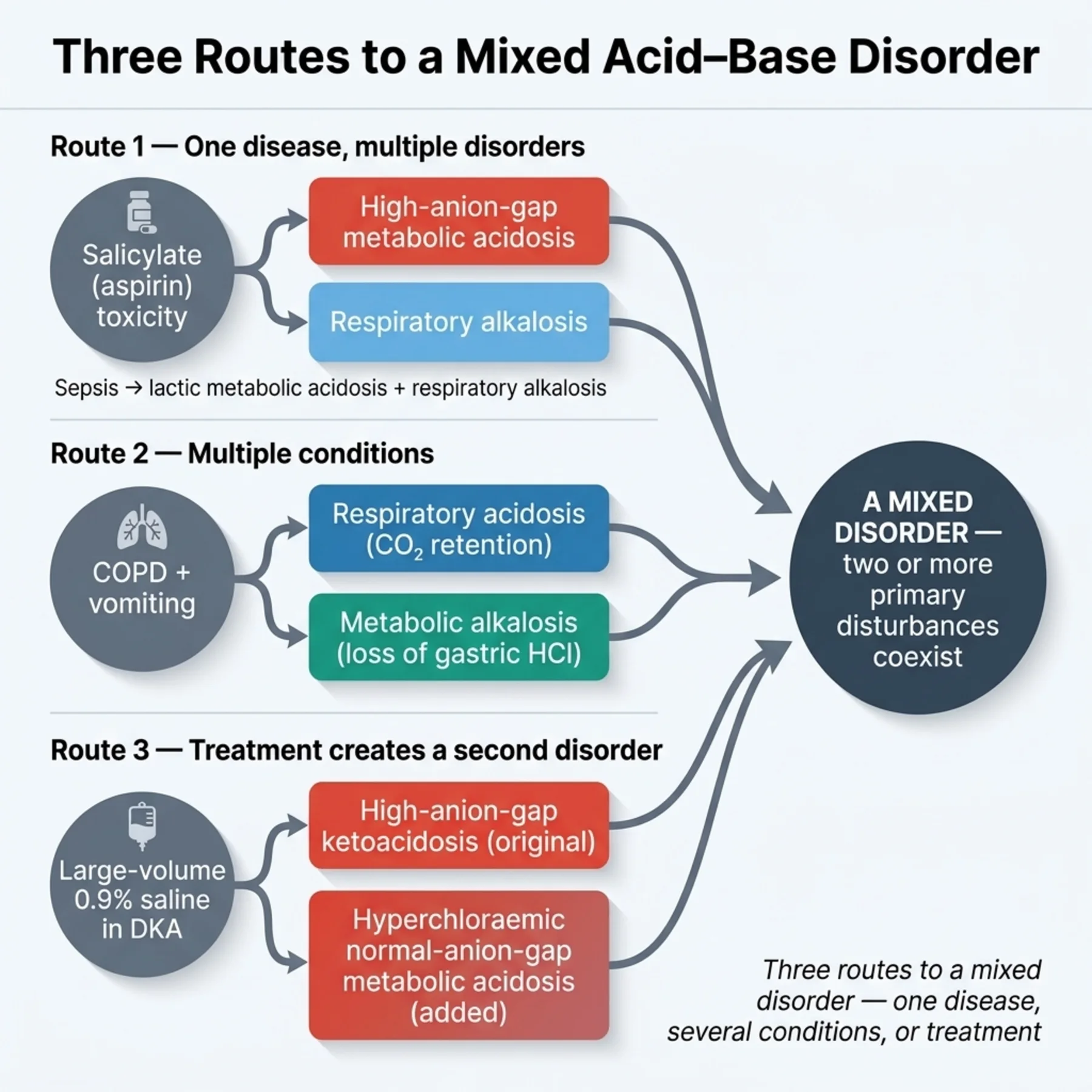
They arise when a single disease causes several disturbances, when multiple conditions coexist, or when treatment creates a second disorder.
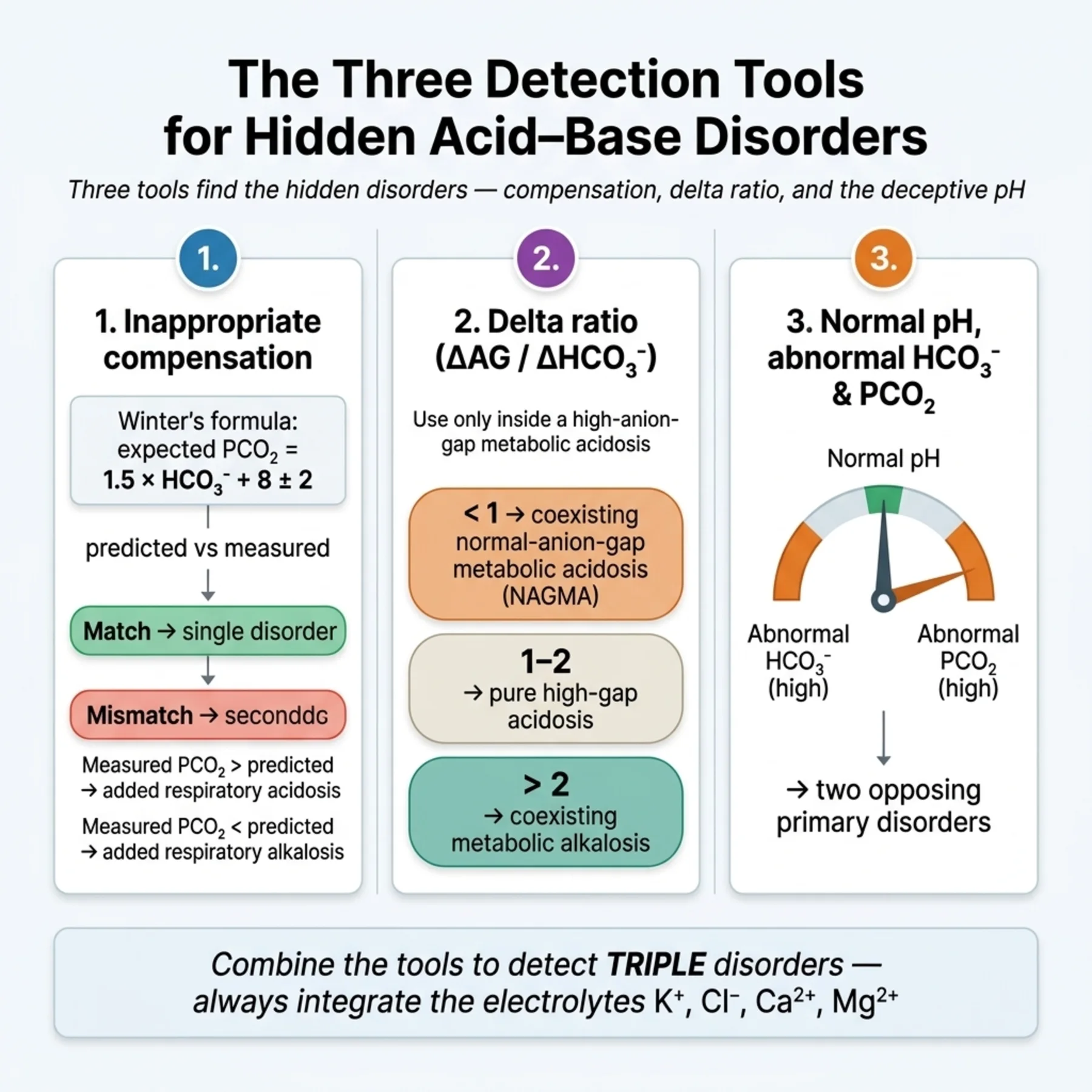
They are detected with the same tools as the systematic method: inappropriate compensation, the delta ratio, and a deceptive pH.
Compensation that does not match the expected formula reveals a second respiratory or metabolic disorder, because compensation never over- or under-shoots alone.
In a high-anion-gap acidosis, a delta ratio away from one-to-two reveals a coexisting normal-gap acidosis (below one) or metabolic alkalosis (above two).
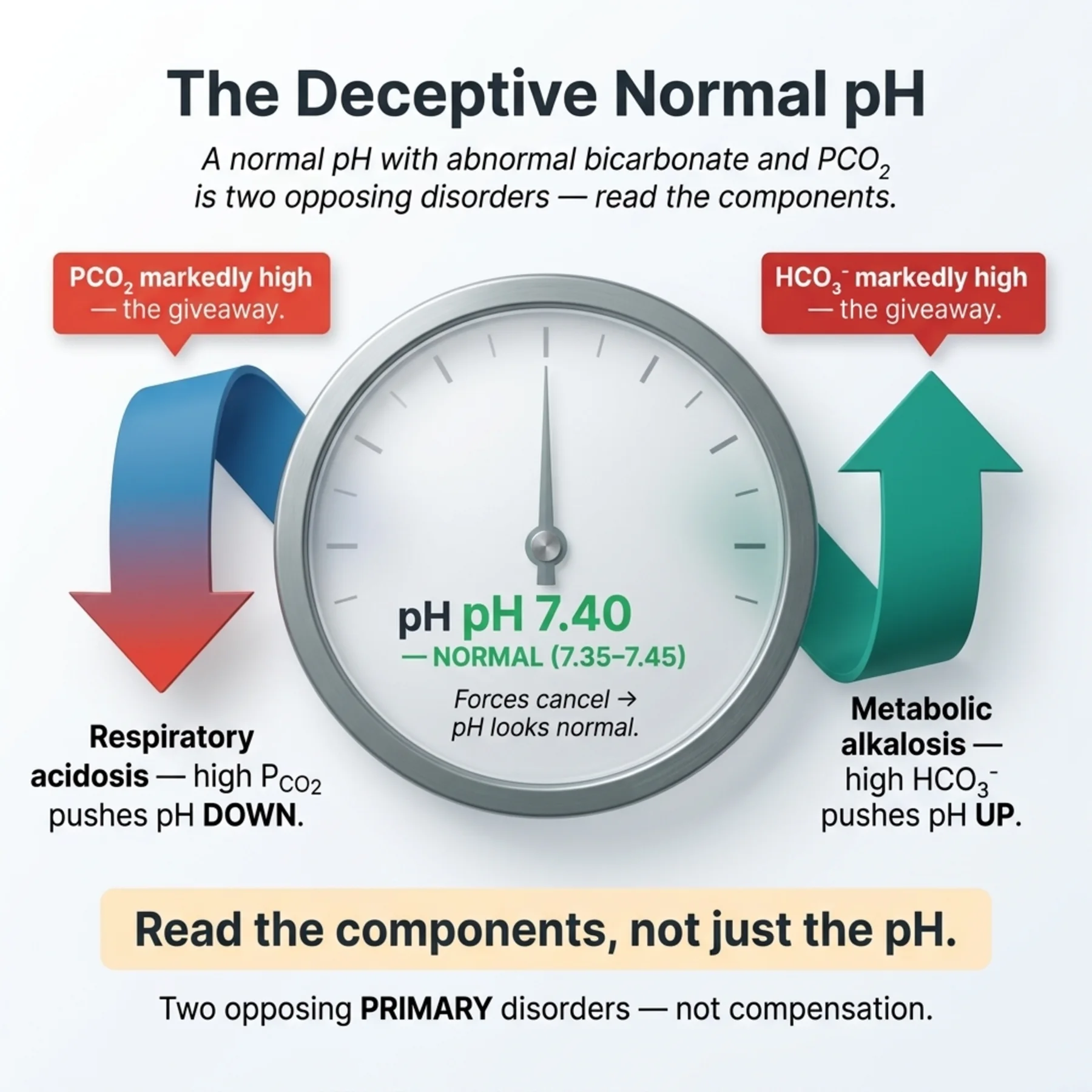
A normal pH with clearly abnormal bicarbonate and PCO2 means two opposing disorders are cancelling each other out.
Triple disorders are found by combining all the tools — the delta ratio exposing a metabolic disorder and the compensation check exposing a respiratory one.
The classic patterns are worth knowing: sepsis (lactic acidosis with respiratory alkalosis), salicylate (high-gap acidosis with respiratory alkalosis), and cardiopulmonary arrest (combined metabolic and respiratory acidosis).
Diabetic ketoacidosis often becomes mixed — a high-gap acidosis with a coexisting normal-gap acidosis from saline or a metabolic alkalosis from vomiting.
COPD with vomiting or diuretics produces a respiratory acidosis and a metabolic alkalosis, often with a near-normal pH.
The clinical context drives suspicion of a mixed disorder, and the numbers confirm it.
The acid-base picture is integrated with the electrolytes — the potassium, chloride, calcium, and magnesium that travel with these disorders.
The cardinal discipline is to apply the full method rigorously and never stop at the first disorder found.
This chapter is where the systematic method of the acid-base part earns its keep.
| 03 | PHASE A · LEVEL 3 · ORIENTATION & KNOWLEDGE Main Narrative |
Real patients rarely have a single, tidy acid-base disorder. The septic patient, the salicylate overdose, the cardiac arrest, the vomiting COPD patient — each carries two or three disturbances at once, and the pH alone will name at most one of them. This chapter is where the systematic method of the acid-base part pays off: the same tools that diagnose a single disorder — compensation, the delta ratio, a deceptive pH — are precisely what uncover the hidden second and third ones. Mixed disorders are not a different skill; they are the method applied without stopping early.
— Why mixed disorders arise
Mixed disorders — two or more coexisting primary disturbances — arise by three routes. First, a single disease can cause several disorders at once: salicylate poisoning produces both a high-gap acidosis (the salicylate anion) and a respiratory alkalosis (direct respiratory-centre stimulation); sepsis produces a lactic acidosis and an early respiratory alkalosis. Second, multiple conditions can coexist: a patient with COPD (a chronic respiratory acidosis) who develops vomiting (a metabolic alkalosis) carries both. Third, treatment can create a second disorder: resuscitating a diabetic ketoacidosis with large volumes of saline can add a hyperchloraemic normal-gap acidosis on top of the high-gap one. Recognising these routes primes suspicion — the clinical context tells you a mixed disorder is likely, and the numbers then confirm which ones are present. A patient who should have a single disorder by their physiology but whose numbers do not fit is the one harbouring a mixed picture.
— Detection tool one: inappropriate compensation
The first detection tool, met in the method chapter, is the compensation check. A single primary disorder produces a predictable degree of compensation, given by the standard formulae, and compensation never overshoots or undershoots on its own. So when the measured compensation does not match the prediction, a second disorder is present. If the PCO2 in a metabolic acidosis is higher than Winter's formula predicts, there is a coexisting respiratory acidosis (the lungs are not compensating enough); if it is lower, a coexisting respiratory alkalosis (they are over-ventilating for another reason). The same logic applies to a respiratory disorder whose bicarbonate response is too large or too small for the acute or chronic expectation — revealing a superimposed metabolic disorder. The compensation check is the tool that finds a respiratory disorder hiding behind a metabolic one, or vice versa.
— Detection tool two: the delta ratio
The second tool finds a metabolic disorder hidden within a high-anion-gap acidosis: the delta ratio, the change in the anion gap compared with the change in bicarbonate. In a pure high-gap acidosis the two move together (ratio one to two). A ratio below one means the bicarbonate fell more than the gap rose — extra bicarbonate has been lost, so a normal-gap acidosis coexists. A ratio above two means the bicarbonate fell less than the gap rose — it started high, so a metabolic alkalosis (or a pre-existing high bicarbonate) coexists. This is how the diabetic ketoacidosis patient with vomiting (an alkalosis raising the ratio) or with saline resuscitation (a normal-gap acidosis lowering it) is detected: the pH and the high gap alone would miss the second metabolic process that only the delta ratio reveals. The delta ratio is the metabolic-within-metabolic detector.
— Detection tool three: the deceptive pH
The third tool is the recognition that a normal, or near-normal, pH does not mean a normal acid-base state. When two opposing disorders coexist — one pushing the pH up, one pushing it down — they can cancel, leaving a pH in the normal range while the bicarbonate and PCO2 are both clearly abnormal. The classic example is the COPD patient (respiratory acidosis, high PCO2) who develops a metabolic alkalosis (high bicarbonate) from vomiting or diuretics: the pH may look normal, but the markedly abnormal bicarbonate and PCO2 betray two disorders. The lesson is to read the bicarbonate and PCO2, not just the pH — a normal pH with abnormal components is a mixed disorder until proven otherwise. This is the most easily missed mixed picture, because the reassuring pH invites the clinician to stop looking.
— Triple disorders and the classic patterns
Combining the tools detects triple disorders. A patient can have a high-gap acidosis, a metabolic alkalosis, and a respiratory disorder simultaneously — the delta ratio (above two) revealing the alkalosis within the high-gap acidosis, and the compensation check revealing the respiratory component. The cirrhotic with a respiratory alkalosis, a diuretic-induced metabolic alkalosis, and a lactic acidosis is a real example. Beyond the triples, a handful of classic mixed patterns recur and should be recognised on sight: sepsis (lactic acidosis plus respiratory alkalosis), salicylate (high-gap acidosis plus respiratory alkalosis), cardiopulmonary arrest (a combined metabolic and respiratory acidosis — a dangerous double acidosis with a very low pH), and the COPD-with-alkalosis pattern. Knowing these by their clinical setting means the numbers are interrogated for the expected combination rather than read naively.
— Integrating the electrolytes
Acid-base and electrolyte disorders travel together, and the complete picture integrates both. Vomiting produces a metabolic alkalosis with hypokalaemia and hypochloraemia — the acid-base and electrolyte derangements are one process. Diabetic ketoacidosis produces a high-gap acidosis with the potassium shifts of insulin deficiency and treatment. The renal tubular acidoses produce a normal-gap acidosis with characteristic potassium patterns (low in types 1 and 2, high in type 4). Hypomagnesaemia underlies refractory hypokalaemia and hypocalcaemia. So the disciplined reading of a complex patient is not 'the acid-base disorder' and separately 'the electrolyte disorder' but a single integrated assessment, drawing on the potassium, chloride, calcium, and magnesium chapters alongside the acid-base ones. The internal milieu is one system, and the volume has built the parts so that they can now be read together.
— The discipline that finds them all
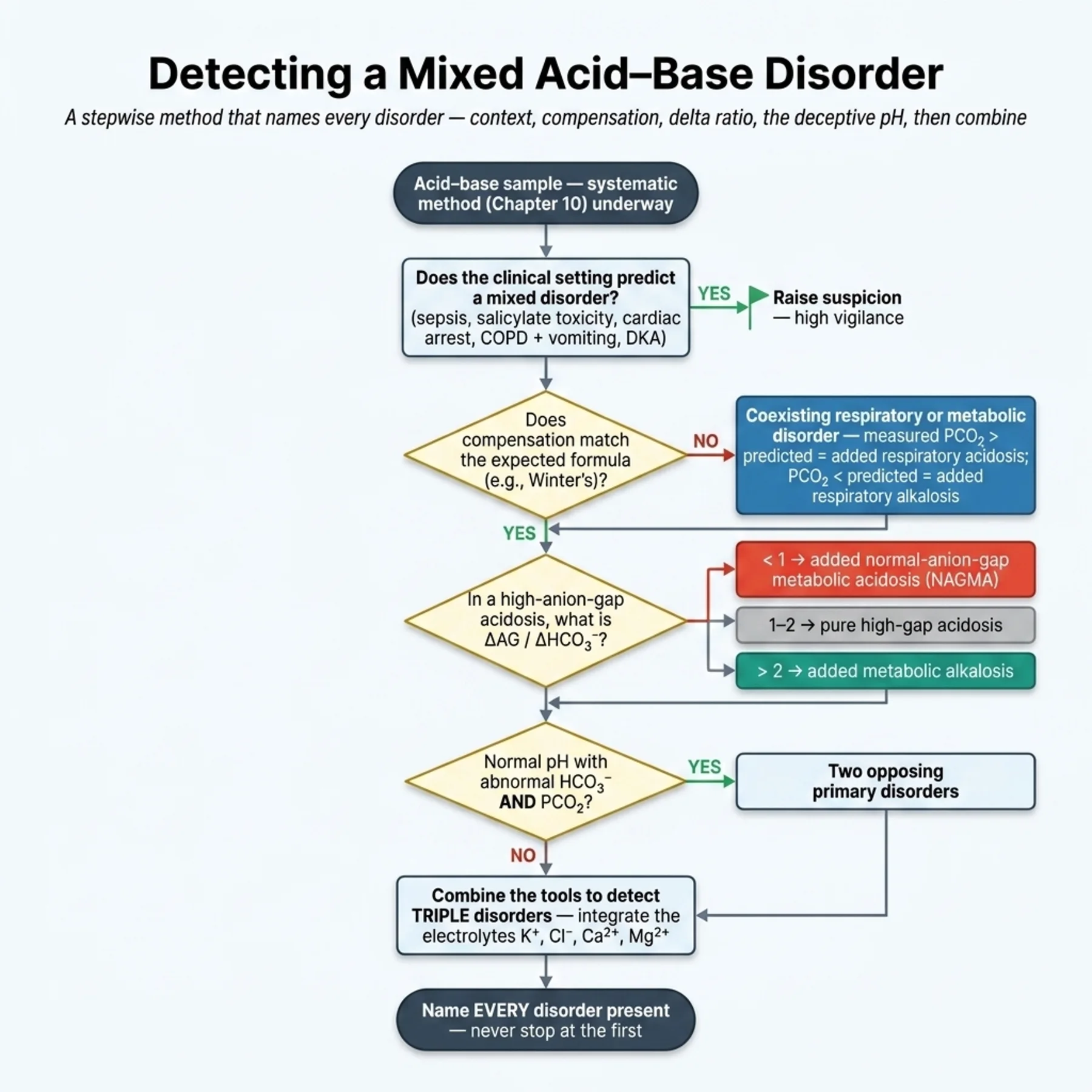
The unifying message of the chapter — and of the acid-base part — is the discipline of the full method, applied rigorously and never abandoned early. The pH names the dominant process; the primary disorder names its cause; the compensation check finds a second respiratory-or-metabolic disorder; the anion gap subclassifies the acidosis; the delta ratio finds a metabolic disorder hidden within a high-gap acidosis; and the recognition of a deceptive pH catches the opposing-disorder pair. A patient can have one, two, or three disturbances, and only the complete method names them all. The commonest error in complex patients is to stop at the first disorder and miss the others — a respiratory acidosis hidden behind a metabolic one, a metabolic alkalosis hidden within a high-gap acidosis, two opposing disorders behind a normal pH. The method exists precisely to prevent this, and the mixed and complex disorders are where it proves its worth. The next chapters apply it under pressure — the emergencies — and in specific settings.
| 04 | PHASE A · LEVEL 4 · ORIENTATION & KNOWLEDGE Reference Tables |
Table 13.1 — How mixed disorders arise
| Route | Example |
| One disease, multiple disorders | Salicylate (HAGMA + respiratory alkalosis); sepsis (lactic + respiratory alkalosis) |
| Multiple coexisting conditions | COPD (respiratory acidosis) + vomiting (metabolic alkalosis) |
| Treatment creates a second disorder | Saline resuscitation of DKA → added normal-gap acidosis |
| Suspicion | The numbers don't fit a single disorder given the physiology |
Table 13.2 — The detection tools
| Tool | What it detects |
| Inappropriate compensation | A coexisting respiratory or metabolic disorder (formula mismatch) |
| Delta ratio (ΔAG/ΔHCO3) | A metabolic disorder within a high-gap acidosis (<1 +NAGMA, >2 +alkalosis) |
| Deceptive (normal) pH | Two opposing disorders cancelling — read HCO3 and PCO2 |
| Combining tools | Triple disorders |
Table 13.3 — Classic mixed patterns
| Setting | Disorders |
| Sepsis | Lactic (high-gap) acidosis + respiratory alkalosis |
| Salicylate | High-gap acidosis + respiratory alkalosis |
| Cardiopulmonary arrest | Metabolic (lactic) + respiratory acidosis — dangerous combined acidaemia |
| COPD + vomiting/diuretics | Respiratory acidosis + metabolic alkalosis (near-normal pH) |
| Cirrhosis | Respiratory alkalosis + metabolic alkalosis ± lactic |
Table 13.4 — Diabetic ketoacidosis as a mixed disorder
| Component | Detail |
| High-gap acidosis | The ketoacids (the primary disorder) |
| + Normal-gap acidosis | From saline resuscitation / ketone loss (delta ratio < 1) |
| + Metabolic alkalosis | From vomiting (delta ratio > 2) |
| + Electrolytes | Potassium shifts of insulin deficiency and treatment (Chapter 7) |
Table 13.5 — A triple disorder
| Element | Detail |
| Example | High-gap acidosis + metabolic alkalosis + respiratory disorder |
| Delta ratio | > 2 reveals the metabolic alkalosis within the high-gap acidosis |
| Compensation | Mismatch reveals the respiratory component |
| Real case | Cirrhosis: respiratory alkalosis + diuretic alkalosis + lactic acidosis |
Table 13.6 — Acid-base + electrolyte combinations
| Disorder | Combined picture |
| Vomiting | Metabolic alkalosis + hypokalaemia + hypochloraemia |
| Diabetic ketoacidosis | High-gap acidosis + potassium shifts |
| Renal tubular acidosis | Normal-gap acidosis + potassium pattern (low 1/2, high 4) |
| Hypomagnesaemia | Refractory hypokalaemia + hypocalcaemia (Chapters 7, 9) |
| 05 | PHASE B · LEVEL 5 · VISUALISE & MAP Imaging & Flowchart Specifications |
| 06 | PHASE B · LEVEL 6 · VISUALISE & MAP Concept Maps |
Each chain runs from physiology to a named diagnostic action; read the arrows as “leads to.”
Why mixed arise. One disease (salicylate, sepsis) / multiple conditions (COPD + vomiting) / treatment (saline in DKA) → two or more coexisting disorders → ACTION: let the clinical context raise suspicion, then confirm with the numbers.
Compensation detection. Compensation is predictable and never over/undershoots → a formula mismatch → a coexisting respiratory or metabolic disorder → ACTION: compute the expected compensation and read the mismatch.
Delta-ratio detection. In a high-gap acidosis Δgap should equal Δbicarbonate → ratio < 1 (+NAGMA) or > 2 (+alkalosis) → ACTION: compute the delta ratio to find a metabolic disorder within the high-gap acidosis.
The deceptive pH. Opposing disorders cancel → normal pH with abnormal HCO3 and PCO2 → ACTION: read the components, not just the pH — a normal pH with abnormal values is a mixed disorder.
Triple disorders. Delta ratio + compensation together → a metabolic and a respiratory disorder within a high-gap acidosis → ACTION: combine the tools to detect triple disturbances.
| 07 | PHASE B · LEVEL 7 · VISUALISE & MAP Decision Pathways |
| R1 | IF the clinical context predicts a mixed disorder (sepsis, salicylate, arrest, COPD with vomiting, DKA), THEN raise suspicion and interrogate the numbers for the expected combination. |
| R2 | IF the compensation does not match the formula, THEN a second respiratory or metabolic disorder is present. |
| R3 | IF there is a high-anion-gap acidosis, THEN compute the delta ratio — below one adds a normal-gap acidosis, above two adds a metabolic alkalosis. |
| R4 | IF the pH is normal but the bicarbonate and PCO2 are clearly abnormal, THEN two opposing disorders are present — read the components. |
| R5 | IF a triple disorder is suspected, THEN combine the delta ratio and the compensation check to expose all three. |
| R6 | IF assessing a complex patient, THEN integrate the acid-base picture with the electrolytes (potassium, chloride, calcium, magnesium). |
| R7 | IF the numbers do not fit a single disorder, THEN a mixed disorder is present — do not force-fit one diagnosis. |
| R8 | IF interpreting any acid-base sample, THEN work the full method to completion — never stop at the first disorder found. |
| 08 | PHASE C · LEVEL 8 · CLINICAL REASONING Clinical Cases |
| CASE 1 | TWO AT ONCE Acid and base together Salicylate's mixed disorder |
Presentation
A patient with a salicylate overdose has a high-anion-gap metabolic acidosis but also a lower-than-expected PCO2. A trainee names the acidosis and is puzzled by the PCO2.
❖ Pause and reflect Why is the PCO2 lower than the acidosis alone would explain? |
Analysis
This is the classic salicylate mixed disorder. Salicylate produces a high-gap acidosis (the salicylate anion and metabolic effects) and, simultaneously, a respiratory alkalosis by directly stimulating the respiratory centre. The PCO2 is lower than Winter's formula would predict for the acidosis alone because the respiratory alkalosis is driving it down independently — the inappropriate compensation reveals the second disorder. Naming only the acidosis would miss the respiratory alkalosis that is part of the same poisoning.
Plan
Diagnose the mixed high-gap acidosis and respiratory alkalosis of salicylate poisoning, confirm with the salicylate level, and treat the poisoning. Use the compensation mismatch as the clue to the second disorder.
Teaching point
Salicylate causes a mixed high-gap acidosis and respiratory alkalosis — a PCO2 lower than expected reveals the second disorder.
Cross-reference
Exercises rules R1 and R2; the compensation-detection concept map; Figure 13.2; Tables 13.2, 13.3; salicylate in Chapters 11–12.
| CASE 2 | THE REASSURING pH Normal pH, abnormal everything Opposing disorders |
Presentation
A patient with COPD and recent vomiting has a normal pH, but a markedly high bicarbonate and a markedly high PCO2. The team is reassured by the normal pH.
❖ Pause and reflect Is a normal pH reassuring here, given the abnormal bicarbonate and PCO2? |
Analysis
No — this is the deceptive-pH trap. The patient has two opposing disorders: a respiratory acidosis (the high PCO2 of COPD) pushing the pH down, and a metabolic alkalosis (the high bicarbonate from vomiting) pushing it up. They cancel to a normal pH, but the markedly abnormal bicarbonate and PCO2 betray two serious disorders. Reading only the pH would conclude, wrongly, that the acid-base state is normal. The components, not the pH, reveal the mixed picture.
Plan
Recognise the combined respiratory acidosis and metabolic alkalosis behind the normal pH, and treat both — the COPD and the vomiting/alkalosis (saline if saline-responsive). Read the bicarbonate and PCO2, not just the pH.
Teaching point
A normal pH with markedly abnormal bicarbonate and PCO2 is two opposing disorders — read the components, not just the pH.
Cross-reference
Exercises rules R4 and R7; the deceptive-pH concept map; Figure 13.3; Tables 13.2, 13.3.
| CASE 3 | THREE DISORDERS Combine the tools A triple disturbance |
Presentation
A patient in diabetic ketoacidosis who has been vomiting has a high-anion-gap acidosis, a delta ratio above 2, and a PCO2 that does not match Winter's prediction. The team has named only the ketoacidosis.
❖ Pause and reflect How many disorders are present, and how do you find them? |
Analysis
Three. The high-gap acidosis is the ketoacidosis. The delta ratio above 2 reveals a coexisting metabolic alkalosis — from the vomiting, which raised the baseline bicarbonate so the gap rose more than the bicarbonate fell. And the PCO2 not matching Winter's formula reveals a coexisting respiratory disorder. Combining the delta ratio (for the metabolic alkalosis) and the compensation check (for the respiratory disorder) exposes the triple disturbance that naming only the ketoacidosis would miss. This is why the full method, applied completely, matters.
Plan
Diagnose the triple disorder — high-gap acidosis, metabolic alkalosis, and a respiratory disorder — by combining the delta ratio and the compensation check, and treat each component and the underlying DKA and vomiting. Integrate the potassium shifts.
Teaching point
Triple disorders are found by combining the tools — the delta ratio for a hidden metabolic disorder, the compensation check for a respiratory one.
Cross-reference
Exercises rules R3, R5, R6; the triple-disorder concept map; Tables 13.4, 13.5; DKA potassium in Chapter 7.
| CASE 4 | DOUBLE ACIDOSIS Two acidoses, very low pH Combined metabolic and respiratory acidosis |
Presentation
A patient after a cardiac arrest has a profoundly low pH with both a high lactate (low bicarbonate) and a high PCO2. The team treats the metabolic acidosis but overlooks the PCO2.
❖ Pause and reflect Why is the pH so low, and what is being missed? |
Analysis
This is a combined metabolic and respiratory acidosis — the most dangerous mixed picture. The arrest produced a lactic (high-gap metabolic) acidosis from tissue hypoperfusion and, simultaneously, a respiratory acidosis from inadequate ventilation (the high PCO2). Because both disorders push the pH in the same direction, there is no cancelling — the pH is profoundly low. Treating only the metabolic component while ignoring the respiratory acidosis (the inadequate ventilation) leaves half the problem unaddressed.
Plan
Address both acidoses: restore perfusion (for the lactic acidosis) and ensure adequate ventilation (for the respiratory acidosis), recognising the combined acidaemia as especially dangerous. Read both the bicarbonate and the PCO2.
Teaching point
A combined metabolic and respiratory acidosis (e.g. cardiac arrest) gives a profoundly low pH — treat both the perfusion and the ventilation.
Cross-reference
Exercises rules R1 and R8; Table 13.3; lactic acidosis in Chapter 11; respiratory acidosis in Chapter 12.
| 09 | PHASE C · LEVEL 9 · CLINICAL REASONING Clinical Implications |
One triad per mechanism the narrative exposed: the physiology, why it matters, and the diagnostic action it dictates.
MECHANISM A single disease, multiple conditions, or treatment can each create more than one acid-base disorder. |
WHY IT MATTERS Real patients commonly carry two or three disturbances at once. |
ACTION Let the clinical context raise suspicion of a mixed disorder, then confirm with the numbers. |
MECHANISM Compensation is predictable and never over- or under-shoots on its own. |
WHY IT MATTERS A compensation that does not match the formula cannot come from a single disorder. |
ACTION Compute the expected compensation — a mismatch reveals a second respiratory or metabolic disorder. |
MECHANISM In a pure high-gap acidosis the rise in gap equals the fall in bicarbonate. |
WHY IT MATTERS A delta ratio away from one-to-two reveals a hidden metabolic disorder. |
ACTION Compute the delta ratio in every high-gap acidosis to find a coexisting acidosis or alkalosis. |
MECHANISM Two opposing disorders can cancel to leave a normal pH. |
WHY IT MATTERS The reassuring pH invites the clinician to stop, missing two serious disorders. |
ACTION Read the bicarbonate and PCO2, not just the pH. |
MECHANISM Acid-base and electrolyte disorders arise from shared processes. |
WHY IT MATTERS The complete picture of a complex patient spans both. |
ACTION Integrate the potassium, chloride, calcium, and magnesium with the acid-base analysis. |
| 10 | PHASE C · LEVEL 10 · CLINICAL REASONING Clinical Pearls |
| A mixed disorder = ≥ 2 coexisting primary acid-base disturbances. | Arise: one disease, multiple conditions, or treatment. |
| The pH names at most one disorder — the method finds the rest. | Tool 1: inappropriate compensation → a second respiratory/metabolic disorder. |
| Tool 2: delta ratio (ΔAG/ΔHCO3) → a metabolic disorder within a HAGMA. | Delta < 1 = + NAGMA; delta > 2 = + metabolic alkalosis. |
| Tool 3: normal pH with abnormal HCO3/PCO2 → opposing disorders. | Combine tools for triple disorders. |
| Sepsis: lactic acidosis + respiratory alkalosis. | Salicylate: high-gap acidosis + respiratory alkalosis. |
| Cardiac arrest: lactic + respiratory acidosis (very low pH, dangerous). | COPD + vomiting/diuretics: respiratory acidosis + metabolic alkalosis (near-normal pH). |
| DKA often mixed: + NAGMA (saline) or + alkalosis (vomiting). | Context drives suspicion; the numbers confirm. |
| Integrate the electrolytes (K/Cl/Ca/Mg) with acid-base. | NEVER stop at the first disorder — work the full method. |
| 11 | PHASE D · LEVEL 11 · SAFETY & EVIDENCE Red Flags & Never-Do |
Panel A — Red flags
| ▲ | Compensation that doesn't match the formula — a second respiratory or metabolic disorder is present. |
| ▲ | A delta ratio far from 1–2 in a high-gap acidosis — a coexisting normal-gap acidosis or alkalosis. |
| ▲ | A normal pH with markedly abnormal bicarbonate and PCO2 — two opposing disorders, not a normal state. |
| ▲ | A profoundly low pH with both a low bicarbonate and a high PCO2 — combined metabolic and respiratory acidosis. |
| ▲ | A high-risk context (sepsis, salicylate, arrest, COPD + vomiting) — expect and look for a mixed disorder. |
Panel B — Never do
| ✖ NEVER — stop at the first disorder found — work the full method. |
| ✖ NEVER — be reassured by a normal pH without reading the bicarbonate and PCO2. |
| ✖ NEVER — skip the delta ratio in a high-gap acidosis. |
| ✖ NEVER — force-fit a single diagnosis when the numbers do not fit. |
| 12 | PHASE D · LEVEL 12 · SAFETY & EVIDENCE Common Pitfalls |
Pitfall 1 — Stopping at one disorder
| ✖ | WRONG Naming the dominant disorder and moving on. |
| ✓ | RIGHT Working the full method to find every disorder. |
| ✉ | WHY A patient can have two or three simultaneous disturbances. |
Pitfall 2 — Trusting the normal pH
| ✖ | WRONG Concluding the acid-base state is normal from a normal pH. |
| ✓ | RIGHT Reading the bicarbonate and PCO2 for opposing disorders. |
| ✉ | WHY Two opposing disorders cancel to a normal pH. |
Pitfall 3 — Skipping the delta ratio
| ✖ | WRONG Assuming a high-gap acidosis is pure. |
| ✓ | RIGHT Computing the delta ratio to detect a coexisting metabolic disorder. |
| ✉ | WHY The delta ratio finds disorders hidden within a high-gap acidosis. |
Pitfall 4 — Ignoring the context
| ✖ | WRONG Reading the numbers without the clinical setting. |
| ✓ | RIGHT Letting the context (sepsis, salicylate, arrest) predict the mixed pattern. |
| ✉ | WHY The setting tells you which combination to look for. |
Pitfall 5 — Separating acid-base from electrolytes
| ✖ | WRONG Analysing the acid-base and electrolyte disorders separately. |
| ✓ | RIGHT Integrating them as one picture. |
| ✉ | WHY They arise from shared processes (vomiting, DKA, RTA, hypomagnesaemia). |
| 13 | PHASE D · LEVEL 13 · SAFETY & EVIDENCE Evidence Grading |
GRADE A HIGH CONFIDENCE The effect is real and the estimate is stable. RCTs at low risk of bias; multiple concordant prospective cohorts; meta-analyses. |
GRADE B MODERATE CONFIDENCE The effect is likely real but may shift with new data. Observational studies, registries, mechanistic human studies. |
GRADE C LOW CONFIDENCE Rests on physiology, reasoning, or consensus rather than outcomes. Pathophysiological reasoning; extrapolation; consensus without outcomes. |
Graded statements (by evidence type)
| Statement | Grade | Basis (evidence type) |
| Inappropriate compensation indicates a second acid-base disorder. | A | Established physiology |
| The delta ratio detects a metabolic disorder within a high-gap acidosis. | A | Established clinical reasoning |
| A normal pH with abnormal HCO3 and PCO2 indicates opposing disorders. | A | Established physiology |
| Salicylate causes a mixed high-gap acidosis and respiratory alkalosis. | A | Established pharmacology |
| Cardiac arrest causes a combined metabolic and respiratory acidosis. | A | Established physiology |
| Acid-base and electrolyte disorders frequently coexist. | A | Established physiology |
| The full systematic method detects mixed disorders the pH misses. | A | Established clinical reasoning |
| 18 | PHASE F · LEVEL 18 · APPLY & TEST Cheat Sheet |
| Mixed = ≥ 2 coexisting primary disorders. | Arise: one disease / multiple conditions / treatment. |
| pH names at most one — the method finds the rest. | Tool 1: inappropriate compensation → respiratory/metabolic 2nd disorder. |
| Tool 2: delta ratio → metabolic disorder within a HAGMA. | Delta < 1 = +NAGMA; > 2 = +metabolic alkalosis. |
| Tool 3: normal pH + abnormal HCO3/PCO2 = opposing disorders. | Combine tools → triple disorders. |
| Sepsis: lactic + respiratory alkalosis. | Salicylate: HAGMA + respiratory alkalosis. |
| Arrest: lactic + respiratory acidosis (very low pH). | COPD + vomiting: respiratory acidosis + metabolic alkalosis. |
| DKA: + NAGMA (saline) or + alkalosis (vomiting). | Context drives suspicion; numbers confirm. |
| Integrate electrolytes (K/Cl/Ca/Mg). | NEVER stop at the first disorder. |
| 19 | PHASE F · LEVEL 19 · APPLY & TEST Flashcards |
| CARD 1 | Q. What is a mixed acid-base disorder, and how does it arise? A. Two or more primary disturbances coexisting — arising when a single disease causes several (salicylate, sepsis), when multiple conditions coexist (COPD plus vomiting), or when treatment creates a second disorder (saline in DKA). DETAILED. The pH names at most one of them. CLINICAL. Let the context raise suspicion and confirm with the numbers. |
| CARD 2 | Q. How does inappropriate compensation reveal a mixed disorder? A. Compensation is predictable and never over- or under-shoots on its own, so a measured value that does not match the expected formula reveals a coexisting respiratory or metabolic disorder. DETAILED. It finds a respiratory disorder behind a metabolic one, or vice versa. CLINICAL. Compute the expected compensation and read the mismatch. |
| CARD 3 | Q. How does the delta ratio reveal a mixed disorder? A. In a high-anion-gap acidosis, the change in gap should equal the change in bicarbonate (ratio 1–2); below one reveals a coexisting normal-gap acidosis, above two a coexisting metabolic alkalosis. DETAILED. It finds a metabolic disorder hidden within a high-gap acidosis. CLINICAL. Compute the delta ratio in every high-gap acidosis. |
| CARD 4 | Q. Why can a normal pH hide a mixed disorder? A. Two opposing disorders — one raising, one lowering the pH — can cancel to a normal pH while the bicarbonate and PCO2 are both markedly abnormal. DETAILED. The reassuring pH invites the clinician to stop looking. CLINICAL. Read the bicarbonate and PCO2, not just the pH. |
| CARD 5 | Q. How are triple disorders detected? A. By combining the tools: the delta ratio reveals a metabolic disorder within a high-gap acidosis, and the compensation check reveals a coexisting respiratory disorder. DETAILED. A DKA patient with vomiting and a respiratory disorder is an example. CLINICAL. Combine the delta ratio and the compensation check. |
| CARD 6 | Q. What are the classic mixed patterns? A. Sepsis (lactic acidosis plus respiratory alkalosis), salicylate (high-gap acidosis plus respiratory alkalosis), cardiac arrest (combined metabolic and respiratory acidosis), and COPD with vomiting or diuretics (respiratory acidosis plus metabolic alkalosis). DETAILED. Each has a characteristic setting. CLINICAL. Recognise them by their clinical context and interrogate the numbers. |
| CARD 7 | Q. Why integrate the electrolytes with the acid-base analysis? A. Because acid-base and electrolyte disorders arise from shared processes — vomiting causes alkalosis with hypokalaemia and hypochloraemia, DKA causes acidosis with potassium shifts, renal tubular acidoses have characteristic potassium patterns. DETAILED. The internal milieu is one system. CLINICAL. Read the potassium, chloride, calcium, and magnesium together with the acid-base. |
| CARD 8 | Q. What is the cardinal discipline in complex acid-base disorders? A. To apply the full systematic method rigorously and never stop at the first disorder found, because the method exists precisely to uncover the second and third disturbances the pH misses. DETAILED. Stopping early is the commonest error in complex patients. CLINICAL. Work the full method to completion every time. |
| 20 | PHASE F · LEVEL 20 · APPLY & TEST One-Minute Preceptor |
| SCENE 1 | The intern reassured by the pH |
GET A COMMITMENT. “You've called this acid-base state normal because the pH is normal — are you sure?”
PROBE FOR EVIDENCE. “The pH is fine” — ask: “What are the bicarbonate and PCO2 doing, and what could a normal pH with both abnormal mean?”
TEACH A GENERAL RULE. Two opposing disorders can cancel to a normal pH, so a normal pH with markedly abnormal bicarbonate and PCO2 is a mixed disorder — read the components.
REINFORCE WHAT WAS RIGHT. Noting the pH was the first step.
CORRECT A MISTAKE. Read the bicarbonate and PCO2 — here a respiratory acidosis and a metabolic alkalosis.
| SCENE 2 | The resident who stopped at the ketoacidosis |
GET A COMMITMENT. “You've named the ketoacidosis and stopped — could there be more?”
PROBE FOR EVIDENCE. “The high gap fits” — ask: “What is the delta ratio, and does the PCO2 match Winter's formula?”
TEACH A GENERAL RULE. The delta ratio and the compensation check find hidden disorders — a vomiting DKA patient can have a triple disturbance the high gap alone misses.
REINFORCE WHAT WAS RIGHT. Identifying the ketoacidosis was correct.
CORRECT A MISTAKE. Compute the delta ratio and the compensation — find the alkalosis and the respiratory disorder too.
| 22 | PHASE F · LEVEL 22 · APPLY & TEST Board-Style Questions |
| Q 01 | A mixed acid-base disorder is: |
| A | A single disorder with compensation |
| B | Two or more coexisting primary disturbances |
| C | Always a normal pH |
| D | Only seen in salicylate poisoning |
Rationale A mixed disorder is two or more primary disturbances at once (Figure 13.1, rule R7). A is a single disorder; C and D are too narrow. |
| Q 02 | Compensation that does not match the expected formula indicates: |
| A | A laboratory error |
| B | A coexisting respiratory or metabolic disorder |
| C | Normal physiology |
| D | A pure disorder |
Rationale Compensation never over- or under-shoots alone, so a mismatch reveals a second disorder (rule R2, case 1). A, C, and D are incorrect. |
| Q 03 | In a high-gap acidosis, a delta ratio below 1 indicates: |
| A | A pure high-gap acidosis |
| B | A coexisting normal-gap acidosis |
| C | A coexisting metabolic alkalosis |
| D | A respiratory disorder |
Rationale If bicarbonate fell more than the gap rose, extra bicarbonate was lost — a coexisting normal-gap acidosis (rule R3, Table 13.2). A is ~1–2; C is > 2; D is a different axis. |
| Q 04 | A patient with COPD and vomiting has a normal pH but a markedly high bicarbonate and PCO2. This represents: |
| A | A normal acid-base state |
| B | A combined respiratory acidosis and metabolic alkalosis (opposing disorders) |
| C | A pure respiratory acidosis |
| D | A pure metabolic alkalosis |
Rationale Two opposing disorders cancel to a normal pH while the components are abnormal (case 2, Figure 13.3, rule R4). A is the trap; C and D are single disorders. |
| Q 05 | How is a triple acid-base disorder detected? |
| A | By the pH alone |
| B | By combining the delta ratio and the compensation check |
| C | It cannot be detected |
| D | By the anion gap alone |
Rationale Combining the tools exposes a metabolic and a respiratory disorder within a high-gap acidosis (case 3, rule R5, Table 13.5). A, C, and D are insufficient. |
| Q 06 | Salicylate poisoning classically produces: |
| A | A pure metabolic alkalosis |
| B | A high-anion-gap acidosis plus a respiratory alkalosis |
| C | A pure respiratory acidosis |
| D | A normal-gap acidosis |
Rationale Salicylate causes both a high-gap acidosis and a respiratory alkalosis — a classic mixed disorder (case 1, Table 13.3). A, C, and D are incorrect. |
| Q 07 | A profoundly low pH with both a low bicarbonate and a high PCO2 after cardiac arrest is: |
| A | A pure metabolic acidosis |
| B | A combined metabolic and respiratory acidosis |
| C | A mixed acidosis and alkalosis |
| D | Normal |
Rationale Both disorders push the pH the same way (no cancelling), giving a profoundly low pH — a dangerous combined acidaemia (case 4, Table 13.3). A misses the respiratory component; C and D are wrong. |
| Q 08 | The cardinal discipline in complex acid-base disorders is to: |
| A | Stop at the dominant disorder |
| B | Work the full systematic method and never stop at the first disorder |
| C | Trust the pH |
| D | Ignore the electrolytes |
Rationale Only the complete method names every disorder; stopping early misses the others (rule R8, L9). A, C, and D are the errors the method prevents. |