Chapter Preamble
Signals declared
Sig-D — Diagnostic (primary). Judge symptoms, acuity, and cause to choose treatment, and recognise overcorrection and demyelination.
Sig-T — Therapeutic (strong). Hypertonic saline for cerebral oedema, cause-specific treatment, the correction limits, and the re-lowering rescue.
Sig-M — Mechanistic (strong). The two competing dangers — cerebral oedema and osmotic demyelination — and the cerebral adaptation that creates them.
Sig-V — Evidence-dense (strong). The correction-rate limits, the risk factors for demyelination, and the place of vaptans — graded and reflected on.
Levels populated and omitted
Populated (20): L1–L14, L17–L22. As a four-signal flagship it fires nearly everything — concept maps and triads (Sig-M), the absolute-risk table and templates (Sig-T), and the reflective prompts (Sig-V).
L15 / L16 preference-sensitive map and SDM scripts — omitted. No Sig-E; treating hyponatraemia is effective, protocol-driven care, not a values-driven choice.
| 01 | PHASE A · LEVEL 1 · ORIENTATION & KNOWLEDGE Learning Objectives |
By the end of this chapter you should be able to:
Explain the two competing dangers — cerebral oedema and osmotic demyelination — that govern treatment.
Treat severe symptomatic hyponatraemia with hypertonic saline to a small, controlled rise.
State the correction-rate limits and the risk factors for osmotic demyelination.
Choose cause-specific treatment for hypovolaemic, euvolaemic, and hypervolaemic hyponatraemia.
Describe the mechanism, clinical course, and prevention of osmotic demyelination syndrome.
Anticipate autocorrection when ADH switches off and prevent overshoot.
Account for the effect of potassium repletion on the sodium.
Use the desmopressin clamp and re-lowering to rescue an overcorrection.
| 02 | PHASE A · LEVEL 2 · ORIENTATION & KNOWLEDGE Executive Summary |
Treatment is governed by two competing dangers: under-treating acute cerebral oedema, and over-correcting chronic hyponatraemia into osmotic demyelination.
The balance is to correct fast enough to relieve cerebral oedema but slow enough to spare the adapted brain.
Severe symptoms — seizures, coma, deep obtundation — signify cerebral oedema and are an emergency, treated with hypertonic (3%) saline regardless of chronicity.
A small rise of about 4 to 6 mmol/L relieves the cerebral oedema and herniation risk; more is not needed acutely.
In chronic hyponatraemia the total correction is then capped — broadly no more than 8 mmol/L in 24 hours, less in high-risk patients — to avoid demyelination.
The correction limit is a ceiling, not a target: aim to relieve symptoms with the minimum rise, then hold.
Osmotic demyelination follows rapid correction of the adapted, osmolyte-depleted brain, which cannot re-accumulate osmolytes fast enough and dehydrates.
It is biphasic and often irreversible, and its risk is highest with a very low sodium, hypokalaemia, alcoholism, malnutrition, and liver disease.
Cause-specific treatment follows the diagnosis: isotonic saline for hypovolaemia, fluid restriction for SIADH, and fluid and sodium restriction for the hypervolaemic states.
Overcorrection most often happens by autocorrection — when ADH suddenly switches off (volume repleted, cause resolved) and a brisk water diuresis raises the sodium quickly.
Potassium repletion raises the sodium and must be counted in the correction.
The sodium is monitored frequently during active correction, and autocorrection is anticipated in predictable settings.
If the sodium is overcorrected, it is re-lowered with electrolyte-free water and desmopressin to prevent or mitigate demyelination.
The desmopressin clamp — proactive desmopressin with controlled hypertonic saline — allows a controlled correction and prevents autocorrection in high-risk cases.
| 03 | PHASE A · LEVEL 3 · ORIENTATION & KNOWLEDGE Main Narrative |
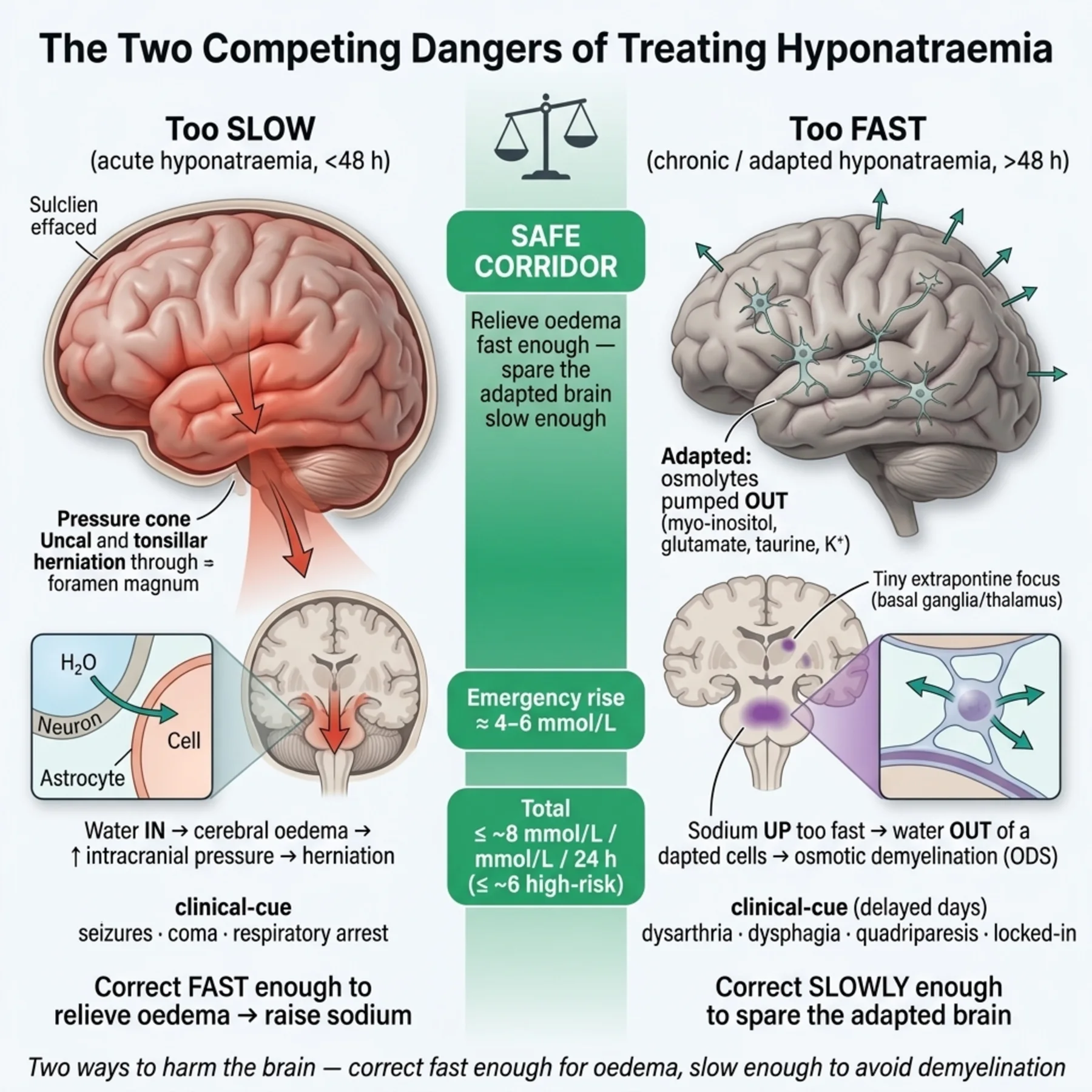
Treating hyponatraemia is a balancing act between two ways of harming the brain. Correct too slowly, and a patient with acute cerebral oedema herniates and dies. Correct too quickly, and a patient whose brain has adapted to chronic hyponatraemia suffers osmotic demyelination — a delayed, often irreversible catastrophe. Almost everything in this chapter is the management of that tension: relieve the oedema fast enough, spare the adapted brain slow enough, and never lose track of the sodium's trajectory.
— The two competing dangers
The cerebral adaptation of the previous chapter creates the dilemma. In acute hyponatraemia the brain has not yet adapted, so it swells in the hypotonic plasma, and severe symptoms — seizures, coma, deep obtundation — signal dangerous cerebral oedema that demands rapid correction. In chronic hyponatraemia the brain has extruded osmolytes to shrink back toward normal volume, so it tolerates the low sodium but is now osmolyte-depleted; if the sodium is raised quickly, the adapted brain cannot re-accumulate osmolytes fast enough and dehydrates, demyelinating. So the same intervention — raising the sodium — is lifesaving when done for oedema and catastrophic when done too fast in an adapted brain. Treatment must therefore answer two questions at once: are there severe symptoms (is there oedema to relieve urgently?), and is this chronic (is the brain adapted and at risk of demyelination?). The acuity established at diagnosis is what makes the answer safe.
— The emergency: hypertonic saline for cerebral oedema
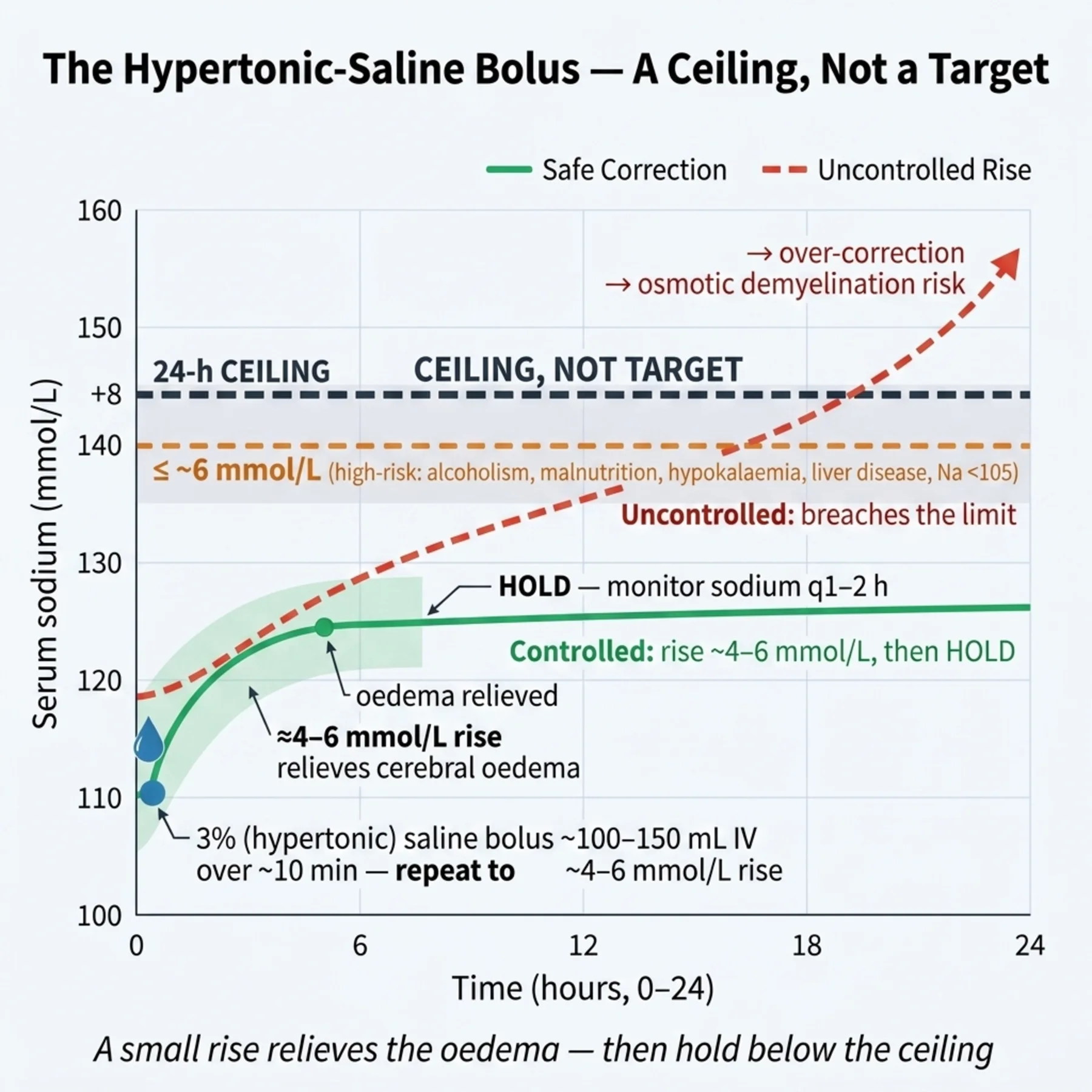
When severe symptoms are present — seizures, coma, severe confusion — cerebral oedema is the threat regardless of chronicity, and the response is urgent hypertonic saline. The modern approach is a small bolus of 3% saline (around 100 to 150 mL over 10 to 20 minutes), repeated once or twice as needed, aiming for a rapid but small rise of about 4 to 6 mmol/L. That small rise is what shrinks the swollen brain enough to relieve the herniation risk; the goal acutely is not to normalise the sodium but to lift it just enough to make the brain safe. Once that small rise is achieved and the severe symptoms abate, the rapid correction stops, and the total correction over the day is then capped to protect against demyelination. The bolus strategy — small, defined, repeatable — has replaced open-ended infusions precisely because it relieves the oedema while limiting the overshoot that causes demyelination.
— The ceiling: correction limits and demyelination risk
Beyond the emergency, the dominant rule is the correction limit — a ceiling on how far the sodium may rise in a day. In chronic hyponatraemia, the correction is broadly limited to no more than about 8 mmol/L in 24 hours (and less, around 6, in high-risk patients), with a 48-hour ceiling as well. This is a ceiling, not a target: the aim is to relieve symptoms with the smallest rise and then hold, not to climb to the limit. The reason is osmotic demyelination syndrome, whose risk is concentrated in identifiable patients — those with a very low sodium (at or below about 105), hypokalaemia, alcoholism, malnutrition, or advanced liver disease — in whom the limit is set lower and the vigilance higher. The whole of safe treatment is, in a sense, respecting this ceiling while relieving the symptoms that justify treating at all.
— Cause-specific treatment
Once the urgency is handled, the diagnosis from the previous chapter directs the definitive treatment. Hypovolaemic hyponatraemia is treated with isotonic saline, which restores volume and — importantly — switches off the volume-driven ADH; the caution is the autocorrection that follows. SIADH is treated first with fluid restriction, escalating if needed to increasing solute (salt or urea), a loop diuretic (which impairs urinary concentration), or a vasopressin V2-receptor antagonist (a vaptan such as tolvaptan, which produces a water diuresis), alongside treating the underlying cause; the vaptans are effective but carry a risk of overcorrection and cost and hepatotoxicity cautions. The hypervolaemic underfill states are treated with fluid and sodium restriction, treatment of the underlying heart, liver, or kidney disease, and loop diuretics, with vaptans in selected cases. Low-solute states and primary polydipsia are treated with water restriction and restored solute. Across all of these, the treatment of the cause and the management of the correction rate run in parallel.
— Osmotic demyelination syndrome
Osmotic demyelination syndrome is the feared complication, and understanding it is what makes the limits make sense. Mechanistically, the adapted brain has shed osmolytes to survive the chronic hyponatraemia; when the sodium rises faster than the brain can re-import those osmolytes, the brain cells lose water and shrink, and the resulting osmotic stress damages myelin — classically in the central pons (central pontine myelinolysis) but also extrapontine. The clinical course is treacherous and biphasic: the patient often improves initially as the sodium corrects, then days later develops dysarthria, dysphagia, a quadriparesis that can progress to a locked-in state, and behavioural changes — frequently irreversible. Because it is delayed, the harm is done before it declares itself, which is why prevention — respecting the limits, identifying high-risk patients, and monitoring obsessively — is everything. There is no good treatment once it occurs; the entire strategy is to never let it happen.
— Autocorrection, potassium, and the desmopressin clamp
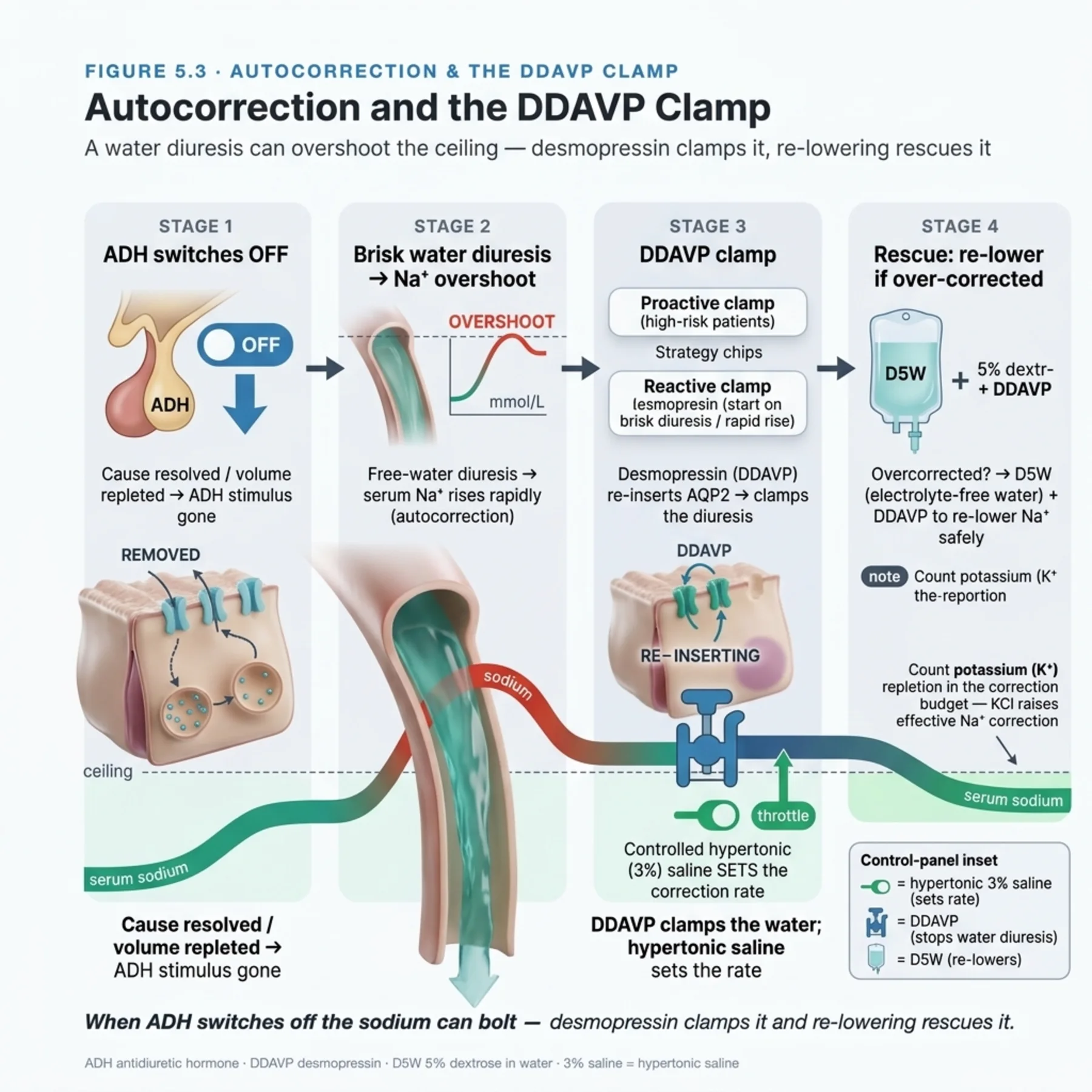
The commonest way the limit is breached is not by giving too much hypertonic saline but by autocorrection. When the stimulus to ADH is suddenly removed — volume repleted with saline, the cause treated, glucocorticoid given in adrenal insufficiency, an offending drug stopped — ADH switches off, the kidney abruptly produces a large dilute water diuresis, and the sodium rises rapidly on its own, overshooting the limit. This is predictable, so it is anticipated in exactly these settings: hypovolaemic hyponatraemia after saline, low-solute states and polydipsia, adrenal insufficiency after steroids. Two further points are practical and easily missed. First, potassium repletion raises the sodium — potassium given enters cells in exchange for sodium and acts osmotically — so the potassium must be counted in the day's correction, and a hypokalaemic patient being repleted can overcorrect unexpectedly. Second, the controlling tool is desmopressin: giving desmopressin clamps the kidney's water handling, preventing the autocorrection diuresis, and the 'DDAVP clamp' strategy — proactive desmopressin combined with controlled hypertonic saline — lets the clinician set the correction rate deliberately in high-risk patients rather than chasing an unpredictable autocorrection.
— When it goes too fast: re-lowering
If, despite care, the sodium overcorrects — rises beyond the daily limit — the situation is not hopeless, because re-lowering the sodium promptly can prevent or mitigate demyelination. The rescue is to bring the sodium back down with electrolyte-free water (5% dextrose) and to administer desmopressin to stop the ongoing water diuresis, re-establishing control and lowering the sodium back below the limit. This re-lowering, done early after an overcorrection, is supported by clinical experience as a way to avert the demyelination that the overshoot would otherwise cause. It reframes overcorrection from an irreversible error into a recoverable one, provided it is recognised quickly — which is the rationale for the frequent sodium monitoring (every few hours during active correction) that the chapter insists upon. The message is that the trajectory of the sodium must be watched continuously, and that both overshoot and its rescue are part of competent management.
— Where the evidence is firm, and where judgement governs
The firm parts are the principles: cerebral oedema from acute hyponatraemia kills and is relieved by a small rapid rise; osmotic demyelination follows rapid correction of the adapted brain and is largely irreversible; and the risk factors and the broad correction limits are well established, as is the value of potassium accounting and the desmopressin clamp. The softer parts are the exact numbers — the precise ceiling, the precise bolus — which vary modestly between guidelines and which justify a conservative, individualised approach rather than a single rule. Vaptan use is effective but tempered by overcorrection risk and cost. The disciplined position is to treat severe symptoms urgently with small hypertonic-saline boluses, respect a conservative correction ceiling, identify the high-risk patient, anticipate autocorrection, count the potassium, monitor the sodium relentlessly, and re-lower promptly if overshoot occurs — holding the two dangers in mind at every step.
| 04 | PHASE A · LEVEL 4 · ORIENTATION & KNOWLEDGE Reference Tables |
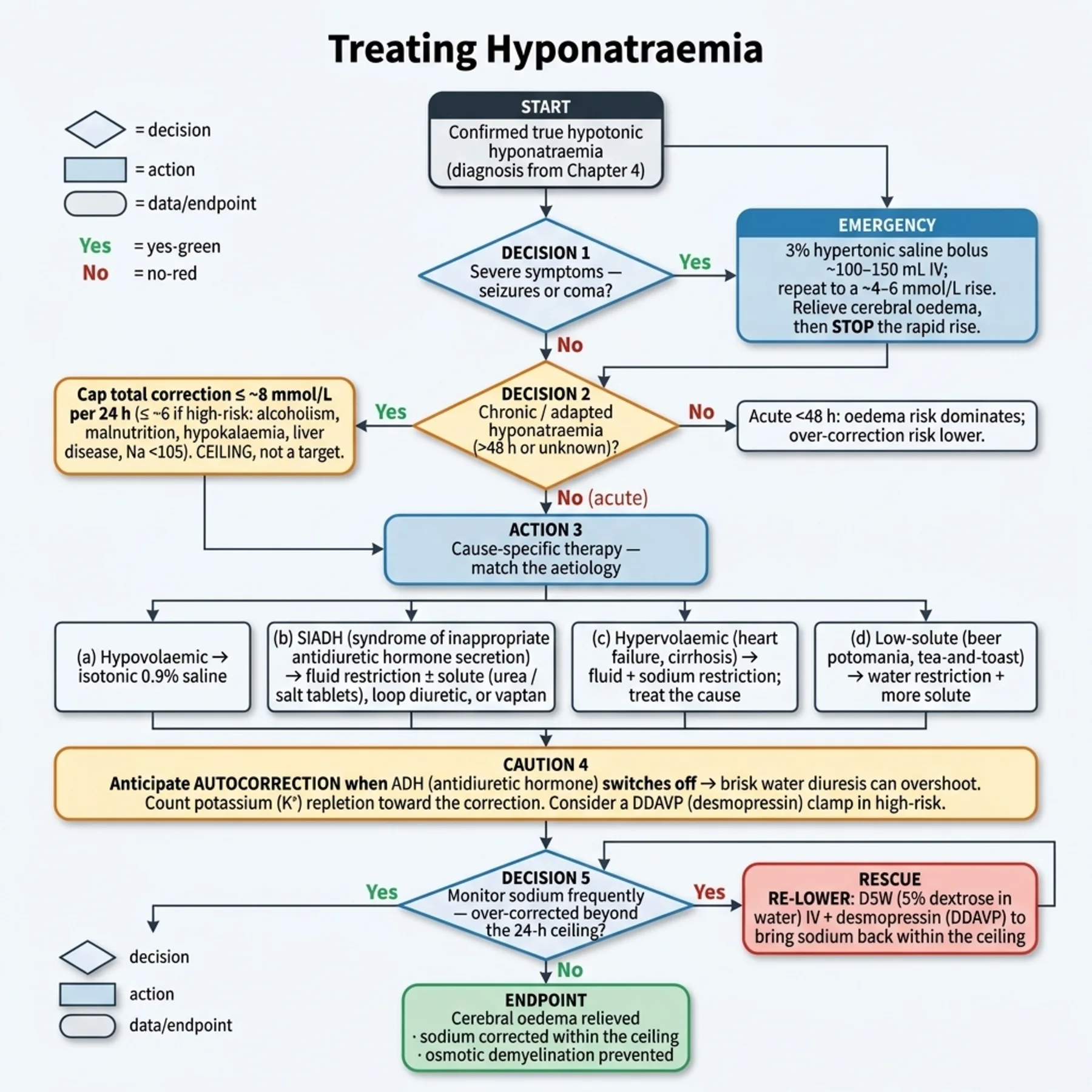
Table 5.1 — The treatment decision
| Question | Determines |
| Severe symptoms (seizures, coma)? | Emergency → hypertonic saline for cerebral oedema |
| Acute or chronic? | Demyelination risk — chronic (adapted) brain needs slow correction |
| Cause / volume status (Chapter 4)? | Cause-specific definitive treatment |
| Two dangers held together | Relieve oedema fast enough; spare the adapted brain slow enough |
Table 5.2 — Severe symptomatic hyponatraemia
| Element | Detail |
| Agent | 3% (hypertonic) saline |
| Bolus | ~100–150 mL over 10–20 min, repeat ×1–2 |
| Target rise | ~4–6 mmol/L — relieves oedema/herniation |
| Then | Stop the rapid rise; cap total daily correction |
| Goal | Make the brain safe — not normalise the sodium acutely |
Table 5.3 — Correction limits and demyelination risk
| Item | Detail |
| Limit (chronic) | ≤ ~8 mmol/L per 24 h (≤ ~6 if high-risk); a 48-h ceiling too |
| The limit is | A ceiling, not a target — relieve symptoms with the minimum rise, then hold |
| High-risk for ODS | Na ≤ ~105, hypokalaemia, alcoholism, malnutrition, liver disease |
| Acute (not adapted) | Faster correction is safer, but rarely needed beyond the small rise |
Table 5.4 — Cause-specific treatment
| Cause | Treatment |
| Hypovolaemic | Isotonic saline (turns off ADH — beware autocorrection); treat cause |
| SIADH (euvolaemic) | Fluid restriction first; then solute (salt/urea), loop, or vaptan; treat cause |
| Hypervolaemic | Fluid + sodium restriction; treat heart/liver/kidney; loop ± vaptan |
| Low-solute / polydipsia | Water restriction, restore solute — high autocorrection risk |
Table 5.5 — Osmotic demyelination syndrome
| Aspect | Detail |
| Mechanism | Rapid rise → osmolyte-depleted adapted brain dehydrates → demyelination |
| Sites | Central pontine ± extrapontine |
| Course | Biphasic — initial improvement, then (days) dysarthria, dysphagia, quadriparesis |
| Prognosis | Often irreversible — no good treatment; prevention is everything |
| Prevention | Respect limits; identify high-risk; monitor sodium frequently |
Table 5.6 — Overcorrection: autocorrection and rescue
| Item | Detail |
| Autocorrection | ADH switches off → brisk water diuresis → sodium overshoots |
| Anticipate in | Hypovolaemia after saline; low-solute/polydipsia; adrenal insufficiency after steroids |
| Potassium | K repletion raises sodium — count it in the correction |
| DDAVP clamp | Proactive desmopressin + controlled hypertonic saline — set the rate |
| Re-lowering | If overcorrected: electrolyte-free water (D5W) + desmopressin to re-lower |
| 05 | PHASE B · LEVEL 5 · VISUALISE & MAP Imaging & Flowchart Specifications |
| 06 | PHASE B · LEVEL 6 · VISUALISE & MAP Concept Maps |
Each chain runs from physiology to a named bedside action; read the arrows as “leads to.”
The two dangers. Acute hyponatraemia → brain swells (oedema, herniation) needing rapid correction; chronic → adapted, osmolyte-depleted brain harmed by rapid correction (demyelination) → ACTION: relieve oedema fast enough and spare the adapted brain slow enough — hold both in mind.
Hypertonic saline. Severe symptoms = cerebral oedema → 3% saline bolus → a small (~4–6 mmol/L) rise shrinks the swollen brain → ACTION: give a small, defined bolus to relieve herniation, then stop the rapid rise.
ODS mechanism. Rapid sodium rise → adapted brain can't re-accumulate osmolytes fast enough → cells dehydrate → demyelination (pontine/extrapontine) → ACTION: respect the correction ceiling, especially in high-risk patients.
Autocorrection. ADH stimulus removed (volume repleted, cause treated, steroids) → brisk water diuresis → sodium overshoots → ACTION: anticipate it, count potassium repletion, and use a desmopressin clamp in high-risk cases.
Re-lowering. Overcorrection beyond the ceiling → demyelination risk → prompt re-lowering with electrolyte-free water + desmopressin → ACTION: monitor sodium frequently and rescue an overshoot early.
| 07 | PHASE B · LEVEL 7 · VISUALISE & MAP Decision Pathways |
| R1 | IF hyponatraemia is severely symptomatic (seizures, coma, deep obtundation), THEN treat the cerebral oedema urgently with hypertonic (3%) saline, regardless of chronicity. |
| R2 | IF giving hypertonic saline for oedema, THEN aim for a small rise of ~4–6 mmol/L to relieve it — not to normalise the sodium acutely — then stop the rapid rise. |
| R3 | IF hyponatraemia is chronic, THEN cap correction at ≤ ~8 mmol/L/24 h (≤ ~6 if high-risk) — the limit is a ceiling, not a target. |
| R4 | IF the patient is high-risk for demyelination (Na ≤ ~105, hypokalaemia, alcoholism, malnutrition, liver disease), THEN correct more slowly and monitor more closely. |
| R5 | IF treating definitively, THEN match the cause — isotonic saline (hypovolaemic), fluid restriction ± escalation (SIADH), fluid/sodium restriction (hypervolaemic), water restriction + solute (low-solute). |
| R6 | IF the ADH stimulus is about to be removed (volume repletion, treating the cause, steroids), THEN anticipate autocorrection and consider a desmopressin clamp. |
| R7 | IF repleting potassium, THEN count it in the day's sodium correction — potassium raises the sodium. |
| R8 | IF the sodium overcorrects beyond the limit, THEN re-lower it promptly with electrolyte-free water and desmopressin to prevent demyelination. |
| 08 | PHASE C · LEVEL 8 · CLINICAL REASONING Clinical Cases |
| CASE 1 | THE SEIZING PATIENT Relieve the oedema Severe symptomatic hyponatraemia |
Presentation
A patient presents with a seizure and a sodium of 112. The team, fearing demyelination, hesitates to correct the sodium and plans only gentle fluid restriction.
❖ Pause and reflect Is cautious fluid restriction the right response to a seizing, severely hyponatraemic patient? |
Analysis
No — the seizure signifies cerebral oedema, an immediate threat to life, and demands urgent treatment regardless of chronicity. The correct response is hypertonic (3%) saline as a small bolus (around 100 to 150 mL), repeated as needed to achieve a rise of about 4 to 6 mmol/L, which relieves the oedema and the herniation risk. Withholding treatment for fear of demyelination is the wrong end of the balance here; demyelination is avoided by capping the total correction afterward, not by failing to relieve life-threatening oedema.
Plan
Give a 3% saline bolus, repeat to a ~4–6 mmol/L rise to stop the seizure and relieve the oedema, then stop the rapid rise and cap the total 24-hour correction. Monitor the sodium frequently thereafter.
Teaching point
Severe symptoms mean cerebral oedema — give hypertonic saline for a small rapid rise; fear of demyelination is managed by the later ceiling, not by withholding.
Cross-reference
Exercises rules R1 and R2; the two-dangers and hypertonic-saline concept maps; Figures 5.1–5.2; Tables 5.1–5.2.
| CASE 2 | CORRECTED TOO FAST Rescue the overshoot Osmotic demyelination and re-lowering |
Presentation
A malnourished patient with alcohol-use disorder and a chronic sodium of 108 is corrected, and over 24 hours the sodium rises by 14 mmol/L. The patient initially seems better.
❖ Pause and reflect What has happened, and is the situation recoverable? |
Analysis
The sodium has been overcorrected — 14 mmol/L far exceeds the limit — in a patient at very high risk for demyelination (a very low sodium, alcoholism, malnutrition). The initial improvement is the deceptive first phase; osmotic demyelination, if it occurs, will declare itself days later and may be irreversible. Crucially, the situation is potentially recoverable: prompt re-lowering of the sodium with electrolyte-free water and desmopressin can prevent or mitigate the demyelination that the overshoot would otherwise cause.
Plan
Re-lower the sodium promptly with electrolyte-free water (5% dextrose) and give desmopressin to stop the ongoing water diuresis, bringing the sodium back below the limit, and monitor frequently. Recognise the overcorrection early — which is why frequent monitoring matters.
Teaching point
Overcorrection in a high-risk patient threatens demyelination — re-lower promptly with electrolyte-free water and desmopressin to rescue it.
Cross-reference
Exercises rules R3, R4, R8; the ODS and re-lowering concept maps; Figure 5.3; Tables 5.3, 5.5, 5.6.
| CASE 3 | SIADH, STEP BY STEP Restrict, then escalate Treating SIADH |
Presentation
A patient with chronic, mildly symptomatic SIADH from a known cause has a sodium of 126. The team considers hypertonic saline as first-line.
❖ Pause and reflect Is hypertonic saline the right first step for mild chronic SIADH? |
Analysis
No — hypertonic saline is reserved for severe symptoms (cerebral oedema), which this patient does not have. Chronic mildly symptomatic SIADH is treated first with fluid restriction, escalating only if that is inadequate to increasing solute (salt or urea), a loop diuretic to impair urinary concentration, or a vasopressin antagonist (vaptan), while treating the underlying cause. Reaching for hypertonic saline here risks an unnecessary, potentially over-rapid correction of a chronic, adapted patient.
Plan
Start fluid restriction and treat the underlying cause; if inadequate, escalate to solute, a loop diuretic, or a vaptan (mindful of overcorrection), correcting within the chronic ceiling. Reserve hypertonic saline for severe symptoms.
Teaching point
Chronic SIADH is treated by fluid restriction first, escalating to solute/loop/vaptan — hypertonic saline is only for severe symptoms.
Cross-reference
Exercises rule R5; Table 5.4; SIADH diagnosis in Chapter 4.
| CASE 4 | THE SODIUM THAT BOLTED Anticipate autocorrection Overcorrection when ADH switches off |
Presentation
A hypovolaemic, chronically hyponatraemic patient is given isotonic saline to replete volume. The volume is restored, and the sodium then rises rapidly on its own, overshooting the limit.
❖ Pause and reflect Why did the sodium rise so fast after the volume was repleted? |
Analysis
This is autocorrection. The hyponatraemia was driven by volume-mediated ADH; repleting volume with saline removed that stimulus, ADH switched off, and the kidney abruptly produced a brisk dilute water diuresis that raised the sodium rapidly — overshooting the limit without any further hypertonic saline. This is entirely predictable when the ADH stimulus is removed, and it should have been anticipated, with frequent monitoring and a readiness to clamp the diuresis with desmopressin.
Plan
Anticipate autocorrection whenever the ADH stimulus is removed (volume repletion, treating the cause, steroids): monitor the sodium frequently, and if it is rising too fast, give desmopressin to clamp the water diuresis and electrolyte-free water to re-lower. Consider a proactive desmopressin clamp in high-risk cases.
Teaching point
When the ADH stimulus is removed the sodium can autocorrect rapidly — anticipate it, monitor closely, and clamp with desmopressin.
Cross-reference
Exercises rules R6 and R8; the autocorrection concept map; Figure 5.3; Table 5.6.
| 09 | PHASE C · LEVEL 9 · CLINICAL REASONING Clinical Implications |
One triad per mechanism the narrative exposed: the physiology, why it matters, and the bedside move.
MECHANISM The acute brain swells in hypotonicity, while the chronic brain has adapted by shedding osmolytes. |
WHY IT MATTERS The same correction relieves oedema in one and causes demyelination in the other. |
ACTION Hold both dangers in mind — relieve oedema fast enough, spare the adapted brain slow enough. |
MECHANISM A small rise in sodium shrinks the swollen brain enough to relieve herniation. |
WHY IT MATTERS Severe symptoms are an emergency, but only a small rise is needed acutely. |
ACTION Give a small, defined hypertonic-saline bolus to a ~4–6 mmol/L rise, then stop. |
MECHANISM The adapted, osmolyte-depleted brain cannot re-import osmolytes as fast as a rapid sodium rise dehydrates it. |
WHY IT MATTERS This causes osmotic demyelination, which is biphasic and often irreversible. |
ACTION Respect the correction ceiling, especially in high-risk patients. |
MECHANISM Removing the ADH stimulus unleashes a brisk dilute water diuresis. |
WHY IT MATTERS The sodium then autocorrects rapidly and can overshoot the limit unaided. |
ACTION Anticipate autocorrection, count potassium repletion, and clamp with desmopressin. |
MECHANISM Re-lowering the sodium re-hydrates the adapted brain before demyelination is established. |
WHY IT MATTERS An overcorrection recognised early is recoverable. |
ACTION Monitor the sodium frequently and re-lower promptly with electrolyte-free water and desmopressin. |
| 10 | PHASE C · LEVEL 10 · CLINICAL REASONING Clinical Pearls |
| Two dangers: under-treating oedema vs over-correcting into demyelination. | Severe symptoms (seizures, coma) = cerebral oedema = emergency. |
| Give 3% saline bolus (~100–150 mL), repeat to a ~4–6 mmol/L rise. | The small rise relieves oedema — don't normalise the sodium acutely. |
| Chronic correction limit: ≤ ~8 mmol/L/24 h (≤ ~6 if high-risk). | The limit is a CEILING, not a target. |
| ODS risk: Na ≤ ~105, hypokalaemia, alcoholism, malnutrition, liver disease. | ODS: adapted brain dehydrates → pontine/extrapontine demyelination. |
| ODS is biphasic, delayed (days), often irreversible — prevention is everything. | Hypovolaemic: isotonic saline (beware autocorrection). |
| SIADH: fluid restriction first; then solute/loop/vaptan; treat cause. | Hypervolaemic: fluid + sodium restriction; treat cause; loop ± vaptan. |
| Autocorrection: ADH switches off → water diuresis → overshoot. | Potassium repletion raises sodium — count it. |
| DDAVP clamp: proactive desmopressin + controlled hypertonic saline. | Monitor sodium frequently (q2–4 h while actively correcting). |
| Overcorrected? Re-lower with electrolyte-free water (D5W) + desmopressin. | Vaptans effective but risk overcorrection — use with care. |
| 11 | PHASE D · LEVEL 11 · SAFETY & EVIDENCE Red Flags & Never-Do |
Panel A — Red flags
| ▲ | Seizure or coma with a low sodium — cerebral oedema; give hypertonic saline urgently, don't withhold. |
| ▲ | A sodium rising faster than ~8 mmol/L/24 h — overcorrection; consider re-lowering with D5W + desmopressin. |
| ▲ | A very low sodium with alcoholism/malnutrition/hypokalaemia — high ODS risk; correct slowly and monitor closely. |
| ▲ | A brisk dilute diuresis after volume repletion or treating the cause — autocorrection; clamp with desmopressin. |
| ▲ | Biphasic course — improvement then days-later dysarthria/dysphagia/quadriparesis — osmotic demyelination. |
Panel B — Never do
| ✖ NEVER — withhold hypertonic saline from severe symptomatic hyponatraemia for fear of demyelination. |
| ✖ NEVER — treat the correction limit as a target to climb to. |
| ✖ NEVER — forget that potassium repletion raises the sodium. |
| ✖ NEVER — leave a correcting patient unmonitored — autocorrection and overshoot are silent until measured. |
| 12 | PHASE D · LEVEL 12 · SAFETY & EVIDENCE Common Pitfalls |
Pitfall 1 — Under-treating oedema
| ✖ | WRONG Withholding hypertonic saline from a seizing hyponatraemic patient. |
| ✓ | RIGHT Giving a small 3% saline bolus to relieve the oedema. |
| ✉ | WHY Cerebral oedema kills; demyelination is avoided by the later ceiling, not by withholding. |
Pitfall 2 — Chasing the limit
| ✖ | WRONG Correcting up to 8 mmol/L because that is 'allowed.' |
| ✓ | RIGHT Relieving symptoms with the minimum rise and then holding. |
| ✉ | WHY The limit is a ceiling, not a target. |
Pitfall 3 — Ignoring autocorrection
| ✖ | WRONG Repleting volume and assuming the sodium will rise gently. |
| ✓ | RIGHT Anticipating the brisk water diuresis when ADH switches off, with monitoring and desmopressin ready. |
| ✉ | WHY Removing the ADH stimulus unleashes autocorrection that overshoots. |
Pitfall 4 — Forgetting potassium
| ✖ | WRONG Repleting potassium without counting its effect on the sodium. |
| ✓ | RIGHT Counting potassium in the day's correction. |
| ✉ | WHY Potassium repletion raises the sodium and can cause overcorrection. |
Pitfall 5 — Hypertonic saline for mild SIADH
| ✖ | WRONG Using hypertonic saline first-line for mild chronic SIADH. |
| ✓ | RIGHT Starting fluid restriction and escalating as needed. |
| ✉ | WHY Hypertonic saline is for severe symptoms, not mild chronic hyponatraemia. |
| 13 | PHASE D · LEVEL 13 · SAFETY & EVIDENCE Evidence Grading |
GRADE A HIGH CONFIDENCE The effect is real and the estimate is stable. RCTs at low risk of bias; multiple concordant prospective cohorts; meta-analyses. |
GRADE B MODERATE CONFIDENCE The effect is likely real but may shift with new data. Observational studies, registries, mechanistic human studies. |
GRADE C LOW CONFIDENCE Rests on physiology, reasoning, or consensus rather than outcomes. Pathophysiological reasoning; extrapolation; consensus without outcomes. |
Graded statements (by evidence type)
| Statement | Grade | Basis (evidence type) |
| Severe symptomatic hyponatraemia (cerebral oedema) needs urgent hypertonic saline. | A | Physiology and consensus guidelines |
| A small rise (~4–6 mmol/L) relieves cerebral oedema. | B | Clinical and mechanistic data |
| Rapid correction of chronic hyponatraemia causes osmotic demyelination. | A | Established physiology and clinical data |
| High-risk features (low Na, hypokalaemia, alcoholism, malnutrition, liver disease) raise ODS risk. | A | Consistent clinical data |
| Potassium repletion raises the serum sodium. | A | Established physiology |
| Re-lowering an overcorrection can prevent/mitigate demyelination. | B | Clinical experience and observational data |
| Vaptans correct hyponatraemia but risk overcorrection. | B | RCTs and clinical data |
| 14 | PHASE E · LEVEL 14 · PATIENT DECISIONS Absolute Risk in Natural Frequency |
Natural-frequency estimates for orientation, from the hyponatraemia literature; they vary with severity and risk factors. They convey the size of the treatment decisions, expressed per 100 comparable patients.
| Per 100 patients… | Outcome | Roughly how many | See |
| Severely symptomatic given prompt hypertonic saline | Avoid death/disability from cerebral oedema | More than those under-treated | L13 row 1 |
| Chronic, high-risk, overcorrected | Develop osmotic demyelination | A meaningful share — hence the ceiling | L13 rows 3–4 |
| Overcorrected then promptly re-lowered | Avoid demyelination | More than those not rescued | L13 row 6 |
| On a vaptan for SIADH | Overcorrect beyond the limit | A notable share — hence caution | L13 row 7 |
★ How to read these Read these as orientation, not promises; outcomes depend on severity, chronicity, and risk factors. The stable signals: prompt hypertonic saline saves the acutely symptomatic, overcorrecting the chronic high-risk brain causes demyelination, and prompt re-lowering rescues an overshoot. Communicate them as people out of 100, not as a hazard ratio. |
| 17 | PHASE F · LEVEL 17 · APPLY & TEST Documentation Templates |
Paste-ready notes. Tick the boxes that apply and delete the rest; make the symptom/acuity judgement, the ceiling, and the monitoring explicit.
Template 1 — Severe symptomatic hyponatraemia protocol
Template 2 — Correction monitoring & overcorrection rescue
| 18 | PHASE F · LEVEL 18 · APPLY & TEST Cheat Sheet |
| Two dangers: oedema (under-treat) vs demyelination (over-correct). | Severe symptoms = cerebral oedema = emergency. |
| 3% saline bolus (~100–150 mL) ×1–2 → rise ~4–6 mmol/L. | Small rise relieves oedema — don't normalise acutely. |
| Chronic ceiling ≤ ~8/24 h (≤ ~6 high-risk). | Ceiling, NOT a target. |
| ODS risk: Na ≤ 105, hypokalaemia, alcohol, malnutrition, liver disease. | ODS = adapted brain dehydrates → demyelination; biphasic, delayed, often irreversible. |
| Hypovolaemic: isotonic saline (autocorrection risk). | SIADH: fluid restriction → solute/loop/vaptan. |
| Hypervolaemic: fluid + Na restriction; treat cause; loop ± vaptan. | Autocorrection: ADH off → water diuresis → overshoot. |
| Potassium repletion raises sodium — count it. | DDAVP clamp = desmopressin + controlled 3% saline. |
| Monitor Na q2–4 h while correcting. | Overcorrected → re-lower with D5W + desmopressin. |
| 19 | PHASE F · LEVEL 19 · APPLY & TEST Flashcards |
| CARD 1 | Q. What are the two competing dangers in treating hyponatraemia? A. Under-treating acute cerebral oedema (herniation, death) and over-correcting chronic, adapted hyponatraemia (osmotic demyelination). DETAILED. The same correction relieves one and causes the other. CLINICAL. Relieve oedema fast enough, spare the adapted brain slow enough. |
| CARD 2 | Q. How is severe symptomatic hyponatraemia treated? A. With hypertonic (3%) saline as a small bolus (~100–150 mL), repeated to achieve a rise of about 4 to 6 mmol/L, which relieves the cerebral oedema; the rapid rise is then stopped. DETAILED. The goal acutely is a safe brain, not a normal sodium. CLINICAL. Give a small defined bolus, then cap the total correction. |
| CARD 3 | Q. What is the correction limit in chronic hyponatraemia? A. Broadly no more than about 8 mmol/L in 24 hours (and less, around 6, in high-risk patients), with a 48-hour ceiling too. DETAILED. It is a ceiling, not a target. CLINICAL. Relieve symptoms with the minimum rise, then hold. |
| CARD 4 | Q. What is the mechanism and course of osmotic demyelination? A. Rapid sodium correction dehydrates the adapted, osmolyte-depleted brain, causing pontine and extrapontine demyelination; the course is biphasic — initial improvement then delayed dysarthria, dysphagia, and quadriparesis — and often irreversible. DETAILED. Prevention is everything; there is no good treatment. CLINICAL. Respect the ceiling, especially in high-risk patients. |
| CARD 5 | Q. Who is at high risk for osmotic demyelination? A. Patients with a very low sodium (at or below about 105), hypokalaemia, alcoholism, malnutrition, or advanced liver disease. DETAILED. In them the correction limit is set lower and vigilance higher. CLINICAL. Identify high-risk patients and correct them more slowly. |
| CARD 6 | Q. What is autocorrection, and when does it occur? A. A brisk dilute water diuresis when the ADH stimulus is suddenly removed (volume repleted, cause treated, steroids given), raising the sodium rapidly and overshooting the limit. DETAILED. It is predictable in these settings. CLINICAL. Anticipate it, monitor closely, and clamp with desmopressin. |
| CARD 7 | Q. How does potassium repletion affect the sodium? A. Potassium given enters cells in exchange for sodium and acts osmotically, raising the serum sodium, so it must be counted in the day's correction. DETAILED. A hypokalaemic patient being repleted can overcorrect unexpectedly. CLINICAL. Count potassium repletion in the sodium correction. |
| CARD 8 | Q. How is an overcorrection rescued? A. By re-lowering the sodium promptly with electrolyte-free water (5% dextrose) and giving desmopressin to stop the ongoing water diuresis, bringing the sodium back below the limit. DETAILED. Done early, it can prevent or mitigate demyelination. CLINICAL. Monitor frequently and re-lower an overshoot at once. |
| CARD 9 | Q. What is the desmopressin clamp? A. Proactive desmopressin combined with controlled hypertonic saline, which clamps the kidney's water handling so the clinician sets the correction rate and prevents autocorrection in high-risk cases. DETAILED. It converts an unpredictable correction into a controlled one. CLINICAL. Use it in high-risk patients to control the rate. |
| 20 | PHASE F · LEVEL 20 · APPLY & TEST One-Minute Preceptor |
| SCENE 1 | The intern afraid to treat |
GET A COMMITMENT. “This patient is seizing with a sodium of 112, and you want to just fluid-restrict — why?”
PROBE FOR EVIDENCE. “I'm worried about demyelination” — ask: “What does a seizure signify here, and how is demyelination actually prevented?”
TEACH A GENERAL RULE. Severe symptoms mean cerebral oedema, which needs urgent hypertonic saline for a small rise; demyelination is prevented by capping the total correction afterward, not by withholding.
REINFORCE WHAT WAS RIGHT. Thinking about demyelination was appropriate.
CORRECT A MISTAKE. Give a 3% saline bolus to a ~4–6 mmol/L rise now, then cap the 24-hour correction.
| SCENE 2 | The resident who hit the limit and kept going |
GET A COMMITMENT. “The sodium has risen 14 in 24 hours in this alcoholic, malnourished patient — what now?”
PROBE FOR EVIDENCE. “He looks better, so it's fine” — ask: “What is the demyelination risk here, and when does it declare itself?”
TEACH A GENERAL RULE. This is a dangerous overcorrection in a high-risk patient; demyelination is delayed and the initial improvement is deceptive — prompt re-lowering with electrolyte-free water and desmopressin can rescue it.
REINFORCE WHAT WAS RIGHT. Tracking the sodium let you catch the overshoot.
CORRECT A MISTAKE. Re-lower the sodium now with D5W and desmopressin.
| 21 | PHASE F · LEVEL 21 · APPLY & TEST Reflective Prompts |
Genuine tensions this evidence leaves open; sit with them rather than resolving them too quickly.
Two opposite errors — under-treating oedema and over-correcting — are both feared, and fear of one drives clinicians into the other. How do you hold both dangers in mind without freezing?
The correction limits are pragmatic ceilings derived from case series, not precise thresholds from trials. How firmly should a soft number govern such a high-stakes decision?
Osmotic demyelination is delayed and the patient improves first, so the harm is invisible when the decisions are made. How do you respect a danger you cannot yet see?
Re-lowering reframes overcorrection as recoverable, but only if caught early. How does that change the discipline of monitoring — and the culture around 'a mistake'?
Vaptans correct hyponatraemia effectively but court overcorrection. How do you weigh an effective drug whose main risk is the very thing you most fear?
| 22 | PHASE F · LEVEL 22 · APPLY & TEST Board-Style Questions |
| Q 01 | A patient seizes with a sodium of 112. The correct immediate treatment is: |
| A | Cautious fluid restriction only |
| B | Hypertonic (3%) saline for a small rapid rise of ~4–6 mmol/L |
| C | Isotonic saline at maintenance |
| D | No treatment until chronicity is known |
Rationale A seizure signifies cerebral oedema, an emergency needing hypertonic saline for a small rise to relieve it (rules R1–R2, case 1). A and D under-treat; C is inadequate for oedema. |
| Q 02 | What is the purpose of the initial ~4–6 mmol/L rise with hypertonic saline? |
| A | To normalise the sodium |
| B | To shrink the swollen brain enough to relieve cerebral oedema/herniation |
| C | To prevent demyelination |
| D | To replace sodium losses |
Rationale A small rise relieves the oedema; the sodium is not normalised acutely (Figure 5.2, Table 5.2). A overshoots; C is the role of the later ceiling; D misframes the problem. |
| Q 03 | The correction limit in chronic hyponatraemia (≈ 8 mmol/L/24 h) is: |
| A | A target to reach |
| B | A ceiling not to exceed |
| C | Irrelevant if asymptomatic |
| D | Only for acute hyponatraemia |
Rationale The limit is a ceiling; the aim is the minimum rise to relieve symptoms, then hold (rule R3, Table 5.3). A, C, and D misuse it. |
| Q 04 | What causes osmotic demyelination syndrome? |
| A | Too-slow correction |
| B | Rapid correction of chronic hyponatraemia in an osmolyte-depleted adapted brain |
| C | Cerebral oedema |
| D | Hyperkalaemia |
Rationale Rapid correction dehydrates the adapted brain, causing demyelination (Table 5.5, case 2). A causes oedema harm; C and D are unrelated. |
| Q 05 | Which patient is at highest risk for osmotic demyelination? |
| A | Acute hyponatraemia over hours |
| B | Chronic Na of 104 with alcoholism and malnutrition |
| C | Mild hyponatraemia at 132 |
| D | Translocational hyponatraemia |
Rationale A very low sodium with alcoholism and malnutrition is the classic high-risk profile (rule R4, Table 5.3, case 2). A is not adapted; C is mild; D is not true hypotonic. |
| Q 06 | Why does the sodium often rise rapidly after volume repletion in hypovolaemic hyponatraemia? |
| A | The saline contains too much sodium |
| B | Autocorrection — ADH switches off, causing a brisk water diuresis |
| C | Demyelination |
| D | Potassium loss |
Rationale Removing the volume-driven ADH stimulus unleashes a dilute water diuresis that overshoots (case 4, Figure 5.3, rule R6). A, C, and D are incorrect. |
| Q 07 | How does potassium repletion affect a hyponatraemic patient? |
| A | It lowers the sodium |
| B | It raises the sodium and must be counted in the correction |
| C | It has no effect |
| D | It causes demyelination directly |
Rationale Potassium acts as an effective cation and raises the serum sodium, so it counts toward the correction (rule R7, Table 5.6). A, C, and D are wrong. |
| Q 08 | If the sodium is overcorrected beyond the limit, the appropriate rescue is to: |
| A | Continue correcting |
| B | Re-lower with electrolyte-free water and desmopressin |
| C | Give more hypertonic saline |
| D | Do nothing if the patient looks well |
Rationale Prompt re-lowering with D5W and desmopressin can prevent or mitigate demyelination (rule R8, case 2, Figure 5.3). A and C worsen it; D ignores a delayed catastrophe. |
| Q 09 | First-line treatment of mild chronic SIADH is: |
| A | Hypertonic saline |
| B | Fluid restriction, escalating to solute/loop/vaptan if needed |
| C | Isotonic saline |
| D | Desmopressin |
Rationale Mild chronic SIADH is treated with fluid restriction first; hypertonic saline is reserved for severe symptoms (case 3, rule R5, Table 5.4). A, C, and D are inappropriate first-line here. |